








Category Archives: assisted technology

PLANNING FOR RESULTS

P L A N N I N G , C O N D U C T I N G , A N D 
G E T T I N G  R E S U L T S 

When it comes to success, are you stuck in 
the same cycle, or are you ready to move beyond? 

Are you ready to move forward – not just a 
step or two, but a whole level? 

Are you ready to leap into a new existence 
of achievement and power? 

Are you ready to leave your old life behind and 
move right into the life you deserve? 

Of course you are – or so you say. But if you were 
so ready, wouldn't you be there already? 

Maybe. Maybe not.

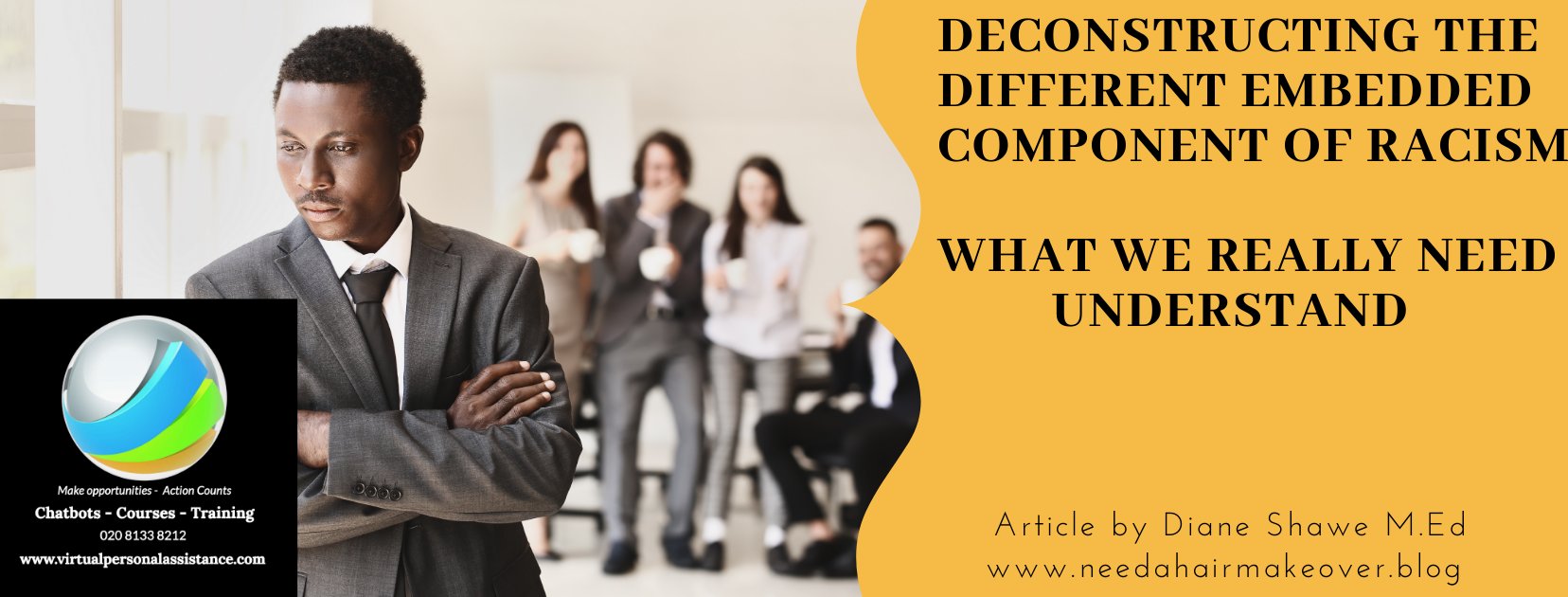
Deconstructing the Different Embedded Component of Racism – What we really need to Understand by Diane Shawe M.Ed

I was five years old when I first heard the phrase or taunt ‘Blacky’ I had played with all my neighbours on the street and in the garden when I was little, looking back my neighbours were black, white and asians. We use to love playing tick. My mum picked me up from my new infant school and I asked her what was a blacky.

She politely asked me were I had heard the phrase and I told her some kids were calling us it at school. She said to take no notice and focus on learning and doing as the teacher said. So I did, but for the next 7 years I could now describe all the various ways I was racially profiled, abused and taunted by both teachers and my classmates without realising it back then. I can now on reflection ask ‘How did that white young child understand to start calling me blacky when I didn’t even know they were white or indeed that I was black? I just saw Jane who was my best friend, she had freckles and ginger hair.

In view of this whilst conducting my mini research for this article, I began to understand that simply making throw away statements as to what racism is and peoples assertion that it may or may not be stamped out was coming from a place of pain, helplessness, denial or plain historical orchestrated planning.

One thing we can all agree on is that racism is alive, it is fed, it has been modernised, debated clinically, psychologically, intellectually, emotionally from generation to generaion.

Contrary to a dictionary definition, racism, as defined in social science research and theory, is about much more than race-based prejudice—it exists when an imbalance in power and social status is generated by how we understand and act upon race.

The UN does not define “racism”; however, it does define “racial discrimination”. According to the 1965 UN International Convention on the Elimination of All Forms of Racial Discrimination

The term “racial discrimination” shall mean any distinction, exclusion, restriction, or preference based on race, colour, descent, or national or ethnic origin that has the purpose or effect of nullifying or impairing the recognition, enjoyment or exercise, on an equal footing, of human rights and fundamental freedoms in the political, economic, social, cultural or any other field of public life.

UN Racial Discrimination 1965

Racism exists when ideas and assumptions about racial categories are used to justify and reproduce a racial hierarchy and racially structured society that unjustly limits access to resources, rights, and privileges on the basis of race. Racism also occurs when this kind of unjust social structure is produced by the failure to account for race and its historical and contemporary roles in society.

So with this in mind, when the slogan ‘Black lives Matter’ descended into competing factions like ‘Blue lives Matter’ or ‘All lives Matter’ I became a little confused as to why visually seeing a unarmed, handcuffed man’s life being snuffed out in broad daylight by an appointed officer sworn in to defend all people, along with insurmountable evidence going back hundreds of years starting from yesterday could then generate competitive slogans in retaliation to minimise what we all saw and witnessed as being equal to everything else?

I then discovered that racism in itself is not a simplified one paragraph statement in a dictonary, it’s not about setting up a Diversity department with one member of staff having no power to affect real change from the board of dircectors, investors, recruitment and legislation.

From Race transitioning into racism, oppression, cruelty and suppression this little child has grown up to be a sophisticated adept monster.

So began my education into the 7 forms of Racism which I have best summarised below (reminds me of the 7 deadly sins)

Let us know how we can help you https://www.virtualpersonalassistance.com/express-business-plan-fundraising

The 7 Forms of Racism

Racism takes seven main forms, according to social science. Rarely does any one exist on its own. Instead, racism typically operates as a combination of at least two forms working together, simultaneously. Independently and together, these seven forms of racism work to reproduce racist ideas, racist interactions and behavior, racist practices and policies, and an overall racist social structure.

Representational Racism

Depictions of racial stereotypes are common in popular culture and media, like the historical tendency to cast people of color as criminals and as victims of crime rather than in other roles, or as background characters rather than as leads in film and television. Also common are racial caricatures that are racist in their representations, like “mascots” for instance or the “Angry Black Women” for instance.

The power of representational racism—or racism expressed in how racial groups are represented within popular culture—is that it encapsulates a whole range of racist ideas that imply inferiority, and often stupidity and untrustworthiness, in images that circulate society and permeate our culture. While those not directly harmed by representational racism might not take it seriously, the presence of such images and our interaction with them on a near-constant basis helps to keep alive the racist ideas attached to them.

Ideological Racism

Ideology is a word that sociologists use to refer to the world views, beliefs, and common sense ways of thinking that are normal in a society or culture. So, ideological racism is a kind of racism that colors and manifests in those things. It refers to world views, beliefs, and common sense ideas that are rooted in racial stereotypes and biases. A troubling example is the fact that many people in American society, regardless of their race, believe that white and light skinned people are more intelligent than dark-skinned people and superior in a variety of other ways.

Historically, this particular form of ideological racism supported and justified the building of European colonial empires and U.S. imperialism through the unjust acquisition of land, people, and resources around the world. Today, some common ideological forms of racism include the belief that Black women are sexually promiscuous, that Latina women are “fiery” or “hot-tempered,” and that black men and boys are criminally oriented. This form of racism has a negative impact on people of color as a whole because it works to deny them access to and/or success within education and the professional world, and subjects them to heightened police surveillance, harassment, and violence, among other negative outcomes.

Get a Copy from Amazon Books by Diane Shawe

Discursive Racism

Racism is often expressed linguistically, in the “discourse” we use to talk about the world and people in it. This kind of racism is expressed as racial slurs and hate speech, but also as code words that have racialised meanings embedded in them, like “ghetto,” “thug,” or “gangsta.” Just as representational racism communicates racist ideas through images, discursive racism communicates them through the actual words we use to describe people and places. Using words that rely on stereotypical racial differences to communicate explicit or implicit hierarchies perpetuates the racist inequalities that exist in society.

Some Comedians often paint a picture to a wide audience. Study has shown that storytelling can form the most embedded images into the subconscious mind, wrap that into laughter another very powerful emotional tool to stimulate memory and feeling, it is easy to see that monkey joke being repeated time and time again for instance. It is viewed as harmless by the presenter because it was packaged as a joke by a well known commedian.

Interactional Racism

Racism often takes an interactional form, which means it is expressed in how we interact with each other. For example, a white or Asian woman walking on a sidewalk may cross the street to avoid passing closely by a black or Latino man because she is implicitly biased to see these men as potential threats. When a person of color is verbally or physically assaulted because of their race, this is interactional racism. When a neighbor calls the police to report a break-in because they do not recognise their black neighbour, or when someone automatically assumes that a person of color is a low-level employee or an assistant, though they might be a manager, executive, or owner of a business, this is interactional racism. 

Hate crimes are the most extreme manifestation of this form of racism. Interactional racism causes stress, anxiety, and emotional and physical harm to people of color on a daily basis.

Institutional Racism

Racism takes institutional form in the ways that policies and laws are crafted and put into practice through society’s institutions, such as the decades-long set of policing and legal policies known as “The War on Drugs,” which has disproportionately targeted neighborhoods and communities that are composed predominantly of people of color. Other examples include Stop-N-Frisk policy that overwhelmingly targets black and Latino males, the practice among real estate agents and mortgage lenders of not allowing people of color to own property in certain neighborhoods and that force them to accept less desirable mortgage rates, and clerks and judges automatically assuming that the presence of a black person in court must be a defendant and not a solicitor or barrister. (recently reported)

Institutional racism preserves and fuels the racial gaps in wealth, education, and social status, and serves to perpetuate white supremacy and privilege.

Structural Racism

Structural racism refers to the ongoing, historical, and long-term reproduction of the racialised structure of our society through a combination of all of the above forms. Structural racism manifests in widespread racial segregation and stratification on the basis of education, income, and wealth, the recurrent displacement of people of color from neighborhoods that go through processes of gentrification, and the overwhelming burden of environmental pollution borne by people of colour given its proximity to their communities. Structural racism results in large-scale, society-wide inequalities on the basis of race.

We can see this when local areas that have enjoyed house prices being maintained and an assumption made that having ethnic people move into the area automatically result in house prices going down. But on the other hand a run down area could be rejuvenated automatically as soon as white people move in forcing residents who have been deprived for years to move out.

Systemic Racism

Many sociologists describe racism in the U.S. and U.K as “systemic” because the country was founded on slavery and racist beliefs that created racist policies and practices, and because that legacy lives today (more so in the U.S) in the racism that courses throughout the entirety of our social system. This means that racism was built into the very foundation of that society, and because of this, it has influenced the development of social institutions, laws, policies, beliefs, media representations, and behaviors and interactions, among many other things. By this definition, the system itself is racist, so effectively addressing racism requires a system-wide approach that leaves nothing unexamined.

But here is the cunnundrum, when what is seen as the norm to white people who have only known to do what they have been doing all along, when they believe their model is already superior and any alternate model from which to compare in order to modify would diminish their position, I would go as far as to say it would be like asking a fish to fly when its only experience has been to swim in water. The fish could end up experiencing stress and trauma or even fear. All of these emotions have a reactionary response, not dissimilar to the person being continuously discriminated against as described above.

Here me out here… However according to Darwin’s Theory of Evolution man evolved from fish and became acquainted to both Land, Sea, Air and Fire. An intelligence beyond all other creatures on earth. All around the world we can now see evidence of what man can create and sadly what he can destroy.

Sociologists observe a variety of styles or types of racism within these seven different forms. Some may be overtly racist, like the use of racial slurs or hate speech, which some people have identified and tried to be political correct whilst others use it to hurt and hammer home their pain, fright or anger.

There are some policies that intentionally discriminate against people on the basis of race. Others may be covert, (but isnt the act of covert implying complicitness?) kept to oneself, hidden from public view, or obscured by color-blind policies that purport to be race-neutral, though they have racist impacts.

While something may not appear obviously racist at first glance, it may, in fact, prove to be racist when one examines the implications of it through a sociological lens or the feedback and complaints presented by the reciepients.  If it relies on stereotypical notions of race and reproduces a racially structured society, then it is racist.

Due to the sensitive nature of race as a topic of conversation some have come to think that simply noticing race, or identifying or describing someone using race, is racist. Sociologists do not agree with this. In fact, many sociologists, race scholars, and anti-racist activists emphasise the importance of recognising and accounting for race and racism as necessary in the pursuit of social, economic, and political justice. (We must however agree that the earth contains different races and that will not change unless we destroy ourselves)

Both sides of the isle often digs in because they are operating from fear. We see the oppressor become more erratic and seek to use the legal system, government, army or commercial power to justify and repackage their unfair practices whilst crushing modernisation and equality by all means necessary using disinformation to divide and sow mistrust.

What are we evolving into? Is it so painful and unjust to want to see the whole world share in our further evolution economically, geographically, socially, environmentally, policically or religiously?

With over 7 billion consumers on this planet perhaps to be serviced by almost 2 billion suppliers, designers, developers, farmers, educationalist and health specialist the list goes on why does a few elite societies prefer to move us towards destruction because they are apposed to equality and human dignity?

We have the luxury of history, it has shown us time and time again the fall of hugh empires imploding because the rulers have abused their fellow man, become corrupt, greedy, uncaring and cruel. Surely we can do better and not repeat history.

So if both parties are blinded by the ‘I lose you gain’ principles one has to ask, is Racism taught and if so who is doing the teaching?

There is more than enough for everyone to enjoy

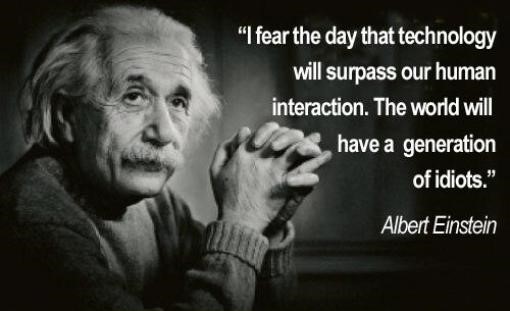
The definition of insanity is doing the same thing over and over again and expecting a different result

Albert Einstein

So where do we go from here? There are two side to every coin, one side could not exist without the other. What I find troubling is there are some people who want to do the same thing over and over again to achieve exactly the same result as before. A chilling thought.

Coronavirus Lockdown Drives Rise in Online Micro Start-ups Amid Fears For Job Security

It’s hard to be excited when talking about today’s coronavirus pandemic, when millions of people have been infected. 

However, various research around the UK like GoDaddy shows the coronavirus pandemic has been a massive boon to entrepreneurship. And this could help our economy both recover and thrive for years to come.

But while jobs have suffered, new micro business startups have skyrocketed.

The government commendably offered a number of startups and etablished busiesses a lifeline at the peak of the crisis, but despite the slowly improving funding picture, we are now starting to see the pent-up effect of the pandemic on UK businesses.

Government support has artificially kept companies afloat and delayed the true impact. but with the second lockdown to non essential businesses we are only now starting to see more severe damage to UK businesses that could puts the survival of an entire bricks and mortar business generation of innovative companies at risk.

Learn how to start a online business properly

Will the Start Up Trends in 2020 continue through 2021?

A survey of 1,000 GoDaddy customers found 15 per cent of new UK entrepreneurs had made the leap due to job loss or furlough

UK workers have been turning to starting their own companies in unprecedented numbers as fears over job security have spurred a new wave of entrepreneurs.

The “State of the Nation” review, compiled by the group GoDaddy, showed there had been a 14 per cent increase in micro-businesses, start-ups with nine or fewer employees. They have experienced a 62 per cent increase in new UK customers and this is only one domain provider.

How many people actually have any desire at all to become the start ups of tomorrow?

There are, on average, 18,100 searches per month in Google UK for “how to start a business” based on data from kwfinder.com

This has surged in recent months with Google Trends predicting that January 2020 will demonstrate the highest number of searches since records began in 2004 for this query in the UK (by quite some way)

Click to enrol http://bit.ly/3fc4nnR

So what’s are we witnessing happening?

We are witnessing a few interesting events. “First, we are seeing unemployed workers starting their own businesses. Realising they need to be responsible for their own financial destinies, these micro entrepreneurs are opting out of the traditional workforce to start their own companies. Secondly, we are seeing virtual employees launching their own businesses.”

With 96 per cent of all UK enterprises identified as “micro-businesses” this sector could play a key role supporting an economic recovery.

With regards to the latter trend, Diane says “I think the mindset for many has become ‘if I’m going to ditch the office, why not ditch the boss too?” And many new work-from-home employees have now gained one to three hours per day as their commutes have been eliminated. Some have been using this time to develop their business plans and launch their own online companies.”

The GoDaddy Figures also revealed encouraging levels of confidence and resilience – 85 per cent were confident that their businesses would continue, with third of these expecting their businesses to thrive.

This was supported by 70 per cent who believed their businesses would recover fully within 12 months.

This was despite 38 per cent of the UK’s smallest businesses being forced to close on temporarily, and almost three-quarters having lost revenue (72 per cent), due to Covid-19 restrictions.

Micro-businesses also still planned to keep up business spending, with 29 per cent confirming that they would continue to invest in their ventures and one in 10 planning to invest more in the companies over the next three to five years

“Government initiatives alone are not sufficient to support startups most in need of funding and cashflow in the current economic climate. It’s possibly the growth of micro businesses that will provide the innovation and jobs that will drive the UK’s economic recovery, and they need urgent support.”

You can use Laybuy to pay for your courses

So How Can We Help and What is our Advice?

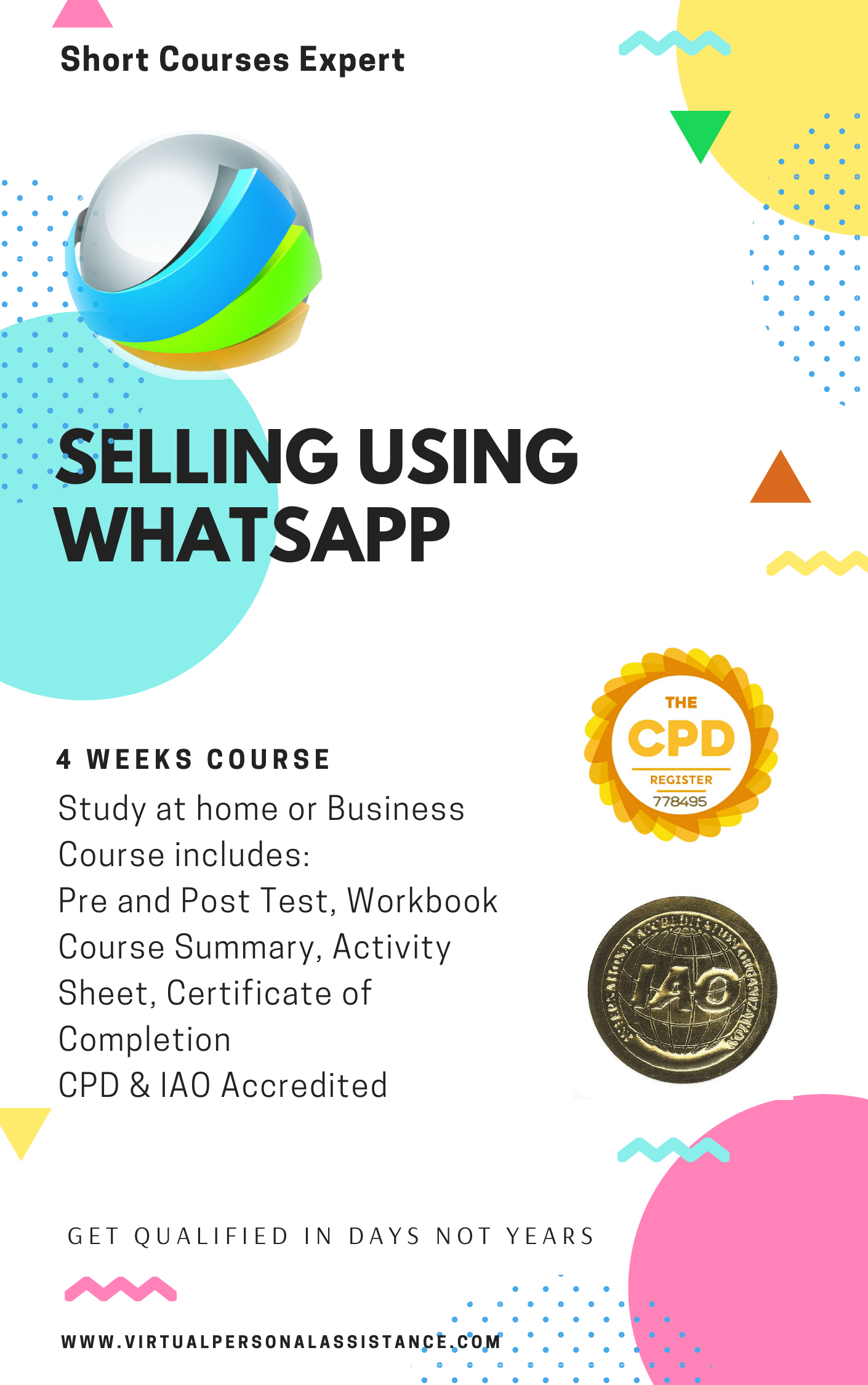
Don’t rush into anything because you could possible Get Scammed! If you want to start and grow a profitable online  business then we recommend you take a quick course on ‘Starting a Online Business’. Without going over board you NEED to consume and LEARN every page of this work book.

Within the pages of this work book is the blueprint to building an online  business from scratch…Its CPD accredited so this is proof!

And we’ve laid it out as easy as possible…even 11 year olds can follow along! (and by the way there is a growing number of online child millionaires)

So if you want to


• learn the correct way,
• Explode your knowledge,
• Learn how to Find a niche,
• Learn how to Evaluate market viability,
• Learn how to Conduct market research,
• Learn how to Conduct competitive analysis,
• Learn online business laws,
• Learn how to Analyse your target market,
• Learn how to source products
• Learn how to choose the right ecommerce platform
And more…

By following the strategy outlined in each module – you’ll learn how to launch and grow an organic profitable online business with minimal risk!

I know it sounds too good to be true…

But you’ll see why once you devour our work book course, (Which has to be done in 4 weeks with an accredited certificate to follow)
you can begin setting up a website, mobile presence, and storefront and give your visiting clients confidence that you truly prepared for your new micro business. Click to enrol http://bit.ly/3fc4nnR

So if your thinking of setting up a online business, learn everything you need to know Plan to succeed so you don’t end up in the online business startup graveyard.

ABOUT VIRTUAL PERSONAL ASSISTANCE SERVICE

We provide a suite of services for Small and Medium size businesses to help them Setup or expand by  learning,  executing a business plan for focus, raising finance and market tools like an effective google verified website and introducing artificial intelligence chatbots to generate quality business leads. We think of ourselves as your Virtual Personal Assistance who will help streamline your business development.

Looking for help to get a job or promotion, start a business or market your business effectively. check out our range of services http://bit.ly/3jObWBL

About Diane Shawe

Get my books on Amazon or Google Books

Diane Shawe is author of several books on Amazon and Google Books.

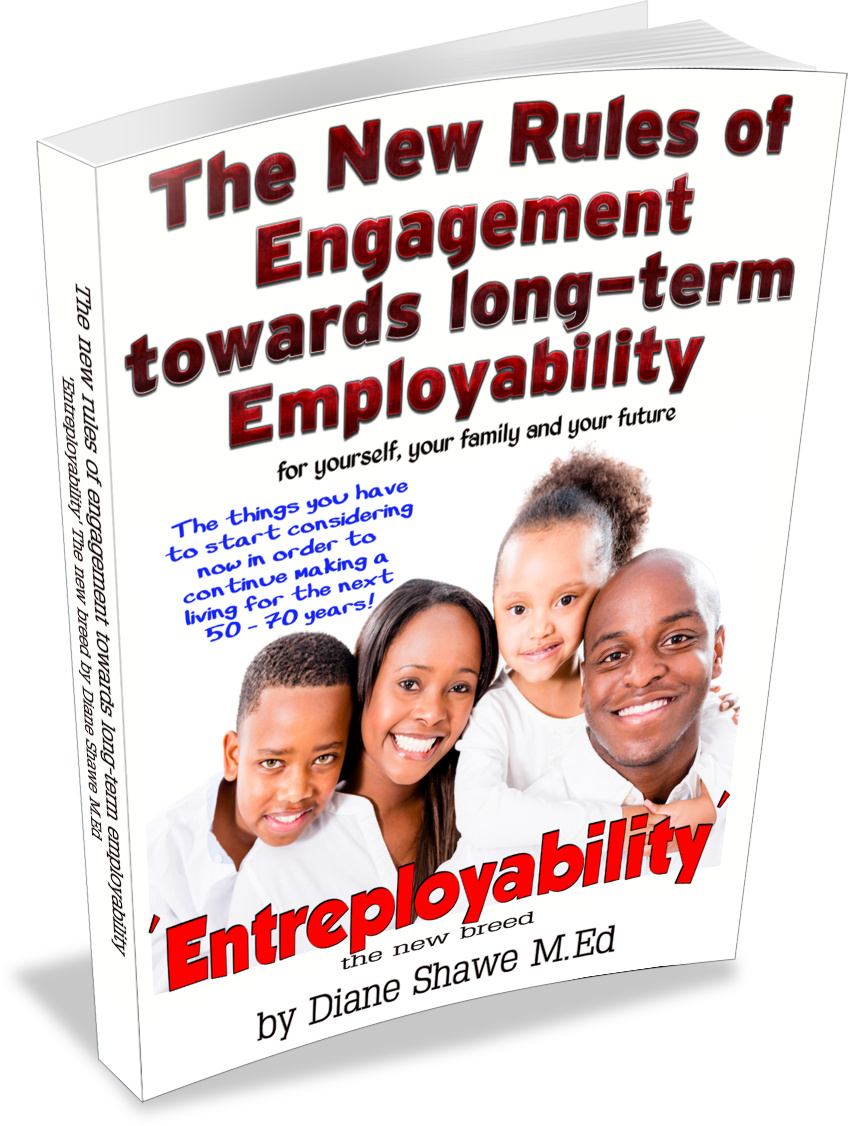
The traditional belief that we must prepare ourselves to be ‘employable’ is under threat. The counter argument encourages us to ‘gear up’ for earning our own money, rather than seeing income as someone else’s responsibility. Get your copy today.
http://amzn.to/3945Njd

Covid 19 is changing the way many think about work

Why a New Training Needs Analysis is Required To Manage Over Whelmed Remote Workers by Diane Shawe

Here’s Help for the bosses on how to help staff to manage stress when working remotely after and during the coronavirus outbreak by restructuring there training needs analysis.

Order your course today

When you (the boss or your board members) think about thriving in a digital world, you probably think first about technology. It’s evolving so fast that your business constantly has to adapt. But the greatest challenge is not the tech itself: It’s developing a knowledgeable, strategically adept, cognitively flexible, and proficient workforce.

You want people who can command artificial intelligence, analyse data, invent and apply solutions on the fly, and slide effortlessly into new roles as needed.
All the while, they should keep their skills sharp with mobile apps and online self-taught courses. Ideas should flow from all corners of the company, whether from full-time managers or a pool of gig workers who jump in when work heats up.

The demand for a more talented workforce goes beyond adapting to the new digital world. CEOs of fast-moving organisations – enterprises with bold strategies, innovative cultures, inclusive workforces, and great expectations – need highly skilled people.

Unfortunately, in nearly every industry, the best talent is in perilously short supply. At the 22nd Annual Global CEO Survey, 79 percent of chief executives around the world said that a lack of key skills threatens their business growth. Retailers need interface designers who understand customer experience. Banks and insurance companies need data visualisation experts. Energy, automotive, and industrial companies need team leaders who can manage interoperable platforms.

Helping remote workers draw a line between work and timeout

Just about everyone is looking for employees adept in robotic process automation, materials science, or simulations with machine learning that can predict outcomes and streamline processes.

They also need people who can master softer skills, such as managing teams effectively, gaining trust, working across boundaries, or applying neuroscience findings to increase their own stature and influence.

Upskilling is part of the answer. But you also need to rethink your jobs: redesign the workflow, combine some positions, add others, and probably eliminate some. You need to be more creative in finding and onboarding people, including through acquisitions, partnerships, gig economy–style freelancing arrangements, and talent pools oriented to flex work.

Finally, you must fill your enterprise with opportunities for continual self-renewal via modern learning strategies and digital technologies, so that becoming adept in new technologies is just part of everyday life.

Many business leaders realise that they can’t just hire the workforce they need. There aren’t enough prospective recruits, and the expense would be enormous. Instead, companies must upskill their existing employees or members of their communities.

This means expanding people’s capabilities entrepreneurial thinking, employability, often using adult learning and training tools, to fulfill the talent needs of a rapidly changing economy. But the old training needs analysis does not sit well in this every changing cog and an increasing number of remote workers.

A remote workforce transformation brings all these elements together, oriented specifically to your organisation. Your initiative must be led directly by the CEO and the other top executives of the enterprise, because your company’s success depends on the ability and commitment of all your employees.

In a successful initiative, you’ll do more than approve a budget and hold the leaders accountable; you’ll take part in the learning efforts yourself, engage in teaching others, and use this transformation as a genuine opportunity to improve your own skills and those of your direct reports.

Online, Workbooks, Zoom Training available now

Because no two organisations have the same circumstances, there is no single recipe to follow. But together, the 10 principles below can help you ready your company’s remote workforce for the future.

  1. Focus on a few concrete business outcome
  2. Foster emotional commitment
  3. Design a compelling experience
  4. Start with the highest-impact roles
  5. Change behaviour first
  6. Promote citizens led wellness groups
  7. Plan and commit to a comprehensive journey
  8. Engage with cultural influencers
  9. Include everyone but the unwilling
  10. Track results and course

Visit https://www.virtualpersonalassistance.com/training-courses-store

Turning 50 isn’t the end of a business career – new wave of silvererpreneurs

Get qualified in days not years

The only way is up after a downturn

article by Diane Shawe M.Ed

Turning 50 isn’t the end of a business career – it’s the beginning. And an ever-growing wave of ‘olderpreneurs’, starting a business have 70% chance of surviving their first five years compared with only a 28% survival rate for those younger than them.

Nearly half the self-employment population is over 50, and one in six new businesses started in the UK are set up by post-half-centurions.

So what’s fuelling the entrepreneurial impetus of the ‘silver startup’, and why are they doing so well?

Necessity

The over-50s age group has been particularly hard-hit by the recession. Last year, the Office of National Statistics (ONS) revealed 28% of those aged between 50 and state pension age were out of work – compared with only 20% of those aged under 50.

Why? One of the biggest factors is the rife ageism that permeates practically every industry in the UK, that anyone over 50 who’s been forced to look for employment will testify to with a weary nod. The ONS estimates those who lose their job aged 50 or over have only a 10% chance of being re-employed.

Deciding to use their money from redundancies to fund ta company, over the course of two years the payout had trickled in its entirety into the business. But it was worth the investment – and they often don’t have to rely on the ineffective banks at the moment.

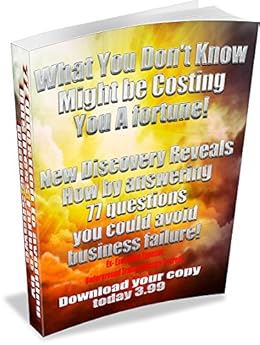
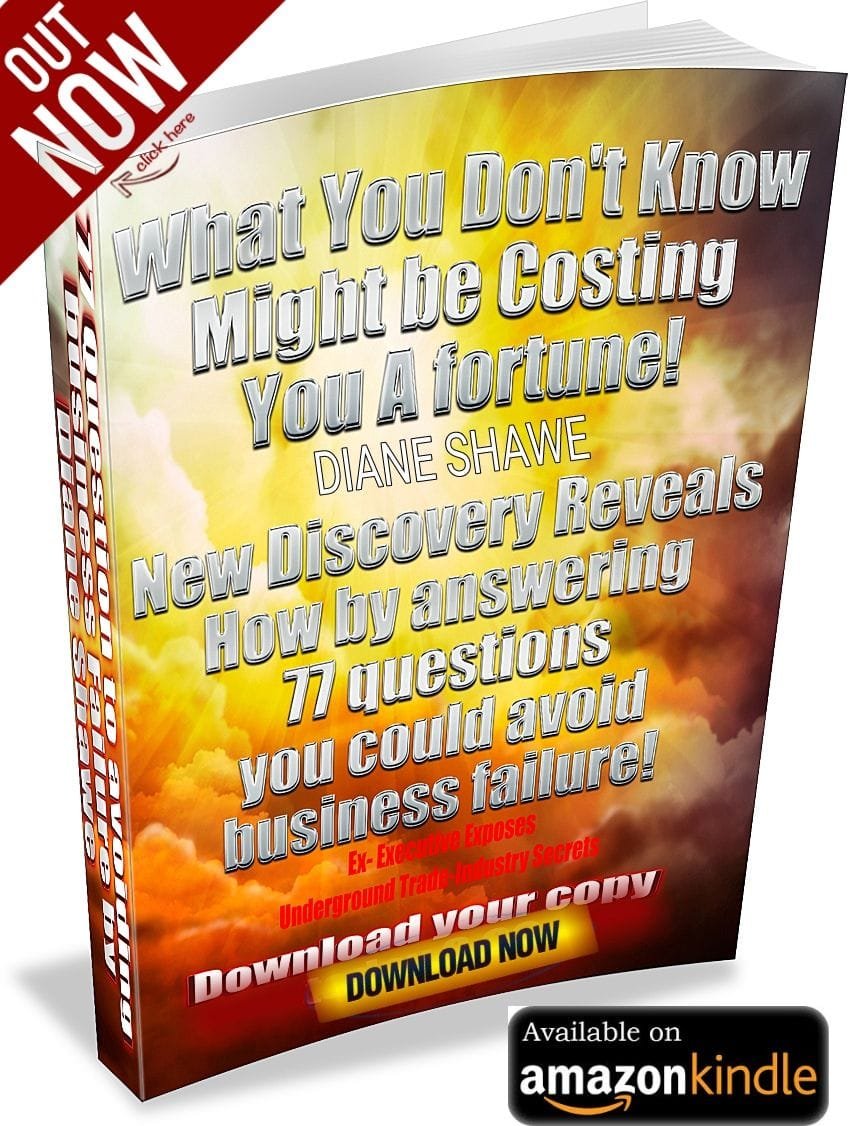
77 Questions to avoid business failure

Order your copy from Amazon

New challenge

At a fundamental level, sometimes people just want to do something different in their later years.

It’s interesting that recent YouGov and Standard Life research found the average age at which people feel totally confident in their working skills is 37, while the more elusive sense of fulfilment peaks at 50. Perhaps this climax of achievement and sense of ability leads to a need for a new direction, a new challenge, once a person passes the half-century mark.

You’re in good company if your over 50 and considering starting a business.

More than four out of 10 new businesses in the UK are started by people over 50, according to the Office for National Statistics. And it’s a growing trend. A recent report from Barclays highlighted that over 55s are now 63% more likely to start businesses than 10 years ago.

And this rise in business owners doesn’t just apply to founders in their 50s – the number of self-employed people aged 65 and over has more than doubled in the UK in the past five years.

While there’s never a ‘right time’ to pursue a business idea, an increasing number of people in their 50s and over – dubbed ‘olderpreneurs’ – are shifting to entrepreneurship. But why?

For starters, budding business owners in their 50s are capitalising on the government pension freedoms – first introduced back in 2015 – and are opting to take their tax free cash lump-sum to “create wealth” by using their pensions to start a business.

However, it’s not just pension-led funding which is boosting the numbers of  the UK’s older entrepreneurs.

Low-interest loans and mentoring, provided by the likes of , is playing an integral part in funding and supporting the growth of founders in their 50s with over 5,700 loans having been supplied to founders aged 50 and over by the organisation to date.

Supported by research from PRIME that those who start a business in their 50s are 42% more likely to be successful than their younger counterparts, we want to shake off the notion that starting a business in middle-age isn’t a good idea. On the contrary, older entrepreneurs have the advantage of being able to tap into wealth of experience and knowledge which they can put to use in a start-up venture.

To break down stereotypes, we’ve highlighted five inspiring businesses founded by entrepreneurs aged 50 and over, who each received a Start Up Loan to make their business dreams a reality.

Operating in industries ranging from domestic care to street food.

After every downturn there is alway a upturn because people really work hard along with banks, investors and government to make it work.

5 things to do this year to help reach your money goals

I hope you’re feeling thrilled about your future prospects for 2019 and make amazing things happen.

Like you some of us found 2018 rather challenging, but it has helped to shape us into who we will be over 2019. Here is a list of 5 things to put in place this month to help you focus and become more disciplined. A little tip, use your mobile phone diary to set up reminders.

Article by Diane Shawe

1 circlue

DEFINE YOUR WORD

Think about the year ahead and ask yourself what one word would best represent your dreams and direction for 2019. This is a powerful practice because no matter how busy or scattered we may get at various points in our 365 day journey, we’ll always have our word to hold onto and guide us through.

Here are some examples of words to consider (you can also think of them as themes for the year):

FOCUS, REST, COURAGE,

ABUNDANCE, MY VALUES,

SIMPLIFY, ELEVATE, ORGANISED,

SPIRITUALITY, LEGACY,

CHARITY, IMPLEMENT. PHEONIX

Take some time and really reflect on which word holds the most meaning to you in the pursuit of your personal goals. Then take a piece of paper, write your word on it and hang it where you can see it every day. You’ll find that more and more, your thoughts, decisions, and actions in the new year will flow in harmony with your word.

2 circle

CREATE YOUR READING LIST

As entrepreneurs, we know that reading great books for our personal and business development is essential if we really want to take things to a new level each year. However, if you’re like most entrepreneurs, you probably have a mountain of books that you are still intending to read and you know you have to be more selective about exactly which books you’re going to focus on (and implement!) in the year ahead.

So in 2019, instead of getting overwhelmed by it all, get intentional and put together a reading plan.

Here are some questions to help you create your list:

Which particular books will help me the most right now?

What area of my business am I resisting due to lack of knowledge?

Are there any books that I should read again and implement better this time?

3 circle

FOCUS ON ONE THING

With the beginning of a new year, it’s exciting to launch into everything we want to do all at once to improve our lives and our businesses, but that’s a recipe for getting quite overwhelmed and discouraged before too long.

There is so much value in focusing on one thing at a time. It’s better to work on 12 habits or goals one at a time, month by month, and successfully achieve them all in a year, than it is to work on everything all at once and only be able to to finish 2 or 3 due to lack of focus.

4 cirlce

MOVE PAST AN OLD FEAR

One of the things we love most about a new year is the feeling of a fresh start that it brings. Use the momentum of starting fresh to face a fear and do something you were afraid to do in 2018.

5 circle

SET A 90 DAY MONEY GOAL

It’s so important to set your goals around money and map out your plans for how you’re going to achieve them. Money loves clarity and the more clear you are about how much you want your business to grow and how you’re going to make it happen, the more you can expect to see results!

First, identify how much money you want to make in your business over the next 90 days. Working from the framework of a 90 day goal is particularly effective because it’s not too long or too short when it comes to achieving something amazing, so don’t be afraid to dream a little bit out of your comfort zone.

Next, map out what that looks like in terms of clients and sales. How many clients would you need in order to hit that goal? How many sales per month, per week, per day? By honing in on these numbers, you’ll be able to set your daily, weekly, and monthly goals with clarity and ease. Best of all, you’ll be able to focus on taking action and making it happen. 🙂

Which is more Productive – Discipline or Motivation?

When it’s time to get something done there two ways to kick yourself into gear.

The first, and most popular, way is by motivating yourself. The second, which isn’t as widely used, is through self-discipline.

But, how different are they? And, which is better, discipline or motivation?

Discipline vs. Motivation

“One of the first things to realise is that self-discipline is different from self-motivation. You might be able to do the things you’re supposed to, but that’s not the same thing as being motivated to a higher purpose, or having the self-motivation to keep going when your willpower is depleted.

“Willpower has been recognised as a limited resource — something that you can ‘use up.’ If you repeatedly resist temptation or force yourself into something, eventually you wear down and it becomes harder and harder.”

If you really want to keep going, you need that self-motivation that helps sustain you when the decision fatigue sets in and your willpower runs low.

In real life, when fear, fatigue, and doubt set in, no speech can provide the motivation you need to keep going. The only thing you and your team can rely on is discipline and faith.

Discipline is cherished in the army for instance. They cultivate it in everything they do, from how they fight to how they dress, cut there hair, and clean there rooms.

Discipline also provides a template for what businesses should identify and develop in their employees. More than any other quality, discipline is what drives a person to succeed when faced with adversity. And that’s what the real world is: adversity.”

Discipline, is what “drives you to do the work you don’t enjoy, but is required. Discipline conquers fear. Discipline keeps you going when your curiosity, motivation, and excitement evaporate.”

While motivation is a good quality to possess, it’s not as important as discipline.

The Anatomy of Discipline

1. It takes consistent self-discipline to master the art of setting goals, time management, leadership, parenting and relationships. If we don’t make consistent self-discipline part of our daily lives, the results we seek will be sporadic and elusive.

2. It takes a consistent effort to truly manage our valuable time. Without it, we’ll be consistently frustrated. Our time will be eaten up by others whose demands are stronger than our own,

3. It takes discipline to conquer the nagging voices in our minds:

  • the fear of failure,
  • the fear of success,
  • the fear of poverty,
  • the fear of a broken heart.

4. It takes discipline to keep trying when that nagging voice within us brings up the possibility of failure.

5. It takes discipline to admit our errors and recognise our limitations.

6. It takes discipline to seperate the voice of the human ego that speaks to all of us.

That voice tells us to magnify our value or accomplishments beyond our actual results.

It leads us to exaggerate, to not be totally honest.

7. It takes discipline to be totally honest, both with ourselves and with others.

8. It takes discipline to change a habit and to plan.

Being disciplined is one of the best ways to remain productive, this is because it increases self-confidence, patience, and teaches you how to overcome failure.

Most importantly, self-discipline ensures that you’re not driven by impulse.

You Still Need Both

However, when Gro Jordalen from the Norwegian School of Sports Sciences studied the correlation between motivation and self-discipline in athletes, she determined that these elite athletes rely on both.

Jordalen studied national level athletes between 16 and 20 years old and determined that in the short term, they need to be very disciplined to stay motivated. For the long term, being motivated makes it easier to remain disciplined.

“These are new and exciting findings. We used to regard self-discipline as a tool to become more motivated. Now, we see that strong self-discipline influences how motivated the athletes are,” Jordalen says.

Jordalen also found that the athletes were more prone to burn out if they were driven by extrinsic motivation.

“Showing restraint and being disciplined can be more draining if motivation is fueled by extrinsic factors. This would increase the risk of ending up feeling exhausted and being burned out. If the athletes are driven by intrinsic motivation, it is easier to resist things that would negatively affect their daily schedule. This way, the athletes keep their training in check,” says Jordalen.

In my experience, motivation is what’s needed to get up-and-running. But, discipline is needed to stay on the right course.

In short, you need both factors to be successful.

Tips of Developing Self-Discipline

Personally, learning how to become self-motivated wasn’t as challenging as developing self-discipline. I’m not exactly sure why. But, it’s definitely been more challenging for me.

Of course, with a little extra effort, I’ve been able to successfully develop self-discipline. This, when used in conjunction with motivation, has made me even more successful. And, you too can harness the power of discipline by doing the following.

Take baby steps.

This was perfectly explained in an article over at Wisdomination.

“Your brain resists abrupt changes. If you motivate yourself to a titanic “Starting tomorrow, I’m a new person” effort, you’ll only burn out and revert. Big and sudden just doesn’t work, slow and steady does it. It’s the yo-yo effect of discipline. You want to surf the edge of your comfort zone, which is the only sustainable attitude.

When you progress in baby steps, you will find yourself a new person a year hence, not knowing precisely when or how it happened.

The trick here is to make a small change and let your brain accept it as the new baseline.This will make the next step easier, because the baseline moved. Wash, rinse, repeat.

Because you’re surfing, which means the wave is moving forward beneath you. Cool stuff.

What I’m gonna say now may sound banal, but it really isn’t: Big things are composed of small things. Small changes that you stick to and follow every day add up to surprisingly massive results.”

For example, if you spend five minutes every day organising your office, you’ll quickly notice how more productive you’ll be because it’s clean and organised.

If you start taking the stairs instead of the elevator, those small calories burned will add-up to lost pounds – and a boost of energy as well.

Start prioritising.

Since you only have so many hours in a day, along with a limited amount of energy, you need to start prioritising. This means completing your most important tasks before moving on to something else.

Learn from past mistakes.

Do you know what separates those with strong self-discipline from those who don’t? Those with internal discipline have learned from their past mistakes. This not only ensures that they won’t repeat the same mistakes, it also improves your discipline.

For example, if you went through a bankruptcy with your previous business, you may be better suited to handle it again. I’m not saying you will, I’m merely pointing out that you survived it the first and now you know what to do to overcome this challenge based on your past experience.

Take frequent breaks.

It definitely takes discipline to create and stick to a routine. For instance, I have a strict morning routine where I wake-up around 5 a.m. This allows me to plan my day, exercise, and catch-up on things like my emails, the news, or book I’ve been reading.

At the same time, self-discipline is also means that that you schedule frequent breaks throughout the day. You need this time to recharge and refocus so that you can focus on the rest of your day.

Practice good habits.

Those who are disciplined have good, daily habits.

They’ll skip that burger for a salad. They’ll leave a party early so that they can get a good night’s sleep. They’ll make the time to fit-in a workout.

Developing good habits is no easy task. But, it keeps you mentally, emotionally, and physically in shape.

IQ scores are falling -It’s not that dumb people are having more kids than smart people

IQ scores are falling and have been for decades, new study finds

Guest Blogger: Rory Smith, CNN

IQ scores have been steadily falling for the past few decades, and environmental factors are to blame, a new study says.

The research suggests that genes aren’t what’s driving the decline in IQ scores, according to the study, published Monday.
Norwegian researchers analysed the IQ scores of Norwegian men born between 1962 and 1

991 and found that scores increased by almost 3 percentage points each decade for those born between 1962 to 1975 — but then saw a steady decline among those born after 1975.

Similar studies in Denmark, Britain, France, the Netherlands, Finland and Estonia have demonstrated a similar downward trend in IQ scores, said Ole Rogeberg, a senior research fellow at the Ragnar Frisch Center for Economic Research in Norway and co-author of the new study.

“The causes in IQ increases over time and now the decline is due to environmental factors,” said Rogeburg, who believes the change is not due to genetics.
“It’s not that dumb people are having more kids than smart people, to put it crudely. It’s something to do with the environment, because we’re seeing the same differences within families,” he said.

These environmental factors could include changes in the education system and media environment, nutrition, reading less and being online more, Rogeberg said.

The earlier rise in IQ scores follows the “Flynn effect,” a term for the long-term increase in intelligence levels that occurred during the 21st century, arguably the result of better access to education, according to Stuart Ritchie, a postdoctoral fellow in cognitive ageing at the University of Edinburgh whose research explores IQ scores and intelligence and who was not involved in the new study.

Researchers have long preferred to use genes to explain variations in intelligence over environmental factors. However, the new study turns this thinking on its head.

Intelligence is heritable, and for a long time, researchers assumed that people with high IQ scores would have kids who also scored above average. Moreover, it was thought that people with lower scores would have more kids than people with high IQ scores, which would contribute to a decline in IQ scores over time and a “dumbing down” of the general population, according to Rogeberg.

Anyone who has seen the film “Idiocracy” might already be familiar with these ideas. In the scientific community, the idea of unintelligent parents having more kids and dumbing-down the population is known as the dysgenic fertility theory, according to Ritchie.

The study looked at the IQ scores of brothers who were born in different years. Researchers found that, instead of being similar as suggested by a genetic explanation, IQ scores often differed significantly between the siblings.

“The main exciting finding isn’t that there was a decline in IQ,” Ritchie said. “The interesting thing about this paper is that they were able to show a difference in IQ scores within the same families.”

The study not only showed IQ variance between children the same parents, but because the authors had the IQ scores of various parents, it demonstrated that parents with higher IQs tended to have more kids, ruling out the dysgenic fertility theory as a driver of falling IQ scores and highlighting the role of environmental factors instead.

What specific environmental factors cause changes in intelligence remains relatively unexplored.

Access to education is currently the most conclusive factor explaining disparities in intelligence, according to Ritchie. In a separate study that has not been released, he and his colleagues looked at existing research in an effort to demonstrate that staying in school longer directly equates to higher IQ scores.

But more research is needed to better understand other environmental factors thought to be linked to intelligence. Robin Morris, a professor of psychology at Kings College in London who was not involved in Ritchie’s research, suggests that traditional measures of intelligence, such as the IQ test, might be outmoded in today’s fast-paced world of constant technological change.

Morris states that “we need to recognise that as time changes and people are exposed to different intellectual experiences, such as changes in the use of technology, for example social media, the way intelligence is expressed also changes. Educational methods need to adapt to such changes,” Morris said.

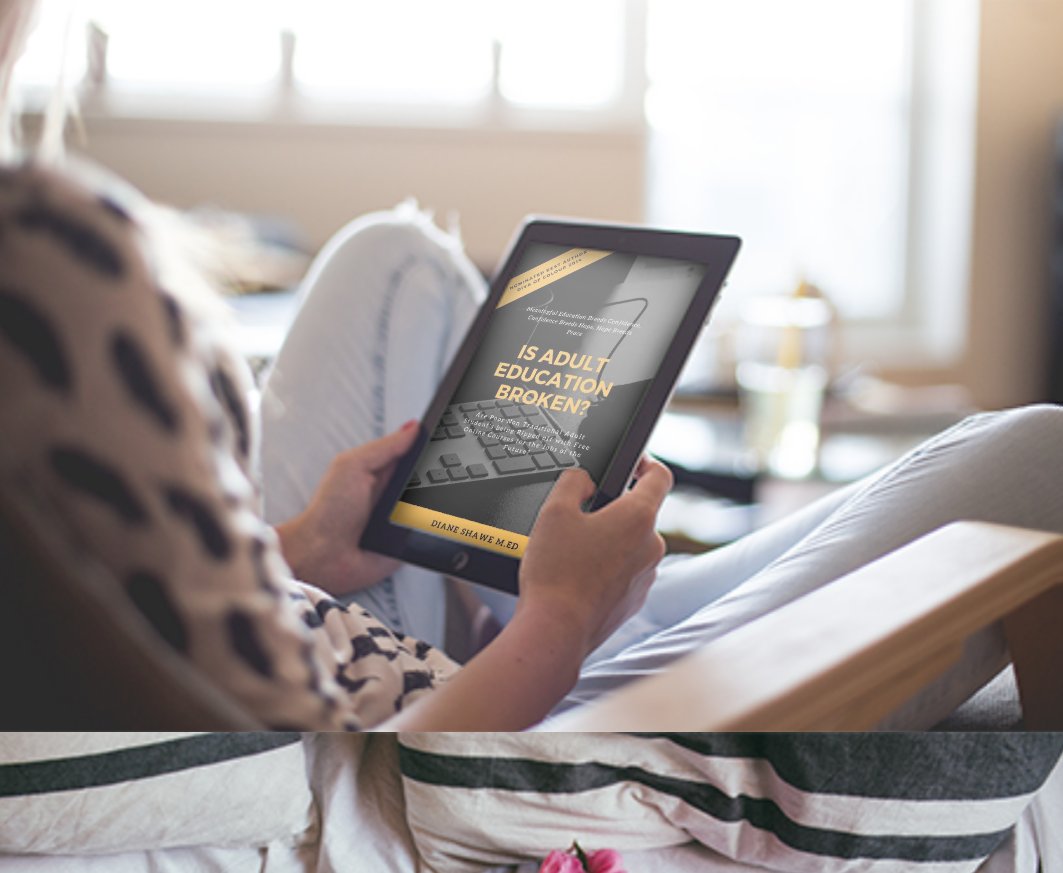
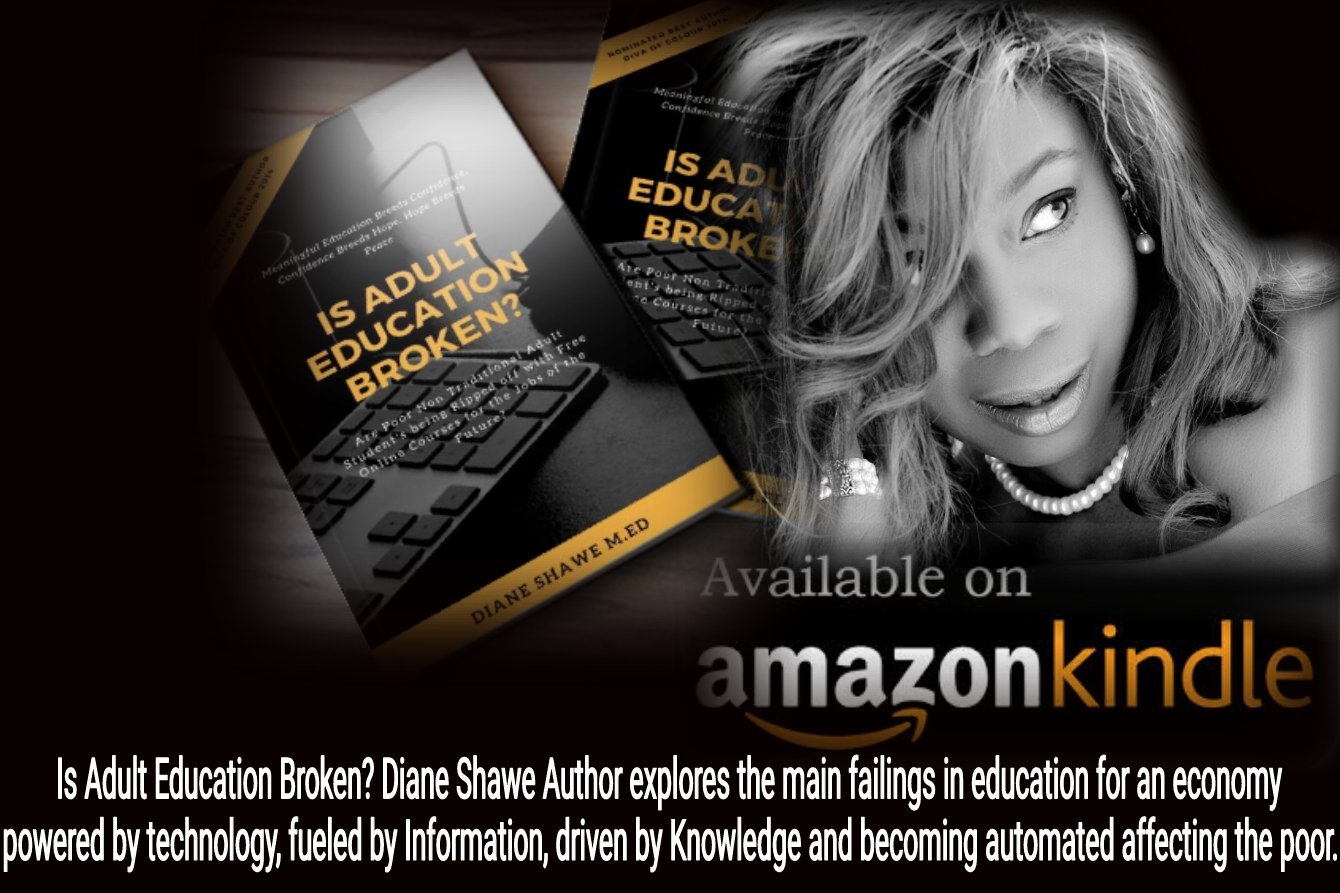
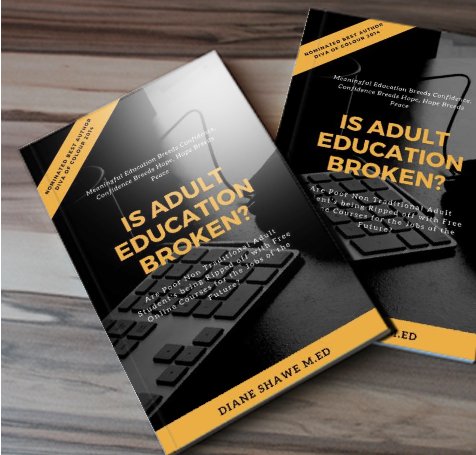
Diane Shawe author of ‘Is Adult Education Broken” goes on to state in her publication that “No sensible decision can be made any longer without taking into account not only the world as it is but the world as it will be.”

In her thought provoking book she explains that we are living in a new economy—powered by technology, fueled by information, and driven by knowledge which increasingly is increasingly becoming automated. We are entering the new century with opportunity on our side with huge problems that require new thinking.

How can we make the new economic age enhance, rather than diminish, our quality of learning?

How can we make this amazing innovation advance the prospects of all people especially those with experience and not just for the youth?

Fundamentally, we need to change what people learn, how people learn, when people learn, and even why people learn.

Inside her publication she explores

: Failure to find a fomular to develop teachers convergent and divergent facilitatingskills

: failure to consider cultural relevance

: failure to develop enterprising and entrepreneurial skills

: failure to prepare students about taking personal responsibility

: failure to encourage international engagement

:failure to manage growth of academic misconduct

Download your copy today https://www.amazon.co.uk/dp/B07BWBMGFM/

Finally a frightening statistic:

“If unemployment formed a country it would be the 5th largest in the world” Isaac Asimov

Outsourcing your knowledge

Albert EinsteinWhy knowing less helps you to do more.

Diane Shawe M.Ed. 

When you think about the power of your brain and how we learn, memorise and recall all those facts, it can get very confusing. Having taught for nearly 25 years and trained some of the brightest professionals over last 10 years, I believe that knowledge is divided in two distinct areas. We can either know about a subject ourselves or we know where we can retrieve information on that subject. The massive amount of information available online has opened an infinite library of easily and quickly retrievable information with simple search engines. I like to think of it as an organic external hard drive, an outsourced memory we can plug in at any time. Some have argued that the internet dilutes the most traditional kind of knowledge: knowing a subject ourselves. They argue that in some way it makes our brains less efficient, diminishing our intelligence and destroying our inner hard drives and memory.

You may remember (if you are of a certain age) that when you were young, you knew by heart the phone number of your closest friends. Since the introduction of digital directories on smartphones there is no longer any reason to memorise numbers by heart.   On the other hand, how many hundreds more contacts do you have now compared to then thanks to the digital directories? In reality, how much more connected are you? The real deal of the information age is not that it allows us to know more, but that it allows us to know less in terms of depth of what we know, as mentioned by David Brooks, a New York Times columnist, in his famous 2006 NY Times article[1] The Outsourced Brain.

neuroscience brain“Memory? I’ve externalised it.” He said, “I am one of those baby boomers who are making this the “It’s on the Tip of My Tongue Decade.” But now I no longer need to have a memory, for I have Google, Yahoo and Wikipedia. Now if I need to know some fact about the world, I tap a few keys and enjoy the vast resource of the external mind.”

I think the positive side of this is that we are free to expand our awareness of subjects we did not have space, or availability, to explore before. Our memory now has a different function: it is a digital index that remembers the existence of a subject and what are the best leads to find information on that subject. I too had thought that the magic of the information age was that it allowed us to know more facts. Then I realised that the magic of the information age is that it allows us to know less.

It provides us with external cognitive servants, silicon memory systems if you will, with collaborative online filters, consumer preference algorithms and networked knowledge. We thus can give these servants the massive raw data and liberate ourselves to think, explore and be creative. You can use your brain to learn new skills, the soft skills that are the true measure of success.

Your outsourced memory (the internet, the cloud and more) allows you to be aware of the existence of information you would never have come across before when you were limited to what your inner memory could hold. It allows you to increase the quantity (and thus the quality) of the information that you can process because you do not always have to worry about memorising every single detail of it. It allows you to use more brain power in linking concepts and applying them rather than remembering them. It empowers you to think and process information faster because your brain has the space to hold links to so much different information, and in doing so it expands your subjective time. Back in the analogue era, the difference between a deep brain and a shallow brain was the availability of information and the choice of whether to take in that information or not came second.

As an educationalist and technophile, combined with my outsourced memory I have the capacity to think deeper. Now that (nearly) everything is available, the power is back to you: it is up to you to take responsibility of what content goes into your mind and how you use your outsourced memory.

Now you have begun to outsource your brain and now have room to do something rather special with your neo-cortex. Enjoy.


Global Personal Bloggers of Influence for 2017

When twitter came out and account holders tweeted what they ate, we all thought twitter had a short life span.  Now the media rummages through top celebrities tweets to find something sensationable to report about.  Would be employers have been know to use candidates social media postings as evidence against them.
The era of the Personal style bloggers use to get caricatured as either geeks or pretty, brainless girls who dress up for their camera-wielding boyfriends and post their results to a WordPress blog.
But wait a minute, with instagram, Facebook, linkedin and twitter integration most of these bloggers have grown quiet influential with hundred of thousands of followers. Over the past decade, these independent publishers have become a real force in the fashion industry — not just snapping up front row seats at fashion shows, but landing major campaigns and collaborations with brands, becoming regular guests on TV shows like “Today” and “America’s Next Top Model,” and turning their blogs into multimillion-dollar businesses. Some have become household names. Independent European bloggers are harder to pin down as most of them are linked to magazines.
Chiara Ferragni, Hanneli Mustaparta and Nicole Warne. Photo: Clemens Bilan/Stringer

Chiara Ferragni, Hanneli Mustaparta and Nicole Warne. Photo: Clemens Bilan/Stringer

To determine the ranking, consideraction was given to:

  • Instagram, Twitter, Facebook, YouTube and Pinterest followers, as well as website traffic. These numbers gave us a snapshot of how many people these bloggers are reaching every day.
  • Brand extensions. We gave props to bloggers who have used their influence to create original products.
  • It factor. We talked to industry insiders about whom advertisers are loving right now, and who is moving the most products via affiliate links.
  • Google News searches. Headline makers were rewarded for extending their reach beyond their own network.

Chiara Ferragni. Photo: Jason Merritt for Getty Images Entertainment

Chiara Ferragni. Photo: Jason Merritt for Getty Images Entertainment

1. Chiara Ferragni, The Blonde Salad 
The 27-year-old Italian, who now lives in Los Angeles, has the broadest reach of any individual fashion blogger on our list, with more than 3 million Instagram followers. She’s a global star, as popular in Europe as she is in the U.S. What’s more, links from her site drive traffic and conversions, according to many of the brands with whom she has partnered. She was also recently named to an expert panel that will help determine the shortlist.

Oh, and she graced the cover of Lucky magazine’s February issue along with fellow bloggers Nicole Warne and Zanita Whittington.

2. Aimee Song, Song of Style 
Song, 28, is a Los Angeles-based interior designer whose straightforward street-style shots have made her popular with brands and readers alike. Song also has an incredible Instagram following — 1.9 million — and has worked hard to build her YouTube audience as well, with more than 28,000 subscribers to her channel.

3. Wendy Nguyen, Wendy’s Lookbook 
Yet another L.A.-based blogger, Nguyen, 31, is best known for her YouTube channel, which currently boasts 600,000-plus subscribers. (Her 2011 video, “25 Ways to Tie a Scarf” has been viewed over 29 million times.) Nguyen’s point of view is unique in that she grew up in the foster system, and has opened up about her experiences to her readers.

Kristina Bazan. Photo: Frazer Harrison for Getty Images Entertainment

Kristina Bazan. Photo: Frazer Harrison for Getty Images Entertainment

4. Kristina Bazan, Kayture 
This Swiss-model blogger, 21, has an impressive reach on Facebook — with more than 1.1 million likes — in addition to a major presence on Instagram, Twitter, etc. Bazan is a favorite of high-end brands: she’s worked with Louis Vuitton, Hugo Boss and Piaget, among others.

5. Julie Sariñana, Sincerely Jules
The 29-year-old blogger, who lives in Los Angeles, started her site in 2009 — early, compared to many of her peers. Her easy, approachable style has translated well into her own line of t-shirts, printed with often inspirational, occasionally irreverent, quotes.

6. Rumi Neely, Fashion Toast 
Neely, 31, launched Fashion Toast in 2007. Her particular style of blogging — photo-heavy posts featuring cool clothes and model poses — has greatly influenced the generation of influencers who have followed her. While Neely has collaborated with established brands in the past, she recently launched her own line. Are You Am I, a collection of slip dresses, tap pants and distinctly cut tees, is notable for its specificity. For fans who want to emulate Neely’s style — and there are plenty of them — there is nothing more perfect.

7. Nicole Warne, Gary Pepper Girl 
One of three bloggers to land Lucky‘s February 2015 cover, the Sydney-based Warne, 25, first launched Gary Pepper as a vintage e-commerce site in 2009. Warne started out blogging and modeling the clothes as a way to market the website, and by 2011, it was one of the largest online vintage retailers in Australia. However, the young entrepreneur’s side project soon became the main event, and in 2012 she shut down the e-commerce leg of Gary Pepper to focus on her blog-driven business.

Blair Eadie. Photo: Cindy Ord for Getty Images Entertainment

Blair Eadie. Photo: Cindy Ord for Getty Images Entertainment

8. Blair Eadie, Atlantic-Pacific 
The New York-based Eadie, 29, is best known for her accessible, yet educated, approach to fashion. Based in San Francisco when she launched the blog, Eadie has worked as a merchandiser for brands like Gap and Tory Burch, which means she has a professional edge when it comes to outfit posts. And brands like love working with her because she has a reputation for converting readers into shoppers.

9. Julia Engel, Gal Meets Glam 
The San Francisco-based Engel, 23, is seen as an up-and-comer in the space. She’s already amassed a large following across platforms, from Pinterest to Instagram. Appealing to the same sorts of readers who worship Lauren Conrad’s pretty aesthetic, Engel’s site is easy to navigate, with lots of opportunities to shop affiliate links.

10. Nicolette Mason 
Mason, who writes a monthly column for Marie Claire and designed her own collection for Modcloth last fall, is one of the most in-demand bloggers working right now. The 29-year-old writer played a role in the promotion and social media around Target’s new plus-size collection Ava & Viv and is also a budding TV personality, offering style advice on programs including “Today” and “Good Morning America.” Mason is notable because she uses her blog as a platform to discuss bigger social issues, including race, sexuality and body image.

11. Shea Marie: Peace, Love Shea 
The Los Angeles-based blogger and TV host, 27, has the high-fashion-meets-Southern-California look brands eat up. She’s worked with the likes of Dior, Gucci, H&M and Guess.

Bryanboy. Photo: Dimitrios Kambouris for Getty Images Entertainment

Bryanboy. Photo: Dimitrios Kambouris for Getty Images Entertainment

12. Bryanboy 
The OG fashion blogger and best friend of Fashion Toast‘s Rumi Neely, the New York-based, Philippines-bred Bryan Grey Yambao has transformed from an online-diary keeper to a celebrity and fashion insider. While other bloggers from his era have fallen off the map, Yambao, 32, has remained relevant by branching out. Memorable projects include a collection with furrier Adrienne Landau and a hosting spot on several seasons of “America’s Next Top Model.”

13. Elin Kling
The New York-based Kling, who is Swedish, was one of the first bloggers to collaborate with a brand on a collection. (In 2011, H&Mreleased a Kling-designed line.) But her fantastic stand-alone label, Toteme, has transformed Kling, 31, from a blogger to a full-fledged designer.

14. Zanita Whittington
The Stockholm-based Aussie, 28, was one of Lucky‘s February cover stars. Along with modeling and blogging, Whittington is also serious about photography. Her site is a sort of “how to” for aspiring bloggers, with service pieces on starting a blog and building an audience.
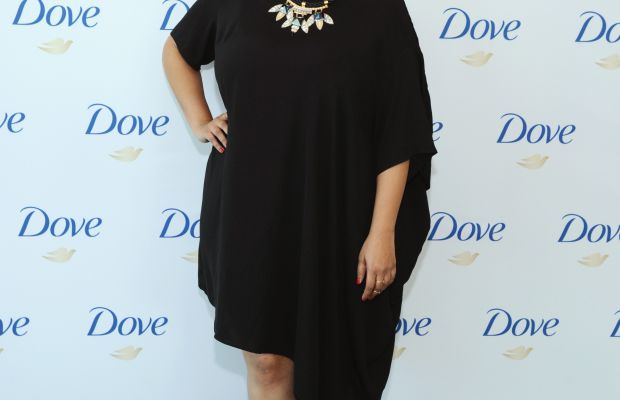
Gabi Gregg. Photo: Ilya S. Savenok for Getty Images Entertainment

Gabi Gregg. Photo: Ilya S. Savenok for Getty Images Entertainment

15. Gabi Gregg, Gabifresh
One of three plus-size bloggers chosen to star in the campaign for Target’s new Ava & Viv collection, Gregg started her blog in 2008 when she couldn’t find an entry-level job in fashion journalism. Now 28 and based in Los Angeles, the blogger has appeared on the “Today” show, designed a sell-out swimwear collection, and partnered with brands including Misguided, Nordstrom and Laura Mercier.

16. Danielle Bernstein, We Wore What
The New York-based blogger, 23, started her site as an FIT undergrad eager to capture the style of her fellow students. It soon transformed into a personal style forum, leading to a design project with Topshop.

17.  Jessica Stein, Tuula Vintage
This Sydney-based blogger, 25, spends a good chunk of her time traveling, and sharing her adventures via Instagram. (She’s currently parked in the Maldives.) Brands like Dior Beauty partner with her for the obvious reasons: she has great taste and an enviable life.

Susanna Lau. Photo: Cindy Ord for Getty Images Entertainment

Susanna Lau. Photo: Cindy Ord for Getty Images Entertainment

18. Susanna Lau, Style Bubble
Forever the no. 1 blogger to fashion insiders, the 31-year-old Lau is now one of the industry’s leading voices. While her creative outfit posts are still appreciated, she is even more loved for her sharp opinion, contributing to publications including Elle UK and Business of Fashion, as well as posting regularly on her own site.

19. Chriselle Lim, The Chriselle Factor
With a massive YouTube following, the Los Angeles-based wardrobe stylist, 29, offers her audience plenty of tips and tricks via video. She’s worked with brands including Coach and Banana Republic.

20. Jane Aldridge, Sea of Shoes
Another blogging pioneer, the Dallas-based Aldridge started her site at age 15. Eight years later, she’s still at it, partnering with brands like Lovegold and Cartier on a regular basis.