Category Archives: mobile learning

Boost Your Immunity with the Power of Liquorice Tea by Diane Shawe

As the season of colds, flus, and coughs approaches, it becomes crucial to find natural ways to boost my immune system. In my quest for a natural remedy, I stumbled upon liquorice tea, a beverage that offers a myriad of health benefits.

From soothing digestive issues to promoting liver health, liquorice tea has been praised for its medicinal properties. In this blog post, we will delve into the various health benefits of liquorice tea and explore how incorporating this herbal drink into your routine can contribute to overall well-being. So grab a cup of tea and join me on this journey of discovering the wonders of liquorice tea.

While liquorice is commonly recognised as a flavoring in sweets and beverages, this naturally sweet ingredient also boasts a plethora of health advantages.

Original liquorice rootFor thousands of years and across various countries, liquorice has been utilised as an herbal remedy. In Traditional Chinese Medicine, it is combined with other herbs to maximize their efficacy, making it a common component in many Traditional Chinese remedies.

Ayurveda, the ancient Indian healing system, employs liquorice to balance the doshas and incorporates it into several formulas as a harmonising herb. It is believed to have a calming effect on the mind and nourish the parasympathetic nervous system.

Furthermore, in Western herbalism, liquorice tea has traditionally been used for treating digestive disorders, alleviating coughs and colds, and supporting the internal organs, including the liver and kidneys.

Moreover, liquorice serves as a delectable natural sweetener that offers a taste approximately 50 times sweeter than sugar. This makes it an excellent addition to any herbal tea blend, enhancing the benefits of the other herbs included.

WHAT IS LIQUORICE TEA?

Liquorice tea is derived from the root of the liquorice plant, which is indigenous to Asia and Southern Europe. Belonging to the pea family, it goes by the Latin name Glycyrrhiza glabra.

Typically, extracts from the liquorice root provide the distinct flavor found in liquorice sweets (although aniseed is occasionally used as a substitute). However, it is the root itself that contains the majority of the beneficial properties, therefore it is used to prepare liquorice tehttps://amzn.to/425miFm

WHAT ARE THE BENEFITS OF LIQUORICE TEA?

Liquorice root offers numerous health advantages. Regularly consuming liquorice tea is a simple way to incorporate this potent herbal ally into your daily diet. Here are some well-known benefits of liquorice tea:

1. SOOTHES DIGESTIVE ISSUES

One of the most popular applications of liquorice tea is its ability to alleviate digestive problems such as heartburn, acid reflux, and indigestion. In the NutraCleanse tea blend, we include liquorice to support a healthy digestive system.https://amzn.to/425miFm

2. FIGHTS INFECTIONS

Liquorice root contains natural antiviral and antibacterial compounds, including glycyrrhizin and glycyrrhetinic acid. These compounds aid in boosting your immune system to combat infections.

3. SUPPORT YOUR LIVER AND KIDNEYS

Your liver and kidneys play a vital role in keeping your body healthy and clear of toxins. Supporting the health and functionality of your liver and kidneys is of utmost importance in maintaining a toxin-free and healthy body. To achieve this, liquorice tea, abundant in antioxidants that aid in preventing inflammation, is often utilised as it supports the healthy operation of these essential organs.

Furthermore, liquorice is known to shield the liver against alcohol-induced damage. which is why it is an integral component of our NutraLiver tea.

4.  TREAT COLDS, COUGHS, AND UPPER RESPIRATORY INFECTIONS

Another traditional use of liquorice tea is to treat the symptoms of colds and other upper respiratory infections. In addition to its aforementioned benefits, liquorice tea is traditionally used to alleviate symptoms associated with colds and upper respiratory infections. This is due, in part, to its antiviral and antibacterial properties, which combat the microorganisms responsible for these ailments.

Moreover, the consumption of liquorice is believed to help maintain open airways and holds potential as a future treatment for asthma, pending further research on its effects in humans.

5. SOOTHE A SORE THROAT

Aside from remedying cold and cough symptoms, liquorice acts as a natural pain reliever, featuring components that coat the throat’s lining. Consequently, it alleviates discomfort and irritation linked to sore throats. No wonder liquorice is often included as an ingredient in local pharmacy sold remedies targeting this issue. When combating the adverse effects of a cold or sore throat, find liquorice blended with other advantageous herbs in our NutraDefence combination

6. PROTECT YOUR TEETH

Protecting your teeth from plaque buildup and cavities is another advantage provided by the antibacterial properties of liquorice. This natural compound not only combats the microorganisms responsible for colds and coughs but also reduces the presence of harmful bacteria in the oral cavity.

To elevate the benefits for your dental health, we have combined liquorice with cinnamon – another herbal tea known for its favorable effects on teeth and gums – creating one of our exquisite flagship teas.

7. REDUCE THE SYMPTOMS OF MENOPAUSE

Uncomfortable hot flushes are one of the many symptoms caused by the seesawing hormones that go hand in hand with menopause. When it comes to menopause, the fluctuating hormones typically induce uncomfortable hot flushes. However, incorporating liquorice tea into your routine might alleviate these symptoms as effectively as hormone replacement therapy (HRT). Liquorice has been proven to reduce the intensity and duration of hot flushes significantly.

https://amzn.to/3S1Q8pk

8. GIVE YOU GLOWING SKIN

In addition to its internal advantages, liquorice’s anti-inflammatory and antimicrobial properties make it a popular ingredient in natural skincare products, particularly those targeted at treating eczema and acne. Our skin’s condition can be influenced by what we consume, so including liquorice in your tea can have a positive impact as well.

You could even use tea as a face wash. Just make sure to let it cool down first!

IS LIQUORICE TEA SAFE?

The Safety of Liquorice tea is generally considered to be safe for consumption by the majority of individuals. Nonetheless, it is advisable for pregnant or breastfeeding women to avoid the consumption of liquorice-based products. Similarly, individuals who suffer from elevated blood pressure or heart conditions should refrain from consuming such products, as they have the potential to raise blood pressure levels.

Furthermore, excessive consumption of liquorice can result in a decrease in potassium levels. Hence, it is recommended that individuals abstain from consuming liquorice in excessive quantities if they already have low potassium. The National Health Service (NHS) cautions against consuming more than 57 grams of black liquorice per day for at least two weeks, as this may lead to potentially severe health issues.

However, it should be noted that most tea bags only contain a small amount of herbs, typically only a few grams. Consequently, one would need to consume a substantial quantity of liquorice tea before reaching dangerous levels. Nevertheless, this consideration should not be taken lightly, particularly for those who also enjoy consuming liquorice in the form of sweets.

Best liquorice allsorts

Get alsorts here https://amzn.to/48Vp81B

Lastly, it is important to be aware that liquorice can interact with certain medications. Therefore, it is advisable to consult with a healthcare professional before combining herbal remedies with other medicines.

HOW TO MAKE LIQUORICE TEA

It is best if you prefer to use liquorice as part of a blend. The flavour can be overwhelming on its own but is a beautiful complement to other herbs. Plus, both Traditional Chinese Medicine and AyurIveda say that liquorice boosts the effectiveness of other herbal remedies.

Choose your preferred blend. Try liquorice in many of our teas – you could opt for NutraLiver, NutraDefence, NutraCleanse, or be a purist and go for Liquorice & Cinnamon.

See full range of teas here https://amzn.to/3S1Q8pk

Place the teabag in your favourite mug and pour over 200ml of freshly boiled water. Leave it to steep for 4-5 minutes, then give the tea bag a squeeze to get all the goodness out. Enjoy! (I usually leave my teabage in to get every last drop of flavour)


Why You Should Consider a CPD Accredited Course by Diane Shawe

If you’re looking to boost your career prospects, you may want to consider the importance of CPD. Used by thousands of professionals to develop new skills and knowledge throughout their career, CPD has become crucial in terms of career progression. So, what is CPD and how could it benefit your career prospects?

What does CPD stand for?

Click to Enrol on a Course today

CPD stands for Continuing Professional Development and it is important as it’s used by professionals to further their career. It’s a conscious and proactive form of learning which uses various methods to help individuals either learn new skills or develop existing ones.

What is a CPD portfolio?

A CPD portfolio helps keep a track of progression from year to year. It is an individual’s evidential documentation of their Continuing Professional Development obligations for their professional body or association. Contained within a CPD portfolio would be the register of activities, such as training courses, workshops and educational events attended, as well as a copy of the delegate CPD certificates for each activity. These act as validation that the learning has been completed. (It is also important that the course has been CPD accredited)

Professional bodies review their members CPD portfolio to ensure they are meeting their annual Continuing Professional Development requirements. A CPD portfolio should demonstrate a range of different methods of learning and the different impacts on future capability. Always ensure that you keep your CPD portfolio up to date, as it is more difficult to record CPD at the end of the year, hoping to remember everything completed over the last 12 months.

Click here to Enrol today and pay later

CPD points, units and credits explained

One of the most frequent questions about Continuing Professional Development is how CPD is recorded, and specifically the question, “What is a CPD point, unit or credit?” The subsequent question is regularly, “How do CPD points relate to CPD Hours?” With the increasing number of professional bodies in the UK and their varying annual requirements of Continuing Professional Development, a natural split in common language terms and expression will arise. Different professional bodies use the terms ‘CPD points’, ‘CPD units’ or ‘CPD credits’ diversely depending on preference, typically for historical reasons when initially implementing their CPD policy, rather than from a modern day strategic perspective.

How do CPD points, units and credits relate to CPD Hours?

It is often found across all industries that CPD points, units and credits all relate to the same thing, CPD Hours?

What are CPD Hours? The definition of a CPD Hour is the time spent for a delegate to be in “active learning”. Active learning defines the actual time spent learning something relevant for their Continuing Professional Development objectives. A great example of this would be 1-day accredited CPD training course. If the training starts at 9 am and ends at 5 pm, with a 1-hour break for lunch, the CPD Hours would be 7 CPD Hours.

Recording your CPD

A structured and consistent approach to recording your CPD makes it easier to manage throughout the year. This also helps ensure an individual attends training and events relevant to their annual capability improvement objectives, which is more valuable than simply attending courses just for general interest. Recording your CPD allows reflection on what has been gained from the CPD activities and what can be implemented in day-to-day objectives, as well as what skill sets to develop next.

As a general rule, when recording your Continuing Professional Development in a CPD portfolio, it should contain the following information:- Date of CPD activity, Title of CPD activity, Brief description including learning objectives, the method of learning (i.e. training course, workshop, event, eLearning), number of CPD hours, points or credits and the overall learning outcome.

5 Benefits of CPD

CPD offers numerous benefits to both professionals and their employers, some of which are of real importance.

1. For you as a professional, it helps to ensure your skills and knowledge are up to date, and the professional standard of your registrations and qualifications are maintained. There are no clear disadvantages for your employer, it ensures that the company standards are both high and consistent. They will see that you are actively dedicated to the job role and value your commitment to the role.

2. Another one of the benefits of CPD and a main purpose of exploring the benefits of continuous personal development is that it also helps you to develop more confidence in the role. You’ll be able to showcase your achievements and develop the knowledge and skills to carry out your job in the most effective, confident way.

3. Whether you’re looking for a promotion, or you’re hoping to gain employment with a prestigious company, CPD can really help. It enables you to stand out from the crowd, with research showing those who have undertaken CPD, have a significantly higher chance of gaining a promotion or moving on to a different area within their chosen field.

4. What this also means of course, is that you’ll also be able to achieve a higher salary.

5. If you are self employed or run your own business, having a CPD accredited skill to your name can give confidence to established and new clients.

These are just some of the great benefits CPD can provide. The question is, how can you partake in continuous professional development?

Continuing Your Professional Development

If you’re interested in undergoing CPD, it’s worth keeping in mind there’s a lot of different types to choose from. Practically anything which can further your knowledge and skills is classed as CPD. This includes:

• Events

• Training courses

• Workshops or Workbooks

• Research

• E-Learning

Each of the above has its own range of benefits and most professionals choose to undergo several types of CPD for best results.

Things to consider

If you want CPD to further your career, there’s a number of factors you need to consider.

1. Ensuring you’re undertaking the correct type of CPD to fit your goals is crucial in helping you minimise any disadvantages. It’s not enough to simply find a course which matches your industry.

2. You also need to consider whether or not the training matches your end goal. Thinking about the importance of CPD suiting your chosen industry might potentially save you time in the future.

3. Have you got the time to commit to the CPD course you’re considering? If you’re already working, you’ll need to find a part-time course which also fits around your family and budget commitments. You’re also going to want to consider the type of study you prefer.

4. Do you thrive in studying with others? If so, you’ll want to look into in-venue courses and seminars. If your sole purpose is to study alone at your own pace, an e-learning or workbook based CPD course would be a better option.

Check out our TNA course

Overall, CPD is crucial in terms of professional development. Provided you choose the right type to match your needs, it can help you progress in your current career or business, or help you to branch out into a totally different field if you’d prefer. There are so many reasons to choose to continue your professional development so why not take a look at our range of CPD courses available in the following levels. Foundation, Intermediate, Advance and Expert.

Our courses are presented as workbooks and must be completed in four weeks. Support is give via virtual assistnce.

Visit http://www.virtualpersonalassistance.com for a list of our services.

Enrol today and learn to Manage your Digital Information

Why a New Training Needs Analysis is Required To Manage Over Whelmed Remote Workers by Diane Shawe

Here’s Help for the bosses on how to help staff to manage stress when working remotely after and during the coronavirus outbreak by restructuring there training needs analysis.

Order your course today

When you (the boss or your board members) think about thriving in a digital world, you probably think first about technology. It’s evolving so fast that your business constantly has to adapt. But the greatest challenge is not the tech itself: It’s developing a knowledgeable, strategically adept, cognitively flexible, and proficient workforce.

You want people who can command artificial intelligence, analyse data, invent and apply solutions on the fly, and slide effortlessly into new roles as needed.
All the while, they should keep their skills sharp with mobile apps and online self-taught courses. Ideas should flow from all corners of the company, whether from full-time managers or a pool of gig workers who jump in when work heats up.

The demand for a more talented workforce goes beyond adapting to the new digital world. CEOs of fast-moving organisations – enterprises with bold strategies, innovative cultures, inclusive workforces, and great expectations – need highly skilled people.

Unfortunately, in nearly every industry, the best talent is in perilously short supply. At the 22nd Annual Global CEO Survey, 79 percent of chief executives around the world said that a lack of key skills threatens their business growth. Retailers need interface designers who understand customer experience. Banks and insurance companies need data visualisation experts. Energy, automotive, and industrial companies need team leaders who can manage interoperable platforms.

Helping remote workers draw a line between work and timeout

Just about everyone is looking for employees adept in robotic process automation, materials science, or simulations with machine learning that can predict outcomes and streamline processes.

They also need people who can master softer skills, such as managing teams effectively, gaining trust, working across boundaries, or applying neuroscience findings to increase their own stature and influence.

Upskilling is part of the answer. But you also need to rethink your jobs: redesign the workflow, combine some positions, add others, and probably eliminate some. You need to be more creative in finding and onboarding people, including through acquisitions, partnerships, gig economy–style freelancing arrangements, and talent pools oriented to flex work.

Finally, you must fill your enterprise with opportunities for continual self-renewal via modern learning strategies and digital technologies, so that becoming adept in new technologies is just part of everyday life.

Many business leaders realise that they can’t just hire the workforce they need. There aren’t enough prospective recruits, and the expense would be enormous. Instead, companies must upskill their existing employees or members of their communities.

This means expanding people’s capabilities entrepreneurial thinking, employability, often using adult learning and training tools, to fulfill the talent needs of a rapidly changing economy. But the old training needs analysis does not sit well in this every changing cog and an increasing number of remote workers.

A remote workforce transformation brings all these elements together, oriented specifically to your organisation. Your initiative must be led directly by the CEO and the other top executives of the enterprise, because your company’s success depends on the ability and commitment of all your employees.

In a successful initiative, you’ll do more than approve a budget and hold the leaders accountable; you’ll take part in the learning efforts yourself, engage in teaching others, and use this transformation as a genuine opportunity to improve your own skills and those of your direct reports.

Online, Workbooks, Zoom Training available now

Because no two organisations have the same circumstances, there is no single recipe to follow. But together, the 10 principles below can help you ready your company’s remote workforce for the future.

  1. Focus on a few concrete business outcome
  2. Foster emotional commitment
  3. Design a compelling experience
  4. Start with the highest-impact roles
  5. Change behaviour first
  6. Promote citizens led wellness groups
  7. Plan and commit to a comprehensive journey
  8. Engage with cultural influencers
  9. Include everyone but the unwilling
  10. Track results and course

Visit https://www.virtualpersonalassistance.com/training-courses-store

Undercutting your Hair Extensions Competition


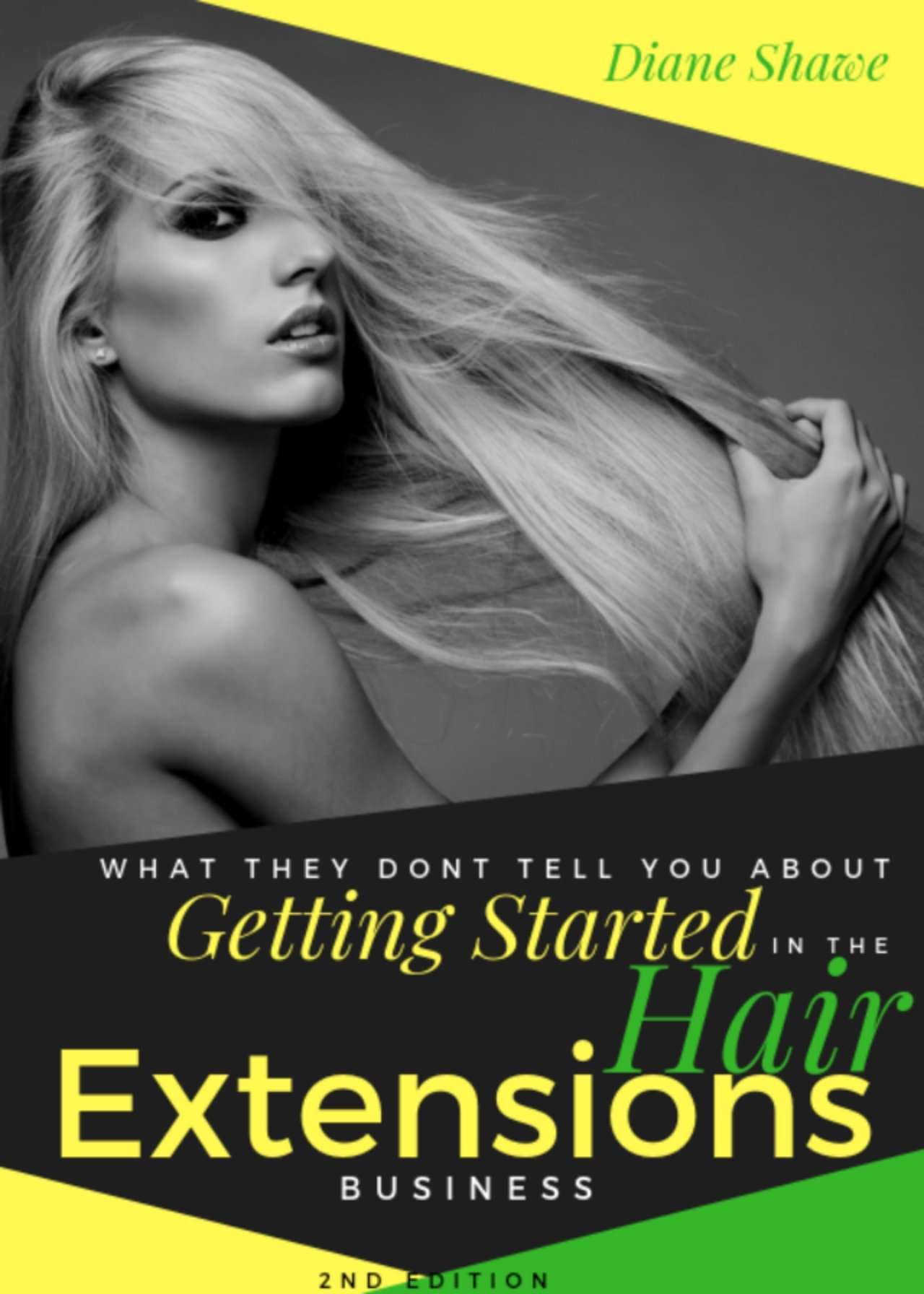
Extracted from Getting Started in the Hair Extension Business by Diane Shawe

If your hair extension studio is a real under-cutter, care will have to be taken to keep costs as low as realistic as possible.

Don’t be shy when it comes to taking money for your services. Charge for the value of the benefits that you offer.

You must put a value on your services; look at your type of clientele, hair extension location, experience of employees, your clients’ needs and, the prices of the competition.
Price is sometimes seen as a sign of quality and value. Price can attract like-minded customers. They think that because your prices are high, the technician in your hair extension studio must be good. If your prices are high, it is important to promote to the high paying customers, the value of your service.

There are a lot of competitors, so low prices alone, might not be enough to keep the low paying customers coming back. Clients who look for bargains are not only looking for low prices, but they want to get great results too.

You must determine how much value you can offer. To be of value to clients, you must know what the clients’ needs are. Understand what benefits they wish to receive, what pain they want to relieve.

Order you copy today from Amazon or Google Play

The benefits they want might be a quick service with no waiting, or it could be that they want an expert doing their hair. They might prefer certain products used on their hair, or to know that they can be squeezed in at short notice occasionally.

Their pain might be that they begrudge spending time on their hair, or that they loathe technicians who don’t listen to them. It might be that they just haven’t found the right retail products to use at home.

Profit margins will be low, so a lot of clients will have to go through the hair extension studio, just for you to be able to pay the overheads. It will most likely mean offering fewer services and probably, rushing clients through. Even the employees will have to be paid a low salary.

In some cases, this could mean that the employees are much less experienced than you may like. You really need to decide on what sort of employees you want in your hair extension studio. You will find that the best technicians won’t want to work in a cheap hair extensions studio. Not only would it hurt their reputations, but they wouldn’t work for a low salary.

Your clientele will most likely be bargain hunters who probably won’t spend on retail products either.

Charge by experience
If your employees have exceptional skills or experience, you can charge more. If you promote these benefits well, you’ll find that clients don’t mind paying extra. A lot of clients don’t mind paying for the name, or the prestige.

Some hair extension studios charge by the experience of the hair technician performing the service. As employees reach certain levels of experience, they charge more. This seems to work very well for them.

Order your copy today

Download this free guide today.

15 Habits Women Entrepreneurs Must Cultivate to Improve Sales

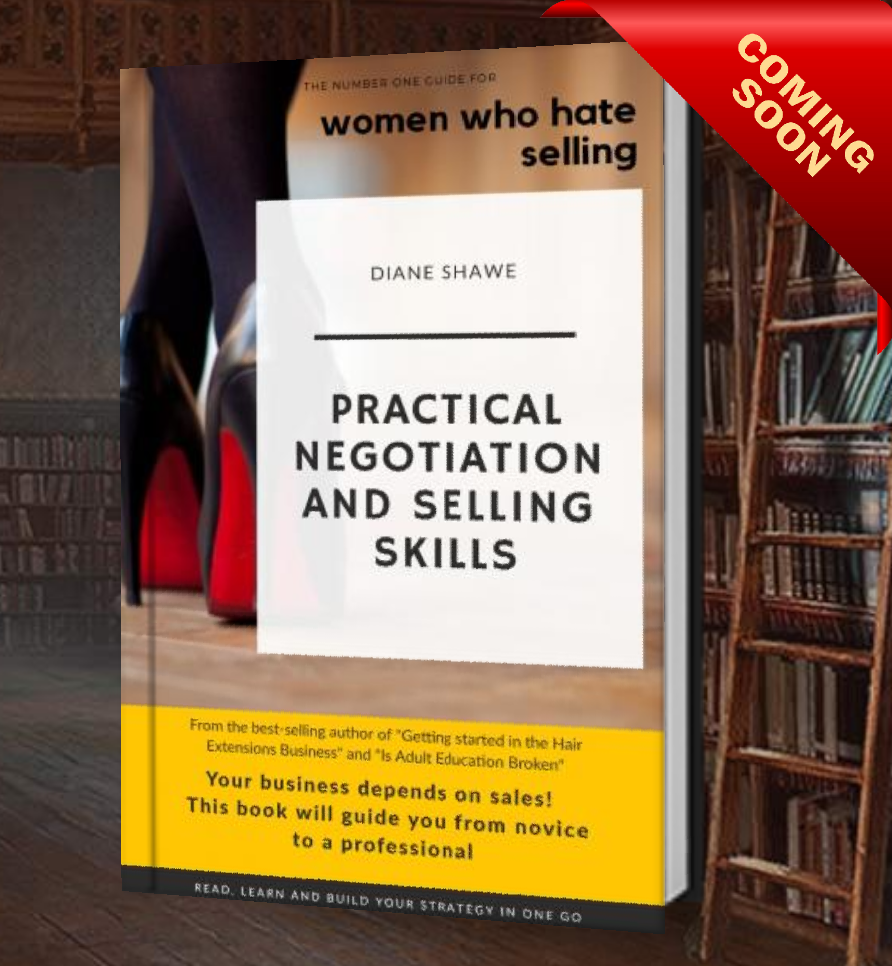
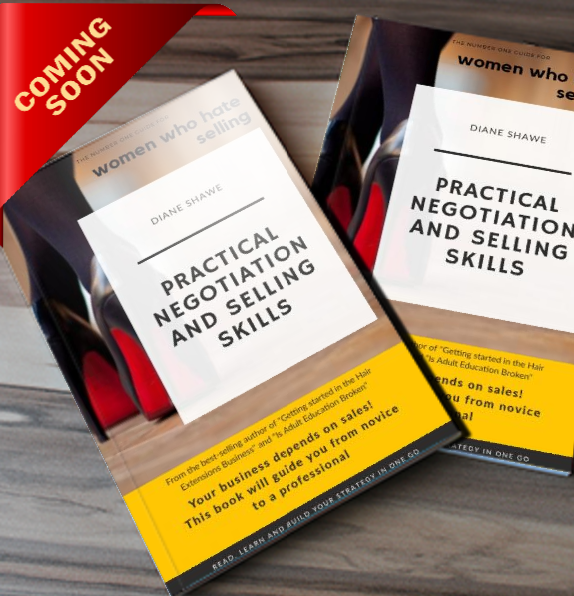
Diane Shawe Author of a forthcoming book ‘The number 1 guide for women who hate selling: Practical Negotiation and Selling Skills’ explores many points on why a high percentage of self employed women don’t achieve the level of sales.

For example she take a look at some of the things women constructively forget to ask for?

 Women Don’t ask For The Order,

 women don’t ask for raises and promotions and better job opportunities.

 They don’t ask for recognition for the good work they do.

 They don’t ask for more help at home.

In other words, a high percentage of women are much less likely than men to use negotiation to get what they want. Instead they spend destructive energy moaning and gossiping about how hard  done by or discriminated against they feel.

Why does this matter?

TRADITIONAL
BELIEFS UNDER THREAT

“The traditional belief that we must prepare ourselves to be ‘employable’ is under threat. The counter argument encourages us to ‘gear up’ for earning our own money, rather than seeing income as someone else’s responsibility. With the population dramatically ageing and low-level jobs increasingly swallowed up by machinery, entrepreneurship will be a necessity for many, rather than a life-style choice for some”

Why does the average woman in today’s society still find themselves debating the perceived concept that they deserves more or should be rewarded with more?

And why are many women still less comfortable asking for changes that would improve their working conditions, enhance their job satisfaction, or help them expand a business more efficiently and profitably?

“What you think you become, what you feel you attract, what you image you create”

So what is a Business Rainmaker?

In business, a rainmaker is a person who brings in new business and wins new accounts almost by magic, since it is often not readily apparent how this new business activity is caused. It means generating substantial new business or additional cash flow from sources sometimes outside established business channels, sometimes by connecting with people in non-traditional or hidden markets, and sometimes by prompting current clients to spend more money.

A rainmaker is usually a key figure in the business or organisation. not merely a salesperson, but a principal or executive who is usually highly regarded within the enterprise.
So I am going to introduce some researched habits, However, cultivating these habits is well within the grasp of any successful female entrepreneur with sufficient commitment in order to become your own Rainmaker.

1. Successful rainmakers treat their clients as the most valuable asset of their business.

For most business entrepreneurs, the vast majority of new business derives, either directly or indirectly, from existing or past clients and referral sources. Past and current clients can be a source of new business by sending new matters. They also can be powerful referral sources.

Yet sometimes business entrepreneurs focus their marketing efforts on cultivating new relationships with people they have never done business with before.

They ask these “strangers” out to lunch, invite them to firm seminars, and call and e-mail them. Meanwhile, their most valuable assets—their existing clients—are being neglected. There is much to be said for customer acquisition strategy vs customer retension strategy.

2. Successful rainmakers treat their current and former clients as well as, or better than they would treat a prospective client.
They recognise that existing clients are the most important people in their marketing mix.

3. Successful rainmakers nurture their relationships

Nurturing your clients by providing outstanding, not just good, service, staying in touch on a regular basis, seeking feedback, celebrating clients’ successes, and showing appreciation by sending gifts or hosting special client-appreciation events.

4. Successful rainmakers make business development a priority.

Successful rainmakers recognise that to be successful at business development, they need to make it a priority and work at it on a consistent basis. They treat their business development activities with the same level of commitment that they bring to client service.

Making business development a priority is as much about mind-set as it is about time management.

There are opportunities to market each day. Throughout the day, business entrepreneurs talk to clients, competition, and even staff. Spending a few extra minutes deepening a relationship at the end of each of these conversations, whether on a professional or personal level, will dramatically increase the probability of winning business.
But mind-set is not enough.

Consistent business development requires a system. The approaches are limitless and highly personal. Some people spend the first ten minutes of each day involved in a business development activity. Some schedule business development on their calendars, just like client meetings.

The important thing is that there is a structure in place that keeps marketing a consistent priority, as opposed to something that is done when there is a lull in a busy workload.

Download the full 15 Habits extracted from the forthcoming book by Diane Shawe. 15 habits women entrepreneurs need to cultivate

IQ scores are falling -It’s not that dumb people are having more kids than smart people

IQ scores are falling and have been for decades, new study finds

Guest Blogger: Rory Smith, CNN

IQ scores have been steadily falling for the past few decades, and environmental factors are to blame, a new study says.

The research suggests that genes aren’t what’s driving the decline in IQ scores, according to the study, published Monday.
Norwegian researchers analysed the IQ scores of Norwegian men born between 1962 and 1

991 and found that scores increased by almost 3 percentage points each decade for those born between 1962 to 1975 — but then saw a steady decline among those born after 1975.

Similar studies in Denmark, Britain, France, the Netherlands, Finland and Estonia have demonstrated a similar downward trend in IQ scores, said Ole Rogeberg, a senior research fellow at the Ragnar Frisch Center for Economic Research in Norway and co-author of the new study.

“The causes in IQ increases over time and now the decline is due to environmental factors,” said Rogeburg, who believes the change is not due to genetics.
“It’s not that dumb people are having more kids than smart people, to put it crudely. It’s something to do with the environment, because we’re seeing the same differences within families,” he said.

These environmental factors could include changes in the education system and media environment, nutrition, reading less and being online more, Rogeberg said.

The earlier rise in IQ scores follows the “Flynn effect,” a term for the long-term increase in intelligence levels that occurred during the 21st century, arguably the result of better access to education, according to Stuart Ritchie, a postdoctoral fellow in cognitive ageing at the University of Edinburgh whose research explores IQ scores and intelligence and who was not involved in the new study.

Researchers have long preferred to use genes to explain variations in intelligence over environmental factors. However, the new study turns this thinking on its head.

Intelligence is heritable, and for a long time, researchers assumed that people with high IQ scores would have kids who also scored above average. Moreover, it was thought that people with lower scores would have more kids than people with high IQ scores, which would contribute to a decline in IQ scores over time and a “dumbing down” of the general population, according to Rogeberg.

Anyone who has seen the film “Idiocracy” might already be familiar with these ideas. In the scientific community, the idea of unintelligent parents having more kids and dumbing-down the population is known as the dysgenic fertility theory, according to Ritchie.

The study looked at the IQ scores of brothers who were born in different years. Researchers found that, instead of being similar as suggested by a genetic explanation, IQ scores often differed significantly between the siblings.

“The main exciting finding isn’t that there was a decline in IQ,” Ritchie said. “The interesting thing about this paper is that they were able to show a difference in IQ scores within the same families.”

The study not only showed IQ variance between children the same parents, but because the authors had the IQ scores of various parents, it demonstrated that parents with higher IQs tended to have more kids, ruling out the dysgenic fertility theory as a driver of falling IQ scores and highlighting the role of environmental factors instead.

What specific environmental factors cause changes in intelligence remains relatively unexplored.

Access to education is currently the most conclusive factor explaining disparities in intelligence, according to Ritchie. In a separate study that has not been released, he and his colleagues looked at existing research in an effort to demonstrate that staying in school longer directly equates to higher IQ scores.

But more research is needed to better understand other environmental factors thought to be linked to intelligence. Robin Morris, a professor of psychology at Kings College in London who was not involved in Ritchie’s research, suggests that traditional measures of intelligence, such as the IQ test, might be outmoded in today’s fast-paced world of constant technological change.

Morris states that “we need to recognise that as time changes and people are exposed to different intellectual experiences, such as changes in the use of technology, for example social media, the way intelligence is expressed also changes. Educational methods need to adapt to such changes,” Morris said.

Diane Shawe author of ‘Is Adult Education Broken” goes on to state in her publication that “No sensible decision can be made any longer without taking into account not only the world as it is but the world as it will be.”

In her thought provoking book she explains that we are living in a new economy—powered by technology, fueled by information, and driven by knowledge which increasingly is increasingly becoming automated. We are entering the new century with opportunity on our side with huge problems that require new thinking.

How can we make the new economic age enhance, rather than diminish, our quality of learning?

How can we make this amazing innovation advance the prospects of all people especially those with experience and not just for the youth?

Fundamentally, we need to change what people learn, how people learn, when people learn, and even why people learn.

Inside her publication she explores

: Failure to find a fomular to develop teachers convergent and divergent facilitatingskills

: failure to consider cultural relevance

: failure to develop enterprising and entrepreneurial skills

: failure to prepare students about taking personal responsibility

: failure to encourage international engagement

:failure to manage growth of academic misconduct

Download your copy today https://www.amazon.co.uk/dp/B07BWBMGFM/

Finally a frightening statistic:

“If unemployment formed a country it would be the 5th largest in the world” Isaac Asimov

Why Having The Right People Around You Matters To An Entrepreneur

Starting and running a business can be very lonely and exposes you to bouts of isolation. When this happens the need to be loved, needed, and pampered is very strong and there is nothing wrong with that.

Ones self esteem can suffer and this can be compounded by historical experiences (childhood, family etc) and frustration and exhaustion when trying to lift your business of the ground and working a 12 hours day.

Being an ideas person, being creative and wanting recognition for that is achieved when the evidence is people buying your services or products.

The people you have surrounding you is very important, they have to be of a similar stock because they get it, they move into activities that support your dream and help you benefit from your hard work.

Many women are brilliant because most of them run several things at once if they are mums, wife, daughters, designer, marketeer, sales person, social media expert, bookeeper, packer and distributors and the list goes on.
The main point is to have total confidence in who you are, listen to tapes and watch video that continually empowers you. Mix with the pack that stimulates and motivates you and you them. When you live like this all who is to be in your life will gravitate towards you and give you joy and support.

You will easily be able to then identify anyone around you that does not naturally fit into your gang because they don’t naturally make you feel better, they add weight to your life and focus on distracting you.

But we are born with free will and you can use it to experience your life in what ever way YOU want.

The ultimate responsibility is your.

How My Teacher Almost Dashed My Dreams Of Writing

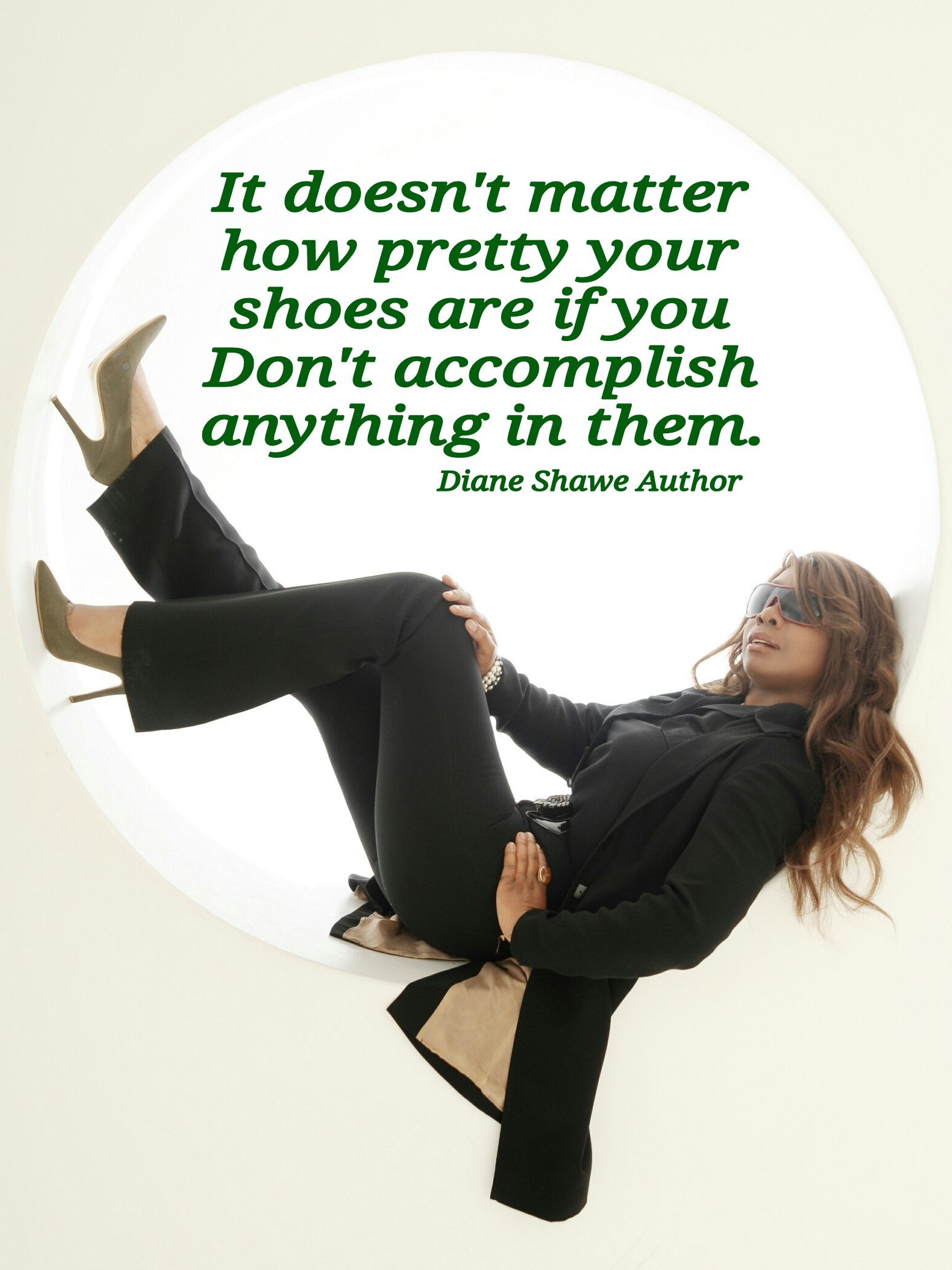
wear your pretty shoes well by diane shawe884346925..jpg

When I was 8 years old I remember my teacher Mr Lester ripping up my homework and accusing me of copying the story I wrote for my homework that week. I remember it was a story about being lost in the woods at night, I use to be afraid of the dark back then.

I cried and said I hadn’t copied it, he gave me detention on top of that and called me a liar.

I was so embarrassed and ashamed I never did well in English Literature again just to spite him I thought but really he had squashed my confidence.

16 books later all published on Amazon with my most recent which took 3 years to write and a healthy vibrant blog with over 35k followers which I have been nurturing since 2010

Do you think adults in position of influence realise what they can do to a child?

Never let negative people define who you are or what you want to become.

Coaching is also important and if you want to propel your vision coaching can help you stay laser focused with a strategic plan

Download your copy on #amazon today https://goo.gl/gm9t2U

Diane Shawe’s eBooks are available on Amazon right now at: https://www.amazon.com/Diane-Shawe/e/B0052WG8V6

Here’s the Main Reasons Adult Education is Broken and I’ll Prove It To You

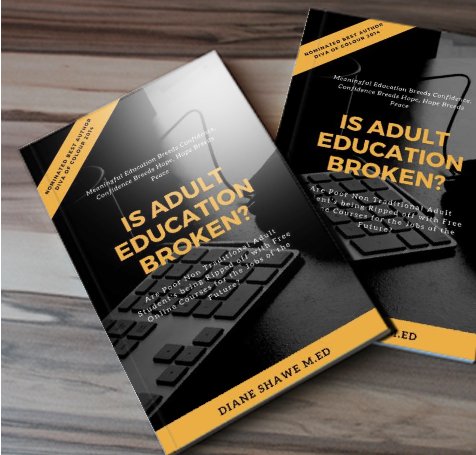
Is Adult Education Broken?

Is Adult Education Broken by Diane Shawe Author (4)

Adult education has become undervalued in an overpriced educational infrastructure.

The people who need the most help are already systematically ripped off by greedy loan companies, NHS parking, having to pay charges for drawing out their own money from private ATM machines in poorer boroughs, pre-paid electric meter’s to name but a few.

The more you seem to need help the more you seem to have to pay.

Off course, the arguments are always about risk, but to compound on top of their needs, a premium, just to make sure the risk is compensated for is questionable indeed. But another kind of ripping off is taking place. ‘Free online education’ you may ask ‘why is this a rip-off people”?
I will answer this from my perspective initially and then make further arguments as to why we should be very concerned about this un-policed, unchallenged butchery of the values originally infused into our adult educational system.

Is Adult Education Broken by Diane Shawe Author (2)So if you all but think Adult Education is Broken and all but given up, this book spills the beans on what has gone wrong, what questions need to be addressed and if certain issues are tackled by Government, then there’s Hope,

As Isaac Asimov—a master of science fiction literature—once said:

“No sensible decision can be made any longer without taking into
          account not only the world as it is but the world as it will be.”

So the big Question is – What has happened?

  • Why have these large institutions priced education out of some fundamental principles?
  • Why on the other spectrum are all these free courses flooded the market?
  • How can we make the new economic age enhance, rather than diminish, our quality of learning?
  • How can we make this amazing innovation advance the prospects of all people especially those with or without experience and not just for the youth?

It is clear that at this moment most educational systems are not keeping pace with changing technology and the ever-evolving world of work.

Is Adult Education Broken by Diane Shawe Author (5)
“If unemployment formed a country it would be the 5th largest in the world”

                                                  Isaac Asimov

 
Not enough people are thinking strategically enough in this area.  Fundamentally, we need to change what people learn, how people learn, when people learn, and even why people learn.

We must get beyond the traditional model of students sitting passively in classrooms, following instructions and memorising material that they are tested and scored on which sometimes turn out to be of little use in an every changing economy.

“It is not the strongest or the most intelligent who will survive but those
                                     who can best manage change.”                       Darwin

Throughout the ages, every human society has experienced challenges adjusting to population growth, maintaining structural order and creating channels for future generations. How well a society prepares the next generation for survival is imperative for the society as a whole but we have stalled in this process.

There seems to be a range of systemic failures such as

: failure to find a formula to develop teachers convergent and divergent Is Adult Education Broken by Diane Shawe Author (3)facilitating skills
: failure to consider cultural relevance
: failure to develop enterprising and entrepreneurial skills
: failure to prepare about taking personal responsibility
: failure to provide adequate technology and supporting curriculum
: failure to encourage international engagement
: failure to manage growth of academic misconduct

Diane Shawe Author states that “the traditional belief that we must prepare ourselves to be ‘employable’ is under threat. The counter argument encourages us to ‘gear up’ for earning our own money, rather than seeing income as someone else’s responsibility”

With the population dramatically aging and low-level jobs increasingly swallowed up by machinery, entrepreneurship will be a necessity for many, rather than a lifestyle choice for some.

SMEs are of course already leading this charge but in order to gear up for the future we need to start off by asking a serious question, defining criteria’s and examining trends, impact these trends will have and plan a way to jointly prepare current and future generations to be both employable and entrepreneurial.

We are living in a new economy—powered by technology, fueled by information, and driven by knowledge. And we are entering the new century with an opportunity on our side but huge problems that require new thinking.

claim free course now

Is Adult Education Broken by Diane Shawe Author (12)

Click to find out more about creating your own On Demand Digital Course Library

How to create a digital on demand course library


Global Personal Bloggers of Influence for 2017

When twitter came out and account holders tweeted what they ate, we all thought twitter had a short life span.  Now the media rummages through top celebrities tweets to find something sensationable to report about.  Would be employers have been know to use candidates social media postings as evidence against them.
The era of the Personal style bloggers use to get caricatured as either geeks or pretty, brainless girls who dress up for their camera-wielding boyfriends and post their results to a WordPress blog.
But wait a minute, with instagram, Facebook, linkedin and twitter integration most of these bloggers have grown quiet influential with hundred of thousands of followers. Over the past decade, these independent publishers have become a real force in the fashion industry — not just snapping up front row seats at fashion shows, but landing major campaigns and collaborations with brands, becoming regular guests on TV shows like “Today” and “America’s Next Top Model,” and turning their blogs into multimillion-dollar businesses. Some have become household names. Independent European bloggers are harder to pin down as most of them are linked to magazines.
Chiara Ferragni, Hanneli Mustaparta and Nicole Warne. Photo: Clemens Bilan/Stringer

Chiara Ferragni, Hanneli Mustaparta and Nicole Warne. Photo: Clemens Bilan/Stringer

To determine the ranking, consideraction was given to:

  • Instagram, Twitter, Facebook, YouTube and Pinterest followers, as well as website traffic. These numbers gave us a snapshot of how many people these bloggers are reaching every day.
  • Brand extensions. We gave props to bloggers who have used their influence to create original products.
  • It factor. We talked to industry insiders about whom advertisers are loving right now, and who is moving the most products via affiliate links.
  • Google News searches. Headline makers were rewarded for extending their reach beyond their own network.
Chiara Ferragni. Photo: Jason Merritt for Getty Images Entertainment

Chiara Ferragni. Photo: Jason Merritt for Getty Images Entertainment

1. Chiara Ferragni, The Blonde Salad 
The 27-year-old Italian, who now lives in Los Angeles, has the broadest reach of any individual fashion blogger on our list, with more than 3 million Instagram followers. She’s a global star, as popular in Europe as she is in the U.S. What’s more, links from her site drive traffic and conversions, according to many of the brands with whom she has partnered. She was also recently named to an expert panel that will help determine the shortlist.

Oh, and she graced the cover of Lucky magazine’s February issue along with fellow bloggers Nicole Warne and Zanita Whittington.

2. Aimee Song, Song of Style 
Song, 28, is a Los Angeles-based interior designer whose straightforward street-style shots have made her popular with brands and readers alike. Song also has an incredible Instagram following — 1.9 million — and has worked hard to build her YouTube audience as well, with more than 28,000 subscribers to her channel.

3. Wendy Nguyen, Wendy’s Lookbook 
Yet another L.A.-based blogger, Nguyen, 31, is best known for her YouTube channel, which currently boasts 600,000-plus subscribers. (Her 2011 video, “25 Ways to Tie a Scarf” has been viewed over 29 million times.) Nguyen’s point of view is unique in that she grew up in the foster system, and has opened up about her experiences to her readers.

Kristina Bazan. Photo: Frazer Harrison for Getty Images Entertainment

Kristina Bazan. Photo: Frazer Harrison for Getty Images Entertainment

4. Kristina Bazan, Kayture 
This Swiss-model blogger, 21, has an impressive reach on Facebook — with more than 1.1 million likes — in addition to a major presence on Instagram, Twitter, etc. Bazan is a favorite of high-end brands: she’s worked with Louis Vuitton, Hugo Boss and Piaget, among others.

5. Julie Sariñana, Sincerely Jules
The 29-year-old blogger, who lives in Los Angeles, started her site in 2009 — early, compared to many of her peers. Her easy, approachable style has translated well into her own line of t-shirts, printed with often inspirational, occasionally irreverent, quotes.

6. Rumi Neely, Fashion Toast 
Neely, 31, launched Fashion Toast in 2007. Her particular style of blogging — photo-heavy posts featuring cool clothes and model poses — has greatly influenced the generation of influencers who have followed her. While Neely has collaborated with established brands in the past, she recently launched her own line. Are You Am I, a collection of slip dresses, tap pants and distinctly cut tees, is notable for its specificity. For fans who want to emulate Neely’s style — and there are plenty of them — there is nothing more perfect.

7. Nicole Warne, Gary Pepper Girl 
One of three bloggers to land Lucky‘s February 2015 cover, the Sydney-based Warne, 25, first launched Gary Pepper as a vintage e-commerce site in 2009. Warne started out blogging and modeling the clothes as a way to market the website, and by 2011, it was one of the largest online vintage retailers in Australia. However, the young entrepreneur’s side project soon became the main event, and in 2012 she shut down the e-commerce leg of Gary Pepper to focus on her blog-driven business.

Blair Eadie. Photo: Cindy Ord for Getty Images Entertainment

Blair Eadie. Photo: Cindy Ord for Getty Images Entertainment

8. Blair Eadie, Atlantic-Pacific 
The New York-based Eadie, 29, is best known for her accessible, yet educated, approach to fashion. Based in San Francisco when she launched the blog, Eadie has worked as a merchandiser for brands like Gap and Tory Burch, which means she has a professional edge when it comes to outfit posts. And brands like love working with her because she has a reputation for converting readers into shoppers.

9. Julia Engel, Gal Meets Glam 
The San Francisco-based Engel, 23, is seen as an up-and-comer in the space. She’s already amassed a large following across platforms, from Pinterest to Instagram. Appealing to the same sorts of readers who worship Lauren Conrad’s pretty aesthetic, Engel’s site is easy to navigate, with lots of opportunities to shop affiliate links.

10. Nicolette Mason 
Mason, who writes a monthly column for Marie Claire and designed her own collection for Modcloth last fall, is one of the most in-demand bloggers working right now. The 29-year-old writer played a role in the promotion and social media around Target’s new plus-size collection Ava & Viv and is also a budding TV personality, offering style advice on programs including “Today” and “Good Morning America.” Mason is notable because she uses her blog as a platform to discuss bigger social issues, including race, sexuality and body image.

11. Shea Marie: Peace, Love Shea 
The Los Angeles-based blogger and TV host, 27, has the high-fashion-meets-Southern-California look brands eat up. She’s worked with the likes of Dior, Gucci, H&M and Guess.

Bryanboy. Photo: Dimitrios Kambouris for Getty Images Entertainment

Bryanboy. Photo: Dimitrios Kambouris for Getty Images Entertainment

12. Bryanboy 
The OG fashion blogger and best friend of Fashion Toast‘s Rumi Neely, the New York-based, Philippines-bred Bryan Grey Yambao has transformed from an online-diary keeper to a celebrity and fashion insider. While other bloggers from his era have fallen off the map, Yambao, 32, has remained relevant by branching out. Memorable projects include a collection with furrier Adrienne Landau and a hosting spot on several seasons of “America’s Next Top Model.”

13. Elin Kling
The New York-based Kling, who is Swedish, was one of the first bloggers to collaborate with a brand on a collection. (In 2011, H&Mreleased a Kling-designed line.) But her fantastic stand-alone label, Toteme, has transformed Kling, 31, from a blogger to a full-fledged designer.

14. Zanita Whittington
The Stockholm-based Aussie, 28, was one of Lucky‘s February cover stars. Along with modeling and blogging, Whittington is also serious about photography. Her site is a sort of “how to” for aspiring bloggers, with service pieces on starting a blog and building an audience.

Gabi Gregg. Photo: Ilya S. Savenok for Getty Images Entertainment

Gabi Gregg. Photo: Ilya S. Savenok for Getty Images Entertainment

15. Gabi Gregg, Gabifresh
One of three plus-size bloggers chosen to star in the campaign for Target’s new Ava & Viv collection, Gregg started her blog in 2008 when she couldn’t find an entry-level job in fashion journalism. Now 28 and based in Los Angeles, the blogger has appeared on the “Today” show, designed a sell-out swimwear collection, and partnered with brands including Misguided, Nordstrom and Laura Mercier.

16. Danielle Bernstein, We Wore What
The New York-based blogger, 23, started her site as an FIT undergrad eager to capture the style of her fellow students. It soon transformed into a personal style forum, leading to a design project with Topshop.

17.  Jessica Stein, Tuula Vintage
This Sydney-based blogger, 25, spends a good chunk of her time traveling, and sharing her adventures via Instagram. (She’s currently parked in the Maldives.) Brands like Dior Beauty partner with her for the obvious reasons: she has great taste and an enviable life.

Susanna Lau. Photo: Cindy Ord for Getty Images Entertainment

Susanna Lau. Photo: Cindy Ord for Getty Images Entertainment

18. Susanna Lau, Style Bubble
Forever the no. 1 blogger to fashion insiders, the 31-year-old Lau is now one of the industry’s leading voices. While her creative outfit posts are still appreciated, she is even more loved for her sharp opinion, contributing to publications including Elle UK and Business of Fashion, as well as posting regularly on her own site.

19. Chriselle Lim, The Chriselle Factor
With a massive YouTube following, the Los Angeles-based wardrobe stylist, 29, offers her audience plenty of tips and tricks via video. She’s worked with brands including Coach and Banana Republic.

20. Jane Aldridge, Sea of Shoes
Another blogging pioneer, the Dallas-based Aldridge started her site at age 15. Eight years later, she’s still at it, partnering with brands like Lovegold and Cartier on a regular basis.