Category Archives: online colleges

3 Personality Types that will Suck your Positive Energy out of your business

recruiting and training winners for your busines

Don’t let toxic people kill your business or energy

It will come as no surprise to some of you but, there are three personality types that could end up sabotaging your small business, management committee or think tank team to the point where you end up not working on your business or project but working in it.

Most of us have been there.  That one personality that just drives you to distraction and no matter what you do, they seem to be in complete denial.

A staggering number of small businesses have sprung up since 2014 according to the FSB 2015 report.

  • There were a record 5.4 million private sector businesses at the start of 2015.
  • This is an increase of 146,000 since 2014 and 1.9 million more since 2000.
  • The number of employing businesses increased by 35,000 and the number of non-employing businesses by 112,000, with the annual growth for both groups being around +3%.
  • Small businesses accounted for 99.3% of all private sector businesses at the start of 2015 and 99.9% were small or medium-sized (SMEs).
  • Total employment in SMEs was 15.6 million; 60% of all private sector employment in the UK.
  • The combined annual turnover of SMEs was £1.8 trillion, 47% of all private sector turnover in the UK.

Most of these business owners would have experienced high staff turnover, partnership problems, customer complaints all of which then culminate into cash flow problems or problems with people who become perpetual saboteurs.

Lets take a look at the personality types

1 People Who Like to Be Right

2 People Who Like to Be Comfortable

3 People Who Like to Be Liked

4 People Who Like to WIN

So most of us when we are looking for someone to join the team, we are often working with a low budget which does not stretch to complicated personality assessment or expensive recruitment companies who want large upfront fees. So we tend to end up going on the ‘Oh you CV is impressive’ or ‘WoW we really get on’ or ‘Yes you so get my business needs’

But is that really enough?

Here are some key indicators that the person you’re working with or about the hire may have such a  personality type:

#1 People Who Like To Be Right

  • They challenge your coaching
  • They argue with you
  • They say “I know that” but then do not take action
  • Have difficulty receiving feedback
  • Need to have the last word
  • Need to justify their choices

This personality type will make it difficult when it comes to creating duplication, receiving and implementing constructive ideas if they’re building a business with you.  At the interview they may make you feel uncomfortable, but impress you at the same time.

#2 People Who Like To Be Comfortable

Here are some key indicators that the person you’re speaking with fits this personality type:

  • Afraid to take risks
  • Fine with watching TV every night instead of focusing on their business growth
  • Has difficulty implementing coaching
  • Comfortable in the current situation that they’re in
  • Very specific on task and hours of work

This style of person will struggle with being a self-starter and will consistently need motivation from YOU in order to build and grow the business. At the interview they may state a lot about the type of people they don’t like which could be describing themself.

#3 People Who Like To Be Liked

Here are some key indicators that the person you’re speaking with fits this personality type:

  • Need approval from others
  • Don’t want to rock the boat
  • People pleaser
  • Loves life when everyone is happy around them
  • Will say yes to others even if they disagree
  • Are afraid of going against the grain and looking different

This personality will have a very hard time with difficult conversations will often appear very latargic and not very helpful.  They don’t want to be seen as the bad guy or gal. At the interview you may not be able to quiet put your finger on it, but you might like them because they seem as though they might not give you any trouble.

The Ultimate Personality For Building A Massive Army Of Implementers

#4 People Who Like To WIN

Here are some key indicators that the person you’re speaking with fits this personality type:

  • Ready to take on challenges
  • Have a clear vision of what they want and how they’re going to get there
  • Coachable
  • Adapt quickly
  • Competitive
  • Have a thick skin and don’t care about what others think
  • Desire for self growth

When you identify this kind of personality, act fast and figure out how to work with them, because they’re going to be successful with or without you. At the interview they may come across as enthusiastic and focused.  Might also want to bring ideas to the table even before they have the job.

Can People Change?

Do you really think it’s possible to change someone’s personality to make them someone who wants to win?

What if there was an easy way to take a look at a  personality type so you could better plan how to work with them and help them become a winner?

Check out our Clarity4d Profiler and learn how it could benefit you and your team

How answering 77 questions could help you avoid business failure

Out Now: 77 Ways to avoid Potential Business Failure77 Questions to avoid business failure by Diane Shawe white background

“Your work is going to fill a large part of your life, and the only way to be truly satisfied is to do what you believe is great work. And the only way to do great work is to love what you do.” –Steve Jobs, co-founder of Apple

Like you I Never Thought I Could answer 77 questions that would help me  avoid business failure  – But I Finally Discovered The Secret! Here’s How…

article by Diane Shawe Author

Are you ready? Is Entrepreneurship For You?
Are you the right person for your business idea?

In business, there are no guarantees. There is simply no way to eliminate all the risks associated with starting a small business – but you can improve your chances of success with good planning, preparation, and insight. Start by evaluating your strengths and weaknesses as a potential owner and manager of a small business. Carefully consider each of the following questions.

  • Are you a self-starter? It will be entirely up to you to develop projects, organise your time, and follow through on details.
  • How well do you get along with different personalities? Business owners need to develop working relationships with a variety of people including customers, vendors, staff, bankers, and professionals such as lawyers, accountants or consultants. Can you deal with a demanding client, an unreliable vendor, or a cranky receptionist if your business interests demand it?
  • How good are you at making decisions? Small business owners are required to make decisions constantly – often quickly, independently, and under pressure.
  • Do you have the physical and emotional stamina to run a business? Business ownership can be exciting, but it’s also a lot of work. Can you face six or seven 12-­hour work days every week?
  • How well do you plan and organise? Research indicates that poor planning is responsible for most business failures. Good organisation ­ of financials, inventory, schedules, and production ­ can help you avoid many pitfalls.
  • Is your drive strong enough? Running a business can wear you down emotionally. Some business owners burn out quickly from having to carry all the responsibility for the success of their business on their own shoulders. Strong motivation will help you survive slowdowns and periods of burnout.
  • How will the business affect your family? The first few years of business start­up can be hard on family life. It’s important for family members to know what to expect and for you to be able to trust that they will support you during this time. There also may be financial difficulties until the business becomes profitable, which could take months or years. You may have to adjust to a lower standard of living or put family assets at risk in the short-term.

So Before you start – Do you know the answer to these 77 questions?  Download your copy today it will be the best £3.99 you spend? 

I recommend you get a little notebook and start working on each question. For those you cannot answer, find the answer and make a note.  This is also an invaluabe excercise if you are already in business, it can help you clarify where you are today and help you plot where you need to get too and how to do it.

Get your exclusive copy today and save £3.00

Get your exclusive copy today and save £3.00


If you want to find out if you are right for your business, we have a surprise link hidden inside this little ebook.  All you have to do is Answer 10 questions and we will send you a full report which will also include your Personal Training Needs Analysis to develop your Entrepreneur skills.

Diane Shawe Author of 77 Question to avoid business failure Available from Amazon

Diane Shawe Author of 77 Question to avoid business failure Available from Amazon

Traction Alopecia – How You Can Stop It and is it Reversible by Diane Shawe

traction alopecia how to stop itAre YOU a Likely candidate for Traction Alopecia?

Anyone can be affected by traction alopecia – young or old, male or female. It’s more common within certain groups of the population, because they are more likely to use some of the hairstyling techniques listed above.

The reason I raise this article is because we are all living longer and some of the current fashionable trends in the younger groups are contributing to traction alopecia. Read about Clip ins and how they cause Traction Alopecia

For example, women and girls are more likely to notice the problem due to braids and weaves. Ballerinas – who tend to wear their hair pulled into very tight ponytails – sometimes suffer from traction alopecia around the hairline as a result.

In a nutshell – if you have a habit of doing something on a frequent basis that puts your hair under some sort of strain, then you are a candidate for traction alopecia.

Read on to discover the many ways you can prevent it from happening, or stop further damage if you’ve already noticed a problem.

Traction Alopecia Symptoms

Have you ever undone a ponytail and found your scalp feels sensitive to the touch afterwards?

Does untying your hair feel like a relief?

Does your scalp itch after you’ve had braids or a weave put in?

Have you ever taken painkillers because your hair is secured so tightly it’s given you a headache?

All of these are warning signs that your hair is under way too much tension. Your body is trying to tell you something… and you need to listen!

If not, the next thing you’ll notice is that sections of your hair are actually missing, or worryingly sparse. You can often see this more clearly around the hairline or behind the ears, but it can often happen around the crown, too. It really depends on what was causing the tension in the first place.

Some people even notice pustules (blisters filled with pus) or papules (little pimples) where the hair is under a lot of tension. This is because of the irritation being caused to the scalp and is a clear indicator that the follicles just can’t cope with the strain.

Can Traction Alopecia be Reversed?

Yes and no.

If you spot the warning signs of traction alopecia early enough and you put a stop to whatever’s causing it, then your hair will stop falling out and should – with time, patience and loving care – be completely restored to its former glory.

But if the hair follicles have been so badly traumatised for such a long period of time that they have scarred over, then the hair will not grow back by itself. Areas of the scalp where this is the case will likely look shiny.

In cases like this, you’ll need to think about some sort of surgical restoration – speak to your dermatologist to establish whether or not your traction alopecia has caused permanent scarring and to discuss the surgical options available to you.

When Traction Alopecia Compounds Other Hair Loss Problems

traction_alopecia_caused_by_hair_clipin_diane_shawe

If you are wearing a hairpiece – such as a clip on topper – to mask other hair problems like androgenetic alopecia, then you need to be very careful not to compound your problem with traction alopecia!

The best option is to ensure that the clips of your topper are firm, but not too tight, and that you rotate them. We also recommend undoing a couple of the clips when you’re at home – it gives your scalp a little rest from the tension.

Traction Alopecia Recovery Time

Most experts agree that your hair should recover within 6 to 9 months of you removing the cause of the problem.

If you’ve followed the guidelines given here and you are still not seeing regrowth, then it’s likely that the damage to your follicles was permanent – a fact your doctor/dermatologist can confirm. In that case, you might like to discuss the possibility of a hair transplant, which will effectively mask the problem.

What are the Causes of Traction Alopecia?

Traction alopecia is a type of hair loss that happens over time. It’s caused by putting the hair under constant strain or tension and is usually caused by one or more of the following…

  • Very tight ponytails or pigtails
  • Tight braids or cornrows
  • Dreadlocks
  • Extension (single) braids
  • Hair weaves or wigs attached with glue, clips or tape
  • Certain hair clips, slides or barrettes that hold the hair tightly and are worn in the same position every day
  • Headbands – even fabric ones – worn day after day
  • Tight hairpieces
  • Tight headgear like cycling helmets that are worn frequently or for long stretches of time and tend to rub or pull repeatedly on the same area of hair
  • Repeated use of hair rollers
  • Repeated pulling of the hair with the hands (this is an emotional condition called trichotillomania)

If you use or do any of the above, then you may find that the constant tension they cause has led to areas of thinning hair – usually around the temples or behind your ears. Alternatively, you might notice that the part in your hair looks wider than it used to.

If so, then it’s quite likely that you’re suffering from traction alopecia.

There’s more to this condition than hair simply breaking off. Instead, the constant tension in the affected area either pulls out the hairs’ roots completely, or causes the follicles to become inflamed. As time goes by, the damage to the follicles causes them to become atrophied (wasted away)… and if you don’t put a stop to the cause of the problem, they will reach the point where they no longer produce hair at all.

Reference: DermHairClinic – Traction Alopecia

Get your copy today from amazon.co.uk

Get your copy today from amazon.co.uk

Traction Alopecia Treatment

As discussed above, ‘treatment’ for traction alopecia is only effective before you’ve arrived at the stage of permanent damage.

But the good news is that ‘treatment’ – if you’ve caught the condition early enough – can be as simple as changing whatever hair styling and hair care practices you were using and really learning to CARE for this precious asset… your hair!

Wearing a weave

One of the biggest ironies about traction alopecia is that it’s the most common cause of hair loss for women wearing hair extension is due to the application being too tight when weaves and hairpieces are applied… yet those weaves and hairpieces are often used in the first place to enhance hair that may seem thin, or lacking in volume.

Weaves are generally applied through braiding, fusion, netting or bonding – and the sad fact is that any or all of these methods can lead to traction alopecia if used extensively, over long periods of time.

To minimize the risk of traction alopecia, or to try to prevent further damage and encourage regrowth, have your weave fitted by a state licensed professional. Yes, it may be more expensive, but you – and your hair – are worth it! Someone properly trained in hair care will keep damage to a minimum and will be able to spot potential problems and nip them in the bud.

The same goes for hair extensions, which can also cause hair loss problems in the lower half of the scalp. Have them fitted by a trained professional – don’t try to fit them yourself or have a friend do them for you.

Speak to your hairdresser about taking care of your scalp – some women find it difficult to maintain good scalp hygiene because the weave or extensions make it awkward… unfortunately, though, this can make the problem of traction alopecia worse.

When chemicals are the culprits

There’s a kind of alopecia called CCCA (central cicatricial centrifugal alopecia), also known as hot comb alopecia, or follicular degeneration syndrome. It’s almost exclusively seen in African American women and it’s often confused with female pattern baldness, because it starts at the crown and spreads to the surrounding areas.

The cause?

A mixture of too much stress (traction) on the hair along with the use of harsh chemicals like dyes, relaxers and bleaches. The chemicals actually damage the keratin structure of the follicle itself, causing hair LOSS, not just hair damage.

In fact, research conducted in 2008 showed that the highest prevalence of traction alopecia was in women with relaxed hair.

If you suspect this is a condition that’s affecting you, speak to your dermatologist. In addition to removing the cause of the traction and stopping the use of chemicals in your hair, you may be tested for any bacterial or viral infection and possibly be prescribed topical steroids, antibiotics or topical minoxidil to encourage regrowth.

NOTE: If you must use a relaxer on your hair, have it done professionally. Specialists are seeing more and more problems caused by home relaxer kits, because it’s tempting to leave the chemicals on longer than necessary, or accidentally use a stronger formula than you really need. (Make sure they have been certified)

Braiding, ponytails, pigtails and locs

The 2008 research into the prevalence of traction alopecia in African girls and women showed that braiding caused more problems than chemicals (although the two together were worse still).

Starting up a hair extension business Diane ShaweConstant, tight braiding – or other styles like ponytails that place hair under chronic tension – can affect any ethnic group. So it’s very important to take a new approach to styling hair that doesn’t rely on placing the hair under extreme tension.

The ideal solution, of course, is to allow the hair to be completely natural, without using any kind of clips, slides or ties.

The reality, though, is that this just isn’t possible for most of us. Our hair may either be unmanageable and wild looking when allowed to ‘do its own thing’ – or, like us, you may live in a climate where it’s simply too hot to have your hair hanging around your face all day.

The answer is that you can continue to secure back your hair, but you MUST change the way you do it from one week to the next. Traction alopecia is usually the result of CONTINUALLY putting the hair under EXACTLY the same tension in the same place, day after day.

How to Avoid Traction Alopecia (and still have beautiful hair!)

Change the location of your ponytail often – wear it high, low, on one side, then the other. Don’t wear a ponytail at all if your hair isn’t really long enough to need one… otherwise you’ll probably be pulling your too-short hair really hard in order to secure it.

Avoid using clipped in ponytails – the weight of them can – quite literally – tear out your hair.

Always use fabric covered hair bands – avoid bare rubber bands like the plague! And remove bands, clips and ponytail holders from the hair at night – this is when you may be putting your hair under tension without even realizing it.

Invest in satin pillowcases. They cause less friction on your hair than cotton or nylon ones – and, as an added bonus, they’re believed to help reduce wrinkles too!

Change the location of your partas often as you can. Even a simple part in the hair can trigger a problem when worn in the same position day after day.

Don’t retwist the roots of dreadlocks – watch this video for first-hand experience of how damaging this can be!

If you use hairspray or hair gel, wash it out before you next brush your hair.Brushing dried hairspray and gels out of your hair is damaging to the shaft and may cause further hair loss.

Make sure your hair is hydrated. If you’re in a dry climate – or you use air conditioning or central heating – the lack of moisture in the air can make your hair brittle and more likely to break

http://http://issuu.com/dianeshawe/docs/course_prospectus_hair_loss_consult

Other related Hair Loss Article by Diane Shawe

The dangers of being out-thought and out- manoeuvre by your competitors

soft skills training for sales team by diane shaweBuyers Don’t Follow a Linear Path anymore so why ask your sales team to do the same?

article by Diane Shawe M.Ed

The sales funnel relies on the theory that someone comes into the top of the funnel and sales fall out the bottom. But is that true in today’s world? Do we start at the top and make our way through to the end? Or do we start at the top, leave, jump levels, come back, leave again, come back at the beginning and some point come back and buy or totally just leave? Are sales people  following a linear purchase pattern or an erratic path of engagement that sometimes results in less and fewer sales?

Distraction is the Number One Barrier to Sale

Distraction is destroying the Sales Funnel. It’s clear that buyer behaviour is erratic, but they are also finicky and overloaded with information.. Distraction may very well be the number one barrier to a sale. We get distracted and abandon our cart. We stop reading the article that brought us to you. Simply put, any little distraction means we move on to something else and we may never come back. We are also finicky buyers, what we think one day may be dramatically changed by another piece of content that contradicts our previous opinion.

Let’s take a look at the Sales Funnel Concept.

The sales funnel has been around for as long as any of us has been in business. It is a tool that has been used to visualize everything from the sales process to marketing impact on an organization. I use to be a  fan of the sales funnel.  But the truth is, the traditional sales funnel model has been dead for years; we just haven’t come to accept it yet. They say a picture paints a thousand words, the problem is clients are overloaded with the same information.

SALES-Marketing-Funnels dead. avpt Diane Shawe

Buying patterns have changed drastically in the last decade. They’ve changed so much that they have truly broken the sales funnel as we know it.

Old habits die hard, so the big question is whether or not a sales funnel is still a viable model for sales concepts. Here are the biggest challenges I see with the sales funnel in today’s buying environment.

Selling the way your customer wants to buy…Not the way you like to sell

Sales Plan Mapping is all about Rapport.  Rapport is defined as:

“A state of mutual trust and respect existing between two or more people. Rapport is the primary basis for all successful communication.”

Sales Plan Mapping is all about Rapport.  Rapport is defined as: “A state of mutual trust and respect existing between two or more people. Rapport is the primary basis for all successful communication.”  To build rapport with someone you have not met face to face is a learned skill referred to as NLP.

Learning to Plan a Sales map requires knowledge in a new type of Consultative Selling.  Planning a Sale Map would mean learning new skills in 5 key areas:

  • Best Practices
  • Communication Skills
  • Strategy and Traction
  • Sales Project Management
  • Presentation

The strategic role of continuous education

One way to stay on top of a rapidly changing market is to implement a business strategy that maximises the synergies between lifelong learning and workforce productivity.

Without appropriate technological support, training programs appear to be less effective. No matter the size of your business, if you stand still and basque in your current success, this is surely the biggest route to new challenges.

Even though research has shown that E-Learning proves to be an excellent way to achieve quality results in a short timeframe, most users still only dabble with free flimsy or overbearing solutions that provide no tracking, evidence or further sign posting to continue competence training.

Getting the world back to work with skills we can trust

Getting the world back to work with skills we can trust

POINT OF NEED TRAINING

Point of Need Online-delivered learning, using mobile technology within a context of continuous education, is considered strategic because it:

  • Keeps the workforce appraised of their job functions’ developing requirements, enabling them to make a positive impact on their role individually and as a team and help that Organisation achieve its aims and goals
  • Aids succession planning, helping workers to acquire the knowledge and skills to help them progress within their Organisation
  • Allows Organisations to keep training budgets under tighter control, develop and retain existing employees and reduce the costs related to external human resources recruitment, selection and on-boarding

The current speed of change means that employees need to be trained continuously for Companies to avoid the dangers of being out-thought and out-manoeuvre by competitors especially on qualities such as leadership.

A poorly educated workforce results in decreased, indeed ever decreasing, levels of productivity and reduces their ability to deliver results. Ignorant and poorly skilled staff can’t (or, at least, shouldn’t) be promoted — since they don’t have the appropriate skills to help their company reach its business objectives. So Organisations need to go to the expense, in terms of time and trouble, of recruiting staff with new knowledge and competencies from outside the organisation to cover middle and senior level positions. It’s important to realise that not only does this practice have a negative impact on the organisation, regarding high costs per individual worker, but company results show that this approach isn’t always successful.

According to recent research (Lifelong Education and Labour Market Needs, published in The EvoLLLution online newspaper) examining the need for continuing education in the workforce, 64% of executives who are recruited externally fail within four years of joining the organisation.

Ideally, every company should have a Personal Training Needs Analysis plan in place for each of their employees. This project should engage the employee in identifying training programs that will enable the employees to develop the necessary knowledge and skills specific to them.

How can we help up-skill your sales team without them taking too much time of work?

Modernising your Sales Team – Project Manage Sales Mapping Whitepaper by Diane Shawe M.Ed

Diane Shawe makes finalist list for Diva Author Award for 2016

divas of colour diane shawe finalist 2016 Author CatogoryDivas of colour releases names of all finalists and award recipients for the 2016 award.

London, January 20, 2016. Organisers of Divas of colour has shortlisted the names of the finalists and recognition recipients for the 2016 award.

“The third edition of Divas of colour awards is the toughest yet with over 200 nominations, some awards with over 50 nominees. It has not been easy for the team to bring each category down to the final four maximum.

We would like to thank all those who took time to put forward names of these women and don’t be disappointed if your nominee is not shortlisted, rather stay in touch for dates for 2017 nominations.” Faustina Anyanwu , founder.

Diane Shawe Author, Founder and Speaker has been shortlisted in the Authors category along with Atiya K Jones, Chioma Nnani and Caroline Bell Foster. we’re happy to present to you our finalists up for Divas of colour 2016 awards. Congratulations to all nominees and all recognition recipients.

Faustina , founder states “we’re happy to present to you our finalists up for Divas of colour 2016 awards. Congratulations to all nominees and all recognition recipients”

All nominees and guests are cordially invited to the grand ceremony on the 26th of March 2016 at Hilton Hotel Tower Bridge , No5 Tooley street, More London, SE1 2BY. Tickets are now available to buy here.

The lists are as follows;

RECOGNITION CATEGORIES

LIFETIME ACHIEVER
Diane Abbott MP.

WOMEN OF HONOUR

Patti Boulaye (OBE)
Mayor Patricia Ekechi
Mandy Sanghera
Prof F. N Obasi
Sponsored by DIAL- A- CARER

GLOBAL LEADERSHIP

Stephanie Busari
Debbie Ariyo (OBE)
Pauline Long
Sponsored by NURUH SKINCARE.

– DIVA AMBASSADOR (Role model for women).

Akua Gyamfi
Nurse Chioma Okeke
Carol Jiani
Grace Alexander

Award CATEGORY FINALISTS


– ENTREPRENEUR DIVA

Placida Acheru
Nefateri Asantewa
Savita Kayê
Bianca Miller

– INSPIRATIONAL DIVA

Salome Ahenkora
Ini Usanga
Polly Harrar
Trishna Bharadia

– OUTSTANDING DIVA

Funke Abimbola
Vivian Timothy
Christy Amalu
Sheila Gatonye

– INTERNATIONAL DIVA

Sonia Poleon
Funke Abimbola
Paulette Harris German
Bibi Owusu- Shadbolt

– COMMUNITY LEADER

Rani Bilkhu
Lena Marshall
Manisha Tailor
Jennifer Okafor

– YOUNG ROLE MODEL

Cherie Johnson
Anaya Kamara
Elizabeth Boampong
Julia Bwoma

Diane Shawe ebooks and published books

– DIVA AUTHOR

Diane Shawe
Atiya K Jones
Chioma Nnani
Caroline Bell Foster

– DIVA ARTIST
Katongo Temba
Euphemia Chukwu
Precious Ngwu
Ijeoma Amazin

– DIVA TV/RADIO PRESENTER

Denise Nurse
Leah Charles King
Tomi Badejoko
Claire Clottey

– DIVA EDITOR

Delia Mayrschofer
Venicia Stelle- Guinot
Gold Ola

– DIVA FASHION STYLIST

Kaft Trendz
Afi Boateng

– DIVA MAKE UP ARTIST

Mercy Kudakwashe

Ends.

For any interviews or media queries, please contact us on

02035321354

pr@mbwpr.com
press@fauntee.com

– See more at: http://www.mbwpr.com/divas-of-colour-2016-award-finalists/#sthash.O0g1FE3F.dpuf

Want To Start showing off your most recent qualification?


Here’s How To Get Qualified in Days, not Years Now!

London, City – January, 19 2016 – Innovation is alive and kicking in London, according to the organisers of 2014 FSB London Business Awards, who announced the finalists. The shortlist included Diane Shawe founder of AVPT Short Courses that provides soft skills courses to people looking to get a job, get a promotion or start a business by them training on their mobile devices.


Whether you are a complete beginner or more experienced, on one of our career development short courses you will find yourself learning in our enjoyable and professional environment online or at one of our Express workshop. For time poor clients or customers wanting a newly recognised qualification, AVPT Short courses is the place to enrol.

Our courses allow you to take full advantage of our specialist facilities and the expert tuition at your fingertips with a full take away manual for further reading.Taking a short course is ideal if you want to add new skills to your tired CV, brush up on an old hobby or refresh your skills, build on your current practice develop expertise to help start your own business review your career build a portfolio for college or work. We have a range of different creative short courses available.

You can be confident in your future success with our fully trained and qualified tutors, they’re as dedicated to your personal development as you are about landing that big promotion, starting that passion project of a business venture, retraining or making that essential career move.

For the past ten years we have been consistently training time poor individuals, organisations and governments all over the world by supplying high-quality soft skills courses that are all globally accredited. At our Academy, we have taken out all the stress of retraining by offering over 390 globally accredited courses in a way that fits in with you and your lifestyle.

Once you’ve decided you want to invest in your professional development; it’s time to choose a study style that suits you. You can either work through a home study manual or online using your own device with an allocated personal tutor or in the classroom for a fast one, two or three-day course. Visit http://www.shortcourses.expert for more info

Dubai, UAE Leading experts Diane Shawe and Eryca Freemantle will be joining the Professional Beauty Show

Diane Shawe and Eryca Freemantle in Dubai 2016Dubai, UAE Leading experts Diane Shawe and Eryca Freemantle will be joining the Professional Beauty Show


(http://professionalbeauty.ae/e/pb/site/exhibiting/) held in Dubai in February of 2016.

The pair plans to share their expertise in how to train for careers in the field of establishing your own International Training Academy as well as insider tips about how to prosper in the industry. They are excited about meeting with their VIP guests at the 2 day show were they will introduce a range of master classes and Franchise opportunity (www.signature-masterclasses.com).

Diane Shawe M.Ed is the founder and CEO of AVPT Short Courses, (www.avptglobal.com) which features the training class: Getting You Qualified in Days not Years. She is a focused on delivering quality materials developed using her strong management background as well as

Getting you qualified in the Hair Extension Sector

Getting you qualified in the Hair Extension Sector

leadership positions at all levels. She is an established author and specialises in strategic planning, training, product positioning, and branding.

Throughout her career, Diane has worked for the Department of Employment as Head of Training, in business development for the Department of Trade and Industry, and as project director in information technology for The Philips Group. She is also actively involved in a number of influential Government Committees and Business Excellence Organisations and has been recognised with a number of prestigious honours and awards.

During her presentation, Diane will deliver a talk entitled: Ever Wanted to Set up an Academy? http://professionalbeauty.ae/e/pb/site/livestages/ Using her fountain of experience in training, strategic management and education, Diane Shawe will reveal the top 10 things you need to consider when setting up a Hair & Beauty Academy. This informative session will cover:

1. Area of Excellence
2. Satisfying the demand
3. Deciding on location
4. Target students and how many to cater for
5. Prospectus and pricing
6. Will courses be ad hoc or term timetable
7. Key members of staff
8. Who will you work with
9. Your business plan
10. Accreditation

Eryca Freemantle is a Global Beauty Industry Strategist known primarily for her work in the makeup industry throughout the world. Formally advisor on the panel at London College of Fashion (UAL). She will be speaking on Embracing All Tones of Women. In addition to her work within the beauty industry, she also works as a TV presenter in the UK and Africa presenting features on makeup for all women.

Featured in Forbes Magazine, she firmly believes that ‘All Women are beautiful.’ Eryca is one of the few experts that embraces and specialises in makeup for all skin tones and frequently works with A-list celebrities and multinational makeup brands worldwide.

Her partners and colleagues consist of the world’s best creative artists and teachers. Collectively their work has been with Naomi Watts, Naomi Campbell, Seal, Christian Dior, NY Fashion Week, Sephora, and many others.

At the show, Eryca Freemantle will share some of her industry secrets of success including:

1. How she remains at the top of her industry after nearly 30 years

2. Her love of the psychology of makeup

3. How makeup literally saves lives

4. Her experience of working with some of the world’s most famous celebrities

5. How you can attract A-list celebrities to your salon

Last year Professional Beauty GCC welcomed over 3,000 trade only visitors from beauty, hair and spa confirming its status as the key exhibition for the industry in the GCC region. The exhibition is doubling in size in 2016 and will take place at a larger venue, The Meydan, Dubai on 1-2 February 2016.

It is the perfect place to discover the latest innovations whilst being updated on forthcoming beauty trends and education. Professional Beauty welcomes all trade professionals from the beauty industry including, senior buyers, salon/ spa owners and nail technicians.

Please register as press quoting promo code PB7 here https://registration.n200.com/survey/34oy239vm3n1l

Visit http://www.signature-masterclasses.com


Can you Maintain Continuity of a Team in the face of personal ambitions and solicitations from other companies?

Building Better TeamsOne of the biggest problems team leaders face is maintaining the continuity of the team. Once the right people are in place on your staff, how do you keep them there in the face of their ambitions and solicitations from other companies?

article by Diane Shawe M.Ed   Accredited Clarity4d Business Partner

Clarity within the team can go a long way toward solving the first problem, and embedded processes that recognise peoples’ contributions can help with the second problem but this can often be a slow and costly procedure.

Well, I went on the most incredible 3-day accreditation course on this very matter, and I just had to blog about it before sending out some information to various organisations who might find it useful. In a nutshell Clarity4d help each member of staff become better at making the team more efficient through feedback and coaching, in days rather than weeks, it’s a game changer!

Research on why people leave companies or underperform found two key reasons: 1) they don’t like their boss,

2) they don’t feel appreciated.

Teaching managers to be “coaches” rather than “bosses”—asking questions rather than just telling someone what to do—would help to create UNITY WITHOUT UNIFORMITY. But where do you begin?  The Old fashion words such as Molding a Team of Leaders does not go down well in today’s working environment. Educating and bringing people along with you instead of dragging them is far healthier and cost effective in many ways.

GETTING YOUR TEAM TOGETHER

So you’ve taken the time and made the effort to spot, recruit, develop, and get in place a group of smart and talented people who are your direct reports. That’s crucial. But the bigger challenge is educating these high-energy, high -powered, high-ego people into a working team of leaders who synchronise their efforts and propel the business forward. Individual team members naturally focus on their own functional specialties and have their own personal ambitions, but those differences often cause them to pull in different directions especially considering the inherent tensions that exist between various silos of the business.

As the leader, you have to get your direct reports to submerge their egos, aggression, and personal agendas so they’re pulling together. You can’t mediate every dispute, ensure that every trade-off is properly made, or that information is flowing as it should on a daily basis. Clarity4d can provide the tools to help all team members learn how to develop team communication strategies, so the business will perform better as they focus and commit to the total business.

Clarity4d will help them create a common granular picture of the company in its external context as you see it or even more critical the way the market it moving. That way, they’ll know how their respective areas fit together, and they’ll have both the motivation and information they need to keep their efforts aligned. You have to mold people’s behavior as well. Too often, talented and ambitious people have a single-minded focus, little aware of what their colleagues in other silos are doing, at worst deeply suspicious of them.
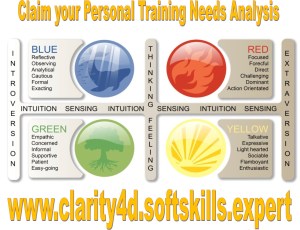
Claim your personal training need analysis

Resources and information are hoarded, and communication is sporadic and formalistic. You’re the one who tolerates or challenges narrow self-interest, big egos, and dominant personalities. Most of the work of educating a team happens in group settings, which may require that you change the way you lead. You can’t just work with your direct reports one to one, setting their budgets and goals in private and coaching them individually as you shift your attention from one part of the business to another. You have to help the group create a picture of the total business and correct any disruptive behaviors in the presence of the team, so you need the emotional strength to direct and stand up to powerful individuals on whom you depend on.

Many leaders think molding a team isn’t worth the effort, but they’re missing a tremendous opportunity to differentiate themselves and build the business. The more people can see the entire anatomy of the company, the team, each and the intersections of its moving parts, along with the broader context in which it operates, the better job they do. When they all see the same facts, discuss their observations and thoughts, and come to understand the interconnectedness of their functions and skills, they’re able to raise the bar, setting higher goals and achieving them faster

So how do you map out your teams strength and weakness and put them all to a positive use in a matter of days?  Clarity4d Profile and Team Profiling solution is designed to give strategies for communicating with people with different personality preferences.

SHAPING A COMMON VIEW OF THE TOTAL BUSINESS

A team of leaders starts being molded when everyone is on the same page. To be on the same page, you first need to understand more about yourself and know more about how others see you.  Once you have identified how personal influence can be enhanced by meeting the needs of others, the team can then move towards getting on the same page.  The key is to develop an internal team dialogue in which each member contributes to the discussion that shapes the team’s collective view of the business— its challenges and opportunities and the resources available. Getting on the same page tests the cognitive bandwidth of not only each member of the team but the team as a whole. Once drawn, however, the conventional picture channels the team’s energy and, more important, provides a reference point for future dialogue as the team members influence and are influenced by their colleagues. The stage is set for collaboration.

FEEDBACK BREEDS BETTER COLLABORATION

Contact us for a Consultation 0203 551 2621

Keep a mental inventory of the skills and methods for getting things done for each member of your team. One team member may be too blunt in arguing a point with others, another may be too shy to participate in debate, and yet another may have a habit of holding back information essential to reaching a good decision. All these impediments to effective teamwork must be clearly identified to the individual, and he or she must be counseled in overcoming them.

Feedback is most effective when given in written form and given frequently, but human beings typically can change only one or two behaviors at a time.

Most people don’t like to give feedback, but they have to look at it from the proper perspective.

Feedback says you’re committed to someone’s development.

Higher performers want to know how to get better, and the only way to achieve this is share numbers, reasoning, and results to share a single view of the business and its context. Having the intellectual courage to confront behaviors that harm the team’s effectiveness. Anticipate, surface, and resolve conflicts. Pick the right people. Provide prompt feedback and coaching. Recognise and avoid derailers.

Having all the right people and great processes isn’t enough. You also have to have the right behaviours and to get the right behaviour people need to understand more about team member’s preferences.

Everything we’ve covered so far needs to be translated into results. The first and most critical step in execution is choosing the right goals. This is where the buck starts. Many leaders are conceptual, high-level intuitive thinkers, this matters because understanding the other variable such as Sensing v Intuition,  Thinking v Feeling thinkers and Introversion thinking v Extroversion thinking can misalign people’s energy within a team.

ARE THE EIGHT KNOW-HOWS BURIED IN YOUR TEAM?
  • Positioning and Repositioning: Finding a central idea for the business that meets customer demands and that makes money.
  • Pinpointing External Change: Detecting patterns in a complex world to put the company on the offensive.
  • Leading the Social System: Getting the right people together with the right behaviors and the right information to make better, faster decisions and achieve business results.
  • Judging People: Calibrating people based on their actions, decisions, and behaviors and matching them to the non-negotiables of the job.
  • Molding a Team: Getting highly competent, high-ego leaders to coordinate seamlessly.
  • Setting Goals: Determining the set of goals that balances what the business can become with what it can realistically achieve.
  • Setting Laser-Sharp Priorities: Defining the path and aligning resources, actions, and energy to accomplish the goals.
  • Dealing with Forces Beyond the Market: Anticipating and responding to societal pressures you don’t control but that can affect your business.

DO YOU KNOW WHO’S PERSONAL TRAITS THAT CAN HELP OR INTERFERE WITH THE KNOW-HOWS IN YOUR TEAM?

  • Ambition—to accomplish something noteworthy BUT NOT win at all costs.
  • Drive and Tenacity—to search, persist, and follow through BUT NOT hold on too long.
  • Self-confidence—to overcome the fear of failure, fear of response, or the need to be liked and use power judiciously BUT NOT become arrogant and narcissistic.
  • Psychological Openness—to be receptive to new and different ideas AND NOT shut other people down.
  • Realism—to see what can actually be accomplished AND NOT gloss over problems or assume the worst.
  • Appetite for Learning—to continue to grow and improve the know-hows AND NOT repeat the same mistakes.

DO YOU KNOW WHO’S HAS THE COGNITIVE TRAITS IN YOUR TEAM THAT COULD IMPROVE THE KNOW-HOWS?

  • A Wide Range of Altitudes—to transition from the conceptual to the specific.
  • A Broad Cognitive Bandwidth—to take in a broad range of input and see the big picture. Ability to Reframe—to see things from different perspectives.

It can get really complicated, but with Clarity4D’s Profiling tools and range of workshops you will find your team members around the world, at home, school or socially easier to communicate with as you become clearer on how you can tend to their preference whilst appreciated your.

Try this simple questionnaire and we will send back your profile report.  We will then explore how it can be used in a team environment. Click here to start the journey to better team building.

http://www.clarity4d.softskills.expert

2 Tips on How To Put Optimism Into Practice On a Daily Basis

Practice being Optimistic each day

Practice being Optimistic each day

Can Optimism be taught?

Being optimistic does not mean forcing yourself to become persuaded that you should always look on the bright side of things. Becoming optimistic is something you can learn. It is a state of mind that is not so hard to assimilate, one that enables you to live quickly the life you want to live.

Optimism is a state of mind

Optimism is a concept that is often poorly explained. Having a high state of mind does not mean that you reject reality because you want everything to be rosy. It means that you can tackle any situation with a state of mind that gives you every chance to take advantage of it or to turn situations around in your favor if you need to.

People often think human beings are either optimistic or pessimistic by nature and that there is nothing we can do about it. This is specifically a cynical way of seeing things! Unfortunately, people often dwell on this incorrect observation.

There are obviously optimistic people. Admittedly, they have an advantage over others, but it does not mean that pessimistic people are destined to remain bleak.

Being optimistic, in a general manner, means that there is a way out of every situation, but it will only show if you do your best, so events turn in your favor.

Being optimistic is not a mere vision of life according to which everybody is good and that all is for the best in the best of all possible worlds, one that consists in denying reality – which often refutes this idyllic point of view.

Being optimistic requires first of all that you be realistic and accept the world as it is: that is, with its positive and negative aspects.

Likewise, you can’t say that people are inherently good because some are, while others are not.

In fact, the truth is more subtle than that because these two tendencies do reside in every one of us. Life consists in expressing our qualities for our own sake but also for that of our dear and near ones or humankind.

To become optimistic, you, first of all, have to be realistic and accept the ambivalence of this world and human beings – they can both be good and bad in turns. The second step is to take action by counting on favorable outcomes to arrive and hoping that the people you’ll meet will adopt a positive attitude. Seeing things this way is fundamental.

First of all, know that, if you are not optimistic by nature, as described in the definition above, you will need some time before you naturally become confident at being optimistic. So, summon your patience. But you may not have to wait for too long if you apply the advice you will find below.

Here is how to bolster your optimism or become optimistic. You may be confronted with two cases:

1.    You have already gone through a situation that did not turn in your favor:

– Do not feel guilty for this failure learn from the experience so you can deal with such a case differently next time.
– Approach the situation in question from a different perspective by visualizing it turning out in your favor and doing what you can so it turns in your favor.

2.    If a situation is unprecedented for you:

–    In this case, it is even easier: approach the situation by visualizing it turning out in your favor and by doing everything you can so things go your way!

These two ways of acting is a learning process which will gradually become second nature to you, helping you to earn one success after another.

Looking for a short course? why not tray five short courses and learn on the move. http://www.crashcourses.academy 

Chunking information as a learning strategy: Micro Learning by Diane Shawe

article by Diane Shawe M.Ed

One of my educational heroes is George A. Miller[1], a Princeton professor who died a few years ago. Miller is considered one of the greats of twentieth-century psychology. I often quote Miller’s law (for those who have heard me speak it is about a toaster that talks) and am struck by his effect on modern learning. At AVPT Short Courses ltd, we are proud that we can deliver very high quality online learning in days rather than years.

The courses are accessible by using tablets, ipads, smart phones and laptops and works on the principle of chunking up material into bite size micro content.  This aide’s memory, improves recall and the  ability to learn rapidly. So what is the science of chunking?

‘Chunking’ refers to organising or grouping separate pieces of information together. When information is ‘chunked’ into groups, you can remember the information easier by remembering the groups as opposed to each piece of information separately. The types of groups can also act as a cue to help you remember what is in each group. Chunking, in psychology, is a phenomenon whereby individuals group responses when performing a memory task. Tests where individuals can demonstrate “chunking” commonly include serial and free recall tasks. All three tasks require the individual to reproduce items that he or she had previously been instructed to study.

There are several ways to chunk information. Chunking techniques include grouping, finding patterns, and organising. The technique you use to chunk will depend on the information you are chunking. Sometimes more than one technique will be possible but with some practice and insight it will be possible to determine which technique will work best for you.

You can organise information into groups arbitrarily. For example if you have to remember a 10 digit number you can group it into pairs of numbers and remember 5 two digit numbers.

Another way to chunk information is by finding patterns in the information. When you find a pattern in information you just need to remember the pattern rather than a list of separate pieces of information. For example, if you have to remember the letter sequence ADGJMPSVY you may notice that these letters are just every third letter of the alphabet. So instead of remembering each individual letter, you can just remember the pattern used to find these letters.

Another chunking technique involves organising the information based on its meaning. For example, let’s say you have to memorise the age of everyone in a group of people. You can chunk the information by organising people by their age, then, for each age group, remember the people that belong to that group.

Chunking information can also help overcome some of the limitations of short term memory. We can generally only have 7 plus or minus 2 things in our short term memory at a time. However, by chunking information we can remember more. For example, if you have to commit a list of 11 numbers to your short term memory you likely won’t be able to. However, by grouping the numbers into chunks, you will greatly increase your chances of doing it.

The word ‘’chunking’’ is from a 1956 paper by my hero George Miller, The Magical Number Seven, Plus or Minus Two: Some Limits on our Capacity for Processing Information[2]. At a time when information theory was beginning to be applied in psychology, Miller observed that some human cognitive tasks fit the model of a “channel capacity,” characterised by a roughly constant capacity in bits, but short-term memory did not. A variety of studies could be summarised by saying that short-term memory had a capacity of about “seven plus-or-minus two” chunks.

Miller wrote that “With binary items the span is about nine and, although it drops to about five with monosyllabic English words, the difference is far less than the hypothesis of constant information would require. The span of immediate memory seems to be almost independent of the number of bits per chunk, at least over the range that has been examined to date.” Miller acknowledged that “we are not very definite about what constitutes a chunk of information.” Miller noted that according to this theory, it should be possible to effectively increase short-term memory for low-information-content items by mentally recoding them into a smaller number of high-information-content items. “It is a little dramatic to watch a person get 40 binary digits in a row and then repeat them back without error. However, if you think of this merely as a mnemonic trick for extending the memory span, you will miss the more important point that is implicit in nearly all such mnemonic devices. The point is that recoding is an extremely powerful weapon for increasing the amount of information that we can deal with.”

Using this as a basis, AVPT Short courses is committed to micro content and the chunking methodology to take out the traditional rote learning styles and avoiding large tracts of materials, making them more accessible and improving learning results. As a result of Miller’s work we can justifiably claim that achieve learning in days, not years. Thanks George!


[1] George Armitage Miller  died o July 22, 2012. He was one of the founders of cognitive psychology.  He also made seminal contributions to psycholinguistics and cognitive science in general. He authored several books and directed the development of WordNet, an online word-linkage database usable by computer programs. He authored the paper, “The Magical Number Seven, Plus or Minus Two,” which experimentally discovered an average limit of seven for human short-term memory capacity.

[2] Miller, G.A. (1956), The Magical Number Seven, Plus or Minus Two: Some Limits on our Capacity for Processing Information. Psychological Review, 63, 81-97.

Get qualified whist on the move

Get qualified whist on the move