Category Archives: micro teaching

How answering 77 questions could help you avoid business failure

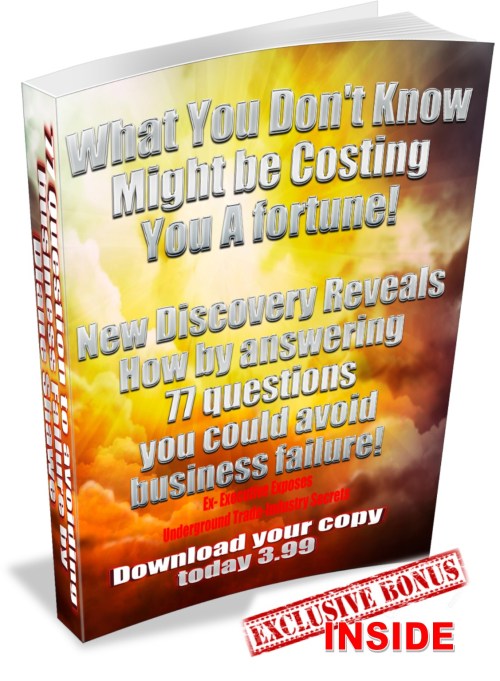
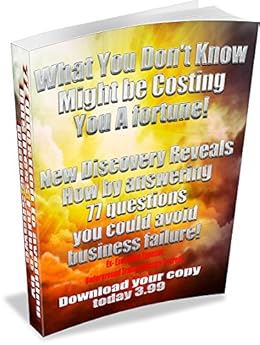
Out Now: 77 Ways to avoid Potential Business Failure77 Questions to avoid business failure by Diane Shawe white background

“Your work is going to fill a large part of your life, and the only way to be truly satisfied is to do what you believe is great work. And the only way to do great work is to love what you do.” –Steve Jobs, co-founder of Apple

Like you I Never Thought I Could answer 77 questions that would help me  avoid business failure  – But I Finally Discovered The Secret! Here’s How…

article by Diane Shawe Author

Are you ready? Is Entrepreneurship For You?
Are you the right person for your business idea?

In business, there are no guarantees. There is simply no way to eliminate all the risks associated with starting a small business – but you can improve your chances of success with good planning, preparation, and insight. Start by evaluating your strengths and weaknesses as a potential owner and manager of a small business. Carefully consider each of the following questions.

  • Are you a self-starter? It will be entirely up to you to develop projects, organise your time, and follow through on details.
  • How well do you get along with different personalities? Business owners need to develop working relationships with a variety of people including customers, vendors, staff, bankers, and professionals such as lawyers, accountants or consultants. Can you deal with a demanding client, an unreliable vendor, or a cranky receptionist if your business interests demand it?
  • How good are you at making decisions? Small business owners are required to make decisions constantly – often quickly, independently, and under pressure.
  • Do you have the physical and emotional stamina to run a business? Business ownership can be exciting, but it’s also a lot of work. Can you face six or seven 12-­hour work days every week?
  • How well do you plan and organise? Research indicates that poor planning is responsible for most business failures. Good organisation ­ of financials, inventory, schedules, and production ­ can help you avoid many pitfalls.
  • Is your drive strong enough? Running a business can wear you down emotionally. Some business owners burn out quickly from having to carry all the responsibility for the success of their business on their own shoulders. Strong motivation will help you survive slowdowns and periods of burnout.
  • How will the business affect your family? The first few years of business start­up can be hard on family life. It’s important for family members to know what to expect and for you to be able to trust that they will support you during this time. There also may be financial difficulties until the business becomes profitable, which could take months or years. You may have to adjust to a lower standard of living or put family assets at risk in the short-term.

So Before you start – Do you know the answer to these 77 questions?  Download your copy today it will be the best £3.99 you spend? 

I recommend you get a little notebook and start working on each question. For those you cannot answer, find the answer and make a note.  This is also an invaluabe excercise if you are already in business, it can help you clarify where you are today and help you plot where you need to get too and how to do it.

Get your exclusive copy today and save £3.00

Get your exclusive copy today and save £3.00


If you want to find out if you are right for your business, we have a surprise link hidden inside this little ebook.  All you have to do is Answer 10 questions and we will send you a full report which will also include your Personal Training Needs Analysis to develop your Entrepreneur skills.

Diane Shawe Author of 77 Question to avoid business failure Available from Amazon

Diane Shawe Author of 77 Question to avoid business failure Available from Amazon

Are you focused, productive, transactional or inspirational? by Diane Shawe

shortcourses expert bannerBeing busy isn’t the same as being productive, but how do you assess what you need to do to improve both your productivity and your staff?

Would an online Personal Training Need Analysis that takes about 10 minutes help?

Then  CLICK HERE TO TRY ONE FREE Personal Training Needs Analysis and in as little as two hours you can judge for yourself if it would be of use in your business.

Would it help if you could find out how to get the best out of your employees?

Would it help to be able to speed up Pre-Interview selections, Staff Appraisals, Training Needs, Personal Development, Management Selection, Team building and any of those otherwise expensive long winded, time consuming and expensive process?

Well click on our complimentary link to see how it works, I promise you will not be disappointed.

What most people, employers, entrepreneurs and even some educational institutions do not have in today’s current environment is time, the necessary resources and the infrastructure they need to support and achieve learning objectives cost effectively.

Out with the Old in with the new but who is going to be ready at the ‘Start Line’ with all the right tools to assist with the new Continued Competences?

We can offer a person centric online Personal Training Needs analysis tools and  reports to aid in the development of any individuals or organisations growth. The profiles and learning programmes are designed to help reduce risk and to create action and results.  Goal setting is no good without implementation.

We invite you with our compliments to click and complete 10 simple questions and we will send you back a report so that you can see how it works and give us your feedback.

In order to better identify and appraise an individual to pinpoint specific training needs, the Speed of Implementation and adaption to change will confirm who gets ahead or sustain growth by using technology to help with self appraisal, self reflection and personal development.

However, the new skill set or competencies, aims to define the standards needed to enter, compete and remain in the profession which mainly comprise of the following:

  1. Ethics, professionalism and judgment;
  2. Financial Literacy and Technical ability;
  3. Managing yourself and your work;
  4. Working with other people.

That said, in order to meet these new core competencies, individuals and organisations will be required to undergo a process of self-reflection through a high-level Personal Training learning needs analysis to identify their own learning gaps; as well as identify gaps specific to those needed by the organisation they work with. Ideally, this process will be recorded and accompanied by an evaluation of the success of the learning completed and ultimately, organisations will be required to make an annual declaration that they have considered and taken action to address Point of Need training.

We look forward to your feedback once you get your free report back and then maybe we can discuss the speed of implementing this process throughout your business or consulting services.

Just click here now and in just 10 minutes you would have completed 10 questions and we will send you back the results.


Why strategies for modernising corporate learning should focus on learning outcome cover by diane shawe


“The only thing worse than training people and having them leave, is not training them and having them stay”


What do we do..

We specialise in resourcing short courses via a pre-populated LMS solution for Point of Need Training via mobile devices so that all different levels of staff can access training whilst on the move using their own device supported by one off our virtual tutors to help them complete their online 4 weeks course.

12 Do’s and Don’t Tips For Getting And Keeping High-Net Worth-Clients by Diane Shawe

Hair Extension and Makep masterclasses Diane ShaweThere are just over 500,000 millionaire households in Britain, more than in any other European country but fewer than in China, Japan and of course the US.

article by Diane Shawe M.Ed and Eryca Freemantle

As for billionaires, the UK has 1,044 and is second only to the US, though as we all know most of those billionaires are people who made their money elsewhere and then moved to the UK, rather than the home-grown variety.

Worldwide there were 16.3m millionaire households at the end of last year, up from 13.7m at the end of 2012.

Those are three of the conclusions from the latest study by Boston Consulting Group of global wealth – it does it every year and 2013 was notable as the rich got quite a lot richer.

Total global private wealth grew by 14.6 per cent to reach $152bn, the two main drivers being the rise in equity markets and the continuing strong economic growth in the emerging world. The region in which wealth grew fastest, unsurprisingly, was the Asia-Pacific. Since the financial crisis China has passed both Germany and Japan in terms of total household wealth.

So with all that pool of statistics, how do you go about bagging a High Networth Client and keeping them?

  1. Do work at Knowing the trends and your product.When selling a product or service to an athlete or celebrity, it’s all about referrals. You won’t get far going directly to the client, Instead, you need to build relationships with trusted sources of the client. For example, find a way to connect with an agent or financial advisor. If you can get these people sold on you, you have a much better chance of getting a referral.
  2. Don’t Scream – No need to scream. Stay cool, calm and collected. After all, they are human.
  3. Do learn to get around the gatekeeper.To approach a client’s trusted sources, you have to find a way in. Social media makes it easier than ever to find connections, but the power of the phone is still the better route, but you need to plan what your going to offer. Remember the gatekeeper can also get bombarded by lots of enquiries every day on social media so be smarter and look at how you can develop  point 7
  4. Don’t say “OMG” – Some people say “Oh my God” to everything, you sound juvenile
  5. Do try and beat the receptionist to the office. A little clever secrets is to make early morning phone calls, before the office opens. If the company has a dial-by-name directory, you can often catch the person you want to reach at their desk, especially if their name is on the door. You’d be amazed at who picks up the phone at 5:30 a.m.”
  6. Don’t Stare: Its rude and frightening
  7. Do try to stand out.When you’re selling a commodity such as makeup, you’re working with the same inventory as every other artist. That means your value comes from standing out.No matter what your industry, work on developing your qualifications and personality, Have an excellent commitment to client, and find a niche and exploit it.
  8. Do not ever say – “I love You” Do you know how silly you sound?  They will no doubt think your crazy
  9. Do say a memorable ‘thank you.’ Often people do things prior to selling to be remembered, but often when you get the sale, doing a memorable thank you can result in other referrals coming your way.
  10. Don’t take Photos –  Do not take photos of them while working on them without asking their permission
  11. Do have a higher mission.It’s not always about making money just to pay your bills, giving back can also encourage high net worth clients feel good about working with you and support any project that is dear to your heart and help people or animals around the world.
  12. Don’t Cry – Professionals do not cry on the job- especially for nothing
Want to learn how to earn £4000 a month?

Want to learn how to earn £4000 a month?

Creating a Win Win situation is not just about Selling

Negotiations outside the box

Negotiations outside the box

Keeping an Open Mind

article by Diane Shawe M.Ed

Have you ever started working on a project and had someone come along with an idea you never thought of that made the project much better? Perhaps it sped up the process, gave it much more depth or meaning, or led to a richer result in some way.

If you were closed-minded about the project, you would not have even noticed that someone came to you with a better suggestion. Being open-minded, however, allowed you to recognise the value and merit of someone else’s ideas, and voila! Things worked out much better than you had ever imagined.

When you apply open-mindedness to negotiating, it helps to support your flexible and adaptable nature. For example, perhaps you set your mind to negotiate the best price you can, but your counterpart approaches you with a better price than you had imagined as your benchmark. If you are open-minded, you hear what your counterpart proposes. If you are closed-minded, you are so focused on the outcome that you might not hear what they offer at all, and you may actually negotiate yourself a weaker deal.

Not every negotiation is about reaching a win-win solution. Sometimes, not everyone can win. For example, when an organization is preparing to downsize, the employees may be looking for the most benefit they can get, but they know that they will not have a job in the end. In collaborative negotiations, your real objective is to reach the best possible result for all parties. This might include some compromise, and should always involve working toward relationships.

Long Term and Short Term Relationships

CPD FrameworkWhen you consider relationships in negotiating, the length of the relationship is very important. If you are negotiating with someone that you will never see again, and with whom you have no investment, go ahead and put everything on the table. This would be the case if you were bargaining about a one-time purchase (such as furniture or a television from a commission based salesman, for example). In many cases, however, you may be looking at a much longer-term relationship. In the case of labour negotiations, many unions have strong negotiators who work with them for many years.

The union negotiators are skilled professionals, and they may approach your meetings very confident that they, themselves, will be around much longer than the current group of managers and negotiators that the employer has. If you are an employer negotiator, you will want to consider the long-term effects of the relationship that you foster, as well as the specific terms that are agreed upon. Expect, for example, that if you are currently negotiating wage or benefit rollbacks, the union is going to be very resistant, and that if you are successful in negotiating those reductions, the union is going to negotiate their reinstatement at the next round.

Labour negotiations are about long-term relationships. Consider also that the terms that you bring up in this kind of negotiation will have a long lasting effect on the company and its employees. The union knows this too, and that it is important to realise that the negotiations are a part of a long-term relationship that can be strengthened or damaged by the results of the negotiations that you are taking part in.

When you are thinking in terms of relationships, be ready to leave some items on the table. That means that some items that you thought were important may not be considered in this round of negotiations. This is one of the times when detaching yourself from the outcome is important; there will be other opportunities to work with this contract or similar ones again, and those may be the times that you will be able to bring those other items to the fore.

Go back

Your message has been sent

Warning
Warning
Warning
Warning

Warning.

branding-mindfeed-ebook-by-diane-shawe
About the Author

Diane Shawe is a speaker, trainer, mentor, consultant, entrepreneur and author with 15 published titles on Amazon.   With more than 25 years of experience. She has personally trained over 2800 people around the world in a variety of fields and has published a number of works. She has contributed to over 100 Kiva Entrepreneur’s around the world.

She was also one of the producers of a Day time Ladies Talk Show in 2015 and Host of one of the UK’s best loved Annual Hair Extensions Awards.

Diane also enjoys oil painting, sailing and clay pigeon shooting. She focuses on topics that she is passionate about in her writing and has attracted over 36,000 followers on her popular blog.

Media Contact
Company Name: AVPT Short Courses
Contact Person: Diane Shawe MEd
Email: Send Email
Phone: +44 208 1333120
City: London
Country: United Kingdom
Blog Website: http://www.academyexpresscourses.com
Training http://www.hairextensionstraining.academy

Diane Shawe’s eBooks are available on Amazon right now at: https://www.amazon.com/Diane-Shawe/e/B0052WG8V6

Diane Shawe Social media links http://www.phollo.me.com/expresscourses


How can prisoners improve if the internal educational system fails them? by Diane Shawe

Michael Gove short courses expert blogPrison education must improve, Michael Gove says, failures were “indefensible”

article by Diane Shawe

Education in prisons must be overhauled in order to tackle a “persistent failure to reduce re-offending”, the justice secretary is to say. Michael Gove stressed in a speech that helping prisoners become literate and numerate makes them “employable”.

Diane Shawe states “The only thing worse than training prisoners and having them stay, is not training them and having them leave”

Whilst the Prison Governors Association welcomed the proposals, as usally after making no practical contribution to change in terms of prisons education,  raised concerns about how changes would work in practice.

Earlier this week, chief inspector of prisons Nick Hardwick said the government’s “rehabilitation revolution”, launched five years ago at the outset of the coalition, had not even started.

He said in his last annual report that prisons were in their worst state for a decade and some jails were “places of violence, squalor and idleness”.

Prison education, work and re-offending

  • £145m spent every year in England and Wales on prison education
  • 95,300 offenders over 18 were in education in 2013/14
  • Almost half of adult prisoners re-offend within one year of their release
  • 60% re-offend if they serve sentences of less than a year
  • Two-thirds of offenders under 18 re-offend within twelve months of release

In his first speech on the issue since being appointed as justice secretary in May, Mr Gove is expected to say that society is collectively to blame for the failure to “redeem and rehabilitate” offenders, and he will call for an end to the “idleness and futility” of prison life.

The justice secretary says he wants to look at “earned release” for offenders who are committed to education and gain qualifications that are respected by employers.

prisons reoffending and education by diane shaweIf prisons moved to such a system, it would be a major change from the current policy under which most prisoners are automatically released on licence at the halfway point of their sentence.

Juliet Lyon, director of the Prison Reform Trust, said: “The challenge now is to translate this marked new reflective tone set by the Justice Secretary into sensible policy and to create a just, humane and effective penal system.”

Educating prisoners can turn them into “contributors to society”

“No government serious about building one nation, no minister concerned with greater social justice, can be anything other than horrified by our persistent failure to reduce re-offending,” Mr Gove is expected to say at the event in London, hosted by the Prisoner Learning Alliance.

“In prisons there is a – literally – captive population whose inability to read properly or master basic mathematics makes them prime candidates for re-offending.

“Ensuring those offenders become literate and numerate makes them employable and thus contributors to society, not a problem for our communities.

Diane Shawe CEO of Express Training Courses (AVPT short courses Ltd) is concerned that once again emphasis is placed on numeracy and literacy which failed most of them at school and not enough critical thinking is placed on providing life skills and soft skills.

Gove states “The failure to teach our prisoners a proper lesson is indefensible. I fear the reason for that is, as things stand, we do not have the right incentives for prisoners to learn or for prison staff to prioritise education. And that’s got to change.”

Mr Gove is also expected to use the speech to propose giving governors more control and rewarding them if offenders do well.

He will say that one of the “biggest brakes on progress” in all prisons is the “lack of operational autonomy and genuine independence enjoyed by governors” – who are often set very tight criteria on how prison life should be managed.

“Yet we know from other public services – from the success of foundation hospitals and academy schools – that operational freedom for good professionals drives innovation and improvement. So we should explore how to give governors greater freedom – and one of the areas ripest for innovation must be prison education.”

It is about time we had some proper joined up thinking, Gove as usual like to deal with the problem straight on whilst some around him loves to keep the mother of all restriction and red tap rolling even when they can see there is no progress.

What do we do..

We specialise in resourcing short courses via a pre-populated LMS solution for Point of Need Training via mobile devices so that all different levels of student can access training whilst on the move using their own device supported by one off our virtual tutors to help them complete their online 4 weeks course. We also specials is short intense classroom style training with student manuals and supportive adult educational material for Learning by Doing in a range of Soft Skills courses.

Source: http://www.bbc.co.uk/news/uk-33554573  17th June 2015

Is you mobile phone germ free?

Mucky mobile: Your phone could carry 10 times as many bugs as a lavatory seat

Next time you use you mobile phone, you might want to give it a little clean.

Researchers have discovered there are more bacteria on the average mobile than you will find in a toilet seat! Experts said the reason is that phones are often passed between people which spreads the germs around – but they are never cleaned which means the diseases keep on building up.

So when did you last clean your mobile phone on your sleeves or on your skirt?

Previous research has found that other things we assume are clean are in reality rather disgusting.

Keep germs at bay this winter

Keep germs at bay this winter

British scientists discovered that cash machines have similar levels of pseudomonads and bacillus, bacterias which are known to cause sickness and diarrhoea, as they found in public toilets.

Computer keyboards are also five times dirtier than the average lavatory seat.

Researchers from Which? swabbed 33 keyboards for food poisoning bugs e.coli, coliforms, staphylococcus aureus and enterobacteria and found four were a potential health hazard.

One was even ‘condemned’ because it was so infectious.

Remote controllers have also long been known as the grubbiest item in hotel rooms as they are never wiped down.
Read more: http://www.dailymail.co.uk/health/article-2196365/Mobile-phones-ger…

Diane Shawe launches online mentoring call preparation form for business startups

mentoring by diane shaweDiane Shawe’s passion for turning dreams into realities has been launching her clients beyond their limitations and into the lives they truly deserve since 2003.

She provides the benefits of mentoring through a number of career planning workshops and online mentor programs globally accredited by IAO

Because we are all busy people, once again Diane believes that technology can help bring about a better lever of convenience and speed to getting constructive assistance.  You can visit www.get.mentoring.dianeshawe.info to start the process or you can click here to complete your Call preparation and request form.

Since establishing her business through AVPT Diane has been committed to offering the benefits of mentoring to individuals and organisations and helping them overcome the range of challenges they face. By continually adding to her vast scope of knowledge, qualifications and experience her clients have been able to enjoy the workable tools she offers that lead to their desired personal and professional success.

Get mentoring with diane shawe business start up loans
Whether you’re looking to add structure to your career planning, provide your workers with professional training in areas such as conflict resolution, time management, and leadership skills you’ll appreciate the confidential, professional and friendly way all her materials are delivered. Diane’s holistic approach to making a positive difference has seen her broadening her scope of influence while giving back to philanthropic organisations such as the Kensington Chelsea and Business Club, Pink Shoe and Nexters.

Diane’s membership to some of the more prestigious bodies such as the Institute of Directors, Chartered Management Institute, Solicitors Regulation Authority and International Accreditation Organisation offers you the utmost peace of mind. As they’re member regulated by lawyers, CEOs and directors both in the private and public sectors you can rest assured that you’ll be enjoying approaches that have been proven to bring about success.

Over the year Diane has been passionate about supporting individuals around the world to become independant.

She is now proud to show you all how she have been able to support all types of people around the world via Kiva to help start or expand their business.

I have now supported over 96 loans in 37 countries and you can see them all by clicking here.

View copy Diane Shawe Draft-Mentoring-Contract

If all the unemployed formed a country it would be the fifth largest in the world. Why does this matter?

Getting the world back to work with skills we can trust

Getting the world back to work with skills we can trust

Why the grip held by outdated educational institutions based on historical prestige needs to take a back seat and become student centric!

Article by Diane Shawe M.Ed

If we hadn’t had the most recent global economical crisis and the unrest in certain war torn regions had not occurred, there might have been 62 million more jobs in the world today, according to the International Labor Organisation as it is, there are over 200 million people looking for work across the globe.

To add to our worries: 75 million of these are young people, eager to take that first firm foothold in the ladder of success. We cannot allow them to become a “lost” generation.

The Great Recession has been particularly hard on older workers also, who have had difficulty finding new jobs after being unemployed for long spells. This is especially troubling because of their pressing needs for health care and retirement preparation.

It is also doubtful that the long-term unemployed are going to become more effective jobseekers simply by being forced to visit a Job centre daily if indeed they have a job centre in some parts of the world. But I am going to site that back in 1996, when the Jobseeker’s Allowance was introduced, the requirement to visit a Job centre every two weeks and provide detailed evidence of active job search did not raise overall job search effort among the unemployed.

If explicit job search requirements were not effective in a period of rapidly growing labour demand and falling unemployment, there is no good reason to expect them to be effective in the aftermath of a severe recession and one cannot certainly make a claim to recovery based on one geographical location sprinkled with opportunities driven by technology and property prices.

So clearly, jobs must be a preeminent priority in the years ahead. The major test of the new technological era is simple: can it provide decent livelihoods for all people?

Technology and rising inequality feeds into a broader concern: Technological advance creates a small cohort of big winners, leaving everybody else behind.

Certainly, those with the lowest skills are having the toughest time in today’s economy.

And yet, we also need to discuss what kind of growth this “right track” leads to. Will it be solid, sustainable, and balanced—or will it be fragile, erratic, and unbalanced?

To answer this question, we need to look at the patterns of economic activity in the years ahead, and especially the role of education, technology and innovation in driving us forward.

As Isaac Asimov—a master of science fiction literature—once said: “No sensible decision can be made any longer without taking into account not only the world as it is, but the world as it will be.” Isaac Asimov

So I have chosen a big topic and what I want to address in my blog today, in the form of three questions:

1. First, what does this new technological era mean for the economy, especially for jobs?

2. Second, how does it relate to one of the scourges of our age—rising inequality?

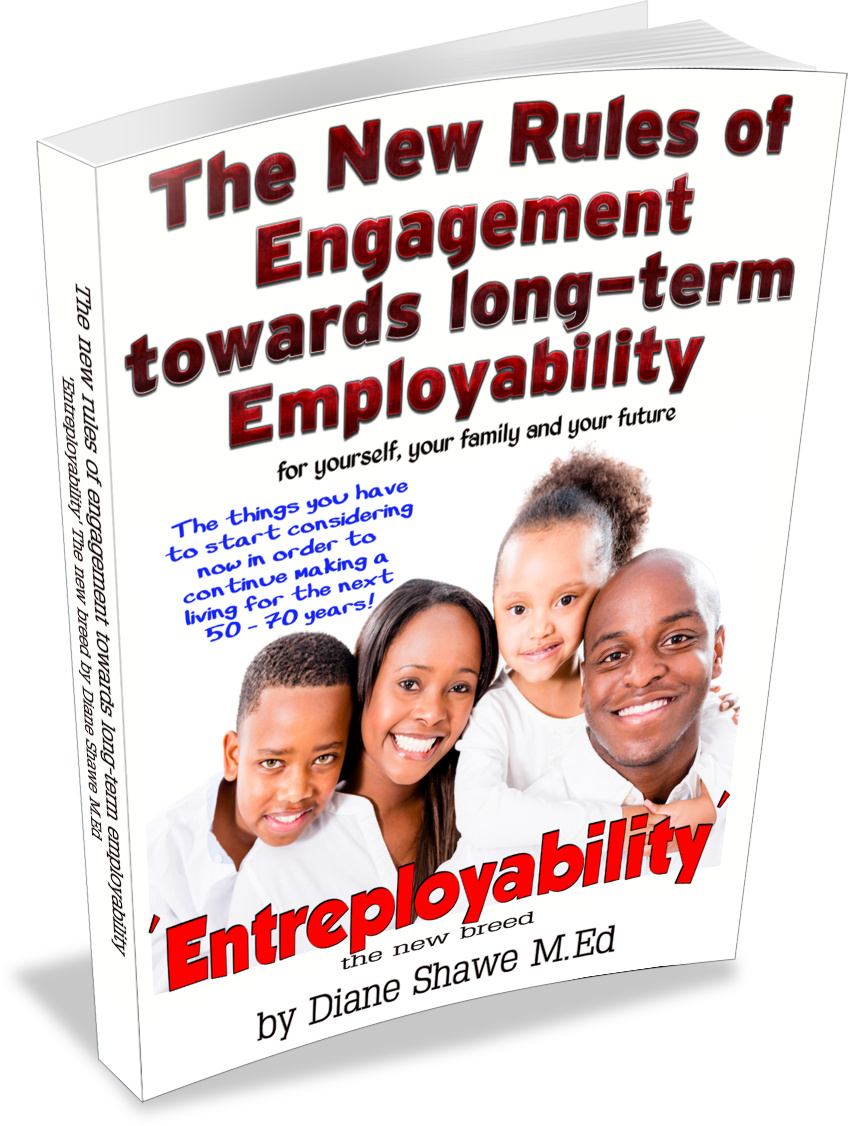
3. Third, what about some solutions, including vocational education and what I refer to as the growing need to foster a new thinking around “Entreployability”

The Interlinkages between Technology and the economy

Innovation is pushing ahead at warp speed. We are certainly living through one of the most exciting periods in human history. The pace of change is so fast that even the technology of five years ago seems prehistoric.

Those of you who are students probably do not even remember a time when phones were not smart, when cameras contained film, when texts meant school books, and when wireless was a word used for old-fashioned radio!

This advance is centered on the rise of a global digital network—the “hyperconnected world”—combined with the rise of genuine machine intelligence. Today’s smart phones are more powerful than yesterday’s supercomputers. We see cars driving themselves, printers making complicated three-dimensional parts, and robots doing the most complex tasks. “Science fiction” is rapidly becoming “science fact”.

What does this all mean for our lives and livelihoods, for our common economic future?

If the previous revolutions were about using machines for brawn, this is about using machines for brains. And since technology is powering a giant leap in global interconnectivity, these are “connected” brains! Just look at some of the trends.

Certainly, we can see some worrying trends. For a start, the effects of new machine technology are not showing up in productivity statistics—at least not yet—and productivity is by far the most important driver of long-term economic growth.

Now I am not an expert on the Economy, but we are all touched by it and using common sense I for one can see that there is a looming problem. For instance one of the biggest worries is how technological innovation affects jobs put simply will machines leave even more workers behind?

You may not want to give this a second glance but even seasoned professionals can find themselves cast adrift on an unfamiliar ocean.

Rising inequality

My second point about rising inequalities is going to be brief. But here’s a little statistic for you to consider. According to Oxfam, almost half the world’s wealth is owned by one percent of the population and, stunningly, the bottom half of the world’s population owns the same as the richest 85 people in the world.

What is causing such a convulsion in the distribution of income? There is no single factor here, although it seems clear that technology is one of the major factors—it can create huge rewards for the extraordinary visionaries at the top, and huge anxieties for the ordinary workers at the bottom. The speed at which information is sent around the world means that the average disgruntled people who make up the 5 largest country can amplify unrest as they all voice their fears to the small percentage of the world wealth holders.

What about some solutions?

So finally what is the purpose of education in today’s 21 Century, I quote Jane Stanford of Standford University — “with a “spirit of equality”. One of her goals for the university was “to resist the tendency to the stratification of society, by keeping open an avenue whereby the deserving and exceptional may rise through their own efforts from the lowest to the highest stations in life”.

What has happened? Why have these large institutions priced education out of these fundamental principles?

How can we make the new economic age enhance, rather than diminish, our humanity? How can we make this amazing innovation advance the prospects of all people?

It is clear that at the moment Educational systems are not keeping pace with changing technology and the ever-evolving world of work.

Not enough people are thinking strategically enough in this area. Fundamentally, we need to change what people learn, how people learn, when people learn, and even why people learn.

We must get beyond the traditional model of students sitting passively in classrooms, following instructions and memorising material. It is evident that computers can do that for us! A 21st century educational system must focus on the areas where humans can outclass computers—such as in cognitive skills, interpersonal skills, fine motor skills, or sophisticated coding skills. Maybe we need to remind ourselves of the purpose of education and vocational education. I summarise in my words the following:

The purpose of education

The first and foremost purpose of education is to educate and give everyone equal opportunity as a means to succeed in life. Education is a way of igniting and enlightening the thought of an individual.

It should help learners to discriminate between knowledge and ignorance, help to create a spark and create the sense of realisation with logic and a way to reason why the other things are illogical.

The purpose of vocational education

Every man must have a vocation – a trade, a business, or a profession – (if they are able too) in order to earn his livelihood so that they can support themselves, their family and people who cannot help themselves in our society. There are institutions for imparting various types of specialised training to help people qualify for this. The specialist is in demand everywhere, – in the office as well as in factories, in educational institutions and governments.

Conclusion.

The traditional belief that we must prepare ourselves to be ‘employable’ is under threat. The counter argument encourages us to ‘gear up’ for earning our own money, rather than seeing income as someone else’s responsibility.

With the population dramatically ageing and low-level jobs increasingly swallowed up by machinery, entrepreneurship will be a necessity for many, rather than a life-style choice for some.

SMEs are of course already leading this charge but in order to gear up for the future we need to start off by asking a serious question, defining criteria’s, and examining trends, impact these trends will have and plan a way to jointly prepare current and future generations to be both employable and entrepreneurial.

We are living in a new economy—powered by technology, fueled by information, and driven by knowledge. And we are entering the new century with opportunity on our side but huge problems that require new thinking.

The Question we should all ask ourselves?

Do you think you have another 20 – 30 years to live Yes [ ] No [ ]

Do you think you have another 30 – 50 years to live Yes [ ] No [ ]

Do you think you have another 50 – 70 years to live Yes [ ] No [ ]

Have you considered what you are going to do for the next 40- 70 years?

What will the job market look like in the next 20 years?

What will you be able to do to solve your problem which could be unemployment and patchy income streams?

What will you be able to do that will solve someone’s problem for which they will pay you a fee?

If computers might even replace our intelligence, they can never replace the capacities that make us truly human: our creativity and innovation, our passion.

So education must be the bridge between the present and future, the old and the new. But we must also build an enduring platform. By that I mean a new way of thinking about the global economy—the “new ©Entreployability the way forward.

Get your copy today from Amazon

This is helping an individual to develop their ‘©Entreployability assets’ which comprise of their knowledge (i.e. what they know), skills (what they do with what they know) and attitudes (how they do it).

To help them keep busy or at work; engaging their skills and attentions to employ themselves independently and maintain work.

To help them organise and manages their own business, contracts or employability.

To help them be available to be hired, provide them with a safe platform to encourage them to supply soft or hard skill for solving problems or being of service for which they will be paid by another party.

Making sure that the skill they have can be updated to help support them firstly, their family and community and economy.


Millions of grandparents expect to have to help fund their grandchildren through university

Grandparents up skill your grandchildren with a soft skills course

Grandparents up skill your grandchildren with a soft skills course

Millions of grandparents to fund grand children’s university education as students continue to struggle with high tuition fees

article by Diane Shawe M.Ed  AVPT

Due to the rising cost of tuition, it has been reported that grandparents are helping to bail out their family by contributing to the rising cost of education for their grandchildren.

Around one in eight over 55s think they will need to contribute to fees of around £9,000 a year, with many dipping into their savings to help out their grandchildren when they go onto higher education.

Researchers found as people got older more expected to make a contribution, 10 per cent of those aged between 55 and 64 planning to help with funding, which increased to 15 per cent for the over 65s.

Around 637,456 students applied to university in 2013, compared with 618,247 in 2012, which suggests people could be using their families to help them pay fees.

Accessing quality courses online and on the move

Accessing quality courses online and on the move

Ucas reveals 4% increase in the number of applicants to UK universities despite slight decline in number of 18-year-olds according to the Guardian’s report in  January 2014

The study of over 55s by Key Retirement Solutions found as many as one in eight grandparents – equivalent to 1.7 million over-55s – expect to have to pay towards their grand children’s university fees.

“The numbers of grandparents providing financial assistance for university tuition is set to rocket from current levels as the implications of the maximum £9,000 a year tuition fees become clear.

Young people from the worst-off areas in England are now almost twice as likely to apply to university as they were 10 years ago, according to the Ucas data.

But academics and policy experts said the buoyant figures masked some unhealthy trends, with wide gaps in participation and a worrying fall in the number of young men applying to university compared with women.

“With finances for the over-55s under strain from falling annuity rates and historically low savings rates taking on extra commitments requires careful thought and planning.”

Why online education will woo the person with the purse strings?

The higher-education model of lecturing, cramming and examination has barely changed for centuries. Now, three disruptive waves are threatening to upend established ways of teaching and learning.

Around the world demand for retraining and continuing education is soaring among workers of all ages. Globalization and automation have shrunk the number of jobs requiring a middling level of education. Those workers with the means to do so have sought more education, in an attempt to stay ahead of the labour-demand curve. In America, higher-education enrollment by students aged 35 or older rose by 314,000 in the 1990s, but by 899,000 in the 2000s.

So demand for education will grow. Who will meet it? Universities face a new competitor in the form of massive open online courses.
These digitally-delivered courses, which teach students via the web or tablet apps, have big advantages over their established rivals.

With low startup costs and powerful economies of scale, online courses dramatically lower the price of learning and widen access to it, by removing the need for students to be taught at set times or places.

This could eventually be the saving grace for lots of grandparents.

As one of the disruptive effects of the job market is the requirement for more people to develop and have doing skills, entrepreneur skills and all round communication skills, looking at short expert courses could be the best gift a grand parent or parent could give to their child.
AVPTGLOBAL almost 400 courses all globally accredited

AVPTGLOBAL almost 400 courses all globally accredited

Could you Access match funding up to £2,000 for every director and senior manager?

leadership and management training by short courses expert

leadership and management training by short courses expert

GrowthAccelerator is a premium service that helps England’s brightest growing businesses achieve their ambitions with rapid, sustainable growth. It’s a partnership between private enterprise and the UK government. And it’s affordable.


GrowthAccelerator’s network of world-class growth experts work side by side with leaders of high-growth potential small and medium-sized businesses to provide them with the know-how and ability to achieve sustainable growth. The service helps business leaders discover the real issues that could be holding their businesses back, define the right growth plan and open doors to world class business experts and networks.

What will my business get from GrowthAccelerator?

Each Growth Managers and coaches will help you:

  • Appreciate your true potential for growth and set achievable goals
  • Attract investment by developing your funding proposition and introducing you to funder – identify and overcome the barriers holding you back
  • Stimulate product development, commercialise your innovation and motivate your employees
  • Energise your plans with one-to-one leadership and management advice
  • Connect with business experts and networks to achieve insight and build relationships

About Growth Coaches:

  • Have proven track records in helping small and medium-sized companies accelerate and sustain their growth, in every size, region and sector
  • Have made the same journey themselves so they know what it’s like to fight for success.
  • Know when to talk, when to listen, and how to lead you to ideas that will transform your business.

Leadership and Management

A great leader can make a business thrive. But having a whole team of great leaders could propel your business into rapid growth.

If investment in your leadership team is crucial to growing your business, GrowthAccelerator, with Government backing, can make a financial contribution that makes your commitment even more worthwhile – invest in your team and GrowthAccelerator will too.

This is where the Academy of Vocational & Professional Training can help as one of the registered training providers we can deliver your Leadership and Management training.

Access match funding up to £2,000 for every director and senior manager

To develop and empower your leadership team during your next drive for business growth, GrowthAccelerator offers match funding of up to £2,000 for every senior manager involved in the strategic direction of the business, to undertake leadership and management training recommended for your business.

Different directors and senior managers will be able to take different types of leadership and management training and you’ll be able to apply for training once you are signed up to GrowthAccelerator and have paid your invoice – with the proviso that training begins within 90 days of match funding being approved.

Any leadership and development training that you need will be given alongside other core workshops, masterclasses and coaching that your Growth Manager recommends in your growth plan. GrowthAccelerator has a team of Leadership and Management Specialists who will recommend the best training for your business needs.

Training eligible for match funding through GrowthAccelerator will fall under the following key areas:

  • Developing an effective personal leadership and management style
  • Leading and managing high performance
  • Planning and developing an effective organisation
  • Creating a joint enterprise culture
  • Sustaining growth and continuous improvement
  • Embedding a culture of innovation
  • New market entry

Is your business eligible?  

If your business is registered in England, has fewer than 250 employees and a turnover of less than £40m contact us on 0203 551 2621.

What do you have to invest?

This is done through the official GrowthAccelerator Managers. GrowthAccelerator is a partnership between private enterprise and government which means we can keep the service affordable. Because Government is investing with you in the growth of your business, the cost to you is significantly reduced. Your investment in GrowthAccelerator will reflect the size of your business:

Micro and start-up businesses (1 to 4 employees) – £600 + VAT

Small businesses (4 to 49 employees) – £1,500 + VAT

Medium-sized companies (50 to 249 employees) – £3,000 + VAT

source Main growthacceleraor website

If you would like to read about the GrowthAccelerator programme and what it has helped businesses achieve in its first year of operation please click here.


You will need to talk to a growth accelerator Manager initially in order for them to process your application and suitability. Call us and we will refer you to our Growth Accelerator Manager.