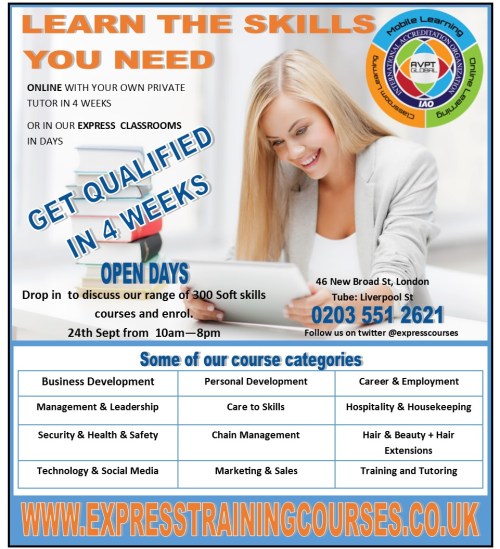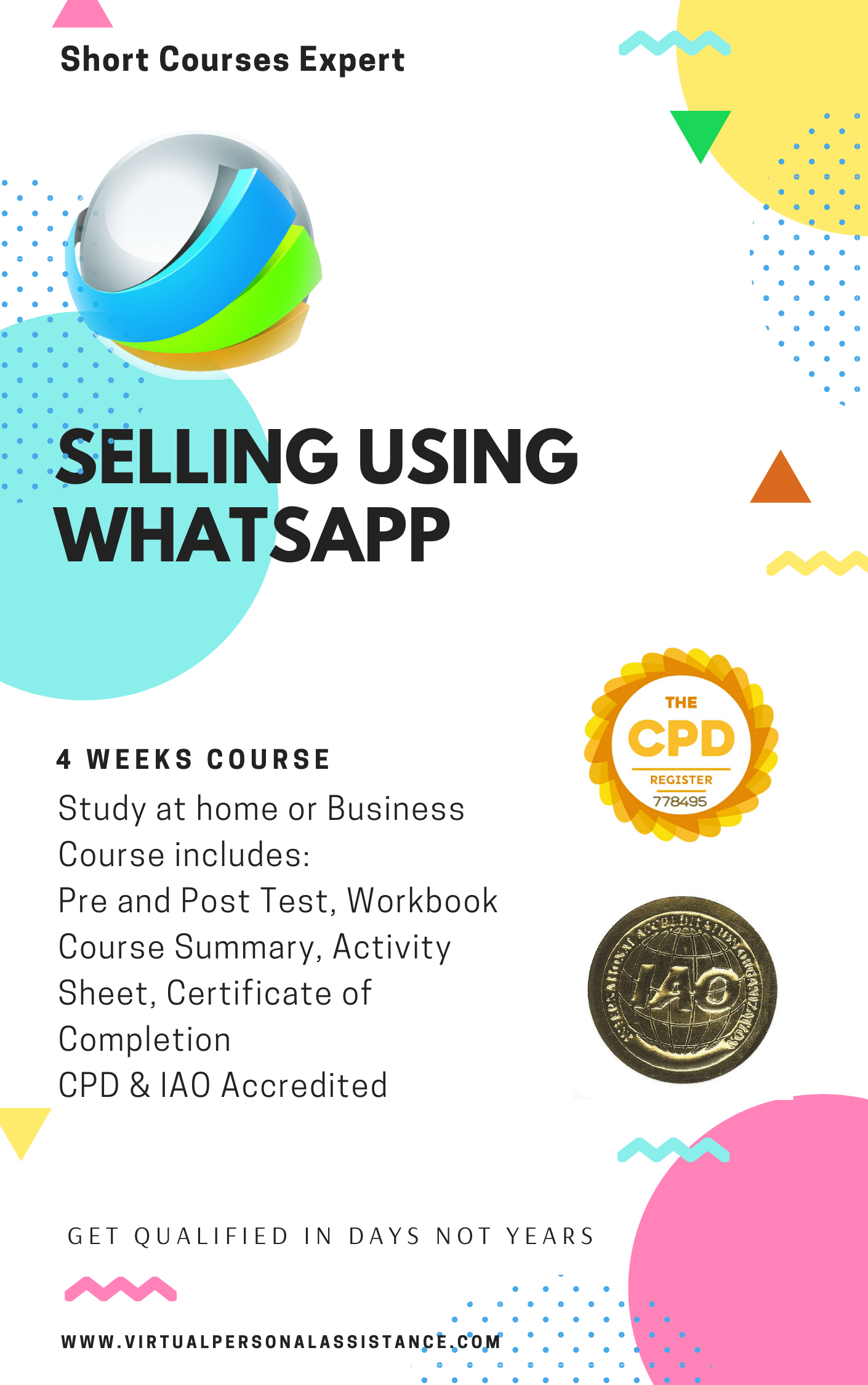
‘Enterprising Women’s Business Group’ Host Diane Shawe Offers A CPD Lifeline To Professional Women Working In The Legal Sector

Join us in May for a productive event

London UK, Thursday 12th May 2014 – An innovative UK based business women has successfully achieved CPD training provider status and recognition through the Solicitors Regulatory Authority (SRA)

Diane Shawe, host of the KCW Enterprising Women’s Business Club will now be offering a comprehensive range of recognised CPD soft skills courses aimed at supporting female legal professionals in a bid to help them establish, develop and grow despite to compete with some of the difficulties and challenges law firms are now facing.

As a traditionally male orientated arena, the legal industry now attracts as many talented female professionals as it does male counterparts, however workplaces are still unfairly weighted towards male work-life balances and working models.

As a result, it’s accepted that female legal professionals often face gender related difficulties in terms of promotion and development (Diversity in the Legal Profession in England and Wales: A Qualitative Study of Barriers and Individual Choices 2013).

The wide range of CPD courses now available have been specifically tailored to support and nurture women looking to achieve and fulfil their potential in the legal industry either as a partner, employee or independent practice.

The ‘Enterprising Women Business Club‘ has over 45,000 members nationally and has a remit to help women achieve the success they want by empowering, connecting, training, inspiring and supporting. The next Kensington, Chelsea & Westminster business club meeting is set for the 15th May. For more information please visit http://academyexpresscourses.com/2014/04/09/kensington-chelsea-and-westminster-enterprise-womens-business-club-meeting-15th-may-2014/

About AVPT

As a leading provider of over 390 soft skills training courses approved and accredited by the IAO, IoSCM, and  Solicitors Regulatory, ‘AVPT’ are now offering CPD applicable courses to the legal profession. For further information on the Enterprising Women’s Business Club, please visit the official website at http://www.enterprising-women.org/local-business-clubs/kcw-business-club.  Contact: Farhana Jaman of Enterprising Women 01223 903913 farhana@enterprising-women.org

Or more info on CPD Softskills courses visit www.cpdforlawfirms.com

Why the legal profession is changing – Part-time partners

CPD on the move with expresscourses

CPD on the move with expresscourses

Only 9.4% of equity partners in law firms are women, despite equal numbers of men and women entering the profession

Article by Nicky Richmond Guardian Professional,

The statue of justice at the Old Bailey court in London. Photograph: Martin Argles for the Guardian

In the world of big law, equity partnership is broadly equivalent to being on a board of directors. In the top 100 law firms in the UK, just 9.4% of equity partners are women. This is even lower than the percentage of board members at FTSE 250 companies who are women, at 9.6%.

Given that equal numbers of women and men enter the legal profession, why is it that so many women don’t reach equity partnership? The Women’s Business Council – set up to advise the government on how to get more women into executive positions – came up with some interesting conclusions in a recent report.

They reveal an overwhelmingly masculine, patriarchal corporate culture, and point to the double burden of work and domestic responsibilities, the “anytime, anywhere” model of management and, a particular curse in the UK, the long hours working culture wired into city law firms.

A large proportion of women who drop out of law do so because they decide to have a family. Many women feel that they simply cannot combine the demands of life in a law firm with the demands of their families.

It’s little surprise they reach this depressing conclusion; at most law firms it is either full-time or nothing. A law firm may offer a woman a career downgrade to ‘support lawyer’ status but for many the cut in remuneration for part-time working or a lesser role are options not worth considering. Factor in the expense of childcare, and it’s little wonder many women conclude that the high cost simply isn’t worth it.

The goal of a partnership becomes more distant for many women once they decide to have a family. In many firms there is no route to partnership for lawyers who work part time. It just isn’t allowed. This is not only morally wrong, it is nonsensical.

There is no reason why a part-time lawyer – female or male – cannot make an outstanding contribution as a partner in their practice. Critical to a woman’s decision as to whether or not she returns to work following maternity leave must be the availability of flexible working. This means flexibility in both hours and location.

In order for things to change in law firms, firms must prioritise retaining their best people for as long as possible. This could include accommodating requests for part-time or flexible working. Given the demands of clients this isn’t always easy, but in most cases – with a real will on both sides – it can be done.

I work for a law firm that is owned equally between men and women. This is key to the day-to-day operations. A number of our lawyers work on a part-time basis. Some work certain days from home, others are consultants who hardly ever come into the office. We try to accommodate people’s real lives and ultimately, it’s the service to the client that counts.

Equality in the law will not happen on its own. In the 25 years I have been in practice I have seen all sorts of attempts to deal with ‘the women issue’, but evidently none of them have worked. Suddenly, however, it has become clear to City law firms that losing women is losing them money. So now, in line with the government’s recommendations, some of those firms have introduced their own targets for senior women. Money talks, and that’s what will drive the change.

AVPT CPD PRESSED FOR TIME LAW FIRMS

Check out Merchant Cash Advance Services for small businesses

365 business financeMerchant Cash Advances, also known as Business Cash Advances, are a quick and easy way to convert your future credit and debit card sales into immediate cash to spend on any of your business’ requirements. They are a simple alternative to unsecured bank loans and overdrafts.

At 365 Business Finance, they’ve helped businesses across many sectors get the finance they need. they’ve provided cash advances to cycle shops, convenience stores, butchers, greengrocers,  pet care stores, garden centres, sports shops,  off-licenses, shoe repairs, cash and carry, and just about any other business that accepts credit and debit cards.

As a business owner, are you considering expanding  your store or making costly refurbishments?  Are your suppliers  unwilling to provide you with the credit line that you previously received? Or maybe  you need to purchase stock ahead of a busy sales period? Perhaps you’d like to launch a new website or run an advertising campaign? Whatever the reason,  you need cash now, but you’re not sure how to proceed. You’ve thought about a small business loan, but some banks have imposed tighter restrictions, some require security and detailed business plans,  and even if you do qualify, you may have to wait for months to get the funds.

With our Cash Advances,  you can avoid some of the hassles of a traditional business loan by utilising your future credit and debit card sales to secure thousands of pounds of ongoing finance for your business. Our unique repayment plan takes a percentage of your daily card sales (typically between 5% and 20%) until the advance is paid off. A traditional loan requires fixed monthly payments irrespective of how your business is performing, but our financing process is designed to match your business’s performance, so during quieter periods, you pay back less. The process happens automatically so there isn’t an extra bill to keep track of each month. Our application process is fast and simple, and you can have your money in days.

business-other

Here are a few examples of how our cash advances can be utilised:

  • Expansions;
  • Refurbishments;
  • Equipment purchases;
  • Bulk stock purchases;
  • Marketing and advertising;
  • Website development;
  • Recruiting staff;
  • General working capital needs

3 Steps to Growing Your Business

Step one

1. Monetise your future card sales

They will  buy a fixed amount of your future (credit and/or debit) card sales

Step two

2. Get your cash in days

You’ll receive the lump sum directly into your bank account to use on any business requirement.

Step three

3. Watch your business grow

You repay a small  percentage of your card sales. Repayments are  automatically processed and hassle-free.

Learn More….

Click to Check our our Budgeting & Accounts Soft Skills courses for your business.

1 day social media and marketing course

10 most profitable hair extension techniques to learn for 2017 by Diane Shawe

Why setting up a hair extension business could give you a long term career?

Article written by Diane Shawe M.Ed

Getting started in the hair extension business by Diane ShaweWe have seen the hair extension market grow over the past 15 years, now there are more hair extension techniques than ever before and it can be confusing to decide which is the right one for you to either apply to your own hair or become a qualified technician.

If you are thinking of becoming a qualified technician, it is important to consider how potential clients might make their decision.  Some people will make a decision based on price, others on their hair type and some based on what they need to achieve. Click to see our training school video

Here are just a few tips to help with your decision making process.

1. Wigs Wigs are a quick and easy way to give yourself a quick makeover.  What you need to bear in mind is that the cheaper the wig the more un-natural it will look.  You don’t need to spend a lot of money but it is worth investing in a wig that you can use from time to time.  Client will pay between £120 – £300 for a good quality wig which could last for up to 12 months.

2. Hair Pieces: There are lots of different hair pieces from pony tails to rear hair attachments in all different shades, curly, straight or plaits. There are also specialist hair pieces for thinning hair that can help disguise any problems.  The thing to bear in mind is that hair pieces are not often very secure and could make you feel a little uncomfortable.  Some of the ponytail pieces can be securely fixed, so if you want a demure look go for a ponytail.

popular integrated weave

3. Integrated Weaves: This is when wefts of hair is sewn onto a fine cornrow which is then hide by the bulk of your hair on top.  It is a popular technique because if done correctly it can look very natural and offer up a robust and secure hair enhancement solution.  If you look after the hair you can reuse it when you go back to have it re tightened. Clients could pay between £190 – £330 for the integrated weave.

How hair extensions are sourced treated and graded by diane shawe M.Ed 2014 price4. Pre-tips: This is small pieces of hair that have been pre bonded together.  They can be added in sections all over the head to aid thickening, give the impression of highlights or lowlight and length.  Pre-tips can be applied using heat, micro rings or even small elastic bands.  Be aware that they have to be professionally removed so as not to damage your own hair.

5. Strand by Strand (glue gun): This is when hot bond is used to bond small sections of hair to the recipients own hair.  It was a very popular technique in 6 years ago, but requires professional application and removal by a qualified technician.  Can give the appearance of flyaway hair that you could somewhat run your fingers through.  It is a very time consuming technique and is much better for a long term wear over 3-4 months.

6) Clip in hair extensions: These are now very popular.  They are best used for lengthening mid should length hair.  If the hair is shorter they don’t sit very well because they can be a little bulky in appearance.  They don’t offer up much security unless they have been professionally fitted.  This is when a very small cornrow is done and the clips are slipped through for much added security.  Great for an evening occasion but not advisable for long term wear.  click to read more

20121208_180137

7) Net Weave:  This technique is used when the client wants to partially extend just a section of their hair or if the client suffers from patchy alopecia.  This technique is suitable for 2-4 months wear.

8) Hook and Latch: This technique does not use any glues or threads. It is a beautiful technique, flat to the touch and hair could be worn up.  It works well with shorter hair especially the Micro ring track technique.

9) Lace Wigs: Lace wigs have become very popular. They are really good for girls with short thin hair, damaged hair, hair that needs a rest or a complete makeover.  Top celebrities have made them really popular and you can see why from the video testimonial below. See Radio TV presenters new lace wig

alopeciaconsultant

10) Braides and PlaitsBraides and Plaits have been around for hundreds of years.  A technique that can look very simple or quite exotic.  Braids can be worn for a number of months until the hair grows out, they can even have beads added to the end for that extra special look.

Hair Loss Specialists
Clients also suffer from thinning hair can be helped, click here to hear what one client had to say.

As we see an aging population, people are becoming more confident about getting help to resolve short term or long term hair problems.
HAIR EXTENSION TRAINERS
There is s shortage of qualified hair extension trainers in the UK. Visit this link to find out more and how you can become qualified.


Go back

Your message has been sent

Warning
Warning
Warning
Warning

Warning.


avpt membership and approved status 2014 jpeg

The not so golden rule of recruiment for small Entrepreneurs

Recruiting is not what it use to be in the 60's

Recruiting is not what it use to be in the 60’s

When it comes to recruitment, I have made every mistake in the book…and then some!

A fascinating blog was sent to me and I just had to reblog it because it is so important for expanding businesses.

Over the years I have signed psychopaths, nymphomaniacs, super depressives, dishonest reprobates, cheats, scoundrels and lazy-good-for-nothings.

I have also hired some of the most talented people in the universe – people with the intelligence, energy, determination and moral character to make a difference and achieve great things.

The golden rule of recruitment is that there is no golden rule! There is no secret formula for pinpointing the perfect person or for identifying the world’s worst worker.

Nonetheless, I have picked up a few nuggets of recruitment wisdom in my journey through life. I’m afraid, however, my methods are not for the faint of heart or the puritans of the planet so, if you are easily offended, STOP READING NOW.

If, on the other hand, your goal is to cease hiring ordinary people and begin hiring extraordinary people – read on!

In the recruitment game, the starting point is realising that every employee will either increase or decrease the profitability of your business.

It’s a fact of life that every employee will either make you money or cost you money.

So, resolve from now on to recruit only employees who will positively impact your business and, at the same time, start weeding out existing employees who are not contributing.

The ten million dollar question is – how do you identify the winners from the losers, the right people from the wrong people?

It’s not easy but it becomes a lot simpler when you realise there are only three categories of employee:

  • People who work against your business.
  • People who work for your business.
  • People who work with your business.

You obviously don’t want people who work against your business and, fortunately, they are as easy to spot as male peacocks during mating season.

Here are a few of their characteristics:

  • They are always happy to lend a listening ear to moaners and groaners.
  • They often have a hidden agenda.
  • They are lazy but they are good at making themselves look busy.
  • They sabotage success.
  • They undermine successful colleagues by gossiping behind their backs.
  • They tend to run in packs with others just like them.

These people are the devil in disguise. They are a cost, not an asset. Don’t hire them and, if you’ve already got them, get rid of them because a leopard can’t change its spots!

Let’s now move onto the second category – employees who work for your business.

Surely these people are OK?

They might be if you are prepared to settle for ordinary people rather than extraordinary people but if you want to build a great business they are not good enough!

The hallmark of people who work for your business is that they are not truly committed. They do what’s necessary to get by and they usually have some excuse for not going the extra mile such as doctor appointments and childcare demands.

They want to get paid for doing the job but their hearts are not in it. In sports parlance, they are people who are happy to settle for a draw. They are not losers but they are not winners either.

This may sound harsh but in my book – you don’t want them in your company unless you are prepared to settle for second best.

Employees who work with the business are the only people you should be hiring.

Here are the characteristics of the men and women you should be recruiting:

  • They are committed.
  • They always go the extra mile.
  • They feel responsible.
  • They are loyal.
  • They love to get involved.
  • They want to win.

In short, they know that the more they put into life, the more they will get out of life. That’s what makes them extraordinary.

Next time you are recruiting, resolve not to settle for ordinary people, instead be determined to hire only extraordinary people.

To ensure you identify these superstars, here are some questions to ask yourself about each candidate you interview:

  1. Will you enjoy working with this individual?
  2. Did they demonstrate an enthusiasm for your company and a passion for the job?
  3. Will they be dedicated to working shoulder-to-shoulder with you to help you achieve your goals?
  4. Will they inspire their colleagues?
  5. Will they be compatible with your team?
  6. Do they have the character to do what it takes?
  7. Will they be loyal through thick & thin?
  8. Will your customers and clients like them?
  9. Will they be industrious and hard working?
  10. Will they be ambitious for success?

If you can put a tick in the ten boxes, you may have found yourself the perfect employee.

There is, however, one more question you might want to ask yourself: “Could they be better than me?”

If the answer is yes – hire them immediately!

The power of a Bucket List – Stephen Sutton exceeded his raising over £3million

stephen sutton raises over 3 million report expresstraining coursesThe Power of a Bucket List

Have you made one, or thought about it? Maybe it includes a marathon or to dive in the Great Barrier Reef, walk the Wall of China or a skydive? Well then this should inspire you to get going on that list…

At the age of 15, Stephen Sutton was diagnosed with bowel cancer and two years later he was told it was terminal. Some teenagers would have quit there, given up on their hopes and dreams and let the b*stard that is cancer beat them. But not this one.

Instead, Stephen created a whopper bucket list with 46 tasks on it that he wanted to complete with all funds raised going to the Teenage Cancer Trust. It included:

 ─        Skydive for charity

─        Organize a charity party

─        Write a book

─        Organize a charity football match

─        Organize a charity gig

─        Go busking!

─        Persuade local schools to have a ‘get wiggy with it’ non uniform day

─        Charity quizzes at local pubs

─        Organize a charity ball

 All of which Stephen completed since being diagnosed, really quite amazing let’s be honest. But the best was yet to come. Stephen aimed to raise £10,000 for the trust but thanks to the wonderful world of social media the world spread with #ThumbsUpForStephen trending in the UK and one point donations were being made at a rate of £1,000 a minute.

The result
Stephen has now raised a total of £2,225,152 and it’s still going up. He really is quite the legend and we hope that Stephen feels proud of what he has done and it motivates him to continue fighting his cancer.

So have you created your own Bucket List  it is similar to setting goals, click here to find out how to go about setting your goals and creating your own fantastic bucket list.

1 AVPT Student Recruitment Advert

6 Things the Most Influential People on Social Media Do

Train to become a Linkd in specialist

Train to become a Linkd in specialist

How do you earn respect, stand out, and get noticed in noisy social-media circles? Take a cue from the Web’s biggest influencers.

Guest Blogger 

Influencers are among the most magical, powerful creatures in social media.

Within specific niches or across large audiences, they have the power to shape how people think about an issue, start important conversations, make businesses stand up and take notice, and more.

Outside of having a large following, how do they do it? And how did these influencers amass the following they have in the first place?

The ability to stand out in noisy social circles helps influencers build their audience and connect with them over and over again. It keeps them relevant. It keeps them influential.

Here are the six things influencers do to stand out:

1. They’re Superconnected and Almost Always On

Brand advocates, superfans, loyalists–influencers of all stripes–are hyperconnected to their audience. They have a passion for their topic of choice, which means they’re always on and use multiple devices to ensure they’re connected throughout the day.

Influencers use tools such as Topsy, Trackur, and Social Mention to find interesting conversations, stay on top of breaking news in their niche, and help them manage and schedule content for maximum exposure.

Influencers treat social like their j-o-b. (and sometimes it is). They get it; you have to invest time and money in yourself to help you scale if you are going to stay superconnected and become an influencer.

2. They Make Boring, Dry, or Otherwise Uninteresting Topics Fascinating

When everyone is saying the same thing, who grabs your attention? Influencers are the people coming up with a creative take on a topic, saying something different or contrary or funnier, etc.

Take Gretchen Rubin, for example. Rubin is a popular author, blogger, and speaker, but then a lot of people write and speak. How is she also one of LinkedIn’s 150 Most Influential People?

For one, while everyone else was writing self-help books, Rubin decided to parody them with her first book, Power Money Fame Sex: A User’s Guide.

See, while everyone else was trying to tell people how to be happy, Rubin decided to take a quirky, self-deprecating, and humorous approach.

When she tweets to her 92,000-plus followers, they listen and share because she’s not spouting the same old conventional wisdom. Her take is unique and makes something that could be tedious–finding happiness–an adventure in which her social connections can all participate.

3. They Create a Ton of Awesome Content

The killer content top influencers are banging out on a regular basis really helps them stand out in a sea of noise, regardless of the topic.

Influencers are great at creating content that people can’t help sharing.

They might do this by way of original research, powerful commentary, sharing a unique take on the news, turning information into stunning visuals, hosting webinars or online chats, or blogging prolifically.

Whichever medium they’re using, influencers love to create awesome content, and they have mastered techniques that allow them to scale their efforts. This might mean partnering with others to increase their reach and maximize their time, or building a great team around them to assist in their efforts.

There are a lot of people out there with something interesting or brilliant to say. The ones who garner influence, though, are incredibly skilled in how they get their message across to the greatest audience possible.

1 day social media and marketing course

4. They Know Who You Are and Want You Want

Influencers don’t operate in a vacuum, churning out social updates and content like traditional broadcasters. They know their audience and what you like–in fact, they often know what you’ll like before you do.

Knowing your audience goes far beyond demographics, and influencers totally get it. They listen, engage, and converse so they can truly understand what drives people. They’re thirsty for audience insights that will help them create that next amazing piece of content, or fuel their next groundbreaking research project.

They don’t get bogged down in popular opinion or go with the crowd, because they know you’re looking for something different. They know this because you’re telling them in a thousand different ways, and they’re actually paying attention.

It might be through social-media activity and sentiment tracking. It could be through website analytics. It may very well be gleaned through actual conversations with the real people who hang on their every word.

The difference is, they actually care about what would be most useful, helpful, or entertaining for you and go from there.

They’re more concerned with what you want to hear than what they want to say.

5. They’re Hip, They’re Happening, They’re Current

And they can’t help being all of these things, because they are so in tune with the topic on which they’re influential.

They read voraciously. They eat data and facts for breakfast. Influencers eat, sleep, and breathe their passion and are always at the forefront of the industry.

When everyone else is talking about what happened this morning, they’re already talking about what’s going to happen tomorrow. And they know what’s going to happen tomorrow, because they know just about everything there is to know about what’s already happened, who is working on what, which technologies or developments are on the horizon, and more.

6. They’re Trustworthy

And this is huge, massive, critical! They don’t waste words, publish fluff pieces, tell half-truths, or otherwise lead their audience astray.

People elevate others to the level of influencer because they trust them. It’s as simple as that.

It can take years to build that trust and one poorly thought out statement to break it, so influencers are incredibly careful about what they’re putting out to their networks.

They stand out in a sea of noise because time and again, they’ve proven their voice is worth listening to and their advice worth taking.

Call us to enquiry about our soft skills courses

Call us to enquiry about our soft skills courses Diane Shawe at express courses, London UK

source: http://www.inc.com/larry-kim/6-things-influencers-do-to-stand-out-in-social-media.html#ixzz2zldfZm9Q

CPD pending? Pressed for time?

CPD on the move

CPD on the move

Continued Professional Development is entering a new phase for UK Law Firms.

At the Academy of Vocational & Professional Training we understand that you firm is often pressed for time, so nudge thinking, heuristic learning, or brain plasticity are great but, your law firm already have complex challenges, so we are going to keep it simple.

We train in soft skills courses like HR, PR, Management, Technology and Social Media to name but a few. CPD approved by the SRA to help you and your staff meet the challenges expected of skilled professionals.

Doing your CPD the smarter way

Doing your CPD the smarter way

You can study on the move using your smartphone, tablet or at our intense 1 day workshops.

Give us a call on 0203 551 2621 to request a quote or visit our http://www.avptglobal.com

How can employers help keep their work force healthy so as to avoid high healthcare costs?

5-natural-ingredients-for-preventing-lung-disease-expresstrainingcourses.co.ukWhether you’re talking about asthma, cancer, COPD, or even rare conditions, lung disease is on the rise.

The experts are calling lung disease a “time bomb waiting to explode.”

sourced: by Diane Shawe from the  Institute for natural healing

Whether you are creating a workplace wellness program from scratch, or enhancing what you already have, you’re already on the right track! With increasing costs of health care, a shrinking workforce, and aging workers, a savvy workplace understands the value in supporting workers to improve their conditioning and to live a fitter lifestyle.

For instance you could help by engaging with your workforce through your company blog by blogging about five natural ingredients to keep their lungs young and healthy as follows:

1. Milk Thistle: You might already know that it has the power to help your liver regenerate its cells. But milk thistle contains silymarin. It’s a compound that flushes toxins out of your liver. It also helps prevent lung cancer from forming and spreading.

Milk thistle also contains silibinin. Like silymarin, it protects you from lung cancer. But even better. These cancer cells spread quickly to other organs in your body. And they can become drug resistant. Silibinin doesn’t only reverse drug resistance in these cells… It causes natural cell death in cancerous lung tumors.2 You can find milk thistle extract pills in health stores and online. Organic milk thistle tea is another option.

2. Fiber: Oddly enough, fiber is critical to your lung health. It may help relieve symptoms of–and even prevent—asthma.

A high-fiber diet changes the makeup of your gut bacteria. The good bacteria feed on fiber. When you keep these bacteria well-fed, they produce short-chain fatty acids. These fatty acids reduce inflammation and irritation in the lungs. But don’t add grains to your diet for more fiber. They actually increase the amount of inflammation in your body—including your lungs. Instead, eat more organic artichokes, peas, raspberries, and blackberries.

3. Ginger: It’s full of antioxidant power. But two of these antioxidants in particular protect your lungs against inflammation and damage. Gingerols help clear your lungs by reducing the amount of mucous they produce.3 And 6-shagaol, the compound that gives ginger its flavor, stops bronchial tubes from tightening.4 This keeps airflow open and easy.

Ginger can be pretty intense if you aren’t used to it. Add it to your diet slowly if you don’t eat it on a regular basis. When it comes to ginger, fresh is always better. Cutting up some fresh ginger and adding it to a meal gives you antioxidant power and extra flavor. You can also juice with it or use it to brew your own tea to help soothe your lungs when you have a cough.

4. Broccoli Sprouts: Broccoli sprouts are rich in vitamins A, K, and C. But they also contain sulforaphane. It’s a compound that helps you fight the inflammation that causes asthma. One study found that it helped restore defective white blood cells in the lungs. More white blood cells mean less bacteria and inflammation.5

Broccoli sprouts have about 50 times more sulforaphane than regular broccoli. But you may not be able to find them at your grocery store. If that’s the case, look at your local farmer’s market. Or you could grow them yourself. Try them steamed or throw them raw into a salad. For convenience, you can also find broccoli sprout extract as a supplement online.

5. Bromelain: It’s an enzyme used to reduce inflammation of the sinuses after surgery. But it’s also a natural way to treat pulmonary edema.6 This condition prevents the fluid from draining out of your lungs. The result? Shortness of breath. If left untreated, it can cause deadly infections. One study found that bromelain reduces the amount of inflammatory neutrophils in the lung by up to 85 percent.7

The best way to start getting more bromelain in your diet is by eating fresh pineapple.8 And lots of it. Most of the bromelain in a pineapple is in the stem. Or you can supplement.

Pollution and secondhand smoke aren’t the only things that can irritate your lungs. Inflammation is a major factor in the development of most lung disease. Lowering it will help ensure that your lungs are working at their best. Using these five natural solutions will help keep you free of disease—and breathing a little easier.

So you can see the benefits of preparing a workplace wellness program.

Creating a Workplace Wellness Program

Whether you are creating a workplace wellness program from scratch, or enhancing what you already have, you’re already on the right track! With increasing costs of health care, a shrinking workforce, and aging workers, a savvy workplace understands the value in supporting workers to improve their conditioning and to live a fitter lifestyle. We have a  two-day course includes all aspects of designing or upgrading a workplace program, from concept through implementation, to review.

AVPT’s two-day workshop will help you  to:

o   Describe the necessity of workplace wellness programs
o   Create program elements that reflect the needs of employees and the objectives of the organisation
o   Select program elements that fit the context of current operations
o   Establish implementation and evaluation strategies

Getting you qualified in days not years!

Getting you qualified in days not years!


other article you might be interested in : Dangers of Hypertension to Founder owners of SME.

Does nine different kinds of intelligence make you any smarter?

In this article, I will talk about the different ways in which Multiple Intelligence Theory can be implemented in e-Learning to help the learner effectively acquire, retain, and utilise the information being provided within the e-Learning course.

the enquiry process to soft skills training april 2014

The Multiple Intelligence Theory was developed by Dr. Howard Gardner in 1983. Dr. Gardner, a noted psychologist and professor of neuroscience from Harvard University, suggested that every human being interacts with their environment differently. We each possess nine different kinds of intelligence, but our experiences, cultural beliefs, and knowledge base determine their exact configuration.

What is “intelligence”, according to Multiple Intelligence Theory?

According to Gardner, there are three key elements that determine a person’s intelligence:

  1. The ability to create a service or product that will be valued in the person’s society of culture.

  2. A skill set that allows the person to solve real world problems that they may encounter in life.

  3. The ability to potentially create new solutions for problems or to utilize existing solutions. This typically involves the acquisition of new knowledge. 

Multiple Intelligence-Based Activities in eLearning

Multiple Intelligence Theory can be implemented in eLearning based upon the nine multiple intelligences. Let’s take a closer look at each category and which multiple intelligence-based activities can be utilized during instructional design to create the best possible eLearning experience for the learners:

  1. Musical (or Rhythmic) Intelligence
    This intelligence involves the capacity to think and learn in terms of music and rhythm, and to recognize and hear patterns. An activity that would appeal to this type of intelligence is a lesson that includes music or sound, such as a multimedia presentation. Try to use music that emphasizes the subject matter and creates a more immersive experience for the learner. Since there is more of an auditory aspect with this particular intelligence, lectures can also be very helpful. People who demonstrate a high degree of musical intelligence may be ideally suited for musical professions, such as composing or playing an instrument.

  2. Linguistic Intelligence
    This intelligence is associated with expression through language. These people tend to be able to eloquently convey their thoughts and to understand the words of others. Writers and speakers typically display a high degree of this sort of intelligence. Any activities that include discussion, such as online forums or group-based scenarios, are ideal for individuals who lean more toward linguistic intelligence.

  3. Mathematical (or Logical) Intelligence
    This involves the ability to identify principles or structures within a system. This intelligence is often associated with the logic or the manipulation of numbers.  Activities ideally suited for this intelligence may include diagrams, charts, or tables. Critical thinking scenarios are also useful with this group. Accountants and researchers often have a high level of mathematical intelligence.

  4. Kinesthetic (or Bodily) Intelligence
    Body Intelligence involves the use of a person’s entire body to figure out solutions or to create something. People who demonstrate a high degree of kinesthetic intelligence may be ideally suited for performing arts professions, such as dancing, or careers that require an innate knowledge of one’s own body, such as a doctor or athlete. Activities that are best suited for this sort of intelligence include games that involve hand-eye-coordination or interactive scenarios that require physical involvement. The thing to keep in mind about this group is that they are best able to learn when muscular movement is involved. So, include activities that require movement and physical response.

  5. Spatial Intelligence
    This intelligence pertains to a keen sense of space and how one can navigate those spaces. Activities that involve flow charts and graphics are ideal for this intelligence group, as well as games or multimedia that is visually appealing.  Architects, pilots, and sailors often have a high degree of spatial intelligence.

  6. Intrapersonal Intelligence
    This involves an in depth understanding of oneself, such as what you can accomplish and how you react to certain situations. As such, individuals with high intrapersonal intelligence often have a sense of what they should avoid and what they want to achieve in their lives. Professors and philosophers often possess high degrees of intrapersonal intelligence. Activities such as collaborative learning exercises (online forums) and chat programs enable intrapersonal intelligence learners to help others and to share experiences and ideas. This category responds well, first and foremost, to activities, which require introspection.

  7. Interpersonal Intelligence
    This is the capacity to understand and learn from others. People who demonstrate a high degree of intrapersonal intelligence may be ideally suited for service professions, such as teaching or politics. Those who identify more with this category of intelligence may benefit from group discussion activities and in depth questions that make them fully explore the topic. What’s important to remember about interpersonal intelligence is that these individuals are sensitive to others’ moods and feelings. They work well in-group settings and are often able to learn more effectively when collaborating.

  8. Naturalist Intelligence
    This intelligence involves the capacity to differentiate between living organisms and to view the connection between all natural things.  People with a high degree of naturalist intelligence usually have a close bond with nature. Botany and biology are two career fields that closely identify with this sort of intelligence. Activities that involve classification or organization appeal to these individuals.

  9. Existential Intelligence
    This particular intelligence was added later by Gardner, and is not commonly associated with learning environments, as it is geared more toward spiritual and philosophical views. For example, someone who has a high degree of existentialist intelligence may have a tendency to pose questions about life’s purpose or death. 

It’s important to note that instructional designers should not feel obligated to incorporate all of these multiple intelligence-based activities into their eLearning courses, just that it may be beneficial to offer a variety of multiple intelligence-based activities to more effectively illustrate the subject matter. If you are able to offer learners a diverse set of learning tools and eLearning strategies, then you gain the ability to increase comprehension and retention, not to mention enhance the overall eLearning experience.

Call us to enquiry about our soft skills courses

Call us to inquiry about our soft skills courses