Tag Archives: distance learning

Looking for a short course this September to fit into your lifestyle?

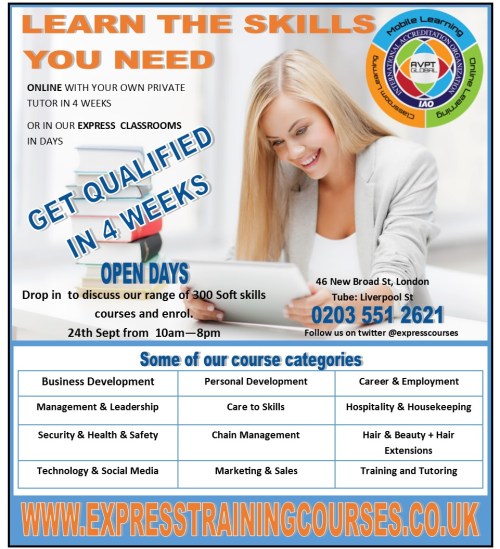
Express Training courses (AVPT) have taken out all the stress of retraining by offering over 390 globally accredited courses in a way that fits in with you and your lifestyle. Now that you’ve decided to invest in your professional development it’s time to choose a study style that suits you. You can either work through a home study manual study online with an allocated personal tutor or in the classroom for an intensive one, two or three day course.

You can be confident in your future success with our fully trained and qualified

short course manuals from expresscoursestutors, they’re as dedicated to your personal development as you are about landing that big promotion, starting that passion project of a business venture, retraining or making that essential career move.

You don’t have to wait until you get home to pick up a text book and start learning, all you need is a tablet a smart phone and an eager mind. With AVPT studying and fitting your professional development around your work life and personal responsibilities has never been easier or more rewarding.

With courses covering everything from Hotel management, Leadership Skills, Marketing and Sales through to Hair extensions and of course becoming one of our virtual teaching facilitators, taking the first step towards being a better version of you has never been easier. Get in touch today and you can boost your skills and be qualified in a matter of hours instead of months

Start your own business in less than a month

Start your own business in less than a month


Does managing change manangement change anything

order your home study manualIt would seem that the world is changing fast, but has it been any slower than it was before?  Technology has helped to give the perception of  speed.  Sometimes we can feel out of control as things around us shift an often the ground from under our feet tremble with change.

article by Diane Shawe M.Ed

Responding to today’s kind of changes requires a new set of skills. Different levels of understanding, self leadership and governance.

What are the seven key areas one needs to consider and build into a Change management programme to aid collective understanding and collaborative progress?

Defining Change?

  • Why organisations or people fail?
  • What are various types of change?
  • What are various phases of growth?
  • What are major established theories on change management and how do they compare with each other?
  • What is the difference between leading and managing?

How Change Affects People

  • How do people respond to change?
  • What goes through people’s mind when they are confronted with change in different stages?
  • How ideas spread and what does this mean for change management?

How Organisational Change Works

  • What are the 8 stages of change and what should you consider in each stage to maximise the likelihood of success?
  • What are the principles of effective change?
  • What are the common problems when managing changes that if neglected can seriously impact the change process?

Managing Resistance

  • Why people resist change?
  • How can you deal with this resistance?
  • What are the techniques available to persuade people on change?
  • How can you engage stakeholders considering their power and interest?

How to Manage Change

  • What are the critical three components of a change management programme?
  • What tools can you use to manage and monitor employee skills and identify skill gaps?
  • How to develop employee skill profile?
  • What are various options in filling these skill gaps and what are each methods advantages and disadvantages?

Mentoring, Coaching and Motivating

  • How critical is motivation in the context of change management?
  • What is Skill/Will Matrix and how can you use it for coaching and managing change?
  • What is mentoring, what is coaching and what is the difference between them?
  • How can you use the GROW model to provide effective coaching?

Management Tools

  • What are the tools used for brainstorming ideas on change and structuring your plans and activities?
  • What tools can you use to identify what works for change and what works against it?
  • What tools can you use to monitor the scope of change and make sure that your plans are consistent and are applied at the right level?

Business Managing public relations home study course Conflict resolution, dealing witn difficult people home study course effective feedback home study course Entrepreneurship home study course Influence and persuasion home study course

Why employers and training organisations need to take heed of this global trend

Diane Shawe CEO AVPT

Diane Shawe CEO

The Changing face of Skills and Training

article by Diane Shawe M.Ed CEO

In a report conducted by Kelly Global Workforce Index in 2013 over 120,000 respondents from 31 countries across the Americas, EMEA an APAC regions where asked several questions about Skills and Training.

When asked to identify the main motivation for earning new skills or undertaking training, the largest share of employees 57% cited the opportunity for promotion with their current employer. A further 47% cited the opportunity to work in another organisation, and 42% planned to enter a new field of work.

Globally, 60% of worker are either actively seeking further education or training (23%) or considering it (37%).  The APAC region stands out as a skilling hotspot, with 69% of those surveyed either considered or seeking further training for a new field.

Across the globe, there are markedly different approaches to the notion of additional training and professional development. The highest rates of planned upskilling are predominantly in developing economies, while the lowest rates tend to be in some of the most prosperous nations.

Russia heads the list for training intensity, with an astonishing 92% planning some form of training. Also high on the list are Thailand, Mexico, Brazil, Indonesia, Puerto Rico and Malaysia.

Surprisingly the lowest rates of planned training are in France, Luxembourg, the US and Switzerland.

Among professional and technical employees, those most likely to be actively seeking to upgrade their skills are in Math, Engineering and IT, while the least likely are in Science, Health Care and Education.

Investing in Training that Works

For training to be meaningful it needs to be relevant and practical – not “training for training sake”.

When asked to identify the mot desirable means of furhering their skills, the overwhelming preference was for on-the-job experience and training, identified by 70% of respondents, significantly ahead of the next hightest ranked “continued education and training” cited by 58%

Building a durable Skills base

The last two decades have radically altered the way skill are acquired and developed. Skill are no longer “front-end loaded” onto a career. Rather they are increasingly embedded as part of lifelong learning and development.

The upgrading and renewal of skills plays a critical role in personal and professional development. It also has a vital role in broader workforce development, which is the cornerstone of organisational efficiency and productivity.

All skills have a finite life, and in industries subject to high rates of technological change and innovation, the lifespan of skills is becoming shorter. Increasingly, new skills will need to be learned and deployed throughout a working life.

It is clear that decisions about training and professional development are now an integral part of the employment equation, and have an important bearing on employee moral, performance and retention.

What Employers can do

  • Consider opportunities for training and personal development.
  • Help to build a culture of continuous learning so that employees are encouraged to develop and use new skills
  • Encourage employees to think about career plans and the type of skills and training they need to stay equipped.
  • Consider training as a key element in employee attraction and retention.
  • Champion individuals who have devoted time to upskilling so they can become ambassadors for an organisation.

The landscape has changed

The scale and duration of the downturn has forced may employees to look afresh at the whole area of training and professional development – one that was previously guided by employers.  Employees now recognise that they cannot solely rely on an employer to direct in this important element of their lives.

A new generation of workers is taking on much greater responsibility for their training and professional development, including the way it is provided and funded.

The global economic shock-waves have unleashed a new orthodoxy and a unforeseen outcomes has a new generation of employees are more independent, globally focused and adaptive.  The new challenges for global employers is to understand why the landscape has changed and prudently look beyond the present and where the best skilled workforce will be and what work will look like in 10 or 15 years.

Call us to enquiry about our soft skills courses

Call us to enquiry about our soft skills courses


Pre employment Short Courses

Call us to enquiry about our soft skills courses

Call us to enquiry about our soft skills courses

Whether you are a complete beginner or more experienced, on one of our career development short courses you will find yourself learning in our enjoyable and professional environment.

Our courses allow you  to take full advantage of our specialist facilities and the expert tuition at your fingertips with a full take away manual for further reading.Taking a short course is ideal if you want to add new skills to your tired CV, brush up on an old hobby or refresh your skills, build on your current practice develop expertise to help start your own business review your career build a portfolio for college or work.  We have a range of different creative short courses available. Follow the links below for further information.


Call 0203 551 2621

visit http://www.expresstrainingcourses.co.uk for more information.

How Blended Education Makes Learning Process More Efficient

Photo courtesy of Guilia Frsythe

Photo courtesy of Guilia Frsythe

As internet connectivity and smart devices become every human being’s daily companion, with 1.75 billion users worldwide as eMarketer reported, more and more academic institutions are now leveraging the power of technology to re-invent the traditional classroom learning model.

The 2013’s United States Education & Workforce Committee study said that 31 states are now offering full-time eLearning tools to almost 275,000 K-12 students and 70% of all US school districts are now integrating blended learning (BL) programs in their curriculum.

One of the biggest trends in the academy, BL is a teaching approach that combines face-to-face learning through online-based instructions/activities. To facilitate, students are allowed to use their smart devices to do research, work on activities, complete their assignments, seek consultations, and consume digital learning resources in or outside the campus. But, how can this teaching methodology make learning efficient? Read on our discussion below as we further elaborate the topic.
Learners Are More Engaged

The infusion of online learning tools and traditional classroom lectures expands the learning resources being offered to the students. Apart from textbooks, teachers can pull out relevant video materials online and project it in front of their students to explain the topics further. Educators can also showcase online slideshows and interactive web applications to further strengthen their class discussions.

With BL, the possibilities of getting a reliable learning resource are endless. With the advent of video conferencing, students and teachers can go beyond the four corners the classroom. For instance, in foreign language topics, this innovative tech solution can be maximized in arranging live language lessons from native speakers worldwide. It can also be utilized when facilitating lectures on different cultures worldwide.
Students are safely browsing

The common concern with this learning strategy is that students are widely open to various content online, such as social media and online games that are deemed to be distracting in class. However, with the latest mobile technology today, we are now presented with devices that can block or curate content specifically for students only. One of the biggest brands Apple launched its own Kid’s App Store where students can only access curated educational apps and games. The latest Samsung smartphones, including the Galaxy S5, are also equipped with Kids Mode that let’s one set some parental control on the device, as featured on this source. As for Nokia’s Lumia range of Windows Phone devices, Microsoft also designed a special feature called Kid’s Corner which allows parents to choose the kind of apps and digital content they can only view and access. These innovations minimize the apprehensions that most parents and traditional educators have towards smart devices.

Teachers Can Access and Create Various Educational Content

Since the Bring Your Own Device (BYOD) policy is a part of this learning strategy, educators are given the opportunity to easily design a variety of content types tailored to their students. Apart from online blogs and Massive Open Online Courses (MOOCs) where professors can access a myriad of educational content (infographics and video lectures), they can also access mobile applications and e-Books to accompany their lectures.

The Academy of Vocational and Professional training are also currently the leaders on online Soft skills courses which are mobile device compliant, globally accredited and accessible 24/7

Since mobile devices nowadays are equipped with media creation tools, teachers can even create or design their own content to accompany their discussion. For instance, with many of the apple and android tablets,  are empowered to create slide shows with engaging music. The free movie making tool can also help them create video presentations combining photograph, audio, and text element.  It’s worth checking out the Samsung and iPad apps.
Makes Students More Engaged

Timothy HuneyCutt of National Math + Science Initiative pointed out that when “technology is integrated into school lessons, learners are more likely to be interested in, focused on, and excited about the subjects they are studying.” In subjects that may appear monotonous to selected students (such as Science and Math), teachers can use virtual lessons and one-on-one tutoring to encourage them to learn.
how to get your online website to attract clients free seminar 2014

Students Can Learn At Their Own Pace

Failure to digest the educator’s lecture can lead to students’ discouragement towards learning. With BL, if they fail to understand a particular lecture, they can ask their instructor to give them individualised instruction or learning materials through emails, video-conferencing, and social media channels. Students who are shy to speak out in the class through face-to-face on-campus discussion are also given the opportunity to shine and excel in class through BL.

BL can further enhance students’ learning by integrating technology and online resources to support the traditional face-to-face lectures. As we move to a more digital era, where handsets are now wearable and voice command accessible, we should see more improvements in educational technology in the coming years.

Blog by Jennifer Birch

Blog by Jennifer Birch

About the Author

As an EdTech advocate, Jennifer Birch believes in the power of Blended Learning. For her, the infusion of online learning tools and traditional classroom expands the learning resources being offered to the students. Connect with Jenni via Google +.

Why the legal profession is changing – Part-time partners

CPD on the move with expresscourses

CPD on the move with expresscourses

Only 9.4% of equity partners in law firms are women, despite equal numbers of men and women entering the profession

Article by Nicky Richmond Guardian Professional,

The statue of justice at the Old Bailey court in London. Photograph: Martin Argles for the Guardian

In the world of big law, equity partnership is broadly equivalent to being on a board of directors. In the top 100 law firms in the UK, just 9.4% of equity partners are women. This is even lower than the percentage of board members at FTSE 250 companies who are women, at 9.6%.

Given that equal numbers of women and men enter the legal profession, why is it that so many women don’t reach equity partnership? The Women’s Business Council – set up to advise the government on how to get more women into executive positions – came up with some interesting conclusions in a recent report.

They reveal an overwhelmingly masculine, patriarchal corporate culture, and point to the double burden of work and domestic responsibilities, the “anytime, anywhere” model of management and, a particular curse in the UK, the long hours working culture wired into city law firms.

A large proportion of women who drop out of law do so because they decide to have a family. Many women feel that they simply cannot combine the demands of life in a law firm with the demands of their families.

It’s little surprise they reach this depressing conclusion; at most law firms it is either full-time or nothing. A law firm may offer a woman a career downgrade to ‘support lawyer’ status but for many the cut in remuneration for part-time working or a lesser role are options not worth considering. Factor in the expense of childcare, and it’s little wonder many women conclude that the high cost simply isn’t worth it.

The goal of a partnership becomes more distant for many women once they decide to have a family. In many firms there is no route to partnership for lawyers who work part time. It just isn’t allowed. This is not only morally wrong, it is nonsensical.

There is no reason why a part-time lawyer – female or male – cannot make an outstanding contribution as a partner in their practice. Critical to a woman’s decision as to whether or not she returns to work following maternity leave must be the availability of flexible working. This means flexibility in both hours and location.

In order for things to change in law firms, firms must prioritise retaining their best people for as long as possible. This could include accommodating requests for part-time or flexible working. Given the demands of clients this isn’t always easy, but in most cases – with a real will on both sides – it can be done.

I work for a law firm that is owned equally between men and women. This is key to the day-to-day operations. A number of our lawyers work on a part-time basis. Some work certain days from home, others are consultants who hardly ever come into the office. We try to accommodate people’s real lives and ultimately, it’s the service to the client that counts.

Equality in the law will not happen on its own. In the 25 years I have been in practice I have seen all sorts of attempts to deal with ‘the women issue’, but evidently none of them have worked. Suddenly, however, it has become clear to City law firms that losing women is losing them money. So now, in line with the government’s recommendations, some of those firms have introduced their own targets for senior women. Money talks, and that’s what will drive the change.

AVPT CPD PRESSED FOR TIME LAW FIRMS

Check out Merchant Cash Advance Services for small businesses

365 business financeMerchant Cash Advances, also known as Business Cash Advances, are a quick and easy way to convert your future credit and debit card sales into immediate cash to spend on any of your business’ requirements. They are a simple alternative to unsecured bank loans and overdrafts.

At 365 Business Finance, they’ve helped businesses across many sectors get the finance they need. they’ve provided cash advances to cycle shops, convenience stores, butchers, greengrocers,  pet care stores, garden centres, sports shops,  off-licenses, shoe repairs, cash and carry, and just about any other business that accepts credit and debit cards.

As a business owner, are you considering expanding  your store or making costly refurbishments?  Are your suppliers  unwilling to provide you with the credit line that you previously received? Or maybe  you need to purchase stock ahead of a busy sales period? Perhaps you’d like to launch a new website or run an advertising campaign? Whatever the reason,  you need cash now, but you’re not sure how to proceed. You’ve thought about a small business loan, but some banks have imposed tighter restrictions, some require security and detailed business plans,  and even if you do qualify, you may have to wait for months to get the funds.

With our Cash Advances,  you can avoid some of the hassles of a traditional business loan by utilising your future credit and debit card sales to secure thousands of pounds of ongoing finance for your business. Our unique repayment plan takes a percentage of your daily card sales (typically between 5% and 20%) until the advance is paid off. A traditional loan requires fixed monthly payments irrespective of how your business is performing, but our financing process is designed to match your business’s performance, so during quieter periods, you pay back less. The process happens automatically so there isn’t an extra bill to keep track of each month. Our application process is fast and simple, and you can have your money in days.

business-other

Here are a few examples of how our cash advances can be utilised:

  • Expansions;
  • Refurbishments;
  • Equipment purchases;
  • Bulk stock purchases;
  • Marketing and advertising;
  • Website development;
  • Recruiting staff;
  • General working capital needs

3 Steps to Growing Your Business

Step one

1. Monetise your future card sales

They will  buy a fixed amount of your future (credit and/or debit) card sales

Step two

2. Get your cash in days

You’ll receive the lump sum directly into your bank account to use on any business requirement.

Step three

3. Watch your business grow

You repay a small  percentage of your card sales. Repayments are  automatically processed and hassle-free.

Learn More….

Click to Check our our Budgeting & Accounts Soft Skills courses for your business.

1 day social media and marketing course

The power of a Bucket List – Stephen Sutton exceeded his raising over £3million

stephen sutton raises over 3 million report expresstraining coursesThe Power of a Bucket List

Have you made one, or thought about it? Maybe it includes a marathon or to dive in the Great Barrier Reef, walk the Wall of China or a skydive? Well then this should inspire you to get going on that list…

At the age of 15, Stephen Sutton was diagnosed with bowel cancer and two years later he was told it was terminal. Some teenagers would have quit there, given up on their hopes and dreams and let the b*stard that is cancer beat them. But not this one.

Instead, Stephen created a whopper bucket list with 46 tasks on it that he wanted to complete with all funds raised going to the Teenage Cancer Trust. It included:

 ─        Skydive for charity

─        Organize a charity party

─        Write a book

─        Organize a charity football match

─        Organize a charity gig

─        Go busking!

─        Persuade local schools to have a ‘get wiggy with it’ non uniform day

─        Charity quizzes at local pubs

─        Organize a charity ball

 All of which Stephen completed since being diagnosed, really quite amazing let’s be honest. But the best was yet to come. Stephen aimed to raise £10,000 for the trust but thanks to the wonderful world of social media the world spread with #ThumbsUpForStephen trending in the UK and one point donations were being made at a rate of £1,000 a minute.

The result
Stephen has now raised a total of £2,225,152 and it’s still going up. He really is quite the legend and we hope that Stephen feels proud of what he has done and it motivates him to continue fighting his cancer.

So have you created your own Bucket List  it is similar to setting goals, click here to find out how to go about setting your goals and creating your own fantastic bucket list.

1 AVPT Student Recruitment Advert

6 Things the Most Influential People on Social Media Do

Train to become a Linkd in specialist

Train to become a Linkd in specialist

How do you earn respect, stand out, and get noticed in noisy social-media circles? Take a cue from the Web’s biggest influencers.

Guest Blogger 

Influencers are among the most magical, powerful creatures in social media.

Within specific niches or across large audiences, they have the power to shape how people think about an issue, start important conversations, make businesses stand up and take notice, and more.

Outside of having a large following, how do they do it? And how did these influencers amass the following they have in the first place?

The ability to stand out in noisy social circles helps influencers build their audience and connect with them over and over again. It keeps them relevant. It keeps them influential.

Here are the six things influencers do to stand out:

1. They’re Superconnected and Almost Always On

Brand advocates, superfans, loyalists–influencers of all stripes–are hyperconnected to their audience. They have a passion for their topic of choice, which means they’re always on and use multiple devices to ensure they’re connected throughout the day.

Influencers use tools such as Topsy, Trackur, and Social Mention to find interesting conversations, stay on top of breaking news in their niche, and help them manage and schedule content for maximum exposure.

Influencers treat social like their j-o-b. (and sometimes it is). They get it; you have to invest time and money in yourself to help you scale if you are going to stay superconnected and become an influencer.

2. They Make Boring, Dry, or Otherwise Uninteresting Topics Fascinating

When everyone is saying the same thing, who grabs your attention? Influencers are the people coming up with a creative take on a topic, saying something different or contrary or funnier, etc.

Take Gretchen Rubin, for example. Rubin is a popular author, blogger, and speaker, but then a lot of people write and speak. How is she also one of LinkedIn’s 150 Most Influential People?

For one, while everyone else was writing self-help books, Rubin decided to parody them with her first book, Power Money Fame Sex: A User’s Guide.

See, while everyone else was trying to tell people how to be happy, Rubin decided to take a quirky, self-deprecating, and humorous approach.

When she tweets to her 92,000-plus followers, they listen and share because she’s not spouting the same old conventional wisdom. Her take is unique and makes something that could be tedious–finding happiness–an adventure in which her social connections can all participate.

3. They Create a Ton of Awesome Content

The killer content top influencers are banging out on a regular basis really helps them stand out in a sea of noise, regardless of the topic.

Influencers are great at creating content that people can’t help sharing.

They might do this by way of original research, powerful commentary, sharing a unique take on the news, turning information into stunning visuals, hosting webinars or online chats, or blogging prolifically.

Whichever medium they’re using, influencers love to create awesome content, and they have mastered techniques that allow them to scale their efforts. This might mean partnering with others to increase their reach and maximize their time, or building a great team around them to assist in their efforts.

There are a lot of people out there with something interesting or brilliant to say. The ones who garner influence, though, are incredibly skilled in how they get their message across to the greatest audience possible.

1 day social media and marketing course

4. They Know Who You Are and Want You Want

Influencers don’t operate in a vacuum, churning out social updates and content like traditional broadcasters. They know their audience and what you like–in fact, they often know what you’ll like before you do.

Knowing your audience goes far beyond demographics, and influencers totally get it. They listen, engage, and converse so they can truly understand what drives people. They’re thirsty for audience insights that will help them create that next amazing piece of content, or fuel their next groundbreaking research project.

They don’t get bogged down in popular opinion or go with the crowd, because they know you’re looking for something different. They know this because you’re telling them in a thousand different ways, and they’re actually paying attention.

It might be through social-media activity and sentiment tracking. It could be through website analytics. It may very well be gleaned through actual conversations with the real people who hang on their every word.

The difference is, they actually care about what would be most useful, helpful, or entertaining for you and go from there.

They’re more concerned with what you want to hear than what they want to say.

5. They’re Hip, They’re Happening, They’re Current

And they can’t help being all of these things, because they are so in tune with the topic on which they’re influential.

They read voraciously. They eat data and facts for breakfast. Influencers eat, sleep, and breathe their passion and are always at the forefront of the industry.

When everyone else is talking about what happened this morning, they’re already talking about what’s going to happen tomorrow. And they know what’s going to happen tomorrow, because they know just about everything there is to know about what’s already happened, who is working on what, which technologies or developments are on the horizon, and more.

6. They’re Trustworthy

And this is huge, massive, critical! They don’t waste words, publish fluff pieces, tell half-truths, or otherwise lead their audience astray.

People elevate others to the level of influencer because they trust them. It’s as simple as that.

It can take years to build that trust and one poorly thought out statement to break it, so influencers are incredibly careful about what they’re putting out to their networks.

They stand out in a sea of noise because time and again, they’ve proven their voice is worth listening to and their advice worth taking.


Call us to enquiry about our soft skills courses

Call us to enquiry about our soft skills courses Diane Shawe at express courses, London UK

source: http://www.inc.com/larry-kim/6-things-influencers-do-to-stand-out-in-social-media.html#ixzz2zldfZm9Q

CPD pending? Pressed for time?

CPD on the move

CPD on the move

Continued Professional Development is entering a new phase for UK Law Firms.

At the Academy of Vocational & Professional Training we understand that you firm is often pressed for time, so nudge thinking, heuristic learning, or brain plasticity are great but, your law firm already have complex challenges, so we are going to keep it simple.

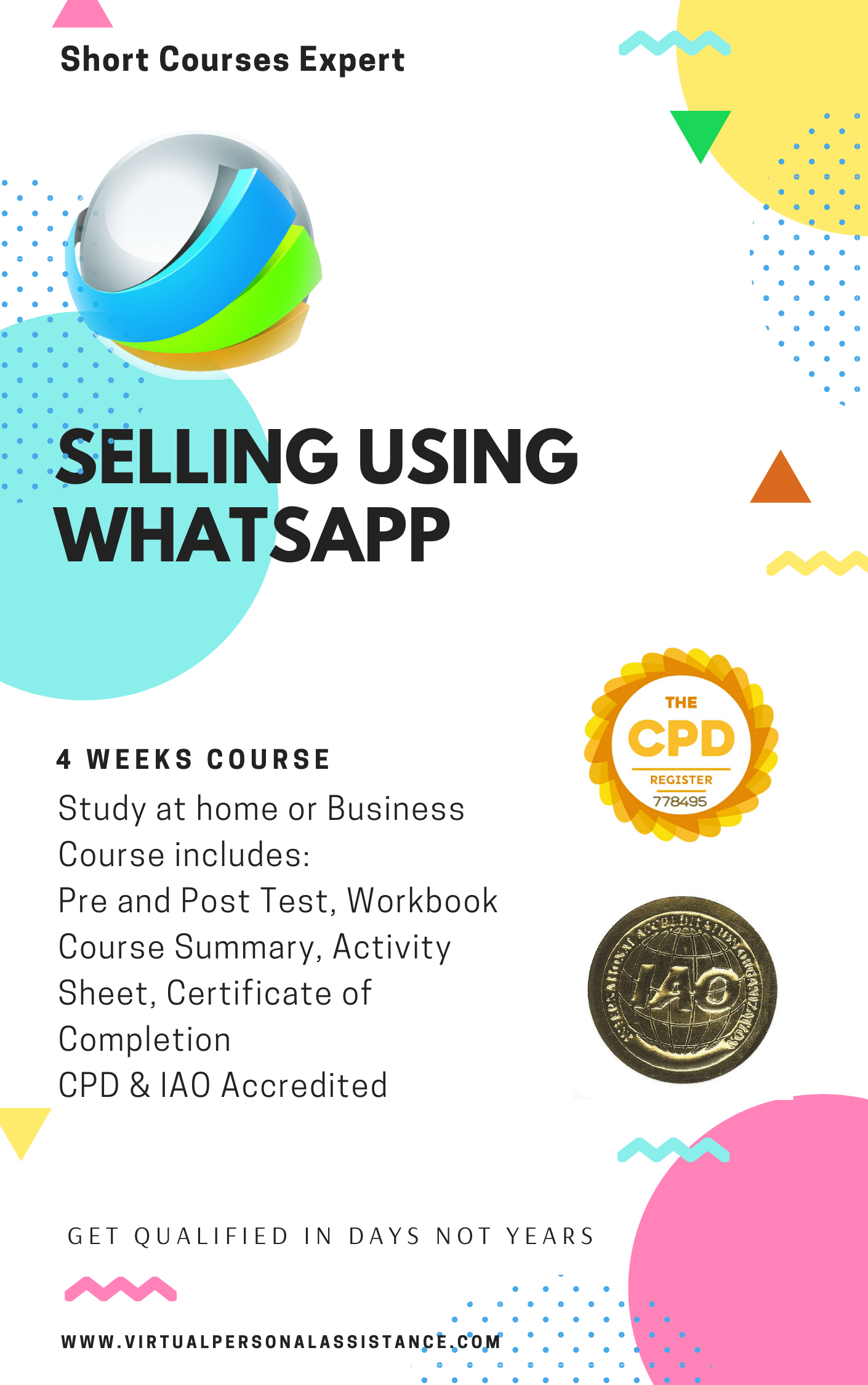
We train in soft skills courses like HR, PR, Management, Technology and Social Media to name but a few. CPD approved by the SRA to help you and your staff meet the challenges expected of skilled professionals.
Doing your CPD the smarter way

Doing your CPD the smarter way

You can study on the move using your smartphone, tablet or at our intense 1 day workshops.

Give us a call on 0203 551 2621 to request a quote or visit our http://www.avptglobal.com