Category Archives: online teaching

Worldclass Free Business Growth Bootcamp with Bill Walsh in London

Do you need to fine tune your big business idea?  Are you looking for a partner? Then this is an event not to be missed!

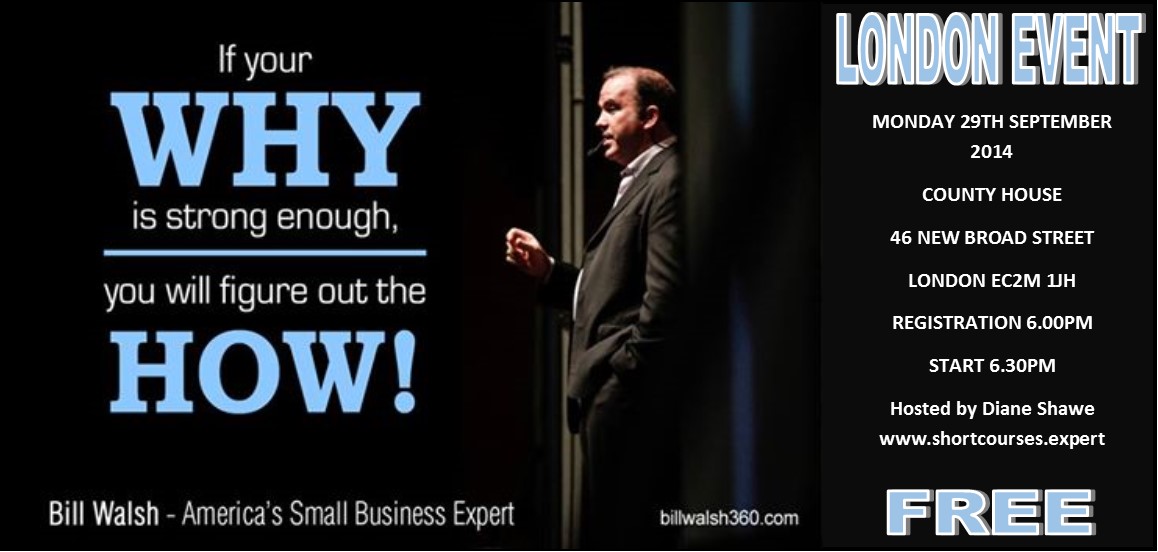
Bill Walsh free Business Growth Seminar in London hosted by Diane Shawe

Bill Walsh has agreed to come to the UK from the US and give a free Business Growth Session whilst I host a business success panel.To post your question to the panelists Click here 

Come to this free event and learn how to launch & build an even more successful business with one of the World’s most successful Business Coach. Normally to attend one of his sessions would cost over £1,000

When you attend you will have the opportunity to put your questions to our Business Panelist and network
with local business executives.

The educational focus is on Business Growth – Public Speaking and how to create your own VIP Masterminds. Plus everyone will receive some amazing gifts just for attending!

Here’s why you should attend:

Bill Walsh will discuss:

How to Monetise your Intellectual Property
How to Build a 12-Month Success Plan
How to Connect & Do deals with the Ultra-Successful
How to Become laser focused & ultra-productive
How to Monetise your Passion

For Complimentary Tickets visit CLICK HERE

Sponsored by Diane Shawe CEO of AVPT Ltd.

get mentoring with diane shawe business start up loans


Bill Walsh New book out now Oblivion Get your copy now

Do you have questions about Business Start up and Growth Bootcamp with Bill Walsh Millionaire Coach? Click here to register your question

If all the unemployed formed a country it would be the fifth largest in the world. Why does this matter?

Getting the world back to work with skills we can trust

Getting the world back to work with skills we can trust

Why the grip held by outdated educational institutions based on historical prestige needs to take a back seat and become student centric!

Article by Diane Shawe M.Ed

If we hadn’t had the most recent global economical crisis and the unrest in certain war torn regions had not occurred, there might have been 62 million more jobs in the world today, according to the International Labor Organisation as it is, there are over 200 million people looking for work across the globe.

To add to our worries: 75 million of these are young people, eager to take that first firm foothold in the ladder of success. We cannot allow them to become a “lost” generation.

The Great Recession has been particularly hard on older workers also, who have had difficulty finding new jobs after being unemployed for long spells. This is especially troubling because of their pressing needs for health care and retirement preparation.

It is also doubtful that the long-term unemployed are going to become more effective jobseekers simply by being forced to visit a Job centre daily if indeed they have a job centre in some parts of the world. But I am going to site that back in 1996, when the Jobseeker’s Allowance was introduced, the requirement to visit a Job centre every two weeks and provide detailed evidence of active job search did not raise overall job search effort among the unemployed.

If explicit job search requirements were not effective in a period of rapidly growing labour demand and falling unemployment, there is no good reason to expect them to be effective in the aftermath of a severe recession and one cannot certainly make a claim to recovery based on one geographical location sprinkled with opportunities driven by technology and property prices.

So clearly, jobs must be a preeminent priority in the years ahead. The major test of the new technological era is simple: can it provide decent livelihoods for all people?

Technology and rising inequality feeds into a broader concern: Technological advance creates a small cohort of big winners, leaving everybody else behind.

Certainly, those with the lowest skills are having the toughest time in today’s economy.

And yet, we also need to discuss what kind of growth this “right track” leads to. Will it be solid, sustainable, and balanced—or will it be fragile, erratic, and unbalanced?

To answer this question, we need to look at the patterns of economic activity in the years ahead, and especially the role of education, technology and innovation in driving us forward.

As Isaac Asimov—a master of science fiction literature—once said: “No sensible decision can be made any longer without taking into account not only the world as it is, but the world as it will be.” Isaac Asimov

So I have chosen a big topic and what I want to address in my blog today, in the form of three questions:

1. First, what does this new technological era mean for the economy, especially for jobs?

2. Second, how does it relate to one of the scourges of our age—rising inequality?

3. Third, what about some solutions, including vocational education and what I refer to as the growing need to foster a new thinking around “Entreployability”

The Interlinkages between Technology and the economy

Innovation is pushing ahead at warp speed. We are certainly living through one of the most exciting periods in human history. The pace of change is so fast that even the technology of five years ago seems prehistoric.

Those of you who are students probably do not even remember a time when phones were not smart, when cameras contained film, when texts meant school books, and when wireless was a word used for old-fashioned radio!

This advance is centered on the rise of a global digital network—the “hyperconnected world”—combined with the rise of genuine machine intelligence. Today’s smart phones are more powerful than yesterday’s supercomputers. We see cars driving themselves, printers making complicated three-dimensional parts, and robots doing the most complex tasks. “Science fiction” is rapidly becoming “science fact”.

What does this all mean for our lives and livelihoods, for our common economic future?

If the previous revolutions were about using machines for brawn, this is about using machines for brains. And since technology is powering a giant leap in global interconnectivity, these are “connected” brains! Just look at some of the trends.

Certainly, we can see some worrying trends. For a start, the effects of new machine technology are not showing up in productivity statistics—at least not yet—and productivity is by far the most important driver of long-term economic growth.

Now I am not an expert on the Economy, but we are all touched by it and using common sense I for one can see that there is a looming problem. For instance one of the biggest worries is how technological innovation affects jobs put simply will machines leave even more workers behind?

You may not want to give this a second glance but even seasoned professionals can find themselves cast adrift on an unfamiliar ocean.

Rising inequality

My second point about rising inequalities is going to be brief. But here’s a little statistic for you to consider. According to Oxfam, almost half the world’s wealth is owned by one percent of the population and, stunningly, the bottom half of the world’s population owns the same as the richest 85 people in the world.

What is causing such a convulsion in the distribution of income? There is no single factor here, although it seems clear that technology is one of the major factors—it can create huge rewards for the extraordinary visionaries at the top, and huge anxieties for the ordinary workers at the bottom. The speed at which information is sent around the world means that the average disgruntled people who make up the 5 largest country can amplify unrest as they all voice their fears to the small percentage of the world wealth holders.

What about some solutions?

So finally what is the purpose of education in today’s 21 Century, I quote Jane Stanford of Standford University — “with a “spirit of equality”. One of her goals for the university was “to resist the tendency to the stratification of society, by keeping open an avenue whereby the deserving and exceptional may rise through their own efforts from the lowest to the highest stations in life”.

What has happened? Why have these large institutions priced education out of these fundamental principles?

How can we make the new economic age enhance, rather than diminish, our humanity? How can we make this amazing innovation advance the prospects of all people?

It is clear that at the moment Educational systems are not keeping pace with changing technology and the ever-evolving world of work.

Not enough people are thinking strategically enough in this area. Fundamentally, we need to change what people learn, how people learn, when people learn, and even why people learn.

We must get beyond the traditional model of students sitting passively in classrooms, following instructions and memorising material. It is evident that computers can do that for us! A 21st century educational system must focus on the areas where humans can outclass computers—such as in cognitive skills, interpersonal skills, fine motor skills, or sophisticated coding skills. Maybe we need to remind ourselves of the purpose of education and vocational education. I summarise in my words the following:

The purpose of education

The first and foremost purpose of education is to educate and give everyone equal opportunity as a means to succeed in life. Education is a way of igniting and enlightening the thought of an individual.

It should help learners to discriminate between knowledge and ignorance, help to create a spark and create the sense of realisation with logic and a way to reason why the other things are illogical.

The purpose of vocational education

Every man must have a vocation – a trade, a business, or a profession – (if they are able too) in order to earn his livelihood so that they can support themselves, their family and people who cannot help themselves in our society. There are institutions for imparting various types of specialised training to help people qualify for this. The specialist is in demand everywhere, – in the office as well as in factories, in educational institutions and governments.

Conclusion.

The traditional belief that we must prepare ourselves to be ‘employable’ is under threat. The counter argument encourages us to ‘gear up’ for earning our own money, rather than seeing income as someone else’s responsibility.

With the population dramatically ageing and low-level jobs increasingly swallowed up by machinery, entrepreneurship will be a necessity for many, rather than a life-style choice for some.

SMEs are of course already leading this charge but in order to gear up for the future we need to start off by asking a serious question, defining criteria’s, and examining trends, impact these trends will have and plan a way to jointly prepare current and future generations to be both employable and entrepreneurial.

We are living in a new economy—powered by technology, fueled by information, and driven by knowledge. And we are entering the new century with opportunity on our side but huge problems that require new thinking.

The Question we should all ask ourselves?

Do you think you have another 20 – 30 years to live Yes [ ] No [ ]

Do you think you have another 30 – 50 years to live Yes [ ] No [ ]

Do you think you have another 50 – 70 years to live Yes [ ] No [ ]

Have you considered what you are going to do for the next 40- 70 years?

What will the job market look like in the next 20 years?

What will you be able to do to solve your problem which could be unemployment and patchy income streams?

What will you be able to do that will solve someone’s problem for which they will pay you a fee?

If computers might even replace our intelligence, they can never replace the capacities that make us truly human: our creativity and innovation, our passion.

So education must be the bridge between the present and future, the old and the new. But we must also build an enduring platform. By that I mean a new way of thinking about the global economy—the “new ©Entreployability the way forward.

Get your copy today from Amazon

This is helping an individual to develop their ‘©Entreployability assets’ which comprise of their knowledge (i.e. what they know), skills (what they do with what they know) and attitudes (how they do it).

To help them keep busy or at work; engaging their skills and attentions to employ themselves independently and maintain work.

To help them organise and manages their own business, contracts or employability.

To help them be available to be hired, provide them with a safe platform to encourage them to supply soft or hard skill for solving problems or being of service for which they will be paid by another party.

Making sure that the skill they have can be updated to help support them firstly, their family and community and economy.

Looking for a short course this September to fit into your lifestyle?

Express Training courses (AVPT) have taken out all the stress of retraining by offering over 390 globally accredited courses in a way that fits in with you and your lifestyle. Now that you’ve decided to invest in your professional development it’s time to choose a study style that suits you. You can either work through a home study manual study online with an allocated personal tutor or in the classroom for an intensive one, two or three day course.

You can be confident in your future success with our fully trained and qualified

short course manuals from expresscoursestutors, they’re as dedicated to your personal development as you are about landing that big promotion, starting that passion project of a business venture, retraining or making that essential career move.

You don’t have to wait until you get home to pick up a text book and start learning, all you need is a tablet a smart phone and an eager mind. With AVPT studying and fitting your professional development around your work life and personal responsibilities has never been easier or more rewarding.

With courses covering everything from Hotel management, Leadership Skills, Marketing and Sales through to Hair extensions and of course becoming one of our virtual teaching facilitators, taking the first step towards being a better version of you has never been easier. Get in touch today and you can boost your skills and be qualified in a matter of hours instead of months

Start your own business in less than a month

Start your own business in less than a month


Hair pulling disorder (Trichotillomania) often unreported article by Diane Shawe

Silent Sufferers of Trichotillomania

Silent Sufferers of Trichotillomania

Compulsive hair pulling, understanding and treating with hair extensions.

article by Diane Shawe M.Ed

Trichotillomania (pronounced /ˌtrɪkəˌtɪləˈmniə/ TRIK-ə-TIL-ə-MAY-NEE, also known as trichotillosis or hair pulling disorder) is an impulse disorder characterised by the compulsive urge to pull out (and in some cases, eat) one’s own hair leading to noticeable hair loss and balding, distress, and social or functional impairment. It appears in the ICD chapter 5 on Mental and behavioral disorders and is often chronic and difficult to treat.

Trichotillomania may be present in infants, but the mis conception that the peak age of onset is 9 to 13 understated to say the least.  It is estimated that 3.4 % of women suffer this and around 1.5% men.

Crowning Glory hair extension technique

Crowning Glory hair extension technique

It may be triggered by depression or stress. Owing to social implications the disorder is often unreported and it is difficult to accurately predict. Common areas for hair to be pulled out are the scalp, eyelashes, eyebrows, legs, arms, hands, nose and the pubic areas.

I have been involved in the hair extension sector for over 30 years.  I have seen clients attend my salon and whilst waiting to get their hair extensions put in I have witnessed them pulling their hair out.

Often these clients are unaware that they have a disorder are sometime highly strung or very nervous.

So what are the symptons?

People who suffer from trichotillomania are said to often pull only one hair at a time and these hair pull episodes can last for hours at a time. Trichotillomania can go into remission-like states where the individual may not experience the urge to “pull” for days, weeks, months, and even years.

I had a client who would bit by bit feel the urge to snip of single hair strands at a time and could not stop snipping with her very small scissors.  It was vital for her to have these scissors at hand at all times.

Individuals with trichotillomania exhibit hair of differing lengths; some are broken hairs with blunt ends, some new growth with tapered ends, some broken mid-shaft, or some uneven stubble. Scaling on the scalp is not present, overall hair density is normal, and a hair pull test is negative (the hair does not pull out easily). Hair is often pulled out leaving an unusual shape. Individuals with trichotillomania may be secretive or shameful of the hair pulling behavior.

Hook & Latch Technique No glue, threads or cornrows.

Hook & Latch Technique No glue, threads or cornrows.

An additional psychological effect can be low self-esteem, often associated with being shunned by peers and the fear of socialising due to appearance and negative attention they may receive.

Some people with trichotillomania wear hats, wigs, false eyelashes, eyebrow pencil, or style their hair in an effort to disguise the probem. There seems to be a strong stress-related component and some individuals with trichotillomania may feel they are the only person with this problem due to the low rates of reporting.

Hair dressers are usually the first to work with clients who may have this problem, and whilst washing, blow drying and back combing with hair spray or using big rollers under a hair dryer to add volume, this does not assist the client in the long term.

Hair enhancement (hair extensions) techniques have come a long way.  Techniques such as Crowning glory, Hair to skin, lace wigs, the net weave and the hook and latch can provide instant gratification.


During this process I have also witnessed the clients change of habit in pulling out their hair because they pay much more attention to not pulling out their hair extensions.

Habit reversal Training can help.

Whilst I agree that certain Habit reversal training (HRT) has the highest rate of success in treating trichotillomania. HRT has been shown to be a successful adjunct to medication as a way to treat trichotillomania. With HRT, the individual is trained to learn to recognise their impulse to pull and also teach them to redirect this impulse. I believe that hair extensions speed up this process because the suffer has a completely different mindset to the hair that has been added to help disguise their problem whilst giving the appearance of a lovely healthy head of hair.

Net Weave Hair enhancement technique

Net Weave Hair enhancement technique

Any hair enhancement technique should be light, non intrusive, well blended and easy to manage.  One of the most effective techniques could be the Hook and Latch hair extension technique.  However if the client has damaged the hair line, the most effective system would be a lace wig applied without using any bonding agents.

The Hair Extension Training Academy offer five hair enhancement techniques designed to work with clients who suffer from alopechia, trichotillomania, hair loss due to medication or severe thinning hair.

Try out our 1 day hook and latch hair extension technique course and you can see for yourself the benefits to the client.

1 day hair extension course for just 150.00 UK

Millions of grandparents expect to have to help fund their grandchildren through university

Grandparents up skill your grandchildren with a soft skills course

Grandparents up skill your grandchildren with a soft skills course

Millions of grandparents to fund grand children’s university education as students continue to struggle with high tuition fees

article by Diane Shawe M.Ed  AVPT

Due to the rising cost of tuition, it has been reported that grandparents are helping to bail out their family by contributing to the rising cost of education for their grandchildren.

Around one in eight over 55s think they will need to contribute to fees of around £9,000 a year, with many dipping into their savings to help out their grandchildren when they go onto higher education.

Researchers found as people got older more expected to make a contribution, 10 per cent of those aged between 55 and 64 planning to help with funding, which increased to 15 per cent for the over 65s.

Around 637,456 students applied to university in 2013, compared with 618,247 in 2012, which suggests people could be using their families to help them pay fees.

Accessing quality courses online and on the move

Accessing quality courses online and on the move

Ucas reveals 4% increase in the number of applicants to UK universities despite slight decline in number of 18-year-olds according to the Guardian’s report in  January 2014

The study of over 55s by Key Retirement Solutions found as many as one in eight grandparents – equivalent to 1.7 million over-55s – expect to have to pay towards their grand children’s university fees.

“The numbers of grandparents providing financial assistance for university tuition is set to rocket from current levels as the implications of the maximum £9,000 a year tuition fees become clear.

Young people from the worst-off areas in England are now almost twice as likely to apply to university as they were 10 years ago, according to the Ucas data.

But academics and policy experts said the buoyant figures masked some unhealthy trends, with wide gaps in participation and a worrying fall in the number of young men applying to university compared with women.

“With finances for the over-55s under strain from falling annuity rates and historically low savings rates taking on extra commitments requires careful thought and planning.”

Why online education will woo the person with the purse strings?

The higher-education model of lecturing, cramming and examination has barely changed for centuries. Now, three disruptive waves are threatening to upend established ways of teaching and learning.

Around the world demand for retraining and continuing education is soaring among workers of all ages. Globalization and automation have shrunk the number of jobs requiring a middling level of education. Those workers with the means to do so have sought more education, in an attempt to stay ahead of the labour-demand curve. In America, higher-education enrollment by students aged 35 or older rose by 314,000 in the 1990s, but by 899,000 in the 2000s.

So demand for education will grow. Who will meet it? Universities face a new competitor in the form of massive open online courses.
These digitally-delivered courses, which teach students via the web or tablet apps, have big advantages over their established rivals.

With low startup costs and powerful economies of scale, online courses dramatically lower the price of learning and widen access to it, by removing the need for students to be taught at set times or places.

This could eventually be the saving grace for lots of grandparents.

As one of the disruptive effects of the job market is the requirement for more people to develop and have doing skills, entrepreneur skills and all round communication skills, looking at short expert courses could be the best gift a grand parent or parent could give to their child.
AVPTGLOBAL almost 400 courses all globally accredited

AVPTGLOBAL almost 400 courses all globally accredited

Could you Access match funding up to £2,000 for every director and senior manager?

leadership and management training by short courses expert

leadership and management training by short courses expert

GrowthAccelerator is a premium service that helps England’s brightest growing businesses achieve their ambitions with rapid, sustainable growth. It’s a partnership between private enterprise and the UK government. And it’s affordable.


GrowthAccelerator’s network of world-class growth experts work side by side with leaders of high-growth potential small and medium-sized businesses to provide them with the know-how and ability to achieve sustainable growth. The service helps business leaders discover the real issues that could be holding their businesses back, define the right growth plan and open doors to world class business experts and networks.

What will my business get from GrowthAccelerator?

Each Growth Managers and coaches will help you:

  • Appreciate your true potential for growth and set achievable goals
  • Attract investment by developing your funding proposition and introducing you to funder – identify and overcome the barriers holding you back
  • Stimulate product development, commercialise your innovation and motivate your employees
  • Energise your plans with one-to-one leadership and management advice
  • Connect with business experts and networks to achieve insight and build relationships

About Growth Coaches:

  • Have proven track records in helping small and medium-sized companies accelerate and sustain their growth, in every size, region and sector
  • Have made the same journey themselves so they know what it’s like to fight for success.
  • Know when to talk, when to listen, and how to lead you to ideas that will transform your business.

Leadership and Management

A great leader can make a business thrive. But having a whole team of great leaders could propel your business into rapid growth.

If investment in your leadership team is crucial to growing your business, GrowthAccelerator, with Government backing, can make a financial contribution that makes your commitment even more worthwhile – invest in your team and GrowthAccelerator will too.

This is where the Academy of Vocational & Professional Training can help as one of the registered training providers we can deliver your Leadership and Management training.

Access match funding up to £2,000 for every director and senior manager

To develop and empower your leadership team during your next drive for business growth, GrowthAccelerator offers match funding of up to £2,000 for every senior manager involved in the strategic direction of the business, to undertake leadership and management training recommended for your business.

Different directors and senior managers will be able to take different types of leadership and management training and you’ll be able to apply for training once you are signed up to GrowthAccelerator and have paid your invoice – with the proviso that training begins within 90 days of match funding being approved.

Any leadership and development training that you need will be given alongside other core workshops, masterclasses and coaching that your Growth Manager recommends in your growth plan. GrowthAccelerator has a team of Leadership and Management Specialists who will recommend the best training for your business needs.

Training eligible for match funding through GrowthAccelerator will fall under the following key areas:

  • Developing an effective personal leadership and management style
  • Leading and managing high performance
  • Planning and developing an effective organisation
  • Creating a joint enterprise culture
  • Sustaining growth and continuous improvement
  • Embedding a culture of innovation
  • New market entry

Is your business eligible?  

If your business is registered in England, has fewer than 250 employees and a turnover of less than £40m contact us on 0203 551 2621.

What do you have to invest?

This is done through the official GrowthAccelerator Managers. GrowthAccelerator is a partnership between private enterprise and government which means we can keep the service affordable. Because Government is investing with you in the growth of your business, the cost to you is significantly reduced. Your investment in GrowthAccelerator will reflect the size of your business:

Micro and start-up businesses (1 to 4 employees) – £600 + VAT

Small businesses (4 to 49 employees) – £1,500 + VAT

Medium-sized companies (50 to 249 employees) – £3,000 + VAT

source Main growthacceleraor website

If you would like to read about the GrowthAccelerator programme and what it has helped businesses achieve in its first year of operation please click here.


You will need to talk to a growth accelerator Manager initially in order for them to process your application and suitability. Call us and we will refer you to our Growth Accelerator Manager.

Does managing change manangement change anything

order your home study manualIt would seem that the world is changing fast, but has it been any slower than it was before?  Technology has helped to give the perception of  speed.  Sometimes we can feel out of control as things around us shift an often the ground from under our feet tremble with change.

article by Diane Shawe M.Ed

Responding to today’s kind of changes requires a new set of skills. Different levels of understanding, self leadership and governance.

What are the seven key areas one needs to consider and build into a Change management programme to aid collective understanding and collaborative progress?

Defining Change?

  • Why organisations or people fail?
  • What are various types of change?
  • What are various phases of growth?
  • What are major established theories on change management and how do they compare with each other?
  • What is the difference between leading and managing?

How Change Affects People

  • How do people respond to change?
  • What goes through people’s mind when they are confronted with change in different stages?
  • How ideas spread and what does this mean for change management?

How Organisational Change Works

  • What are the 8 stages of change and what should you consider in each stage to maximise the likelihood of success?
  • What are the principles of effective change?
  • What are the common problems when managing changes that if neglected can seriously impact the change process?

Managing Resistance

  • Why people resist change?
  • How can you deal with this resistance?
  • What are the techniques available to persuade people on change?
  • How can you engage stakeholders considering their power and interest?

How to Manage Change

  • What are the critical three components of a change management programme?
  • What tools can you use to manage and monitor employee skills and identify skill gaps?
  • How to develop employee skill profile?
  • What are various options in filling these skill gaps and what are each methods advantages and disadvantages?

Mentoring, Coaching and Motivating

  • How critical is motivation in the context of change management?
  • What is Skill/Will Matrix and how can you use it for coaching and managing change?
  • What is mentoring, what is coaching and what is the difference between them?
  • How can you use the GROW model to provide effective coaching?

Management Tools

  • What are the tools used for brainstorming ideas on change and structuring your plans and activities?
  • What tools can you use to identify what works for change and what works against it?
  • What tools can you use to monitor the scope of change and make sure that your plans are consistent and are applied at the right level?

Business Managing public relations home study course Conflict resolution, dealing witn difficult people home study course effective feedback home study course Entrepreneurship home study course Influence and persuasion home study course

What are the 10 less flashy skills employers want?

It can take up to 3 days to gain a new soft skill with expresscourses.co.uk

It can take up to 3 days to gain a new soft skill with expresscourses.co.uk

The less flashy skills are the ones really dominating employers selection criteria.

article by Diane Shawe CEO AVPT

“Knowing which skills are in high demand can help guide decisions around education and work experience,” says Diane Shawe CEO of Academy of Vocational and Professional Training UK. “It can help workers identify where they can potentially transfer their current skill sets or supplement their education to prepare for future opportunities.”

No. 1 Critical Thinking (found in 9 out of the 10 most in-demand jobs)

Using logic and reasoning to identify the strengths and weaknesses of alternative solutions, conclusions or approaches to problems.

No. 2 Complex Problem Solving (found in 9 out of the 10 most in-demand jobs)

Identifying complex problems and reviewing related information to develop and evaluate options and implement solutions.

No. 3 Judgment and Decision-Making (found in 9 out of the 10 most in-demand jobs)

Considering the relative costs and benefits of potential actions to choose the most appropriate ones.

No. 4 Active Listening (found in 9 out of the 10 most in-demand jobs)

Giving full attention to what other people are saying, taking time to understand the points being made, asking questions as appropriate and not interrupting.

No. 5 Computers and Electronics (found in 8 out of the 10 most in-demand jobs)

Knowledge of circuit boards, processors, electronic equipment and computer hardware including applications and programs.

No. 6 Mathematics (found in 6 out of the 10 most in-demand jobs)

Knowledge of arithmetic, algebra, geometry, calculus, statistics and their application.

No. 7 Operations and Systems Analysis (found in 5 out of the 10 most in-demand jobs)

Determining how a system or operation should work and how changes in conditions, operations and environments will affect outcomes. Understanding the needs and product requirements of a particular design.

No. 8 Monitoring (found in 5 out of the 10 most in-demand jobs)

Monitoring and assessing performance of yourself, other individuals or organizations to make improvement or take corrective action.

No. 9 Programming (found in 3 out of the 10 most in-demand jobs)

Writing computer programming for various purposes.

No. 10 Sales and Marketing (found in 2 out of the 10 most in-demand jobs)

Knowledge of principles and methods for showing, promoting and selling products or services. Includes marketing strategy and tactics, product demonstration, sales techniques and sales control systems.

Click to order your copy today

Click to order your copy today


Why employers and training organisations need to take heed of this global trend

Diane Shawe CEO AVPT

Diane Shawe CEO

The Changing face of Skills and Training

article by Diane Shawe M.Ed CEO

In a report conducted by Kelly Global Workforce Index in 2013 over 120,000 respondents from 31 countries across the Americas, EMEA an APAC regions where asked several questions about Skills and Training.

When asked to identify the main motivation for earning new skills or undertaking training, the largest share of employees 57% cited the opportunity for promotion with their current employer. A further 47% cited the opportunity to work in another organisation, and 42% planned to enter a new field of work.

Globally, 60% of worker are either actively seeking further education or training (23%) or considering it (37%).  The APAC region stands out as a skilling hotspot, with 69% of those surveyed either considered or seeking further training for a new field.

Across the globe, there are markedly different approaches to the notion of additional training and professional development. The highest rates of planned upskilling are predominantly in developing economies, while the lowest rates tend to be in some of the most prosperous nations.

Russia heads the list for training intensity, with an astonishing 92% planning some form of training. Also high on the list are Thailand, Mexico, Brazil, Indonesia, Puerto Rico and Malaysia.

Surprisingly the lowest rates of planned training are in France, Luxembourg, the US and Switzerland.

Among professional and technical employees, those most likely to be actively seeking to upgrade their skills are in Math, Engineering and IT, while the least likely are in Science, Health Care and Education.

Investing in Training that Works

For training to be meaningful it needs to be relevant and practical – not “training for training sake”.

When asked to identify the mot desirable means of furhering their skills, the overwhelming preference was for on-the-job experience and training, identified by 70% of respondents, significantly ahead of the next hightest ranked “continued education and training” cited by 58%

Building a durable Skills base

The last two decades have radically altered the way skill are acquired and developed. Skill are no longer “front-end loaded” onto a career. Rather they are increasingly embedded as part of lifelong learning and development.

The upgrading and renewal of skills plays a critical role in personal and professional development. It also has a vital role in broader workforce development, which is the cornerstone of organisational efficiency and productivity.

All skills have a finite life, and in industries subject to high rates of technological change and innovation, the lifespan of skills is becoming shorter. Increasingly, new skills will need to be learned and deployed throughout a working life.

It is clear that decisions about training and professional development are now an integral part of the employment equation, and have an important bearing on employee moral, performance and retention.

What Employers can do

  • Consider opportunities for training and personal development.
  • Help to build a culture of continuous learning so that employees are encouraged to develop and use new skills
  • Encourage employees to think about career plans and the type of skills and training they need to stay equipped.
  • Consider training as a key element in employee attraction and retention.
  • Champion individuals who have devoted time to upskilling so they can become ambassadors for an organisation.

The landscape has changed

The scale and duration of the downturn has forced may employees to look afresh at the whole area of training and professional development – one that was previously guided by employers.  Employees now recognise that they cannot solely rely on an employer to direct in this important element of their lives.

A new generation of workers is taking on much greater responsibility for their training and professional development, including the way it is provided and funded.

The global economic shock-waves have unleashed a new orthodoxy and a unforeseen outcomes has a new generation of employees are more independent, globally focused and adaptive.  The new challenges for global employers is to understand why the landscape has changed and prudently look beyond the present and where the best skilled workforce will be and what work will look like in 10 or 15 years.

Call us to enquiry about our soft skills courses

Call us to enquiry about our soft skills courses


How Blended Education Makes Learning Process More Efficient

Photo courtesy of Guilia Frsythe

Photo courtesy of Guilia Frsythe

As internet connectivity and smart devices become every human being’s daily companion, with 1.75 billion users worldwide as eMarketer reported, more and more academic institutions are now leveraging the power of technology to re-invent the traditional classroom learning model.

The 2013’s United States Education & Workforce Committee study said that 31 states are now offering full-time eLearning tools to almost 275,000 K-12 students and 70% of all US school districts are now integrating blended learning (BL) programs in their curriculum.

One of the biggest trends in the academy, BL is a teaching approach that combines face-to-face learning through online-based instructions/activities. To facilitate, students are allowed to use their smart devices to do research, work on activities, complete their assignments, seek consultations, and consume digital learning resources in or outside the campus. But, how can this teaching methodology make learning efficient? Read on our discussion below as we further elaborate the topic.
Learners Are More Engaged

The infusion of online learning tools and traditional classroom lectures expands the learning resources being offered to the students. Apart from textbooks, teachers can pull out relevant video materials online and project it in front of their students to explain the topics further. Educators can also showcase online slideshows and interactive web applications to further strengthen their class discussions.

With BL, the possibilities of getting a reliable learning resource are endless. With the advent of video conferencing, students and teachers can go beyond the four corners the classroom. For instance, in foreign language topics, this innovative tech solution can be maximized in arranging live language lessons from native speakers worldwide. It can also be utilized when facilitating lectures on different cultures worldwide.
Students are safely browsing

The common concern with this learning strategy is that students are widely open to various content online, such as social media and online games that are deemed to be distracting in class. However, with the latest mobile technology today, we are now presented with devices that can block or curate content specifically for students only. One of the biggest brands Apple launched its own Kid’s App Store where students can only access curated educational apps and games. The latest Samsung smartphones, including the Galaxy S5, are also equipped with Kids Mode that let’s one set some parental control on the device, as featured on this source. As for Nokia’s Lumia range of Windows Phone devices, Microsoft also designed a special feature called Kid’s Corner which allows parents to choose the kind of apps and digital content they can only view and access. These innovations minimize the apprehensions that most parents and traditional educators have towards smart devices.

Teachers Can Access and Create Various Educational Content

Since the Bring Your Own Device (BYOD) policy is a part of this learning strategy, educators are given the opportunity to easily design a variety of content types tailored to their students. Apart from online blogs and Massive Open Online Courses (MOOCs) where professors can access a myriad of educational content (infographics and video lectures), they can also access mobile applications and e-Books to accompany their lectures.

The Academy of Vocational and Professional training are also currently the leaders on online Soft skills courses which are mobile device compliant, globally accredited and accessible 24/7

Since mobile devices nowadays are equipped with media creation tools, teachers can even create or design their own content to accompany their discussion. For instance, with many of the apple and android tablets,  are empowered to create slide shows with engaging music. The free movie making tool can also help them create video presentations combining photograph, audio, and text element.  It’s worth checking out the Samsung and iPad apps.
Makes Students More Engaged

Timothy HuneyCutt of National Math + Science Initiative pointed out that when “technology is integrated into school lessons, learners are more likely to be interested in, focused on, and excited about the subjects they are studying.” In subjects that may appear monotonous to selected students (such as Science and Math), teachers can use virtual lessons and one-on-one tutoring to encourage them to learn.
how to get your online website to attract clients free seminar 2014

Students Can Learn At Their Own Pace

Failure to digest the educator’s lecture can lead to students’ discouragement towards learning. With BL, if they fail to understand a particular lecture, they can ask their instructor to give them individualised instruction or learning materials through emails, video-conferencing, and social media channels. Students who are shy to speak out in the class through face-to-face on-campus discussion are also given the opportunity to shine and excel in class through BL.

BL can further enhance students’ learning by integrating technology and online resources to support the traditional face-to-face lectures. As we move to a more digital era, where handsets are now wearable and voice command accessible, we should see more improvements in educational technology in the coming years.

Blog by Jennifer Birch

Blog by Jennifer Birch

About the Author

As an EdTech advocate, Jennifer Birch believes in the power of Blended Learning. For her, the infusion of online learning tools and traditional classroom expands the learning resources being offered to the students. Connect with Jenni via Google +.