Category Archives: Hair Extensions courses

Are Emerging Demographics reshaping New Emerging Markets

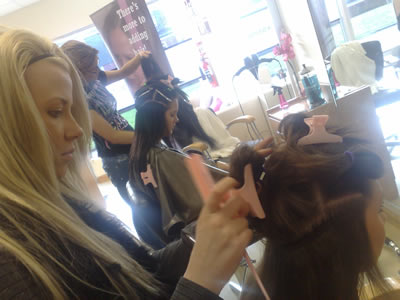
Hair extension staff training (1)

Creative ways to find new customers

Emerging Demographics Are the New Emerging Markets

Guest Blog Richard Dobbs Jaana RemesJonathan Woetzel

Marketing savvy just isn’t enough to track consumers anymore. Companies will need a more detailed portrait of target customer groups than ever, including their age, income, ethnicity, and shopping preferences. But what could this mean for small businesses?
A radical demographic shift is transforming the nature of consumer markets. Until the turn of the century, population growth powered more than half of global consumption. As population growth slows, that will fall to only one-quarter in the next 15 years.

Per capita spending will be the engine of consumption growth. In this new world, companies need to know which consumers have the purchasing firepower, where they are, what they want to buy, and what drives their spending.

There are surprises. For example, people aged over 50 bought nearly two-thirds of the new cars sold in the United States in 2011. McKinsey Glog research finds that China is expected to spend 12.5% of all consumption growth on education for those under 30 — higher than any other country apart from Sweden. Young people in China are learning to love coffee. And North American millennials don’t trust company claims about their products, but are happy to let a room in their house to a stranger who they trust because of an Airbnb rating.

A recent report by the McKinsey Global Institute, Urban World: The Global Consumers to Watch, has identified three key groups of urban consumers with the numbers and purchasing power to shape the consumer landscape over the next 15 years. One thing common to all the groups is their location in cities. Over 91% of world consumption growth over this period will come from city-dwelling consumers.

The first of these is the 60-plus age group in the United States, Western Europe, and Northeast Asia. Their number will grow by more than one-third to stand at 222 million in 2030. In those 15 years, they will generate more than one-third of global consumption growth. In comparison, European millennials, for instance, will contribute less than 2%. The young may be the darlings of marketers, but for companies chasing growth, the truly glamorous market is the elderly.

To give an idea of their dominance, the 60-plus age group will account for 60% of total urban consumption growth in Western Europe and Northeast Asia, the latter comprised of Japan and South Korea. This group, not surprisingly, spends heavily on healthcare, but that’s not all. In the United States, these consumers will contribute more than 40% of consumption growth in housing, transport, and entertainment. A decade ago, those aged 55 and older accounted for less than one-third of all U.S. spending on home improvement. By 2011, this share was more than 45%. Companies in every sector — some of which have never been associated with the elderly — will need to prioritize this market as never before.

The second group is China’s working-age consumers age 15–59. Their numbers are set to rise by 20% or 100 million people in just the next 15 years and their per capita consumption is expected to double. By 2030, they will be spending 12 cents of every $1 spent in cities worldwide. These individuals are more optimistic about their financial future and willing to spend a greater share of their disposable income than their counterparts in previous generations.

The 2016 McKinsey Global Sentiment Survey of more than 22,000 consumers finds that nearly 30% of these Chinese consumers are willing to pay more for new and innovative household products—double the share of their counterparts in North America and Western Europe. These consumers are the successors to Western baby boomers who were, in their time, the richest in history in their prime years.

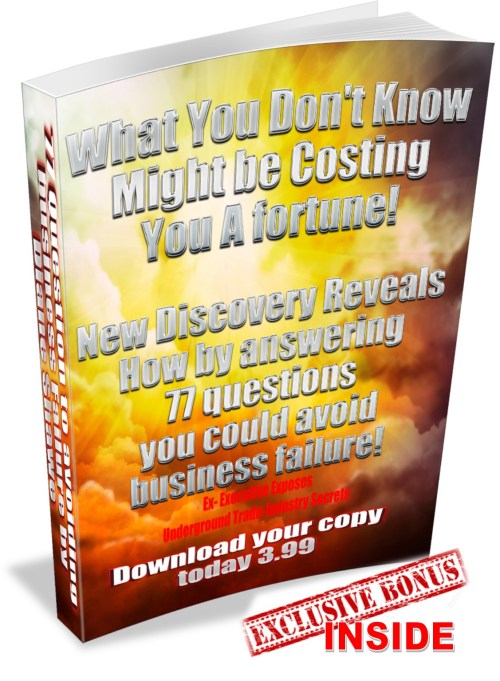
77 Questions to avoid business failure by Diane Shawe with Exclusive Bonus

Get your exclusive copy today and save £3.00

Third is North America’s working-age consumers. They already constitute a major market, and will continue to grow modestly in number and per capita spending. But they also pose new challenges to companies, because inequality is rising, and most incomes are under increasing pressure. Today, the median net worth of the top 20% of young adult households is eight times that of the other 80%; as recently as 2000, that multiple was four times. That means companies need to work harder to offer goods and services at very different price points. Compared with older cohorts, young adults are 10 to 20 percentage points more likely to consider and use sharing economy services from accommodation to car rental to furnishing. The behavioral differences for this age group require new customized strategies from companies seeking their dollars.

The consumer markets that matter have arguably never been more varied and complex. Rising inequality is one challenge. Another is that, as population growth slows, city demographics — and therefore their growth prospects — are diverging. Companies need to be in the right places. Cities are where 91% of global consumption will take place over the next 15 years – the trick will be knowing which cities, and even which neighborhoods within cities will house the highest-spending consumers.

Richard Dobbs is a senior partner in McKinsey & Company’s London office.
Jaana Remes is a partner at the McKinsey Global Institute.
Jonathan Woetzel is a director at the McKinsey Global Institute.


Why are they contaminating bottled spring water?

Bottle-of-water-and-floride doane shawe
Most Bottled Water is FILLED With Fluoride, Here’s a Complete List of Brands to Avoid

“Fluoride seems to fit in with lead, mercury, and other poisons that cause chemical brain drain,”Grandjean says.
“The effect of each toxicant may seem small, but the combined damage on a population scale can be serious, especially because the brain power of the next generation is crucial to all of us.”

As with other fresh water supplies (e.g., spring water, lake water, river water), bottled waters have low levels of fluoride.
Fresh surface water contains an average of just 0.05 ppm. To put this in perspective, artificially fluoridated water (using industrial-grade fluoride chemicals) contains 0.7 to 1.2 ppm fluoride, which is 14 to 24 times more than the average natural level.

Fluoride Health Problems

There is a lot of controversy surrounding the presence of fluoride in public drinking water (fluoridation). For starters, before fluoride was used to fight cavities, it was (and still is) used in insecticides and rat poision.

Fluorosis is a condition that wears down the enamal of the tooth, leaving behind white spots, making the teeth more vulnerable to cavities and decay. Fluorosis is a very real health condition that can effect both children and adults. More and more evidence is mounting against the use of fluoride, even in small amounts. But it doesn’t appear to be a critical issue according to the US Surgeon Generals, as the last 5 Surgeon Generals have supported the fluoridation of drinking water. Incidentally, the claimed health benefits almost always point to oral health. Fortunately, the CDC is calling for new labeling rules requiring manufacturers to list a product’s fluoride content, which we have found to be missing in some cases.

What is too much Fluoride?

Fluoride itself is actually required by our bodies in low doses. When consumed in high amounts, specifically the man-made fluoride that is in public drinking water, can cause problems.

An estimated 5-10g of sodium fluoride can be lethal for some adults. While fluoride provides benefits to your oral health, it can also come with adverse side effects, that vary in severity depending upon the amount of fluoride consumed. Excessive consumption of fluoride can lead to gastrointestinal discomfort. This can occur with doses 15 to 20 times lower than actual lethal doses (0.2-0.3mg/kg). Fluoride in exessive amounts can also cause problems in the formation bone.

Here are some bottled water brands that contain little to no fluoride:

  • A Better Water
  • Agromas Natural Mineral Water
  • Albertsons
  • Alpina
  • American Fare
  • American Star
  • Appco
  • Aqua Fresca
  • Aqua Panna
  • Aqua Pure
  • Aquarius Natural Mineral Water
  • Arbor Springs
  • Arlington Springs
  • Aquafina Water
  • Aqua Systems
  • Aqua Von
  • Artesian Wells
  • Augusta Medical – Daniels
  • Badger Water
  • Besco Pure Premium Drinking Water
  • BIOTA Colorado Pure Spring Water
  • Bio-2
  • Black Berry Farms
  • Blue Ice Natural Mineral Water
  • Boney’s
  • BORNEO
  • Bountyland
  • Buches
  • Calistoga
  • Callaway Blue
  • CAPA
  • Cascade
  • Century Springs
  • Chemung
  • Chippewa Spring Water
  • Citi Stop
  • Classic Selection
  • Clearly Arctic
  • Clear Mountain Spring Water
  • Clover Company Limited
  • Coach
  • Cold Country
  • Cohutta Mountain Spring Water
  • Cowboy Squeeze
  • Crowne Plaza Drinking Water
  • Crowne Plaza Natural Mineral Water
  • Cruel Jacks Spring Water
  • Crystal Mountain Spring Water
  • Crystal Point
  • Crystal Ridge
  • Crystal Spring Natural Spring Water
  • Culligan Water
  • Dakota Splash
  • Dannon
  • Deep Rock
  • Deep Rock Crystal Drop
  • Deep Rock Fontenelle
  • Deja Blue
  • Desert Quench
  • East Phils
  • Eco Quest
  • Elite
  • Equatorial Natural Mineral Water
  • Essentia Water
  • Eureka
  • Evian
  • E Water
  • Family Pantry
  • Famous Ramona Water
  • Flowing Springs
  • Food Club
  • Founders Square Bank
  • Fresh Brands Artesian
  • Fresh Brands Distilled Water
  • Fresh Brands Drinking Water
  • Fresh Market
  • Get-N-Go
  • Glacier Bay
  • Glen Summit Springs Water
  • Glen Summit Distilled Water
  • Glenwood Inglewood
  • Gordon Food Service
  • Great Bear
  • Great Value
  • Harvey’s
  • H2O4U
  • Henry’s
  • Hidden Valley Natural Mineral Water
  • Hillcrest Distilled Water
  • Hillcrest Drinking Water
  • Hillcrest Spring Water
  • Hilton PJ Natural Mineral Water
  • Hinckley Springs
  • HINT
  • Hi-Sprint Drinking Water
  • Hi-Sprint Natural Mineral Water
  • Hog Wash
  • Hon Less Natural Mineral Water
  • Ice Jam
  • Inland
  • Istana Natural Mineral Water
  • Joe Muggs
  • Joe Ragan’s Pure Water
  • Junior Johnson
  • Just Squeezed
  • KLGCC Natural Mineral Water
  • Kroger Bottled Water (Reverse Osmosis)
  • Krystal J Artesian Water
  • Krystal J Distilled Water
  • Laure
  • Leroy Jenkins Ministries
  • Logansport Savings Bank
  • Lowe’s
  • Martins
  • Masafi Pure Natural Mineral Water
  • Mercurio Produce
  • Mesra Drinking Water
  • Mesra Natural Mineral Water
  • Misty Mountain
  • Monadnock Mountain Spring Water
  • Montclair
  • Mountain Energy
  • Mountain Forest
  • Mountain Valley Spring Water
  • Mutiara Natural Mineral Water
  • Nantze Springs
  • New Frontier Bank
  • Niagra Mist
  • Nicolet Distilled
  • Northern Illinois University
  • Oasis Pure Drinking Water
  • Oasis Sparkling Water
  • Ogallala – Clear Cool Water
  • OUI Drinking Water
  • OUI Natural Mineral Water
  • Paiges
  • Parmer Pure H2O
  • Patriots Choice
  • Pelangi Natural Mineral Water
  • Penta Ultra Premium Purified Drinking Water
  • Piggly Wiggly
  • Polaris Water
  • Pristine Natural Artesian
  • Purely Sedona
  • Quick Stop
  • Rain Soft
  • Refresh Natural Mineral Water
  • Reiser Drinking Water
  • Request Foods, Inc.
  • Rip Time
  • Roundy’s “Purified Water”
  • Safeway – Refreshe
  • Sam’s Wine & Spirits
  • San Faustino Natural Mineral Water
  • San Pellegrino
  • Santee Springs
  • Scheopner’s Water
  • Sequoia Springs
  • Scotts
  • Shamrock
  • Shop-N-Cart
  • Shur-Fine
  • Silver Creek Purified Water
  • Silver Creek Spring Water
  • Sky Drinking Water
  • Smart Water
  • Snow Valley
  • Spinx
  • Stator Bros. Markets
  • Summit Mountain
  • Summit Springs
  • Summit Valley
  • T-Rex
  • Teton Mountain Lodge Spring Water
  • Tweetsie
  • United Dairy Farmers
  • Volvic
  • Vitamin Water
  • Veta Drinking Water
  • Valutime
  • Whistler Water
  • Whole Foods 365
  • Woodland Spring Water
  • Wyoming Machinery “Catipillar” Spring Water
  • Zodiac

List of brands to avoid that are known to be high in fluoride:

  • Alhambra
  • Arrowhead
  • Belmont Springs
  • Crystal Rock
  • Crystal Springs
  • Deer Park
  • Diamond Springs
  • Hindley Spri
  • Ice Mountain
  • Kandiyohi
  • Kentwood Springs
  • Mayer Bros.
  • Mount Olympus
  • Nursery Water
  • Ozarka
  • Poland Spring
  • Pure Flo
  • Puritan Springs
  • Shenandoah
  • Sierra Springs
  • Sparkletts
  • Zephyrhills

The list contains data provided by the International Bottled Water Association that you can use to make sure you’re not feeding fluoride to yourself and your family.

Source: http://www.foodandourhealth.com/

 SHORT COURSES TRAINING

Don’t let others failures make a monkey out of you

Fear of failure and not standing out from the crowd will not get you far up the ladder of success

article by Diane Shawe M.Ed. Ed
Four monkeys were placed in a room that had a tall pole in the center. Suspended from the top of that pole was a bunch of bananas. One of the hungry monkeys started climbing the pole to get something to eat, but just as he reached out to grab a banana, he was doused with a torrent of cold water.

Squealing, he scampered down the pole and abandoned his attempt to feed himself.

Each monkey made a similar attempt, and each one was drenched with cold water. After making several attempts, they finally gave up.

Then researchers removed one of the monkeys from the room and replaced him with a new monkey. As the newcomer began to climb the pole, the other three grabbed him and pulled him down to the ground.

After trying to climb the pole several times and being dragged down by the others, he finally gave up and never attempted to climb the pole again.

recruiting and training winners for your busines

The researchers replaced the original monkeys, one by one, and each time a new monkey was brought in, he would be dragged down by the others before he could reach the bananas.

In time, the room was filled with monkeys who had never received a cold shower. None of them knew why.

DON’T LET FAILURE MAKE A MONKEY OUT OF YOU!


3 Personality Types that will Suck your Positive Energy out of your business

recruiting and training winners for your busines

Don’t let toxic people kill your business or energy

It will come as no surprise to some of you but, there are three personality types that could end up sabotaging your small business, management committee or think tank team to the point where you end up not working on your business or project but working in it.

Most of us have been there.  That one personality that just drives you to distraction and no matter what you do, they seem to be in complete denial.

A staggering number of small businesses have sprung up since 2014 according to the FSB 2015 report.

  • There were a record 5.4 million private sector businesses at the start of 2015.
  • This is an increase of 146,000 since 2014 and 1.9 million more since 2000.
  • The number of employing businesses increased by 35,000 and the number of non-employing businesses by 112,000, with the annual growth for both groups being around +3%.
  • Small businesses accounted for 99.3% of all private sector businesses at the start of 2015 and 99.9% were small or medium-sized (SMEs).
  • Total employment in SMEs was 15.6 million; 60% of all private sector employment in the UK.
  • The combined annual turnover of SMEs was £1.8 trillion, 47% of all private sector turnover in the UK.

Most of these business owners would have experienced high staff turnover, partnership problems, customer complaints all of which then culminate into cash flow problems or problems with people who become perpetual saboteurs.

Lets take a look at the personality types

1 People Who Like to Be Right

2 People Who Like to Be Comfortable

3 People Who Like to Be Liked

4 People Who Like to WIN

So most of us when we are looking for someone to join the team, we are often working with a low budget which does not stretch to complicated personality assessment or expensive recruitment companies who want large upfront fees. So we tend to end up going on the ‘Oh you CV is impressive’ or ‘WoW we really get on’ or ‘Yes you so get my business needs’

But is that really enough?

Here are some key indicators that the person you’re working with or about the hire may have such a  personality type:

#1 People Who Like To Be Right

  • They challenge your coaching
  • They argue with you
  • They say “I know that” but then do not take action
  • Have difficulty receiving feedback
  • Need to have the last word
  • Need to justify their choices

This personality type will make it difficult when it comes to creating duplication, receiving and implementing constructive ideas if they’re building a business with you.  At the interview they may make you feel uncomfortable, but impress you at the same time.

#2 People Who Like To Be Comfortable

Here are some key indicators that the person you’re speaking with fits this personality type:

  • Afraid to take risks
  • Fine with watching TV every night instead of focusing on their business growth
  • Has difficulty implementing coaching
  • Comfortable in the current situation that they’re in
  • Very specific on task and hours of work

This style of person will struggle with being a self-starter and will consistently need motivation from YOU in order to build and grow the business. At the interview they may state a lot about the type of people they don’t like which could be describing themself.

#3 People Who Like To Be Liked

Here are some key indicators that the person you’re speaking with fits this personality type:

  • Need approval from others
  • Don’t want to rock the boat
  • People pleaser
  • Loves life when everyone is happy around them
  • Will say yes to others even if they disagree
  • Are afraid of going against the grain and looking different

This personality will have a very hard time with difficult conversations will often appear very latargic and not very helpful.  They don’t want to be seen as the bad guy or gal. At the interview you may not be able to quiet put your finger on it, but you might like them because they seem as though they might not give you any trouble.

The Ultimate Personality For Building A Massive Army Of Implementers

#4 People Who Like To WIN

Here are some key indicators that the person you’re speaking with fits this personality type:

  • Ready to take on challenges
  • Have a clear vision of what they want and how they’re going to get there
  • Coachable
  • Adapt quickly
  • Competitive
  • Have a thick skin and don’t care about what others think
  • Desire for self growth

When you identify this kind of personality, act fast and figure out how to work with them, because they’re going to be successful with or without you. At the interview they may come across as enthusiastic and focused.  Might also want to bring ideas to the table even before they have the job.

Can People Change?

Do you really think it’s possible to change someone’s personality to make them someone who wants to win?

What if there was an easy way to take a look at a  personality type so you could better plan how to work with them and help them become a winner?

Check out our Clarity4d Profiler and learn how it could benefit you and your team

The Prince’s Trust launches new Achieve programme for 13-19 years old

Helping the youths to achieve more

Helping the youths to achieve more

The Prince’s Trust has launched a new programme designed to support young people who are at risk of underachieving at school or college to engage with and succeed in education.

The Prince’s Trust Achieve programme is a flexible provision for 13-19 year olds who are experiencing challenges with attendance, attainment or motivation and may be at risk of exclusion or not attaining the grades they are capable of. It incorporates the best of the youth charity’s existing xl and Fairbridge programmes, which have long helped young people of school age to reach their potential, both in education and in their future employment.

The need for alternative curriculum offerings like Achieve remains clear, with a third of school-leavers still not achieving five A*-C grade GCSEs and more than half of young people in Scotland not achieving 5 National Fives. The situation is even worse for young people from disadvantaged backgrounds, who are far more likely to fail to achieve at these levels than their peers.

The new Achieve programme is designed to help disadvantaged young people who are struggling to develop important character skills through relevant, engaging and informal learning. It will connect young people with the world of work and equip them with the transferrable skills and knowledge they need to succeed, focusing particularly on literacy, language and numeracy (LLN) and science, technology, engineering and maths (STEM).

According to Richard Chadwick, Director of Programmes and Development at The Prince’s Trust, “Too many students in the UK become disengaged with education and leave school or college with few qualifications, low levels of confidence and low aspirations for the future. We have a long history of working successfully with education providers to combat this problem and have drawn on our expertise in youth based work to develop our new Achieve programme, which is our most flexible provision yet for people of school age.”

Young people will be able to access Achieve from August 2016 in schools, colleges or, in some regions, at a Prince’s Trust Centre. Further Education providers can also deliver the programme as NEET prevention, either as a part time study programme or as part of a full time study programme.

This year, The Prince’s Trust will work with more than 500 partner schools and organisations to support almost 10,000 young people through the Achieve programme. More information about how a school, college or alternative education provider can deliver the Achieve programme can be found at https://www.princes-trust.org.uk/help-for-young-people/unlock-your-potential/achieve

Traction Alopecia – How You Can Stop It and is it Reversible by Diane Shawe

traction alopecia how to stop itAre YOU a Likely candidate for Traction Alopecia?

Anyone can be affected by traction alopecia – young or old, male or female. It’s more common within certain groups of the population, because they are more likely to use some of the hairstyling techniques listed above.

The reason I raise this article is because we are all living longer and some of the current fashionable trends in the younger groups are contributing to traction alopecia. Read about Clip ins and how they cause Traction Alopecia

For example, women and girls are more likely to notice the problem due to braids and weaves. Ballerinas – who tend to wear their hair pulled into very tight ponytails – sometimes suffer from traction alopecia around the hairline as a result.

In a nutshell – if you have a habit of doing something on a frequent basis that puts your hair under some sort of strain, then you are a candidate for traction alopecia.

Read on to discover the many ways you can prevent it from happening, or stop further damage if you’ve already noticed a problem.

Traction Alopecia Symptoms

Have you ever undone a ponytail and found your scalp feels sensitive to the touch afterwards?

Does untying your hair feel like a relief?

Does your scalp itch after you’ve had braids or a weave put in?

Have you ever taken painkillers because your hair is secured so tightly it’s given you a headache?

All of these are warning signs that your hair is under way too much tension. Your body is trying to tell you something… and you need to listen!

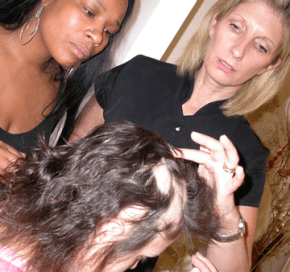
If not, the next thing you’ll notice is that sections of your hair are actually missing, or worryingly sparse. You can often see this more clearly around the hairline or behind the ears, but it can often happen around the crown, too. It really depends on what was causing the tension in the first place.

Some people even notice pustules (blisters filled with pus) or papules (little pimples) where the hair is under a lot of tension. This is because of the irritation being caused to the scalp and is a clear indicator that the follicles just can’t cope with the strain.

Can Traction Alopecia be Reversed?

Yes and no.

If you spot the warning signs of traction alopecia early enough and you put a stop to whatever’s causing it, then your hair will stop falling out and should – with time, patience and loving care – be completely restored to its former glory.

But if the hair follicles have been so badly traumatised for such a long period of time that they have scarred over, then the hair will not grow back by itself. Areas of the scalp where this is the case will likely look shiny.

In cases like this, you’ll need to think about some sort of surgical restoration – speak to your dermatologist to establish whether or not your traction alopecia has caused permanent scarring and to discuss the surgical options available to you.

When Traction Alopecia Compounds Other Hair Loss Problems

traction_alopecia_caused_by_hair_clipin_diane_shawe

If you are wearing a hairpiece – such as a clip on topper – to mask other hair problems like androgenetic alopecia, then you need to be very careful not to compound your problem with traction alopecia!

The best option is to ensure that the clips of your topper are firm, but not too tight, and that you rotate them. We also recommend undoing a couple of the clips when you’re at home – it gives your scalp a little rest from the tension.

Traction Alopecia Recovery Time

Most experts agree that your hair should recover within 6 to 9 months of you removing the cause of the problem.

If you’ve followed the guidelines given here and you are still not seeing regrowth, then it’s likely that the damage to your follicles was permanent – a fact your doctor/dermatologist can confirm. In that case, you might like to discuss the possibility of a hair transplant, which will effectively mask the problem.

What are the Causes of Traction Alopecia?

Traction alopecia is a type of hair loss that happens over time. It’s caused by putting the hair under constant strain or tension and is usually caused by one or more of the following…

  • Very tight ponytails or pigtails
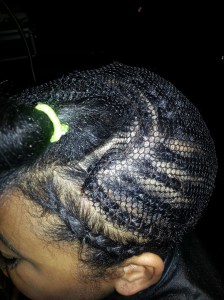
  • Tight braids or cornrows
  • Dreadlocks
  • Extension (single) braids
  • Hair weaves or wigs attached with glue, clips or tape
  • Certain hair clips, slides or barrettes that hold the hair tightly and are worn in the same position every day
  • Headbands – even fabric ones – worn day after day
  • Tight hairpieces
  • Tight headgear like cycling helmets that are worn frequently or for long stretches of time and tend to rub or pull repeatedly on the same area of hair
  • Repeated use of hair rollers
  • Repeated pulling of the hair with the hands (this is an emotional condition called trichotillomania)

If you use or do any of the above, then you may find that the constant tension they cause has led to areas of thinning hair – usually around the temples or behind your ears. Alternatively, you might notice that the part in your hair looks wider than it used to.

If so, then it’s quite likely that you’re suffering from traction alopecia.

There’s more to this condition than hair simply breaking off. Instead, the constant tension in the affected area either pulls out the hairs’ roots completely, or causes the follicles to become inflamed. As time goes by, the damage to the follicles causes them to become atrophied (wasted away)… and if you don’t put a stop to the cause of the problem, they will reach the point where they no longer produce hair at all.

Reference: DermHairClinic – Traction Alopecia

Get your copy today from amazon.co.uk

Get your copy today from amazon.co.uk

Traction Alopecia Treatment

As discussed above, ‘treatment’ for traction alopecia is only effective before you’ve arrived at the stage of permanent damage.

But the good news is that ‘treatment’ – if you’ve caught the condition early enough – can be as simple as changing whatever hair styling and hair care practices you were using and really learning to CARE for this precious asset… your hair!

Wearing a weave

One of the biggest ironies about traction alopecia is that it’s the most common cause of hair loss for women wearing hair extension is due to the application being too tight when weaves and hairpieces are applied… yet those weaves and hairpieces are often used in the first place to enhance hair that may seem thin, or lacking in volume.

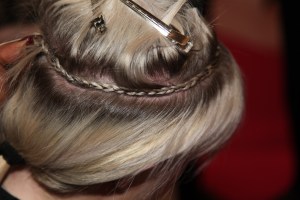
Weaves are generally applied through braiding, fusion, netting or bonding – and the sad fact is that any or all of these methods can lead to traction alopecia if used extensively, over long periods of time.

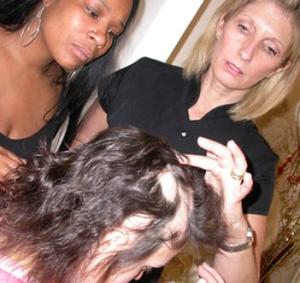
To minimize the risk of traction alopecia, or to try to prevent further damage and encourage regrowth, have your weave fitted by a state licensed professional. Yes, it may be more expensive, but you – and your hair – are worth it! Someone properly trained in hair care will keep damage to a minimum and will be able to spot potential problems and nip them in the bud.

The same goes for hair extensions, which can also cause hair loss problems in the lower half of the scalp. Have them fitted by a trained professional – don’t try to fit them yourself or have a friend do them for you.

Speak to your hairdresser about taking care of your scalp – some women find it difficult to maintain good scalp hygiene because the weave or extensions make it awkward… unfortunately, though, this can make the problem of traction alopecia worse.

When chemicals are the culprits

There’s a kind of alopecia called CCCA (central cicatricial centrifugal alopecia), also known as hot comb alopecia, or follicular degeneration syndrome. It’s almost exclusively seen in African American women and it’s often confused with female pattern baldness, because it starts at the crown and spreads to the surrounding areas.

The cause?

A mixture of too much stress (traction) on the hair along with the use of harsh chemicals like dyes, relaxers and bleaches. The chemicals actually damage the keratin structure of the follicle itself, causing hair LOSS, not just hair damage.

In fact, research conducted in 2008 showed that the highest prevalence of traction alopecia was in women with relaxed hair.

If you suspect this is a condition that’s affecting you, speak to your dermatologist. In addition to removing the cause of the traction and stopping the use of chemicals in your hair, you may be tested for any bacterial or viral infection and possibly be prescribed topical steroids, antibiotics or topical minoxidil to encourage regrowth.

NOTE: If you must use a relaxer on your hair, have it done professionally. Specialists are seeing more and more problems caused by home relaxer kits, because it’s tempting to leave the chemicals on longer than necessary, or accidentally use a stronger formula than you really need. (Make sure they have been certified)

Braiding, ponytails, pigtails and locs

The 2008 research into the prevalence of traction alopecia in African girls and women showed that braiding caused more problems than chemicals (although the two together were worse still).

Starting up a hair extension business Diane ShaweConstant, tight braiding – or other styles like ponytails that place hair under chronic tension – can affect any ethnic group. So it’s very important to take a new approach to styling hair that doesn’t rely on placing the hair under extreme tension.

The ideal solution, of course, is to allow the hair to be completely natural, without using any kind of clips, slides or ties.

The reality, though, is that this just isn’t possible for most of us. Our hair may either be unmanageable and wild looking when allowed to ‘do its own thing’ – or, like us, you may live in a climate where it’s simply too hot to have your hair hanging around your face all day.

The answer is that you can continue to secure back your hair, but you MUST change the way you do it from one week to the next. Traction alopecia is usually the result of CONTINUALLY putting the hair under EXACTLY the same tension in the same place, day after day.

How to Avoid Traction Alopecia (and still have beautiful hair!)

Change the location of your ponytail often – wear it high, low, on one side, then the other. Don’t wear a ponytail at all if your hair isn’t really long enough to need one… otherwise you’ll probably be pulling your too-short hair really hard in order to secure it.

Avoid using clipped in ponytails – the weight of them can – quite literally – tear out your hair.

Always use fabric covered hair bands – avoid bare rubber bands like the plague! And remove bands, clips and ponytail holders from the hair at night – this is when you may be putting your hair under tension without even realizing it.

Invest in satin pillowcases. They cause less friction on your hair than cotton or nylon ones – and, as an added bonus, they’re believed to help reduce wrinkles too!

Change the location of your partas often as you can. Even a simple part in the hair can trigger a problem when worn in the same position day after day.

Don’t retwist the roots of dreadlocks – watch this video for first-hand experience of how damaging this can be!

If you use hairspray or hair gel, wash it out before you next brush your hair.Brushing dried hairspray and gels out of your hair is damaging to the shaft and may cause further hair loss.

Make sure your hair is hydrated. If you’re in a dry climate – or you use air conditioning or central heating – the lack of moisture in the air can make your hair brittle and more likely to break

http://http://issuu.com/dianeshawe/docs/course_prospectus_hair_loss_consult

Other related Hair Loss Article by Diane Shawe

10 Secrets To How To Earn £4000 a month consistently And Start attracting high net work clients every month by Diane Shawe

Hair extension staff training (1)

Creative ways to find new customers

New IS MAKING A STATEMENT OR CREATING A SIGNATURE MORE IMPORTANT? We want to Help You Start attracting high net work clients every month…

Leaving your SIGNATURE as a professional is important if you want to leave a legacy and or be the trendsetter knowing who to work with and how to network is vital and important to your business growth and success.

Search for our bootcamps and we will let you into 10 secrets.   Click here to book your at one of our events.  https://www.signature-masterclasses.com

Learn the art of collaborations and branding. Hear from global Trend setters and designer about the correlation between the fashion world, hair and makeup.

Network and meet your future industry colleagues

HAIR EXTENSIONS THE WAY FORWARD

LEARN HOW TO CONSISTENTLY ATTRACT THE RIGHT TYPE OF CLIENTS AND TURN THEM INTO YOUR NET WORTH BUSINESS IN HAIR EXTENSIONS

It is estimated that the UK and European market for Hair Extensions, Makeup and cosmetics is worth a staggering 400 billion per annum of which the majority expenditure comes from around 20% of the population. WHY because 80% of the female population around the world do not wear makeup or Hair Extensions.

The growing Hair extension and Makeup industry has paved the way to one of the greatest opportunity for Experts in that field to expand their businesses.  Evidence is everywhere that marketers of this segment are dominating retail sales and targeting women with hair and skin problems,

Just check out these stats below:

  • 7 BILLION PEOPLE IN THE WORLD
  • 60 MILLION IN UK
  • £400 BILLION SPENT WORLD WIDE ON COSMETIC
  • 80% OF THE FEMALE POPULATION DO NOT WEAR MAKEUP
  • THE COSMETIC INDUSTRY IN UK WORK APPROX 17 BILLION
  • AVERAGE WOMEN SPENDS 200 PER YEAR ON MAKEUP
  • AVERAGE WOMEN SPEND 600 PER YEAR ON HAIR EXTENSIONS
  • AVERAGE MAKEUP PRODUCT IS MANUFACTURED TO LAST ONE YEAR
  • AVERAGE HAIR EXTENSIONS PRODUCT LAST APPROX 4 MONTHS
  • WOMEN TEND TO KEEP THEIR MAKEUP PRODUCT ON AVERAGE 3 YEARS
  • WOMEN TEND TO CHANGE THEIR HAIR EXTENSION EVERY 4 MONTHS
  • 70% WOMEN DO NOT KNOW HOW TO LOOK AFTER THEIR SKIN
  • 80% WOMEN DO NOT KNOW WHICH HAIR EXTENSION TECHNIQUE IS BEST FOR THEIR HAIR
  • GIRLS FROM THE AGE OF 7 ASPIRE TO WEAR MAKEUP
  • WOMEN FROM THE AGE OF 30 NEED HAIR ENHANCEMENT
  • 90% OF MAKEUP ARTIST ATE NOT COMFORTABLE DOING MAKEUP THAT IS NOT THEIR OWN SKIN COLOUR
  • 90% OF PROFESSIONAL HAIRDRESSERS DO NOT KNOW HOW TO APPLY MORE THAN 3 HAIR EXTENSION TECHNIQUES

WHAT DO YOU PICK UP FROM THESE FACTS?

Just Imagine Being Able To:

  • Provide an addition premium Hair Extension & High profile in under 3 hours
  • Stop having to send on average 4 clients a month away who would spend on average £250 each on hair extensions
  • Introducing a hair extension technique that uses No Glues, Threads or Cornrows and is good for business
  • Offering your current client a safe, non evasive and natural looking hair extensions
  • Being able to help clients with real hair problems and seeing them leaving your salon with a smile
  • Beign able to help clients with all types of skin tone and issues and leaving your salon with a smile

…And that’s just for starters!

Check out our Main website for more details on other conference http://www.signature-masterclasses.com download the latest prospectus here

1 start a hair extension business earn 1000 with 6 clients by diane shawe


Getting started in the hair extension business by Diane Shawe

Starting a Hair Extension business by this ebook from amazon.Co. uk

Are you focused, productive, transactional or inspirational? by Diane Shawe

shortcourses expert bannerBeing busy isn’t the same as being productive, but how do you assess what you need to do to improve both your productivity and your staff?

Would an online Personal Training Need Analysis that takes about 10 minutes help?

Then  CLICK HERE TO TRY ONE FREE Personal Training Needs Analysis and in as little as two hours you can judge for yourself if it would be of use in your business.

Would it help if you could find out how to get the best out of your employees?

Would it help to be able to speed up Pre-Interview selections, Staff Appraisals, Training Needs, Personal Development, Management Selection, Team building and any of those otherwise expensive long winded, time consuming and expensive process?

Well click on our complimentary link to see how it works, I promise you will not be disappointed.

What most people, employers, entrepreneurs and even some educational institutions do not have in today’s current environment is time, the necessary resources and the infrastructure they need to support and achieve learning objectives cost effectively.

Out with the Old in with the new but who is going to be ready at the ‘Start Line’ with all the right tools to assist with the new Continued Competences?

We can offer a person centric online Personal Training Needs analysis tools and  reports to aid in the development of any individuals or organisations growth. The profiles and learning programmes are designed to help reduce risk and to create action and results.  Goal setting is no good without implementation.

We invite you with our compliments to click and complete 10 simple questions and we will send you back a report so that you can see how it works and give us your feedback.

In order to better identify and appraise an individual to pinpoint specific training needs, the Speed of Implementation and adaption to change will confirm who gets ahead or sustain growth by using technology to help with self appraisal, self reflection and personal development.

However, the new skill set or competencies, aims to define the standards needed to enter, compete and remain in the profession which mainly comprise of the following:

  1. Ethics, professionalism and judgment;
  2. Financial Literacy and Technical ability;
  3. Managing yourself and your work;
  4. Working with other people.

That said, in order to meet these new core competencies, individuals and organisations will be required to undergo a process of self-reflection through a high-level Personal Training learning needs analysis to identify their own learning gaps; as well as identify gaps specific to those needed by the organisation they work with. Ideally, this process will be recorded and accompanied by an evaluation of the success of the learning completed and ultimately, organisations will be required to make an annual declaration that they have considered and taken action to address Point of Need training.

We look forward to your feedback once you get your free report back and then maybe we can discuss the speed of implementing this process throughout your business or consulting services.

Just click here now and in just 10 minutes you would have completed 10 questions and we will send you back the results.


Why strategies for modernising corporate learning should focus on learning outcome cover by diane shawe


“The only thing worse than training people and having them leave, is not training them and having them stay”


What do we do..

We specialise in resourcing short courses via a pre-populated LMS solution for Point of Need Training via mobile devices so that all different levels of staff can access training whilst on the move using their own device supported by one off our virtual tutors to help them complete their online 4 weeks course.

12 Do’s and Don’t Tips For Getting And Keeping High-Net Worth-Clients by Diane Shawe

Hair Extension and Makep masterclasses Diane ShaweThere are just over 500,000 millionaire households in Britain, more than in any other European country but fewer than in China, Japan and of course the US.

article by Diane Shawe M.Ed and Eryca Freemantle

As for billionaires, the UK has 1,044 and is second only to the US, though as we all know most of those billionaires are people who made their money elsewhere and then moved to the UK, rather than the home-grown variety.

Worldwide there were 16.3m millionaire households at the end of last year, up from 13.7m at the end of 2012.

Those are three of the conclusions from the latest study by Boston Consulting Group of global wealth – it does it every year and 2013 was notable as the rich got quite a lot richer.

Total global private wealth grew by 14.6 per cent to reach $152bn, the two main drivers being the rise in equity markets and the continuing strong economic growth in the emerging world. The region in which wealth grew fastest, unsurprisingly, was the Asia-Pacific. Since the financial crisis China has passed both Germany and Japan in terms of total household wealth.

So with all that pool of statistics, how do you go about bagging a High Networth Client and keeping them?

  1. Do work at Knowing the trends and your product.When selling a product or service to an athlete or celebrity, it’s all about referrals. You won’t get far going directly to the client, Instead, you need to build relationships with trusted sources of the client. For example, find a way to connect with an agent or financial advisor. If you can get these people sold on you, you have a much better chance of getting a referral.
  2. Don’t Scream – No need to scream. Stay cool, calm and collected. After all, they are human.
  3. Do learn to get around the gatekeeper.To approach a client’s trusted sources, you have to find a way in. Social media makes it easier than ever to find connections, but the power of the phone is still the better route, but you need to plan what your going to offer. Remember the gatekeeper can also get bombarded by lots of enquiries every day on social media so be smarter and look at how you can develop  point 7
  4. Don’t say “OMG” – Some people say “Oh my God” to everything, you sound juvenile
  5. Do try and beat the receptionist to the office. A little clever secrets is to make early morning phone calls, before the office opens. If the company has a dial-by-name directory, you can often catch the person you want to reach at their desk, especially if their name is on the door. You’d be amazed at who picks up the phone at 5:30 a.m.”
  6. Don’t Stare: Its rude and frightening
  7. Do try to stand out.When you’re selling a commodity such as makeup, you’re working with the same inventory as every other artist. That means your value comes from standing out.No matter what your industry, work on developing your qualifications and personality, Have an excellent commitment to client, and find a niche and exploit it.
  8. Do not ever say – “I love You” Do you know how silly you sound?  They will no doubt think your crazy
  9. Do say a memorable ‘thank you.’ Often people do things prior to selling to be remembered, but often when you get the sale, doing a memorable thank you can result in other referrals coming your way.
  10. Don’t take Photos –  Do not take photos of them while working on them without asking their permission
  11. Do have a higher mission.It’s not always about making money just to pay your bills, giving back can also encourage high net worth clients feel good about working with you and support any project that is dear to your heart and help people or animals around the world.
  12. Don’t Cry – Professionals do not cry on the job- especially for nothing
Want to learn how to earn £4000 a month?

Want to learn how to earn £4000 a month?

Clip in hair extensions can cause traction alopecia if worn for over 5 hours a day by Diane Shawe

Nickle Clips can irritate the scalp

Nickle Clips can irritate the scalp

If nickle clip-in extensions are continually worn and the tension on your hair is not regularly alleviated, scarring can occur as well as permanent hair loss, leaving the wearer with a less then desirable appearance they’ll be forced to deal with for the rest of their lives.

article by Diane Shawe M.Ed

Almost all of these clips are made from nickle and if the wearer is allergic to nickle, wearing them for over 5 hours a day will eventually cause traction alopecia and scarring.

In today’s modern society, most people think only of the final appearance of their hair.

backcombing-to-Attach-Clip-in-Hair-Extensions-causes-traction-alopecia-diane shaweHours spent back combing and coating the scalp with lots of hair spray so that the clips can stay in longer, or even wearing really heavy hair extensions caused by the length of the hair purchased continually irritates the scalp all day whilst at the same time slowly pulling the hair out of it’s follicles.

Cheryl Guttman (2) research found that the continual over processing with Chemical treatment such as bleaches, dyes, or strengtheners disrupts the keratin structure in a manner that reduces its tensile strength.

traction_alopecia_caused_by_hair_clipin_diane_shaweThe hair follicles can become fragile. At first the hair fall out is not so noticeable because the clip on extensions are disguising it. Add brushing and combing your hair, you will note a difference in the reduced thickness of your hair line but ignore it initially. Later on some people might experience heavy fall out which can occur with brushing, combing and washing your hair. On top of that using extreme heat to fashion each day can also permanently damage the hair follicle.

If detected early, traction alopecia is reversible if diagnosed early. However, permanent loss can occur too slowly for immediate detection. Hair loss is often occurs in the front, but is also subject to the immediate adjacent area to where the clip in extension were pulling and damaging the hair root.

According to Basil M Hantash, MD, PhD (1)  The sad truth of the matter is that permanent traction alopecia does not respond to medical treatment such as minoxidil or finasteride since by its nature, the loss is different then genetic hair loss.

The only way one can treat traction alopecia is with transplants. Follicular unit hair grafting has been identified as the only practical solution to treating traction alopecia. Hair transplant clinics are reportedly seeing a rise in the number of patients with traction alopecia and say the results can be good to excellent.

nickle-clipins-damage-scalp-diane shaweHowever this can be a costly approach especially whilst clip in extensions appear so cheap. What you have to consider is whether wearing clip on extensions for over 5 hours a day versus the value of your own hair. Which is worth more?

There are over 16 different extension techniques. It is important that you find a technique that is suitable for your type and life style. There is a misconception that hair extensions can be worn permanently for up to 6 months at a time.

In today’s society, you need to hold on to what you’ve got, look after what you have and start being kinder to your hair.

Want to find out how to train to become a Hair Loss Hair Extension Consultant then click to view our course prospectus

Get your copy today from amazon.co.uk

Get your copy today from Get a copy of #DianeShawe latest ebook. Visit available on #amazon #amazonkindle and #googlebooks

Sources:
1. Basil M Hantash, MD, PhD, Robert A Schwartz, MD, MPH. (2005) Traction Alopecia, Emedicine.com

2. Cheryl Guttman, May 1, 2003 Alopecia Options for Black Women, Dermatology Times,