Category Archives: mobile phone broadcasting

Dubai, UAE Leading experts Diane Shawe and Eryca Freemantle will be joining the Professional Beauty Show

Diane Shawe and Eryca Freemantle in Dubai 2016Dubai, UAE Leading experts Diane Shawe and Eryca Freemantle will be joining the Professional Beauty Show


(http://professionalbeauty.ae/e/pb/site/exhibiting/) held in Dubai in February of 2016.

The pair plans to share their expertise in how to train for careers in the field of establishing your own International Training Academy as well as insider tips about how to prosper in the industry. They are excited about meeting with their VIP guests at the 2 day show were they will introduce a range of master classes and Franchise opportunity (www.signature-masterclasses.com).

Diane Shawe M.Ed is the founder and CEO of AVPT Short Courses, (www.avptglobal.com) which features the training class: Getting You Qualified in Days not Years. She is a focused on delivering quality materials developed using her strong management background as well as

Getting you qualified in the Hair Extension Sector

Getting you qualified in the Hair Extension Sector

leadership positions at all levels. She is an established author and specialises in strategic planning, training, product positioning, and branding.

Throughout her career, Diane has worked for the Department of Employment as Head of Training, in business development for the Department of Trade and Industry, and as project director in information technology for The Philips Group. She is also actively involved in a number of influential Government Committees and Business Excellence Organisations and has been recognised with a number of prestigious honours and awards.

During her presentation, Diane will deliver a talk entitled: Ever Wanted to Set up an Academy? http://professionalbeauty.ae/e/pb/site/livestages/ Using her fountain of experience in training, strategic management and education, Diane Shawe will reveal the top 10 things you need to consider when setting up a Hair & Beauty Academy. This informative session will cover:

1. Area of Excellence
2. Satisfying the demand
3. Deciding on location
4. Target students and how many to cater for
5. Prospectus and pricing
6. Will courses be ad hoc or term timetable
7. Key members of staff
8. Who will you work with
9. Your business plan
10. Accreditation

Eryca Freemantle is a Global Beauty Industry Strategist known primarily for her work in the makeup industry throughout the world. Formally advisor on the panel at London College of Fashion (UAL). She will be speaking on Embracing All Tones of Women. In addition to her work within the beauty industry, she also works as a TV presenter in the UK and Africa presenting features on makeup for all women.

Featured in Forbes Magazine, she firmly believes that ‘All Women are beautiful.’ Eryca is one of the few experts that embraces and specialises in makeup for all skin tones and frequently works with A-list celebrities and multinational makeup brands worldwide.

Her partners and colleagues consist of the world’s best creative artists and teachers. Collectively their work has been with Naomi Watts, Naomi Campbell, Seal, Christian Dior, NY Fashion Week, Sephora, and many others.

At the show, Eryca Freemantle will share some of her industry secrets of success including:

1. How she remains at the top of her industry after nearly 30 years

2. Her love of the psychology of makeup

3. How makeup literally saves lives

4. Her experience of working with some of the world’s most famous celebrities

5. How you can attract A-list celebrities to your salon

Last year Professional Beauty GCC welcomed over 3,000 trade only visitors from beauty, hair and spa confirming its status as the key exhibition for the industry in the GCC region. The exhibition is doubling in size in 2016 and will take place at a larger venue, The Meydan, Dubai on 1-2 February 2016.

It is the perfect place to discover the latest innovations whilst being updated on forthcoming beauty trends and education. Professional Beauty welcomes all trade professionals from the beauty industry including, senior buyers, salon/ spa owners and nail technicians.

Please register as press quoting promo code PB7 here https://registration.n200.com/survey/34oy239vm3n1l

Visit http://www.signature-masterclasses.com


Can you Maintain Continuity of a Team in the face of personal ambitions and solicitations from other companies?

Building Better TeamsOne of the biggest problems team leaders face is maintaining the continuity of the team. Once the right people are in place on your staff, how do you keep them there in the face of their ambitions and solicitations from other companies?

article by Diane Shawe M.Ed   Accredited Clarity4d Business Partner

Clarity within the team can go a long way toward solving the first problem, and embedded processes that recognise peoples’ contributions can help with the second problem but this can often be a slow and costly procedure.

Well, I went on the most incredible 3-day accreditation course on this very matter, and I just had to blog about it before sending out some information to various organisations who might find it useful. In a nutshell Clarity4d help each member of staff become better at making the team more efficient through feedback and coaching, in days rather than weeks, it’s a game changer!

Research on why people leave companies or underperform found two key reasons: 1) they don’t like their boss,

2) they don’t feel appreciated.

Teaching managers to be “coaches” rather than “bosses”—asking questions rather than just telling someone what to do—would help to create UNITY WITHOUT UNIFORMITY. But where do you begin?  The Old fashion words such as Molding a Team of Leaders does not go down well in today’s working environment. Educating and bringing people along with you instead of dragging them is far healthier and cost effective in many ways.

GETTING YOUR TEAM TOGETHER

So you’ve taken the time and made the effort to spot, recruit, develop, and get in place a group of smart and talented people who are your direct reports. That’s crucial. But the bigger challenge is educating these high-energy, high -powered, high-ego people into a working team of leaders who synchronise their efforts and propel the business forward. Individual team members naturally focus on their own functional specialties and have their own personal ambitions, but those differences often cause them to pull in different directions especially considering the inherent tensions that exist between various silos of the business.

As the leader, you have to get your direct reports to submerge their egos, aggression, and personal agendas so they’re pulling together. You can’t mediate every dispute, ensure that every trade-off is properly made, or that information is flowing as it should on a daily basis. Clarity4d can provide the tools to help all team members learn how to develop team communication strategies, so the business will perform better as they focus and commit to the total business.

Clarity4d will help them create a common granular picture of the company in its external context as you see it or even more critical the way the market it moving. That way, they’ll know how their respective areas fit together, and they’ll have both the motivation and information they need to keep their efforts aligned. You have to mold people’s behavior as well. Too often, talented and ambitious people have a single-minded focus, little aware of what their colleagues in other silos are doing, at worst deeply suspicious of them.
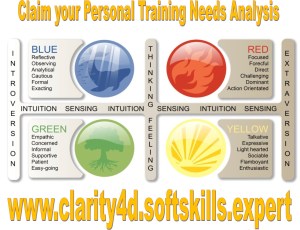
Claim your personal training need analysis

Resources and information are hoarded, and communication is sporadic and formalistic. You’re the one who tolerates or challenges narrow self-interest, big egos, and dominant personalities. Most of the work of educating a team happens in group settings, which may require that you change the way you lead. You can’t just work with your direct reports one to one, setting their budgets and goals in private and coaching them individually as you shift your attention from one part of the business to another. You have to help the group create a picture of the total business and correct any disruptive behaviors in the presence of the team, so you need the emotional strength to direct and stand up to powerful individuals on whom you depend on.

Many leaders think molding a team isn’t worth the effort, but they’re missing a tremendous opportunity to differentiate themselves and build the business. The more people can see the entire anatomy of the company, the team, each and the intersections of its moving parts, along with the broader context in which it operates, the better job they do. When they all see the same facts, discuss their observations and thoughts, and come to understand the interconnectedness of their functions and skills, they’re able to raise the bar, setting higher goals and achieving them faster

So how do you map out your teams strength and weakness and put them all to a positive use in a matter of days?  Clarity4d Profile and Team Profiling solution is designed to give strategies for communicating with people with different personality preferences.

SHAPING A COMMON VIEW OF THE TOTAL BUSINESS

A team of leaders starts being molded when everyone is on the same page. To be on the same page, you first need to understand more about yourself and know more about how others see you.  Once you have identified how personal influence can be enhanced by meeting the needs of others, the team can then move towards getting on the same page.  The key is to develop an internal team dialogue in which each member contributes to the discussion that shapes the team’s collective view of the business— its challenges and opportunities and the resources available. Getting on the same page tests the cognitive bandwidth of not only each member of the team but the team as a whole. Once drawn, however, the conventional picture channels the team’s energy and, more important, provides a reference point for future dialogue as the team members influence and are influenced by their colleagues. The stage is set for collaboration.

FEEDBACK BREEDS BETTER COLLABORATION

Contact us for a Consultation 0203 551 2621

Keep a mental inventory of the skills and methods for getting things done for each member of your team. One team member may be too blunt in arguing a point with others, another may be too shy to participate in debate, and yet another may have a habit of holding back information essential to reaching a good decision. All these impediments to effective teamwork must be clearly identified to the individual, and he or she must be counseled in overcoming them.

Feedback is most effective when given in written form and given frequently, but human beings typically can change only one or two behaviors at a time.

Most people don’t like to give feedback, but they have to look at it from the proper perspective.

Feedback says you’re committed to someone’s development.

Higher performers want to know how to get better, and the only way to achieve this is share numbers, reasoning, and results to share a single view of the business and its context. Having the intellectual courage to confront behaviors that harm the team’s effectiveness. Anticipate, surface, and resolve conflicts. Pick the right people. Provide prompt feedback and coaching. Recognise and avoid derailers.

Having all the right people and great processes isn’t enough. You also have to have the right behaviours and to get the right behaviour people need to understand more about team member’s preferences.

Everything we’ve covered so far needs to be translated into results. The first and most critical step in execution is choosing the right goals. This is where the buck starts. Many leaders are conceptual, high-level intuitive thinkers, this matters because understanding the other variable such as Sensing v Intuition,  Thinking v Feeling thinkers and Introversion thinking v Extroversion thinking can misalign people’s energy within a team.

ARE THE EIGHT KNOW-HOWS BURIED IN YOUR TEAM?
  • Positioning and Repositioning: Finding a central idea for the business that meets customer demands and that makes money.
  • Pinpointing External Change: Detecting patterns in a complex world to put the company on the offensive.
  • Leading the Social System: Getting the right people together with the right behaviors and the right information to make better, faster decisions and achieve business results.
  • Judging People: Calibrating people based on their actions, decisions, and behaviors and matching them to the non-negotiables of the job.
  • Molding a Team: Getting highly competent, high-ego leaders to coordinate seamlessly.
  • Setting Goals: Determining the set of goals that balances what the business can become with what it can realistically achieve.
  • Setting Laser-Sharp Priorities: Defining the path and aligning resources, actions, and energy to accomplish the goals.
  • Dealing with Forces Beyond the Market: Anticipating and responding to societal pressures you don’t control but that can affect your business.

DO YOU KNOW WHO’S PERSONAL TRAITS THAT CAN HELP OR INTERFERE WITH THE KNOW-HOWS IN YOUR TEAM?

  • Ambition—to accomplish something noteworthy BUT NOT win at all costs.
  • Drive and Tenacity—to search, persist, and follow through BUT NOT hold on too long.
  • Self-confidence—to overcome the fear of failure, fear of response, or the need to be liked and use power judiciously BUT NOT become arrogant and narcissistic.
  • Psychological Openness—to be receptive to new and different ideas AND NOT shut other people down.
  • Realism—to see what can actually be accomplished AND NOT gloss over problems or assume the worst.
  • Appetite for Learning—to continue to grow and improve the know-hows AND NOT repeat the same mistakes.

DO YOU KNOW WHO’S HAS THE COGNITIVE TRAITS IN YOUR TEAM THAT COULD IMPROVE THE KNOW-HOWS?

  • A Wide Range of Altitudes—to transition from the conceptual to the specific.
  • A Broad Cognitive Bandwidth—to take in a broad range of input and see the big picture. Ability to Reframe—to see things from different perspectives.

It can get really complicated, but with Clarity4D’s Profiling tools and range of workshops you will find your team members around the world, at home, school or socially easier to communicate with as you become clearer on how you can tend to their preference whilst appreciated your.

Try this simple questionnaire and we will send back your profile report.  We will then explore how it can be used in a team environment. Click here to start the journey to better team building.

http://www.clarity4d.softskills.expert

2 Tips on How To Put Optimism Into Practice On a Daily Basis

Practice being Optimistic each day

Practice being Optimistic each day

Can Optimism be taught?

Being optimistic does not mean forcing yourself to become persuaded that you should always look on the bright side of things. Becoming optimistic is something you can learn. It is a state of mind that is not so hard to assimilate, one that enables you to live quickly the life you want to live.

Optimism is a state of mind

Optimism is a concept that is often poorly explained. Having a high state of mind does not mean that you reject reality because you want everything to be rosy. It means that you can tackle any situation with a state of mind that gives you every chance to take advantage of it or to turn situations around in your favor if you need to.

People often think human beings are either optimistic or pessimistic by nature and that there is nothing we can do about it. This is specifically a cynical way of seeing things! Unfortunately, people often dwell on this incorrect observation.

There are obviously optimistic people. Admittedly, they have an advantage over others, but it does not mean that pessimistic people are destined to remain bleak.

Being optimistic, in a general manner, means that there is a way out of every situation, but it will only show if you do your best, so events turn in your favor.

Being optimistic is not a mere vision of life according to which everybody is good and that all is for the best in the best of all possible worlds, one that consists in denying reality – which often refutes this idyllic point of view.

Being optimistic requires first of all that you be realistic and accept the world as it is: that is, with its positive and negative aspects.

Likewise, you can’t say that people are inherently good because some are, while others are not.

In fact, the truth is more subtle than that because these two tendencies do reside in every one of us. Life consists in expressing our qualities for our own sake but also for that of our dear and near ones or humankind.

To become optimistic, you, first of all, have to be realistic and accept the ambivalence of this world and human beings – they can both be good and bad in turns. The second step is to take action by counting on favorable outcomes to arrive and hoping that the people you’ll meet will adopt a positive attitude. Seeing things this way is fundamental.

First of all, know that, if you are not optimistic by nature, as described in the definition above, you will need some time before you naturally become confident at being optimistic. So, summon your patience. But you may not have to wait for too long if you apply the advice you will find below.

Here is how to bolster your optimism or become optimistic. You may be confronted with two cases:

1.    You have already gone through a situation that did not turn in your favor:

– Do not feel guilty for this failure learn from the experience so you can deal with such a case differently next time.
– Approach the situation in question from a different perspective by visualizing it turning out in your favor and doing what you can so it turns in your favor.

2.    If a situation is unprecedented for you:

–    In this case, it is even easier: approach the situation by visualizing it turning out in your favor and by doing everything you can so things go your way!

These two ways of acting is a learning process which will gradually become second nature to you, helping you to earn one success after another.

Looking for a short course? why not tray five short courses and learn on the move. http://www.crashcourses.academy 

10 Top Tips on How to Influence Online buying by Diane Shawe

Try out 5 Courses this Christmas for just £25.00

Try out 5 Courses this Christmas for just £25.00

The trends and predictions are already in for 2016. Many digital advancements will be made in 2016, from the rise of mobile messaging apps to mobile commerce finally gaining some mojo. 

You the reader even you are becoming more savvy and intend to be heard when things are not going right.  Smartphone use is driving up the number of inbound calls to businesses. Voice-activated search has been rising steadily. Consumers are talking to personal assistants through their smartphones and cars, and those “assistants” are getting smarter. And with the rise of smart watches and connected home devices, they’re talking to a wider variety of devices from various locations.

Marketers need to be prepared and ready to optimise digital content for speech-based (not keyword) queries and learn how to make sure that content can be discovered by personal assistants.

– So what about small businesses, the lone sole trader, what can you do to influence online buying?

  1. Change your ads Your prospects could get bored seeing the same ad all the time. Statistics show people usually see the same ad 7 times before they actually buy. Just change them enough to keep them from being over-exposed. For example, if your ad said. “FREE Killer Marketing E-book!”, you could change it later on to “FREE Sizzling Marketing E-book!”
  2. Give people a deadline to order. Tell people if they order by January 15 2016, they will get a discount or free bonuses. This will create an urgency so they don’t put off buying. Another example, “Order before 8:00 p.m. and get a second product of your choice for free!”
  3. Publish testimonials on your ad copy. They will give your business credibility and you’ll gain people’s It’s important to include the person’s full name and location with the testimonial.
  4. Allow people to make money reselling the product or Tell people they can join your affiliate program if they order. You could pay them per sale, per click, per referral, etc. Just provide them with proven and tested marketing materials, detailed statistics and plenty of affiliate training.
  5. Offer a buy-one, get-one-free deal. If you sell more than one product, this type of deal works People will feel they are getting more for their money and will order quicker. You could also offer them a ‘buy one, get one half’, ‘buy two, get the third one free’, ‘buy two, get a free watch’.
  6. Have them sign up to get access to download a free e-book. The subject of the e-book should be related to your target audience. You could have them sign up to a opt-in list or your regular The e-book should have high perceived value so they’ll take the time to sign up. Landing pages are really good for this.
  7. Give your visitors a free membership inside your Members Only web site or closed membership group on LinkedIn or Facebook. Have them sign up to receive a user name and password or an exclusive invitation. Members groups are particularly good on LinkedIn and your blogs because each time you post some news they get an automatic update.
  8. Offer your visitors free consulting via e-mail. Have them fill out a web form to e-mail you with their When you answer their questions, include an offer for a product you sell or highly recommend products that could help them. You could join the product’s affiliate program to earn commission if they take your advice.
  9. Give people free bonuses when they order your product or The free bonuses could be books, jewelry, reports, newsletters, etc. Make their bonuses sound extra valuable by listing their retail value, either separately or together in one amount, or limiting how long you will offer the bonuses. (you can partner with free gift websites)
  10. Provide free package and postage with all orders. If you can’t afford it, you could offer free P&P on orders over a specific You could also offer a rebate on their P&P costs. Most customers probably won’t send in the rebate card unless it’s a huge shipping cost, for example, £30 or more

Try our Audio Courses this Christmas.

Niche Marketing Made Easy

Produce Persuasive Copyright

Building online Traffic and List Systems

Email Marketing secrets

How to set up and generate a powerful Blog website

The Affiliate Chemistry

7 Habits of Highly Effective People

Internet Business Optimisation

12 Effective selling techniques

50 Best and Worse Business Deals of all time

20 Advertising Tips

Art of Making money

Breakthrough Sales Solutions

Clever Profit Generating Insights

How to Combine Cooperation & Competition

Customer Tested – Buying Triggers

How to work with change

Explosive Influence Tactics

Extreme Persuasion Strategies

Manage your Intellectual Capital

The Servant Power Leadership

Visit www.crashcourses.academy and select 5 course and start listening, watching and learning today.

Where does the hair come from for Hair Extensions? by Diane Shawe

where does hair extensions come from by diane shaweDiane Shawe Author of “How Hair Extensions are Sourced, Treated and Graded” states that the first question all new customers ask is “where did the hair come from”?

They want to know about the geography and even history of the hair and so should you. In her book she covers this question by explaining the characteristics of each variety and summarises the pros and cons.

For instance dealing with the different hair origins.

Get your copy today from amazon.co.uk

Get your copy today from amazon.co.uk

· Origin: China, Eastern Europe, Russia and India

· Grade: Virgin, Cuticle, Non-Cuticle, Processed, Single Drawn, Double Drawn, Remy and Non-Remy

· Type: Caucasian, Asian

Diane’s book goes on to explain in some detail the differences, here we summarise the pros and cons from different regions.

Chinese Hair (Aka Asian Hair): A thick fibre that is naturally straight and dark brown to black in colour.

Advantages: High Quantity, Durability and Low Cost. It is the strongest human hair and is able to withstand multiple chemical and mechanical processes.

Disadvantages: Chinese hair requires extensive chemical processing to output hair that simulates European texture, colour and body. The majority of the hair is collected and processed as double drawn.

Indian Hair (aka Asian Hair, Italian Hair): A variety of fibre types from fine and straight, medium thick with body wave and curly to thick coarse hair. “Italian hair” is actually Indian hair that has been processed in Italy or Spain and then sold at premium prices.

Advantages: High Quantity, Good Quality, Variety and Low Manufacturing Cost. Indian hair is popular to use for custom made hairpieces because it can be made to resemble European hair. When not cuticle correct (non-remy) hair requires heavy-duty chemicals to remove cuticle layers. It is still at a high risk for severe tangling problems.

Disadvantages: Low Quality and Higher Retail Cost. Indian hair still requires quite a lot of chemical processing to make it appear as European hair. To reduce time and materials, many manufacturers choose to work with non-remy Indian hair that results in a poorer quality and most exporters handle the hair badly.

European Hair

(Aka Russian Hair, Caucasian Hair): A fine to medium density fibre that is naturally straight to slight wave and available in a variety of natural colours, most commonly dark blonds to medium browns. The Virgin colours will often be streaked with lighter shades or the ends will be much lighter than the roots due to weathering.

Advantages: High Quality. True Caucasian hair, whether originating from Russia, Eastern Europe or even the United States, is the best quality for the European and American market.

Disadvantages: Low Quantity and quantity and High Cost. It has always been an availability problem and is becoming more difficult to source lengths longer than 15 inches and of a good quality.

For more information about Diane’s extensive work on hair loss and consultancy, please see her website

For a copy of her book you can visit Amazon and download the full version or a sample “How Hair Extensions are Sourced, Treated and Graded”

Getting you qualified in the Hair Extension Sector

Getting you qualified in the Hair Extension Sector


Managing Pressure and Maintaining work balance

How to manage pressure at work 1 day course

When things are extremely busy at work and you have your hands full with many tasks and dealing with difficult people, having skills you can draw on are essential for peace of mind and growth. This one-day course will help participants understand the causes and costs of workplace pressure, the benefits of creating balance, and how to identify pressure points. They will also learn how to apply emotional intelligence, increase optimism and resilience, and develop strategies for getting ahead.

This one-day workshop will help participants learn how to:

  • o   Apply a direct understanding of pressure points and their costs and payoffs
  • o   Speak in terms related to emotional intelligence, optimism, and resilience
  • o   Create a personalized toolkit for managing stressors and anger
  • o   Work on priorities and achieve defined goals

 Cick to book your seat now.

Course Overview

You will spend the first part of the day getting to know participants and discussing what will take place during the workshop. Students will also have an opportunity to identify their personal learning objectives.

Under Pressure!

To begin the course, participants will explore the causes and costs of workplace pressure as well as the benefits of creating balance. Participants will also learn what their pre-assignment score means.

Getting to the Heart of the Matter

Next, participants will learn how to identify their pressure points and create an action plan to manage them. They will also learn some tips for facing problems and when to seek help.

Emotional Intelligence

In this session, participants will learn about the seven human emotions and Plutchik’s wheel of emotions. They will also learn how to validate emotions in others, build optimism, and develop resilience.

Coping Toolkit

This session will give participants some ways to manage stress, cope with anger, and express themselves assertively.

Getting Organised

To wrap things up, participants will learn some ways to get organised and reduce pressure set up a action plan.

Workshop Wrap-Up

At the end of the course, students will have an opportunity to ask questions and fill out an action plan.

http://academyexpresscourses.com/2014/03/28/high-blood-pressure-hypertension-the-new-aids-epidemic/

nido how to move forward

http://www.shortcourses.expert

0203 551 2621

Why we can’t blame God

Diane Shawe www.shortcourses.ExpertBilly Graham’s daughter was interviewed on the Early Show and Jane Clayson asked her “How could God let something like this happen?” (regarding the attacks on Sept. 11). Anne Graham gave an extremely profound and insightful response. She said
“I believe God is deeply saddened by this, just as we are, but for years we’ve been telling God to get out of our schools, to get out of our government and to get out of our lives. And being the gentleman He is, I believe He has calmly backed out. How can we expect God to give us His blessing and His protection if we demand He leave us alone?”

In light of recent events…terrorists attack, school shootings, etc. I think it started when Madeleine Murray O’Hare (she was murdered, her body found recently) complained she didn’t want prayer in our schools, and we said OK.

Then someone said you better not read the Bible in school …. the Bible says thou shalt not kill, thou shalt not steal, and love your neighbor as yourself. And we said OK.

Then Dr. Benjamin Spock said we shouldn’t spank our children when they misbehave because their little personalities would be warped and we might damage their self-esteem (Dr. Spock’s son committed suicide).

We said an expert should know what he’s talking about. And we said OK. Now we’re asking ourselves why our children have no conscience, why they don’t know right from wrong, and why it doesn’t bother them to kill strangers, their classmates, and themselves.

Probably, if we think about it long and hard enough, we can figure it out. I think it has a great deal to do with “WE REAP WHAT WE SOW.”

Funny how simple it is for people to trash God and then wonder why the world’s going to hell. Funny how we believe what the newspapers say, but question what the Bible says.

Funny how you can send ‘jokes’ through e-mail and they spread like wildfire but when you start sending messages regarding the Lord, people think twice about sharing.

Funny how lewd, crude, vulgar and obscene articles pass freely through cyberspace, but public discussion of God is suppressed in the school and workplace.
fools and fanatics diane shawe
Are you laughing?

Funny how when you forward this message, you will not send it to many on your address list because you’re not sure what they believe, or what they WILL think, of you for sending it.

Funny how we can be more worried about what other people think of us than what God thinks of us.

Pass it on if you think it has merit. If not then just discard it… no one will know you did. But, if you discard this thought process, don’t sit back and complain about what bad shape the world is in.

How safe is your business, staff, customers and assets?

Deterrence through Preparedness Security Awareness Training Courses by Diane ShaweI am frightened by what has been happening recently and would like to help as many companies and business strengthen their security awareness by keeping busy instead of being scared.

article by Diane Shawe

The main purpose of this post is to see how I could contribute by bringing to your attention three courses that I have that could help your organisation keep it’s personnel, customers and assets as safe as possible.

I want to do something, and I hope you will help me to be of use in a time when we, the general public can only defend with preparedness.

No matter how large or small your company is, you need to have a plan to ensure the security of your personnel, customers, organisation and assets. Such a plan is called A Security Awareness Preparedness Scheme.

Whether yours is five or 200 pages long, whether you have 4 or 5000+ staff the process of creating a security program will make you and your team think holistically about your business or organisation’s security. A security awareness scheme provides the framework for keeping your company at a desired security level by assessing the risks you face, deciding how you will mitigate them, and planning for how you keep the program and your security practices up to date.

With no time to waste, now is the time to make that investment by training as many of your employees to become not just aware but knowledgeable about security practices.

Business disruption can be a very expensive experience and sometime hard to come back from. Download Course manual by clicking here

1. Why is security important?

Lapses in security places personnel, customers, assets, staff and property at risk.  Any responsible employer will wish to take all reasonable steps to protect the lives of its staff, customers and to protect its assets.

With the increasing serious and unanticipated security incidents recently this has also placed the provision of assistance at risk, with the danger that personnel, customers and assets, when assistance is needed in an emergency an overstretched team may be curtailed.  If personnel, customers and staff are aware of how to become more secure, they are able to do a more effective job in both awareness, prevention and bringing assistance to those who need it.

Getting the world back to work with skills we can trust

Keeping the workforce safe

Common protection measures which includes gates, guards, locks, alarms and safes are not enough to be relied on anymore.  Other protection measures are decided on according to the threat in each specific context and we are now in a new paradigm when information on the wider context will assist the working general public to become more vigilant and safe.

There may be some threats to personnel, customers and assets, organisation’s which do not arise from the local community at all.  These may include attacks from terrorist groups, whose decision-makers may be distant or even in a different country, orchestrating violence against personnel, customers and assets, and other organisation’s for political reasons.  If so, protection measures will need to take these threats into account and a higher degree of protection is necessary if the work is to continue.  In this case managers will usually consider whether the work should stop, either temporarily or permanently.

Download the Course Manual by clicking here

2.  Deterrence vs Awareness

Deterrence is a further security approach used by some organisations, notably the police and the military.  They deter attack by threatening retaliation against anyone who attacks them.  This is not an option available to personnel, customers, and localised organisations, whose principles forbid them to attack anyone, or to threaten attack.

The sole possible exception is when personnel, customers and organisation’s can become aware through training to heighten their levels of awareness.

1.2       Risk = Threat x Vulnerability

You may be able to do nothing about the level of threat around you, but you can probably do a great deal to reduce your level of vulnerability in two main ways:  To avoid getting into an accident for instance by:

  • Reducing the chances of an incident happening (e.g. by driving slowly, improving locks, or introducing a neighbourhood watch system)
  • Reducing the impact of an incident (e.g. by wearing seatbelts, or limiting the amount of cash held in the safe)

By reducing your vulnerability, you reduce the risk that the threat will become reality and have a serious impact on you and your business.  A major part of good security management is reducing vulnerability in every way possible.

Download the course Manual by clicking here


You can click here to enrol your company and staff.

Ready to step out on your own and join the growing ranks of the self-employed? by Diane Shawe

So if you are seriously considering becoming Self-employed and leaving your PAYE job behind if this sounds like you, then you are probably half way out the door.

Does this sound like you?

  • Your boss is driving you crazy because of his short-sightedness.
  • You are sick of your great ideas being ignored.
  • You are frustrated at the status quo and the lack of innovation in your field.
  • Maybe you’ve been discriminated against, laid off, restructured, demoted and under-valued.

Well you must be thoroughly fed up and ready for a change.

Being self-employed is a way of life radically different from anything. To be successful at it you will have to make a real turn-about in how you both think and act. We can often be our hardest critic but remember….

“You are not judged on the height you have risen but from the depth which you have climbed.”

 Frederick Douglass, 1881

But will I be successful?

The little doubting voices inside your head start going off

So lets take a look at how we define success?  To some, is all about wealth. To some, success is all about achieving the perfect job, or the perfect marriage, or living the perfect life.

Let’s examine what Webster says about success:

  1. degree or measure of succeeding
  2. favourable or desired outcome,
  3. the attainment of wealth, favour or eminence.

There are many ways in which people have come to define success, but one thing is clear: in order for your success to be defined a goal must be set in order to measure your achievements and success.

So why do some people live their life and go through each days, wasting precious time, effort and other resources without defining their actual goal? The question may sound elementary, but many people live this way and wonder why they fail to achieve anything of substance.

Goal Setting Mistakes

A popular goal setting mistake people make is pursuing someone else’s goal. So I am going to use the driving analogy:

How could you arrive   at your own desired destination, if you focus on where other people are going? Would you get on the motorway and drive north just because other people are driving in that direction?

Where do you really want to go? In order to define your own destination in life, you must take the time to think about who you really are and what will really make you happy. Your success may be to teach small children to read and write, or your success may be to lead a girls football team to a national championship.

Resurrect latent skills and old interests!

Self-employment is a career alternative which requires mental and physically resilient, each moment can change the rest of your life and the course of your direction. If you are not intentional with your actions, you have already planned to fail. Successful people are driven by their vision which is fuelled by their passion. Successful people don’t become successful by accident-it’s sheer, practical application (although I agree that some element of luck goes a long way).

You have to do at least one thing toward your goal every single day. You have to dedicate yourself every day to doing what you love. Don’t just talk about it. Dreams are cheap, passion is Priceless. You may have no concept where you want to be other than theory, and that’s okay. You are guaranteed to get closer to your dreams if you just walk forward with confidence and passion and focus on being of service to those who want your assistance.

So what if you cannot see a way forward, well I am sure you have heard this saying, If you say you can’t your right, if you say you can your right.  So you might as well adopt the ‘I can’ mantra.

Using your imagination

Albert Einstein once said, “Your imagination is your preview of life’s coming attraction.” I believe he’s right. That phrase encapsulates so much of how I try to live each day.

Remember, when you think positively about your future, instead of living in the past which you cannot change, using your imagination in a positive way will help you attract what you desire toward you. It’s about your imagination and no one else’s. I challenge you to take what I’ve already given you this far and start to imagine your future in a constructive way.  To get you going just ponder upon the following question.

“What would you attempt to do if you knew you could not fail?”

Interested in personal development courses then click here.

How to become a Ace Networker by Diane Shawe

CPD FrameworkYou know, sometimes all you need is 20 seconds of insane courage.  Just literally 20 seconds of just embarrassing bravery.  And I promise you, something great will come of it.

Life is meant to be an adventure.

article by Diane Shawe M.Ed

If your life is anything less than interesting and inspiring to other people, you’re doing something wrong. The range of possible thrills and spills at your disposal is limited only by your imagination and the choices you make. You are not too old. You are not too young. You don’t need to wait until you get a promotion, Get that big deal, have a funny success story. You don’t need more savings. You don’t need to wait until you’re finished university. You don’t need to wait for a better time.

Right now is the only moment you ever have. You can apply this to so many aspects of your life. 

Don’t you hate when you’ve showed up at a networking event late or on your own and you’re the only person who isn’t part of the conversation? Every time you try to say something you seem to get interrupted or ignored; and the more you try to take part, the more awkward things get. So you stare off into space, pretend to watch something or pull out your mobile phone and act like you just got a text message.

Nobody enjoys being a networking wallflower. No matter how shy or introverted you claim to be, beyond our fragile, wounded egos, we all so badly want to be a part of the conversation, to be paid attention, to have as much fun as everyone else. Sitting on the side lines is just boring and uncomfortable.

Sometimes all you need is 20 seconds of insane courage.

You reduce your nerves by mastering your start. This is essential because people can get so nervous before a communication that they:

  • Don’t make a good job of it.  For example, their presentations become a robotic read-through of boring slides, with zero personality and charm;
  • Or don’t even do it at all.  For example, when people say “I’m just too busy to go to that networking event”, but really mean “I’m too nervous, so I’ve de-prioritised it”

Both are understandable.  You can often reduce or even eliminate your nerves when you know how to start.  After all, if you’re clear what your first three sentences are and, by clear, I mean you know them word-for-word – you know you’ll start well.  So you do.  And then things tend to go well through the rest of it.

Networking?  You only need to know (1) who you’ll approach and (2) what you’ll say when you do:

  • If you see someone you know and like, go up to them and say “hello”!
  • If you don’t know/like anyone, go to someone standing on their own and say “mind if I join you?”

You’ll choose your own opening lines of course.  But do choose them.  Don’t hope it will turn out well when it matters, because it probably won’t.  Or it won’t be as good as it could have been.  Or you won’t even do it.

The key to making the transition from networking wallflower to networking Ace is to develop strong social skills, a great opening 20 seconds and to go in with the right mind set. The art of talking to strangers is a learnable skill. Through practice, you can go from frustrated networker to choosing your own adventure, by taking massive action to meet new people. It is the core skill of moving from the social side lines to centre stage. If you go out to social gatherings, but are uncomfortable anywhere but in your tiny little bubble of friends, those fake text message moments are virtually guaranteed.

10 tips on becoming social media influencer by Diane Shawe

When you go networking, make it your goal to amuse yourself by exchanging energy with people. This is the state of mind from which your entire social experience will flow. Instead of hanging out, treat networking as an intense form of play. Striving for acceptance is torture. It turns you into an energy vampire and only further annoys people who already weren’t that interested in you. Instead of seeking others’ approval, become the CEO of your own networking environment. Invest your attention into only those people, places, and things that amplify your energy and show you a good time.

Don’t ask yourself what the world needs; ask yourself what makes you come alive. And then go and do that. Because what the world needs is people who have come alive.

Howard Thurman

Identify a communication you’re nervous about. Script, edit and practise how you’ll start. After that, it only takes 20 seconds of bravery and some planning.

Are you ready?