Tag Archives: personal development

Author Diane Shawe Mindfeed Coffee ebooks get featured on Fox News

Available from Amazon

Available from Amazon

October 10, 2016 – City of London, United Kingdom –Need help getting organized? Want to learn how to take a business into a global marketplace? Looking for ways to improve leadership skills? Then check outThe Little Coffee Break Mindfeed eBooks from IQ 2 EQ by Diane Shawe. This collection of eBooks exposes readers to new ideas and proven strategies, and each can be completed on a lunch break, over breakfast, or while enjoying a cup of coffee.

According to author Diane Shawe, “The idea for the short, powerful eBooks came to my mind when I realized how often people need to brush up on topics, but do not always have time to sit down to read 200 pages. As a result, I have authored several short yet effective eBooks that get right to the point with tips and advice.”

Readers from all across the globe have praised Diane for her eBooks, and the opportunity it gives them to learning new information or refreshing their memory quickly. And with topics ranging from stress management and problem solving, to public relations and networking, there is truly something for everyone.

Mindfeed ebooks by Diane Shawe

Shawe’s eBooks are available on Amazon right now at: https://www.amazon.com/Diane-Shawe/e/B0052WG8V6

Visit www.diane-shawe.co.uk for more information about her other publications, training courses, blogs and fundraising.

YouTube: https://www.youtube.com/watch?v=7wIU4tI8kw0

About the Author

Diane Shawe is an author, speaker, trainer, mentor, consultant and entrepreneur with more than 15 years of experience. She has personally trained over 1800 people around the world in a variety of fields and has published a number of works. She has contributed to over 100 Kiva Entrepreneur’s around the world.

She was also one of the producers of a Day time Ladies Talk Show in 2015 and Host of one of the UK’s best loved Annual Hair Extensions Awards.

Diane also enjoys oil painting, sailing and clay pigeon shooting. She focuses on topics that she is passionate about in her writing and has attracted over 36,000 followers on her popular blog.

Media Contact
Company Name: AVPT Short Courses
Contact Person: Diane Shawe MEd
Email: Send Email
Phone: +44 208 1333120
City: London
Country: United Kingdom
Website: www.academyexpresscourses.com

Press Release Distributed by ABNewswire.com

To view the original version on ABNewswire visit:15 Must-Own Books No Serious Entrepreneur Should Ignore

15 Must-Own Books No Serious Entrepreneur Should Ignore – FOX5 Vegas – KVVU
http://www.fox5vegas.com/story/33305573/15-must-own-books-no-serious-entrepreneur-should-ignore

Information contained on this page is provided by an independent third-party content provider. Frankly and this Station make no warranties or representations in connection therewith. If you are affiliated with this page and would like it removed please contactpressreleases@franklyinc.com

Why you should switch to Raw Cocoa

cocoa-powder-lead-jpg-653x0_q80_crop-smart

THE HEALTH BENEFITS OF RAW CACAO

Magnesium

Raw cacao is one of the best food sources of magnesium – a mineral that many of us don’t get enough of in our diets. Magnesium is essential for energy production, for a healthy brain and nervous system, for our muscles and for strong bones and teeth. Magnesium may also support a healthy blood pressure.

Iron

Cacao is also a source of iron, which builds the blood and helps to transport oxygen around our body, as well as potassium, copper, zinc, manganese and selenium.

Flavonoids

Cacao can also be high in flavonoids, which have antioxidant activity. Cacao and flavonoid-rich chocolate have been linked with heart health benefits including increasing the good form of cholesterol (HDL) in our blood, lowering blood pressure and even improving vascular function in patients with congestive heart failure. These effects are thought to be primarily due to the antioxidants contained in the cacao.

PEA

In addition, cacao contains a compound called phenylethylamine (PEA for short!). PEA is thought to elevate mood and support energy, and is said to be one of the reasons that many people love chocolate!

Raw cacao is also very low in sugar, and of course does not contain any milk, so is suitable for those who are milk-sensitive or following a low-sugar diet.

THE PROBLEM WITH CHOCOLATE

The cacao – or cocoa – part of a chocolate bar is not ‘unhealthy’ as such. The main factor that makes it less healthy is the sugar that’s added to it to create a standard chocolate bar. Also, when cacao is roasted to make a standard chocolate bar, you do lose some of the antioxidant flavonoids, beneficial enzymes and other nutrients – which of course doesn’t happen with raw cacao or raw chocolate.

So what about painfully dark chocolate, you know the 99% cocoa solids stuff? Cocoa solids are what’s left after the cacao butter (the oil in the cacao bean) has been separated from the ground up raw cacao beans. Cacao solids are used to make cacao powder. ‘Raw cacao’ can refer to the whole beans, opl

the solids, or the powder, as long as it is not heated during processing. It is this heating process that robs some of the nutrients.

Don't forget to use the Discount Code when you order

Don’t forget to use the Discount Code when you order

Source: http://www.womenshealthmag.co.uk/weight-loss/healthy-eating/2736/health-benefits-of-raw-cacao-over-chocolate#ixzz4MZm1GgNU

Read more: http://www.womenshealthmag.co.uk/weight-loss/healthy-eating/2736/health-benefits-of-raw-cacao-over-chocolate#ixzz4MZipYusd

Is free online courses dumbing down adult education?

Ignorance is not bliss

Ignorance is not bliss

Is free online courses dumbing down adult education?

Adult education has become under-valued in an overpriced educational infrastructure.

The people who need the most help are already systematically ripped off by greedy loan companies, NHS parking, having to pay charges for drawing out their own money from private ATM machines in poorer boroughs, pre-paid electric meter’s to name but a few.  The more you seem to need help the more you seem to have to pay.

Off course the arguments are always about risk, but to compound on top of their needs, a premium, just to make sure the risk is compensated for is questionable indeed.

But another kind of ripping off is taking place. ‘Free online education’ you may ask ‘why is this a rip off?’

I will answer this from my prospective initially and then make further arguments as to why we should be very concerned about this unpoliced, unchallenged butchery of the values originally infused into our adult educational system.

As Isaac Asimov—a master of science fiction literature—once said:

“No sensible decision can be made any longer without taking into account not only the world as it is, but the world as it will be.”

What has happened?  Why have these large institutions priced education out of some fundamental principles?

How can we make the new economic age enhance, rather than diminish, our quality of learning? How can we make this amazing innovation advance the prospects of all people especially those with experience and not just youth?

It is clear that at this moment most educational systems are not keeping pace with changing technology and the ever-evolving world of work.

Not enough people are thinking strategically enough in this area.  Fundamentally, we need to innovate what people learn, how people learn, when people learn, and even why people learn.

We must get beyond the traditional model of students sitting passively in classrooms, following instructions and memorising material that they are tested and scored on which sometimes turn out to be of little use in an ever changing economy. It is evident that computers can do that for us!

What should a 21st Pedagogy for Adult Education Look Like?

A 21st century educational system must focus on the areas where humans can outclass computers—such as in cognitive skills, interpersonal skills, fine motor skills, or sophisticated coding skills.

We need to make sure that the type of education can keep a population in work or self-employment, performing meaningful tasks relevant to todays and tomorrow needs within a community.

I believe that education has to become student centric and move away from solely institutional constructs that are not fluid to change.

There has always been a great deal of lip service given to the idea of learning by doing, but not much has been done about it. In fact, John Dewey remarked in 1916, in his book, Democracy and Education:  

“Why is it that, in spite of the fact that teaching by pouring in, learning by passive absorption, are universally condemned, that they are still so entrenched in practice? That education is not an affair of “telling” and being told, but an active constructive process, is a principle almost as generally violated in practice as conceded in theory”


I think it is imperative that this century focuses on Adult Transformative Learning because, if we don’t, we are already seeing the internet unintenionally affect the minds of some of our  impressional adults who have no sence of usefulness within our society and can be easily motivated in learned stimulative blended information that could be perceived as devisive withing many communities.

“Transformative learning is a structured way forward in time of crisis when Individuals face Collective Challenges”

                                                 Diane Shawe M.Ed.

During the last twenty years, the use of the word “crisis” seems to have increased around the world. Referring to sudden and intense political, economic, social, psychological, cultural or environmental changes, this term emerges now more frequently in everyday vocabulary.

According to transformative learning theory, the emergence of a crisis represents a potential opportunity for personal and/ or collective transformation, grounded in the capacity of individuals and groups to revisit the perspectives through which they interpret their own experience.

Considering recent history, how does the emergence of social, economic, political, cultural, intellectual or environmental crisis manifest an opportunity, or an expression, of transformative learning?

In the mean time I think that some of these fundlemental questions need to be addressed:

  • How does the experience of individual or collective crisis affect the way one learns to critically interpret one’s own experiences?
  • What are the learning resources required in order to overcome the experience of individual or collective crisis?
  • What kinds of learning opportunities facilitate the management of personal and collective transformations triggered by a crisis?
  • What are the emerging issues and how do they affect research on transformative learning?

How can we effectively deal with some of these burning question when we are constantly dumbing down Adult education?

If you would like a copy of  my full essay on this topic fill in the form below to request a copy be sent to you.

Go back

Your message has been sent

Warning
Warning
Warning

Warning.

Why life coaching is a really really hard sell

Coaching - Specialise and gain more clients

Coaching – Specialise and gain more clients

What they don’t tell you in coaching school? Is that “life coaching” is a really, really hard sell.

article by Diane Shawe M.Ed

I know some excellent life coaches – they’ve written best-selling books, they’ve got 75k+ likes on Facebook, they’ve done everything right, business-wise – they have more of a reach than I will ever have in my business – and they still struggle to get clients. They are still living month to month. And they have to hustle every  day to find new ways to make coaching a viable business.

Why? Because they are generalied “life coaches”. And life coaching isn’t something that people really “get”.  Here are 10 Definitions of Coaching

  1. “Unlocking a person’s potential to maximize their own performance.  It is helping them to learn rather than teaching them” (Whitmore 2003)
  2. “A collaborative, solution focused, result-orientated and systematic process in which the coach facilitates the enhancement of work performance, life experience, self-directed learning and person growth of the coachee”  (Grant 1999, basic definition also referred to by the Association for Coaching, 2005).
  3. “A professional partnership between a qualified coach and an individual or team that support the achievement of extra-ordinary results, based on goals set by the individual or team “(ICF, 2005)
  4.  “The art of facilitating the performance, learning and development of another” (Downey, 2003)
  5.  “Coaching is directly concenred with the immediate improvement of performance and development of skills by a form of tutoring or instruction”  (Parsloe, 1995).
  6. “Coaching psychology is for enhancing well-being and performance in personal life and work domains underpinned by models of coaching grounded in established adult and child learning or psychological approaches” (Special Group of Coaching Psychologists, part of the British Psychological Society)
  7. “Coaching is about developing a person’s skills and knowledge so that their job performance improves, hopefully leading to the achievement of organisational objectives. It targets high performance and improvement at work, although it may also have an impact on an individual’s private life. It usually lasts for a short period and focuses on specific skills and goals.” (CIPD 2009)
  8. “Psychological skills and methods are employed in a one-on-one relationship to help someone become a more effective manager or leader.  These skills are typically applied to a specific present-moment work-related issues….in a way that enable this client to incorporate them into his or her permanent management or leadership repertoire” (Peltier 2010)
  9. [Co-active] coaching is “a powerful alliance designed to forward and enhance a life-long process of human learning, effectiveness and fulfilment”  Whitworth et al (2007)
  10. “Coaching is about enabling individuals to make conscious decisions and empowering them to become leaders in their own lives” (Wise 2010 – sorry couldn’t help sneaking one in myself!).

So after reviewing the definitions, which one would you say best sums up your offering? The truth is that people will be coming to you because of YOU and what you have accomplished. Your story is important. Your skills and expertise are just as important. And while coaching isn’t about telling people what to do – sometimes people will need guidance, advice, and hand holding. And you are 100% allowed to be their coach, their mentor, their teacher, and  advisor.

You might be veering away from what you learned in coaching school, but in order to stand out from the crowd it will help you fast-track your business success by playing to your strengths and personality and the need of your specific and targeted client base.

So I am going to call out the elephant in the room: The majority of coaches who are killing it in business are doing one of several things:

1. They coach and/or mentor other coaches

2. They coach specialist clients (sports, personalities, celebrities)

3. They coach executives within large companies.

Unfortunately many small businesses who would really like to have a coach cannot commit the resources, this is why most coaches are also starving.

People are interestd in you

People are interestd in you

Here’s what you can do to make the life coaching business easier on yourself:

  • Get specific about who you work with and what problem you solve for them.
  • Drop the jargon STAT of what other coaches have achieved
  • Stop doing open ended, ongoing coaching. It’s hard to sell and doesn’t get you known for anything.
  • Learn the common mistakes people make in creating packages, and then don’t make them.
  • Create ONE specific package for a specific market (based on your unique expertise) and get really, really good at it.
  • Build a solid client base, and THEN you can expand.
  • Create a blog and don’t be afraid to give away step by step advice, it will get you known.
  • And in the meantime, keep your day job.

Home Study Courses to help refine your Specialism for Coaching. Fully accredited. Request course outlineand price by clicking here

Change Management: Change and How to Deal With It Managers traditionally have had the task of contributing to the effectiveness of their organization while maintaining high morale. Today, these roles often have to be balanced off with the reality of implementing changes imposed by senior management. Managers who have an understanding of the dynamics of change are better equipped to analyze the factors at play in their own particular circumstances, and to adopt practical strategies to deal with resistance. This one-day workshop will help you deal with change and will give you strategies to bring back to your employees.
Coaching: A Leadership Skill Coach, Role Model, Counselor, Supporter, Guide…do these words ring a bell? Being a coach involves being a role model, sometimes a counselor or supporter, and always a guide. Coaching is based on a partnership that involves giving both support and challenging opportunities to employees. Knowing how and when to coach is an essential skill that can benefit both you and your organization. This one-day workshop will help you become a better coach in all senses of the word.
Communication Strategies This course is designed to help you improve your interactions with other people in your workplace or at home. This course wil help you guide your clients on how to improve the critical communication skills of listening, asking questions and being aware of nonverbal messages. To help your clients who are struggling to find that middle ground between being too aggressive and too passive, and how to counter the manipulative tactics of difficult people.  Your clients will  also learn more about the elements of our communication with others that help us reveal appropriate information about ourselves, and how to get a handle on how to better manage ourselves for a professional image.
 The Art of Delegating Effectively  Delegation is often one of the hardest skills for a manager to master. However, the skill can be learned. You will explore many of the facets of delegation: when to delegate, and who to delegate to. We will also go through the delegation process step by step, to see where the pitfalls lie, and what we can do about getting around them.  These are useful tools for your clients.
Networking for success  Business networking is an effective and efficient way for business people to connect, develop meaningful relationships, and grow their businesses. These achievements don’t come through a direct sales approach, however. They come from being interested in helping others, in listening, and in purposefully meeting and introducing people to one another. You will  learn the essential ingredients to help your clients with business networking, including in-person, people-centered connections and online spaces such as LinkedIn.
Conflict Resolution There are two major myths about conflict: that it always involves anger and that it’s always negative. Conflict can actually be a positive tool for growth if you know how to manage it properly. This course will help you specialise in helping your clients develop quality mediation skills.
Dealing with Difficult People All of us experience conflict. We argue with our spouses, disagree with our friends, and sometimes even quarrel with strangers at a hockey game. At times we lose sight of the fact that all this conflict is normal. So long as people are individuals there will be the potential for conflict. Since you can’t prevent conflict, the most important thing is to learn how to handle or manage it in productive ways. What is critical for resolving conflict is developing an understanding of, and a trust in, shared goals. It requires openness, discipline, and creativity. Showing respect for other people and not blaming them enables people to work for mutual benefit.
Conflict Resolution: Getting Along in the Workplace Conflict Resolution: Getting Along in the Workplace
Conquering Your Fear of Speaking in Public Do you get nervous when presenting at company meetings? Do you find it hard to make conversation at gatherings and social events? Do you lock up in awkward social situations? If so, this one day workshop is just for you! It’s aimed at anybody who wants to improve their speaking skills in informal situations. We’ll give you the confidence and the skills to interact with others and to speak in informal situations and in front of small groups.
Controlling Anger Before It Controls You – A One Day Primer Everyone gets angry; it’s a completely natural response. But do you know how to manage that anger constructively? Most individuals throughout coaching need a set of tools to help them with this problem.
Core Negotiation Skills Negotiation is a key skill that, when mastered, can enhance communications and provide better results from communication. You can specialise in helping your client on how to prepare to negotiate, ways to respond to negotiation challenges, how to create win-win solutions, and how to create sustainable agreements.
Creating a Dynamic Job Portfolio The job market continues to change, as does the way we look for work. This course examines the value of presenting yourself as a complete package by using a resume as an introduction to an employer and backing it up with a portfolio presented at the interview.

You can learn to help to executives for instance prepare themselves for new challenges.

Critical Thinking In today’s society, many people experience information overload. We are bombarded with messages to believe various ideas, purchase things, support causes, and lead our lifestyle in a particular way. How do you know what to believe? How do you separate the truth from the myths?

Help your clients with constructive tools on how to put their thoughts into order.

Go back

Your message has been sent

Warning
Warning
Warning
Warning

Warning.

Powerful last words of Steve Jobs

Steve jobs on living and educationSomeone once asked me a question: “When have you ever seen a removal van following a coffin?”

I found this the last wise words to be said ntabrazil@hotmail.com.br Steve Jobs and I share them with you today.

I have come to the pinnacle of success in business.

In the eyes of others, my life has been the symbol of success.

However, apart from work, I have little joy. Finally, my wealth is simply a fact to which I am accustomed.

At this time, lying on the hospital bed and remembering all my life, I realize that all the accolades and riches of which I was once so proud, have become insignificant with my imminent death.

In the dark, when I look at green lights, of the equipment for artificial respiration and feel the buzz of their mechanical sounds, I can feel the breath of my approaching death looming over me.

Only now do I understand that once you accumulate enough money for the rest of your life, you have to pursue objectives that are not related to wealth.

It should be something more important:
For example, stories of love, art, dreams of my childhood.

No, stop pursuing wealth, it can only make a person into a twisted being, just like me.
God has made us one way, we can feel the love in the heart of each of us, and not illusions built by fame or money, like I made in my life, I cannot take them with me.

I can only take with me the memories that were strengthened by love.

This is the true wealth that will follow you; will accompany you, he will give strength and light to go ahead.

Love can travel thousands of miles and so life has no limits. Move to where you want to go. Strive to reach the goals you want to achieve. Everything is in your heart and in your hands.
What is the world’s most expensive bed? The hospital bed.

You, if you have money, you can hire someone to drive your car, but you cannot hire someone to take your illness that is killing you.

Ignorance is not bliss

Ignorance is not blissM

Material things lost can be found. But one thing you can never find when you lose: life.

Whatever stage of life where we are right now, at the end we will have to face the day when the curtain falls.

Please treasure your family love, love for your spouse, love for your friends…

Treat everyone well and stay friendly with your neighbours.

I hear you Steve Jobs. RIP Diane Shawe

Traction Alopecia – How You Can Stop It and is it Reversible by Diane Shawe

traction alopecia how to stop itAre YOU a Likely candidate for Traction Alopecia?

Anyone can be affected by traction alopecia – young or old, male or female. It’s more common within certain groups of the population, because they are more likely to use some of the hairstyling techniques listed above.

The reason I raise this article is because we are all living longer and some of the current fashionable trends in the younger groups are contributing to traction alopecia. Read about Clip ins and how they cause Traction Alopecia

For example, women and girls are more likely to notice the problem due to braids and weaves. Ballerinas – who tend to wear their hair pulled into very tight ponytails – sometimes suffer from traction alopecia around the hairline as a result.

In a nutshell – if you have a habit of doing something on a frequent basis that puts your hair under some sort of strain, then you are a candidate for traction alopecia.

Read on to discover the many ways you can prevent it from happening, or stop further damage if you’ve already noticed a problem.

Traction Alopecia Symptoms

Have you ever undone a ponytail and found your scalp feels sensitive to the touch afterwards?

Does untying your hair feel like a relief?

Does your scalp itch after you’ve had braids or a weave put in?

Have you ever taken painkillers because your hair is secured so tightly it’s given you a headache?

All of these are warning signs that your hair is under way too much tension. Your body is trying to tell you something… and you need to listen!

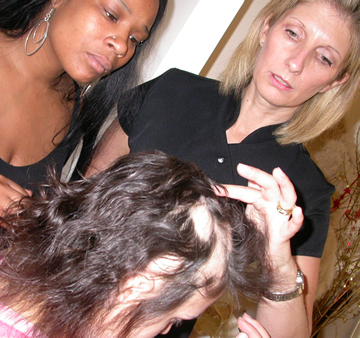
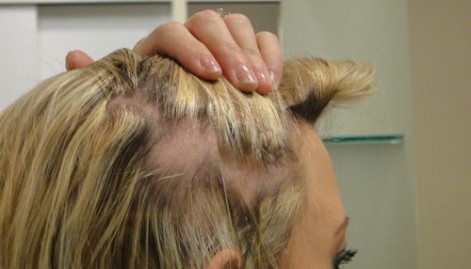
If not, the next thing you’ll notice is that sections of your hair are actually missing, or worryingly sparse. You can often see this more clearly around the hairline or behind the ears, but it can often happen around the crown, too. It really depends on what was causing the tension in the first place.

Some people even notice pustules (blisters filled with pus) or papules (little pimples) where the hair is under a lot of tension. This is because of the irritation being caused to the scalp and is a clear indicator that the follicles just can’t cope with the strain.

Can Traction Alopecia be Reversed?

Yes and no.

If you spot the warning signs of traction alopecia early enough and you put a stop to whatever’s causing it, then your hair will stop falling out and should – with time, patience and loving care – be completely restored to its former glory.

But if the hair follicles have been so badly traumatised for such a long period of time that they have scarred over, then the hair will not grow back by itself. Areas of the scalp where this is the case will likely look shiny.

In cases like this, you’ll need to think about some sort of surgical restoration – speak to your dermatologist to establish whether or not your traction alopecia has caused permanent scarring and to discuss the surgical options available to you.

When Traction Alopecia Compounds Other Hair Loss Problems

traction_alopecia_caused_by_hair_clipin_diane_shawe

If you are wearing a hairpiece – such as a clip on topper – to mask other hair problems like androgenetic alopecia, then you need to be very careful not to compound your problem with traction alopecia!

The best option is to ensure that the clips of your topper are firm, but not too tight, and that you rotate them. We also recommend undoing a couple of the clips when you’re at home – it gives your scalp a little rest from the tension.

Traction Alopecia Recovery Time

Most experts agree that your hair should recover within 6 to 9 months of you removing the cause of the problem.

If you’ve followed the guidelines given here and you are still not seeing regrowth, then it’s likely that the damage to your follicles was permanent – a fact your doctor/dermatologist can confirm. In that case, you might like to discuss the possibility of a hair transplant, which will effectively mask the problem.

What are the Causes of Traction Alopecia?

Traction alopecia is a type of hair loss that happens over time. It’s caused by putting the hair under constant strain or tension and is usually caused by one or more of the following…

  • Very tight ponytails or pigtails
  • Tight braids or cornrows
  • Dreadlocks
  • Extension (single) braids
  • Hair weaves or wigs attached with glue, clips or tape
  • Certain hair clips, slides or barrettes that hold the hair tightly and are worn in the same position every day
  • Headbands – even fabric ones – worn day after day
  • Tight hairpieces
  • Tight headgear like cycling helmets that are worn frequently or for long stretches of time and tend to rub or pull repeatedly on the same area of hair
  • Repeated use of hair rollers
  • Repeated pulling of the hair with the hands (this is an emotional condition called trichotillomania)

If you use or do any of the above, then you may find that the constant tension they cause has led to areas of thinning hair – usually around the temples or behind your ears. Alternatively, you might notice that the part in your hair looks wider than it used to.

If so, then it’s quite likely that you’re suffering from traction alopecia.

There’s more to this condition than hair simply breaking off. Instead, the constant tension in the affected area either pulls out the hairs’ roots completely, or causes the follicles to become inflamed. As time goes by, the damage to the follicles causes them to become atrophied (wasted away)… and if you don’t put a stop to the cause of the problem, they will reach the point where they no longer produce hair at all.

Reference: DermHairClinic – Traction Alopecia

Get your copy today from amazon.co.uk

Get your copy today from amazon.co.uk

Traction Alopecia Treatment

As discussed above, ‘treatment’ for traction alopecia is only effective before you’ve arrived at the stage of permanent damage.

But the good news is that ‘treatment’ – if you’ve caught the condition early enough – can be as simple as changing whatever hair styling and hair care practices you were using and really learning to CARE for this precious asset… your hair!

Wearing a weave

One of the biggest ironies about traction alopecia is that it’s the most common cause of hair loss for women wearing hair extension is due to the application being too tight when weaves and hairpieces are applied… yet those weaves and hairpieces are often used in the first place to enhance hair that may seem thin, or lacking in volume.

Weaves are generally applied through braiding, fusion, netting or bonding – and the sad fact is that any or all of these methods can lead to traction alopecia if used extensively, over long periods of time.

To minimize the risk of traction alopecia, or to try to prevent further damage and encourage regrowth, have your weave fitted by a state licensed professional. Yes, it may be more expensive, but you – and your hair – are worth it! Someone properly trained in hair care will keep damage to a minimum and will be able to spot potential problems and nip them in the bud.

The same goes for hair extensions, which can also cause hair loss problems in the lower half of the scalp. Have them fitted by a trained professional – don’t try to fit them yourself or have a friend do them for you.

Speak to your hairdresser about taking care of your scalp – some women find it difficult to maintain good scalp hygiene because the weave or extensions make it awkward… unfortunately, though, this can make the problem of traction alopecia worse.

When chemicals are the culprits

There’s a kind of alopecia called CCCA (central cicatricial centrifugal alopecia), also known as hot comb alopecia, or follicular degeneration syndrome. It’s almost exclusively seen in African American women and it’s often confused with female pattern baldness, because it starts at the crown and spreads to the surrounding areas.

The cause?

A mixture of too much stress (traction) on the hair along with the use of harsh chemicals like dyes, relaxers and bleaches. The chemicals actually damage the keratin structure of the follicle itself, causing hair LOSS, not just hair damage.

In fact, research conducted in 2008 showed that the highest prevalence of traction alopecia was in women with relaxed hair.

If you suspect this is a condition that’s affecting you, speak to your dermatologist. In addition to removing the cause of the traction and stopping the use of chemicals in your hair, you may be tested for any bacterial or viral infection and possibly be prescribed topical steroids, antibiotics or topical minoxidil to encourage regrowth.

NOTE: If you must use a relaxer on your hair, have it done professionally. Specialists are seeing more and more problems caused by home relaxer kits, because it’s tempting to leave the chemicals on longer than necessary, or accidentally use a stronger formula than you really need. (Make sure they have been certified)

Braiding, ponytails, pigtails and locs

The 2008 research into the prevalence of traction alopecia in African girls and women showed that braiding caused more problems than chemicals (although the two together were worse still).

Starting up a hair extension business Diane ShaweConstant, tight braiding – or other styles like ponytails that place hair under chronic tension – can affect any ethnic group. So it’s very important to take a new approach to styling hair that doesn’t rely on placing the hair under extreme tension.

The ideal solution, of course, is to allow the hair to be completely natural, without using any kind of clips, slides or ties.

The reality, though, is that this just isn’t possible for most of us. Our hair may either be unmanageable and wild looking when allowed to ‘do its own thing’ – or, like us, you may live in a climate where it’s simply too hot to have your hair hanging around your face all day.

The answer is that you can continue to secure back your hair, but you MUST change the way you do it from one week to the next. Traction alopecia is usually the result of CONTINUALLY putting the hair under EXACTLY the same tension in the same place, day after day.

How to Avoid Traction Alopecia (and still have beautiful hair!)

Change the location of your ponytail often – wear it high, low, on one side, then the other. Don’t wear a ponytail at all if your hair isn’t really long enough to need one… otherwise you’ll probably be pulling your too-short hair really hard in order to secure it.

Avoid using clipped in ponytails – the weight of them can – quite literally – tear out your hair.

Always use fabric covered hair bands – avoid bare rubber bands like the plague! And remove bands, clips and ponytail holders from the hair at night – this is when you may be putting your hair under tension without even realizing it.

Invest in satin pillowcases. They cause less friction on your hair than cotton or nylon ones – and, as an added bonus, they’re believed to help reduce wrinkles too!

Change the location of your partas often as you can. Even a simple part in the hair can trigger a problem when worn in the same position day after day.

Don’t retwist the roots of dreadlocks – watch this video for first-hand experience of how damaging this can be!

If you use hairspray or hair gel, wash it out before you next brush your hair.Brushing dried hairspray and gels out of your hair is damaging to the shaft and may cause further hair loss.

Make sure your hair is hydrated. If you’re in a dry climate – or you use air conditioning or central heating – the lack of moisture in the air can make your hair brittle and more likely to break

http://http://issuu.com/dianeshawe/docs/course_prospectus_hair_loss_consult

Other related Hair Loss Article by Diane Shawe

The dangers of being out-thought and out- manoeuvre by your competitors

soft skills training for sales team by diane shaweBuyers Don’t Follow a Linear Path anymore so why ask your sales team to do the same?

article by Diane Shawe M.Ed

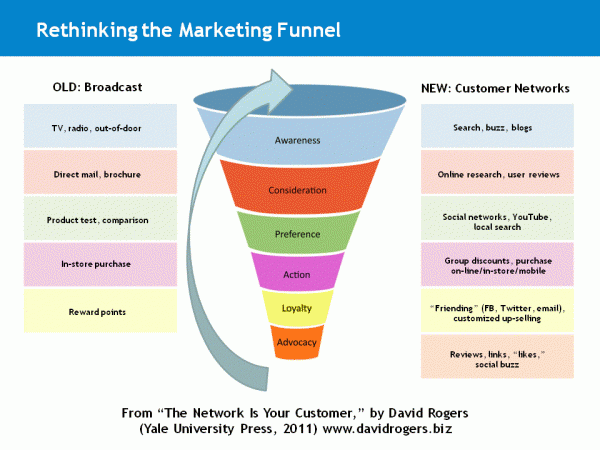
The sales funnel relies on the theory that someone comes into the top of the funnel and sales fall out the bottom. But is that true in today’s world? Do we start at the top and make our way through to the end? Or do we start at the top, leave, jump levels, come back, leave again, come back at the beginning and some point come back and buy or totally just leave? Are sales people  following a linear purchase pattern or an erratic path of engagement that sometimes results in less and fewer sales?

Distraction is the Number One Barrier to Sale

Distraction is destroying the Sales Funnel. It’s clear that buyer behaviour is erratic, but they are also finicky and overloaded with information.. Distraction may very well be the number one barrier to a sale. We get distracted and abandon our cart. We stop reading the article that brought us to you. Simply put, any little distraction means we move on to something else and we may never come back. We are also finicky buyers, what we think one day may be dramatically changed by another piece of content that contradicts our previous opinion.

Let’s take a look at the Sales Funnel Concept.

The sales funnel has been around for as long as any of us has been in business. It is a tool that has been used to visualize everything from the sales process to marketing impact on an organization. I use to be a  fan of the sales funnel.  But the truth is, the traditional sales funnel model has been dead for years; we just haven’t come to accept it yet. They say a picture paints a thousand words, the problem is clients are overloaded with the same information.

SALES-Marketing-Funnels dead. avpt Diane Shawe

Buying patterns have changed drastically in the last decade. They’ve changed so much that they have truly broken the sales funnel as we know it.

Old habits die hard, so the big question is whether or not a sales funnel is still a viable model for sales concepts. Here are the biggest challenges I see with the sales funnel in today’s buying environment.

Selling the way your customer wants to buy…Not the way you like to sell

Sales Plan Mapping is all about Rapport.  Rapport is defined as:

“A state of mutual trust and respect existing between two or more people. Rapport is the primary basis for all successful communication.”

Sales Plan Mapping is all about Rapport.  Rapport is defined as: “A state of mutual trust and respect existing between two or more people. Rapport is the primary basis for all successful communication.”  To build rapport with someone you have not met face to face is a learned skill referred to as NLP.

Learning to Plan a Sales map requires knowledge in a new type of Consultative Selling.  Planning a Sale Map would mean learning new skills in 5 key areas:

  • Best Practices
  • Communication Skills
  • Strategy and Traction
  • Sales Project Management
  • Presentation

The strategic role of continuous education

One way to stay on top of a rapidly changing market is to implement a business strategy that maximises the synergies between lifelong learning and workforce productivity.

Without appropriate technological support, training programs appear to be less effective. No matter the size of your business, if you stand still and basque in your current success, this is surely the biggest route to new challenges.

Even though research has shown that E-Learning proves to be an excellent way to achieve quality results in a short timeframe, most users still only dabble with free flimsy or overbearing solutions that provide no tracking, evidence or further sign posting to continue competence training.

Getting the world back to work with skills we can trust

Getting the world back to work with skills we can trust

POINT OF NEED TRAINING

Point of Need Online-delivered learning, using mobile technology within a context of continuous education, is considered strategic because it:

  • Keeps the workforce appraised of their job functions’ developing requirements, enabling them to make a positive impact on their role individually and as a team and help that Organisation achieve its aims and goals
  • Aids succession planning, helping workers to acquire the knowledge and skills to help them progress within their Organisation
  • Allows Organisations to keep training budgets under tighter control, develop and retain existing employees and reduce the costs related to external human resources recruitment, selection and on-boarding

The current speed of change means that employees need to be trained continuously for Companies to avoid the dangers of being out-thought and out-manoeuvre by competitors especially on qualities such as leadership.

A poorly educated workforce results in decreased, indeed ever decreasing, levels of productivity and reduces their ability to deliver results. Ignorant and poorly skilled staff can’t (or, at least, shouldn’t) be promoted — since they don’t have the appropriate skills to help their company reach its business objectives. So Organisations need to go to the expense, in terms of time and trouble, of recruiting staff with new knowledge and competencies from outside the organisation to cover middle and senior level positions. It’s important to realise that not only does this practice have a negative impact on the organisation, regarding high costs per individual worker, but company results show that this approach isn’t always successful.

According to recent research (Lifelong Education and Labour Market Needs, published in The EvoLLLution online newspaper) examining the need for continuing education in the workforce, 64% of executives who are recruited externally fail within four years of joining the organisation.

Ideally, every company should have a Personal Training Needs Analysis plan in place for each of their employees. This project should engage the employee in identifying training programs that will enable the employees to develop the necessary knowledge and skills specific to them.

How can we help up-skill your sales team without them taking too much time of work?

Modernising your Sales Team – Project Manage Sales Mapping Whitepaper by Diane Shawe M.Ed

Want To Start showing off your most recent qualification?


Here’s How To Get Qualified in Days, not Years Now!

London, City – January, 19 2016 – Innovation is alive and kicking in London, according to the organisers of 2014 FSB London Business Awards, who announced the finalists. The shortlist included Diane Shawe founder of AVPT Short Courses that provides soft skills courses to people looking to get a job, get a promotion or start a business by them training on their mobile devices.


Whether you are a complete beginner or more experienced, on one of our career development short courses you will find yourself learning in our enjoyable and professional environment online or at one of our Express workshop. For time poor clients or customers wanting a newly recognised qualification, AVPT Short courses is the place to enrol.

Our courses allow you to take full advantage of our specialist facilities and the expert tuition at your fingertips with a full take away manual for further reading.Taking a short course is ideal if you want to add new skills to your tired CV, brush up on an old hobby or refresh your skills, build on your current practice develop expertise to help start your own business review your career build a portfolio for college or work. We have a range of different creative short courses available.

You can be confident in your future success with our fully trained and qualified tutors, they’re as dedicated to your personal development as you are about landing that big promotion, starting that passion project of a business venture, retraining or making that essential career move.

For the past ten years we have been consistently training time poor individuals, organisations and governments all over the world by supplying high-quality soft skills courses that are all globally accredited. At our Academy, we have taken out all the stress of retraining by offering over 390 globally accredited courses in a way that fits in with you and your lifestyle.

Once you’ve decided you want to invest in your professional development; it’s time to choose a study style that suits you. You can either work through a home study manual or online using your own device with an allocated personal tutor or in the classroom for a fast one, two or three-day course. Visit http://www.shortcourses.expert for more info

10 Top Tips on How to Influence Online buying by Diane Shawe

Try out 5 Courses this Christmas for just £25.00

Try out 5 Courses this Christmas for just £25.00

The trends and predictions are already in for 2016. Many digital advancements will be made in 2016, from the rise of mobile messaging apps to mobile commerce finally gaining some mojo. 

You the reader even you are becoming more savvy and intend to be heard when things are not going right.  Smartphone use is driving up the number of inbound calls to businesses. Voice-activated search has been rising steadily. Consumers are talking to personal assistants through their smartphones and cars, and those “assistants” are getting smarter. And with the rise of smart watches and connected home devices, they’re talking to a wider variety of devices from various locations.

Marketers need to be prepared and ready to optimise digital content for speech-based (not keyword) queries and learn how to make sure that content can be discovered by personal assistants.

– So what about small businesses, the lone sole trader, what can you do to influence online buying?

  1. Change your ads Your prospects could get bored seeing the same ad all the time. Statistics show people usually see the same ad 7 times before they actually buy. Just change them enough to keep them from being over-exposed. For example, if your ad said. “FREE Killer Marketing E-book!”, you could change it later on to “FREE Sizzling Marketing E-book!”
  2. Give people a deadline to order. Tell people if they order by January 15 2016, they will get a discount or free bonuses. This will create an urgency so they don’t put off buying. Another example, “Order before 8:00 p.m. and get a second product of your choice for free!”
  3. Publish testimonials on your ad copy. They will give your business credibility and you’ll gain people’s It’s important to include the person’s full name and location with the testimonial.
  4. Allow people to make money reselling the product or Tell people they can join your affiliate program if they order. You could pay them per sale, per click, per referral, etc. Just provide them with proven and tested marketing materials, detailed statistics and plenty of affiliate training.
  5. Offer a buy-one, get-one-free deal. If you sell more than one product, this type of deal works People will feel they are getting more for their money and will order quicker. You could also offer them a ‘buy one, get one half’, ‘buy two, get the third one free’, ‘buy two, get a free watch’.
  6. Have them sign up to get access to download a free e-book. The subject of the e-book should be related to your target audience. You could have them sign up to a opt-in list or your regular The e-book should have high perceived value so they’ll take the time to sign up. Landing pages are really good for this.
  7. Give your visitors a free membership inside your Members Only web site or closed membership group on LinkedIn or Facebook. Have them sign up to receive a user name and password or an exclusive invitation. Members groups are particularly good on LinkedIn and your blogs because each time you post some news they get an automatic update.
  8. Offer your visitors free consulting via e-mail. Have them fill out a web form to e-mail you with their When you answer their questions, include an offer for a product you sell or highly recommend products that could help them. You could join the product’s affiliate program to earn commission if they take your advice.
  9. Give people free bonuses when they order your product or The free bonuses could be books, jewelry, reports, newsletters, etc. Make their bonuses sound extra valuable by listing their retail value, either separately or together in one amount, or limiting how long you will offer the bonuses. (you can partner with free gift websites)
  10. Provide free package and postage with all orders. If you can’t afford it, you could offer free P&P on orders over a specific You could also offer a rebate on their P&P costs. Most customers probably won’t send in the rebate card unless it’s a huge shipping cost, for example, £30 or more

Try our Audio Courses this Christmas.

Niche Marketing Made Easy

Produce Persuasive Copyright

Building online Traffic and List Systems

Email Marketing secrets

How to set up and generate a powerful Blog website

The Affiliate Chemistry

7 Habits of Highly Effective People

Internet Business Optimisation

12 Effective selling techniques

50 Best and Worse Business Deals of all time

20 Advertising Tips

Art of Making money

Breakthrough Sales Solutions

Clever Profit Generating Insights

How to Combine Cooperation & Competition

Customer Tested – Buying Triggers

How to work with change

Explosive Influence Tactics

Extreme Persuasion Strategies

Manage your Intellectual Capital

The Servant Power Leadership

Visit www.crashcourses.academy and select 5 course and start listening, watching and learning today.

Bad habits that damage Hair Extensions by Diane Shawe

BAD HABITS THAT DO YOUR HAIR AND HAIR EXTENSIONS MORE HARM THAN GOOD

article by Diane Shawe M.Ed

There are common habits we knowing do that damages our hair. For instance like using a flat iron at the highest possible tempreture that will surely harm your hair.

Less common however is ponytails, super tight buns or braids, the sun, birth control pills, hair extension glues and hair extension clips and micro rings made from Nickel.

Let’s first talk about using flat irons or curling irons. These man-made styling equipment are very drying to hair extensions and not to mention, harmful too hair. This is because the temperature and heat in the irons are to unreasonably hot for the hair so you end up cooking your delicate hair whilst drying it out at the same time.

using hot iron damages hair extensionsHair ironing will damage the state of your already process hair extensions. It does not just dry the hair from head to tip, it makes your hair become frizzy and hard to manage especially if the hair is blended you end up melting the synthetic bonded in with the real hair which become crinkly. Once hair extension becomes too damaged, it is very hard to rejuvenate them back as they were already ‘dead hair’.

Trimming or cutting the damaged hair will work, but then you end up losing the length of your hair extension which would have cost you a lot of money to install in the first place. Doing hair treatments is crucial to hydrating the hair.  Hair treatments such as oil treatments are good for your natural hair but can end up making hair extensions heavy, clumpy and then eventually matting by themselves.

Hair extension Clip-in can also damage your hair if left in for over 5 hours a day

Diet also plays a role in the health of your hair too. Eating too much food that has little or no beneficial nutrition to your hair will cause your hair to be brittle and weak. Foods with good source of omega-3 is good for your hair whilst your hair extensions require a good non oil based leave in conditioner twice a day to keep it hydrated.

Pick up a a copy today from Amazon

Pick up a a copy today from Amazon

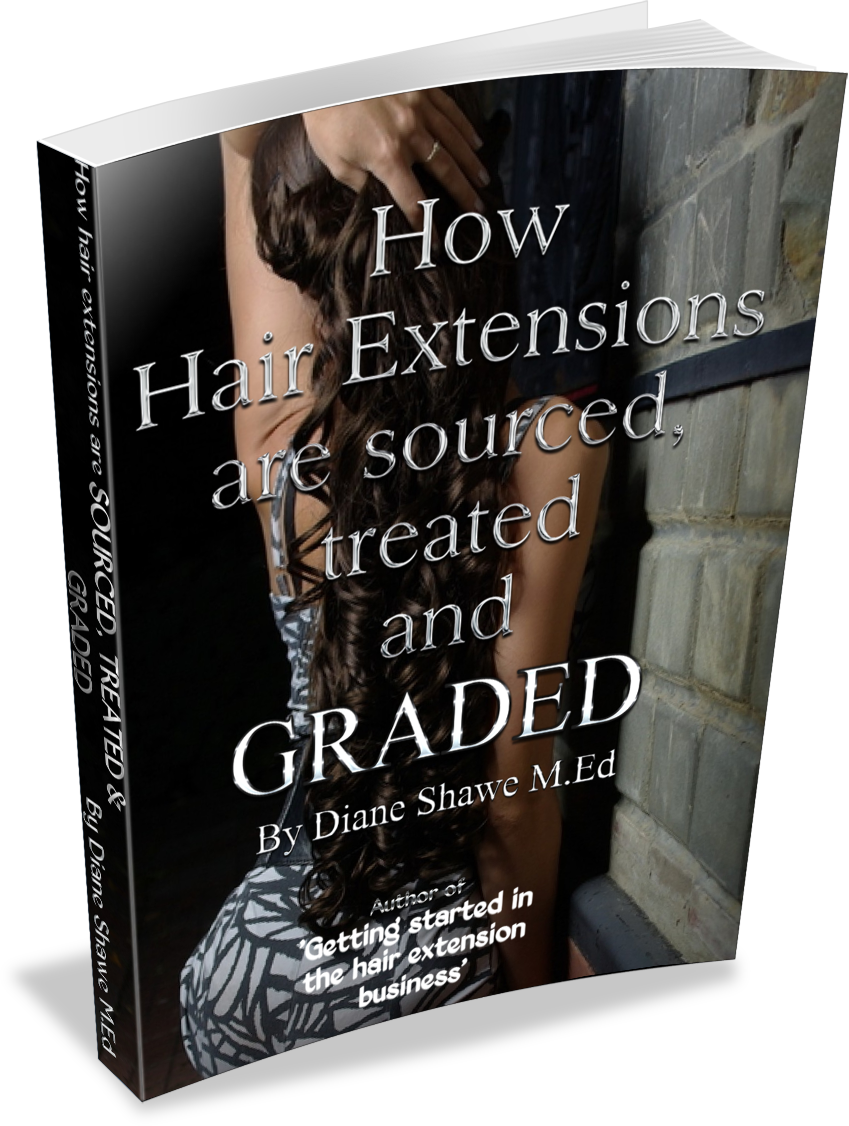
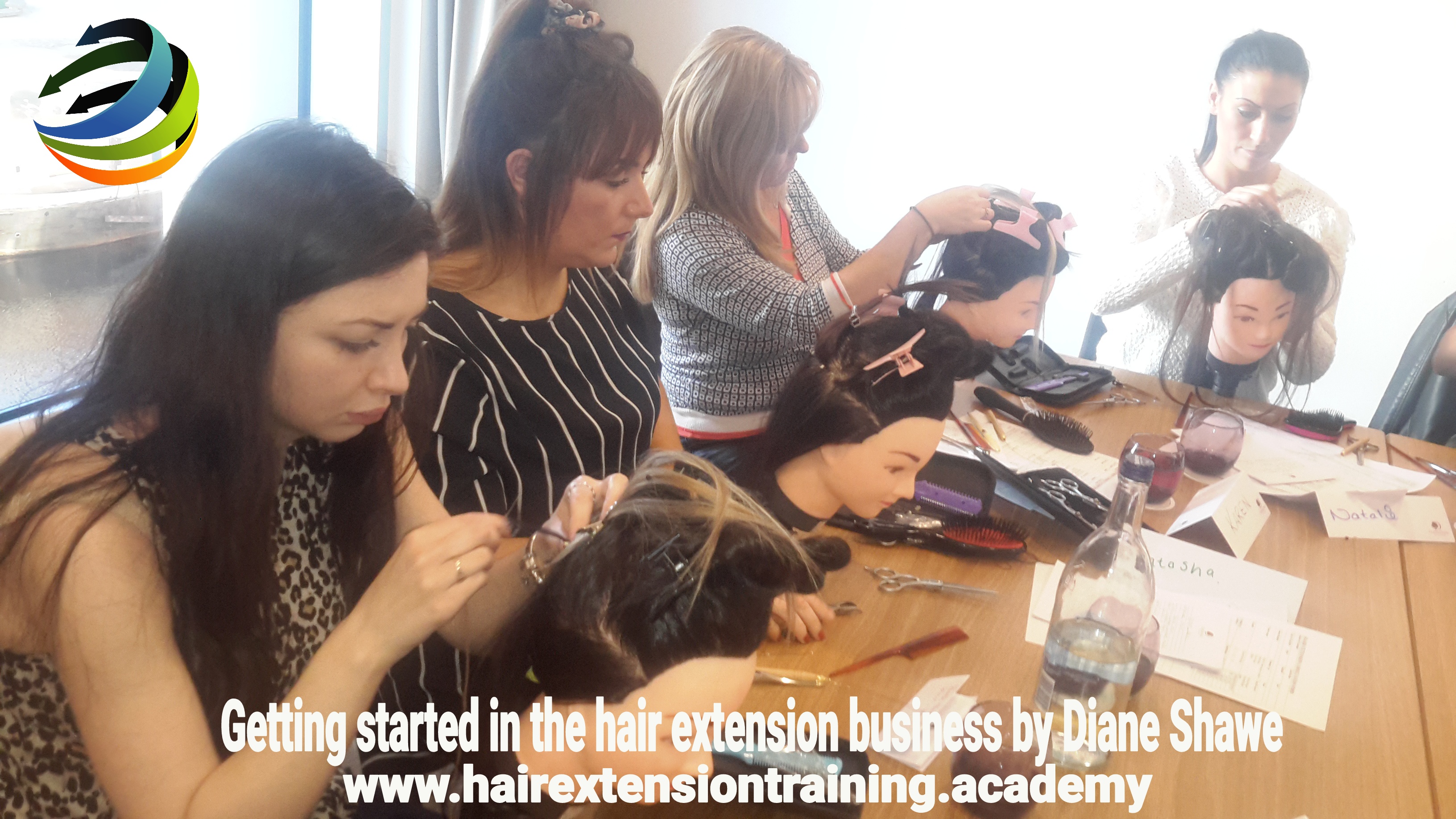
Getting started in the Hair Extension business

If you want to find out more about becoming a hair extension consultant, hair loss consultant or hair extension trainer, download our course prospectus for more information about the Hair extension training academy.