Tag Archives: express training

6 Things the Most Influential People on Social Media Do

Train to become a Linkd in specialist

Train to become a Linkd in specialist

How do you earn respect, stand out, and get noticed in noisy social-media circles? Take a cue from the Web’s biggest influencers.

Guest Blogger 

Influencers are among the most magical, powerful creatures in social media.

Within specific niches or across large audiences, they have the power to shape how people think about an issue, start important conversations, make businesses stand up and take notice, and more.

Outside of having a large following, how do they do it? And how did these influencers amass the following they have in the first place?

The ability to stand out in noisy social circles helps influencers build their audience and connect with them over and over again. It keeps them relevant. It keeps them influential.

Here are the six things influencers do to stand out:

1. They’re Superconnected and Almost Always On

Brand advocates, superfans, loyalists–influencers of all stripes–are hyperconnected to their audience. They have a passion for their topic of choice, which means they’re always on and use multiple devices to ensure they’re connected throughout the day.

Influencers use tools such as Topsy, Trackur, and Social Mention to find interesting conversations, stay on top of breaking news in their niche, and help them manage and schedule content for maximum exposure.

Influencers treat social like their j-o-b. (and sometimes it is). They get it; you have to invest time and money in yourself to help you scale if you are going to stay superconnected and become an influencer.

2. They Make Boring, Dry, or Otherwise Uninteresting Topics Fascinating

When everyone is saying the same thing, who grabs your attention? Influencers are the people coming up with a creative take on a topic, saying something different or contrary or funnier, etc.

Take Gretchen Rubin, for example. Rubin is a popular author, blogger, and speaker, but then a lot of people write and speak. How is she also one of LinkedIn’s 150 Most Influential People?

For one, while everyone else was writing self-help books, Rubin decided to parody them with her first book, Power Money Fame Sex: A User’s Guide.

See, while everyone else was trying to tell people how to be happy, Rubin decided to take a quirky, self-deprecating, and humorous approach.

When she tweets to her 92,000-plus followers, they listen and share because she’s not spouting the same old conventional wisdom. Her take is unique and makes something that could be tedious–finding happiness–an adventure in which her social connections can all participate.

3. They Create a Ton of Awesome Content

The killer content top influencers are banging out on a regular basis really helps them stand out in a sea of noise, regardless of the topic.

Influencers are great at creating content that people can’t help sharing.

They might do this by way of original research, powerful commentary, sharing a unique take on the news, turning information into stunning visuals, hosting webinars or online chats, or blogging prolifically.

Whichever medium they’re using, influencers love to create awesome content, and they have mastered techniques that allow them to scale their efforts. This might mean partnering with others to increase their reach and maximize their time, or building a great team around them to assist in their efforts.

There are a lot of people out there with something interesting or brilliant to say. The ones who garner influence, though, are incredibly skilled in how they get their message across to the greatest audience possible.

1 day social media and marketing course

4. They Know Who You Are and Want You Want

Influencers don’t operate in a vacuum, churning out social updates and content like traditional broadcasters. They know their audience and what you like–in fact, they often know what you’ll like before you do.

Knowing your audience goes far beyond demographics, and influencers totally get it. They listen, engage, and converse so they can truly understand what drives people. They’re thirsty for audience insights that will help them create that next amazing piece of content, or fuel their next groundbreaking research project.

They don’t get bogged down in popular opinion or go with the crowd, because they know you’re looking for something different. They know this because you’re telling them in a thousand different ways, and they’re actually paying attention.

It might be through social-media activity and sentiment tracking. It could be through website analytics. It may very well be gleaned through actual conversations with the real people who hang on their every word.

The difference is, they actually care about what would be most useful, helpful, or entertaining for you and go from there.

They’re more concerned with what you want to hear than what they want to say.

5. They’re Hip, They’re Happening, They’re Current

And they can’t help being all of these things, because they are so in tune with the topic on which they’re influential.

They read voraciously. They eat data and facts for breakfast. Influencers eat, sleep, and breathe their passion and are always at the forefront of the industry.

When everyone else is talking about what happened this morning, they’re already talking about what’s going to happen tomorrow. And they know what’s going to happen tomorrow, because they know just about everything there is to know about what’s already happened, who is working on what, which technologies or developments are on the horizon, and more.

6. They’re Trustworthy

And this is huge, massive, critical! They don’t waste words, publish fluff pieces, tell half-truths, or otherwise lead their audience astray.

People elevate others to the level of influencer because they trust them. It’s as simple as that.

It can take years to build that trust and one poorly thought out statement to break it, so influencers are incredibly careful about what they’re putting out to their networks.

They stand out in a sea of noise because time and again, they’ve proven their voice is worth listening to and their advice worth taking.

Call us to enquiry about our soft skills courses

Call us to enquiry about our soft skills courses Diane Shawe at express courses, London UK

source: http://www.inc.com/larry-kim/6-things-influencers-do-to-stand-out-in-social-media.html#ixzz2zldfZm9Q

Does nine different kinds of intelligence make you any smarter?

In this article, I will talk about the different ways in which Multiple Intelligence Theory can be implemented in e-Learning to help the learner effectively acquire, retain, and utilise the information being provided within the e-Learning course.

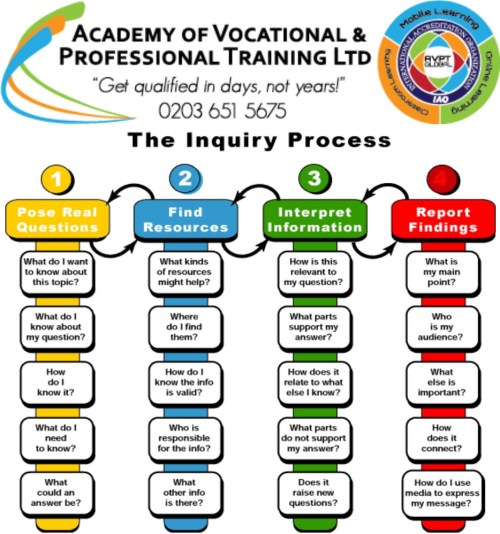
the enquiry process to soft skills training april 2014

The Multiple Intelligence Theory was developed by Dr. Howard Gardner in 1983. Dr. Gardner, a noted psychologist and professor of neuroscience from Harvard University, suggested that every human being interacts with their environment differently. We each possess nine different kinds of intelligence, but our experiences, cultural beliefs, and knowledge base determine their exact configuration.

What is “intelligence”, according to Multiple Intelligence Theory?

According to Gardner, there are three key elements that determine a person’s intelligence:

  1. The ability to create a service or product that will be valued in the person’s society of culture.

  2. A skill set that allows the person to solve real world problems that they may encounter in life.

  3. The ability to potentially create new solutions for problems or to utilize existing solutions. This typically involves the acquisition of new knowledge. 

Multiple Intelligence-Based Activities in eLearning

Multiple Intelligence Theory can be implemented in eLearning based upon the nine multiple intelligences. Let’s take a closer look at each category and which multiple intelligence-based activities can be utilized during instructional design to create the best possible eLearning experience for the learners:

  1. Musical (or Rhythmic) Intelligence
    This intelligence involves the capacity to think and learn in terms of music and rhythm, and to recognize and hear patterns. An activity that would appeal to this type of intelligence is a lesson that includes music or sound, such as a multimedia presentation. Try to use music that emphasizes the subject matter and creates a more immersive experience for the learner. Since there is more of an auditory aspect with this particular intelligence, lectures can also be very helpful. People who demonstrate a high degree of musical intelligence may be ideally suited for musical professions, such as composing or playing an instrument.

  2. Linguistic Intelligence
    This intelligence is associated with expression through language. These people tend to be able to eloquently convey their thoughts and to understand the words of others. Writers and speakers typically display a high degree of this sort of intelligence. Any activities that include discussion, such as online forums or group-based scenarios, are ideal for individuals who lean more toward linguistic intelligence.

  3. Mathematical (or Logical) Intelligence
    This involves the ability to identify principles or structures within a system. This intelligence is often associated with the logic or the manipulation of numbers.  Activities ideally suited for this intelligence may include diagrams, charts, or tables. Critical thinking scenarios are also useful with this group. Accountants and researchers often have a high level of mathematical intelligence.

  4. Kinesthetic (or Bodily) Intelligence
    Body Intelligence involves the use of a person’s entire body to figure out solutions or to create something. People who demonstrate a high degree of kinesthetic intelligence may be ideally suited for performing arts professions, such as dancing, or careers that require an innate knowledge of one’s own body, such as a doctor or athlete. Activities that are best suited for this sort of intelligence include games that involve hand-eye-coordination or interactive scenarios that require physical involvement. The thing to keep in mind about this group is that they are best able to learn when muscular movement is involved. So, include activities that require movement and physical response.

  5. Spatial Intelligence
    This intelligence pertains to a keen sense of space and how one can navigate those spaces. Activities that involve flow charts and graphics are ideal for this intelligence group, as well as games or multimedia that is visually appealing.  Architects, pilots, and sailors often have a high degree of spatial intelligence.

  6. Intrapersonal Intelligence
    This involves an in depth understanding of oneself, such as what you can accomplish and how you react to certain situations. As such, individuals with high intrapersonal intelligence often have a sense of what they should avoid and what they want to achieve in their lives. Professors and philosophers often possess high degrees of intrapersonal intelligence. Activities such as collaborative learning exercises (online forums) and chat programs enable intrapersonal intelligence learners to help others and to share experiences and ideas. This category responds well, first and foremost, to activities, which require introspection.

  7. Interpersonal Intelligence
    This is the capacity to understand and learn from others. People who demonstrate a high degree of intrapersonal intelligence may be ideally suited for service professions, such as teaching or politics. Those who identify more with this category of intelligence may benefit from group discussion activities and in depth questions that make them fully explore the topic. What’s important to remember about interpersonal intelligence is that these individuals are sensitive to others’ moods and feelings. They work well in-group settings and are often able to learn more effectively when collaborating.

  8. Naturalist Intelligence
    This intelligence involves the capacity to differentiate between living organisms and to view the connection between all natural things.  People with a high degree of naturalist intelligence usually have a close bond with nature. Botany and biology are two career fields that closely identify with this sort of intelligence. Activities that involve classification or organization appeal to these individuals.

  9. Existential Intelligence
    This particular intelligence was added later by Gardner, and is not commonly associated with learning environments, as it is geared more toward spiritual and philosophical views. For example, someone who has a high degree of existentialist intelligence may have a tendency to pose questions about life’s purpose or death. 

It’s important to note that instructional designers should not feel obligated to incorporate all of these multiple intelligence-based activities into their eLearning courses, just that it may be beneficial to offer a variety of multiple intelligence-based activities to more effectively illustrate the subject matter. If you are able to offer learners a diverse set of learning tools and eLearning strategies, then you gain the ability to increase comprehension and retention, not to mention enhance the overall eLearning experience.

Call us to enquiry about our soft skills courses

Call us to inquiry about our soft skills courses

Enterprise Women Launching Club in Kensington, Chelsea and Westminster

Calling ALL BUSINESSWOMEN in Kensington, Chelsea and Westminster!!  Are you looking to grow your business and build strong local networks of trusted peers who will share and learn from each other? Do you want to be part of a community of substance that understands female-owned businesses and delivers practical value to its members?

County House
Date:

Tuesday, March 25, 2014 – 10:00 to 12:00

Venue:

County House

Venue address:

46 New Broad Street, London, EC2M 1JH

Price:

£27.60 inc VAT (includes lunch)

Then local host, Diane Shawe, offers you a warm welcome to join her at the Kensington, Chelsea and Westminster Women’s Business Club launch. The event is for women who are looking for that extra special support, advice, collaborative relations to help them develop and expand their business.  Join us on Linkedin

Get your free copy when you attend this event

Diane is Chief Executive Officer of the Academy of Vocational and Professional Training Ltd, which provides online and workshop fast-track soft skills training courses, Ms. Shawe is passionate about technology and the impact it will have on delivering training to students on the move that can be measured and proven. In addition Diane sits on several executive committee which includes the Conservative Education Society. As well as being a published author of several business books including, “The 10 habits of a successful women Rainmaker – From Tactics to Strategy: What works”, which is included!

Our first theme will be called, “No Random acts of Lunch.” The people who are most successful at business development, do not commit “random acts of lunch”.

Diane, will also be discussing how plans can take on many different forms and why developing your negotiation skills is VITAL! She will look at the 10 steps of honing in your negotiation skills, so that you never have to stumble away feeling unsure, vulnerable or disappointed about a meeting or presentation.  This will be the best 2 hours you could spend.

We are delighted to have guest speaker Bev Hurley at our meeting. A dynamic serial entrepreneur, mentor, angel investor and one of the UK’s leading authorities on female entrepreneurship, Bev Hurley has spent more than 30 years building successful businesses of all sizes – and sharing her expertise to create and grow hundreds of others.

PRESENTERS FOCUS

Diane Shawe

The Kensington, Chelsea and Westminster Business Club is being hosted by Diane Shawe. She is the founder and CEO of two successful training companies based in London and Luxembourg as well as an established publisher of several business books. Diane has a wealth of knowledge and experience across multi-disciplines. Diane believes that people should try to integrate the following practice into their daily lives: “never do anything as though you are a professional amateur”

Bev Hurley

A dynamic serial entrepreneur, mentor, angel investor and one of the UK’s leading authorities on female entrepreneurship, Bev Hurley has spent more than 30 years building successful businesses of all sizes – and sharing her expertise to create and grow hundreds of others.
So what are you waiting for? Book your place now!

We look forward to seeing you all there…

To book your place, first log in or create a new account, and click the BUY NOW

If you have any problems registering for this event, please email farhana@enterprising-women.org
or
diane@avptglobal.com

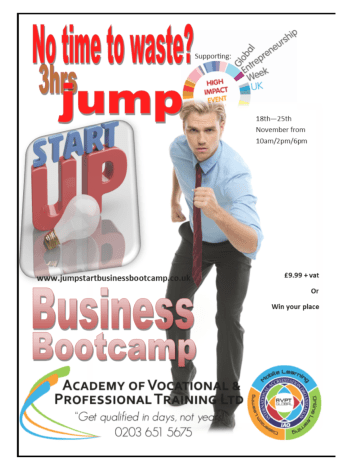
Press Release: Leading Vocational Training Provider to Support Global Entrepreneur Week

jumpstartbusinessbootcampnotimetowastegewuk 5Article written by: Rebecca Appleton at Dakota Digital

A top vocational training provider will continue its mission to get budding business leaders up and running next month with a series of high intensity bootcamps as part of Global Entrepreneur Week.

The Academy of Vocational and Professional Training was awarded a High Impact badge for its efforts during the 2012 series of events. On the back of this, it has designed a series of three hour ‘Jump Start Your Business’ master classes which focus on a dozen essentials that every entrepreneur-in-the-making should know.

Taking place throughout Global Entrepreneur Week (18 – 24 November 2013) the Academy of Vocational and Professional Training’s bootcamps are packed with practical information, indispensable no-nonsense advice, hands on guidance and immediately implementable strategy. Designed for anyone looking to start their own businesses, the sessions are led by experienced trainers and business gurus from the Academy of Vocational and Professional Training.

Starting right from the germination of an idea through to getting a fledging new company flying, classes on the 18th- 19thNovember cover how to write a business plan, identifying a USP, how to write a perfect pitch and adding value.

Calculating prices and worth, creating a brand, designing business processes and using social media will be tackled on the 20th– 21st. To round out the week, the bootcamp sessions will focus on the marketing plan, goal setting, working on yourself and raising finance.

Informative, professional and inspiring, the bootcamp has been designed to support key Global Entrepreneur week values. Taking place in more than 115 countries simultaneously, the UK programme of events is focused on getting more young people started in business to encourage a nationwide culture of entrepreneurism.

Diane Shawe founder and CEO of The Academy of Vocational and Professional Training said, “We were thrilled to receive our High Impact badge of honour in recognition of our efforts during last year’s Global Entrepreneur Week and are determined to do even better this time around!

1 a good deal“We know that starting a business can be an immense challenge and even though government and other agencies do provide some support, many of those interested in starting their own business can still feel overwhelmed. We have poured all of our knowledge and experience into creating our Jump Start programme of events. Feedback from last year’s sessions was so encouraging that we have further developed the concept, packed in even more useful advice and pledged to help everyone attending feel empowered and confident about taking their first steps in business.”

The UK Global Entrepreneur Week activities will be organised by Youth Business International. Its aim it to create a collaborative, local and practical week which makes it easier for those new to business to learn more and more easily access the support available to them.

AVPT is the only UK Globally Accredited online and workshop based provider of over 390 Soft Skills courses using a cutting edge, proprietary online Learning Management system.

The Academy of Vocational and Professional Training’s bootcamp sessions are all priced at £9.99. To register for a master class and to see the full timetable of events visit click here.

For more information about The Academy of Vocational and Professional Training visit www.expresstrainingcourses.com

Please direct press queries to Rebecca Appleton at Dakota Digital. Email Rebecca@dakotadigital.co.uk or Tel: 01623 428996.

Tags:

Manisha Gaur discusses why Global Accreditation is leading the way to unified integrated accreditation

The rise of International Accreditation

News Title

by AVPT Global

For decades, regional accreditation bodies had been granting educational institutes with primary accreditation after evaluating them on a regional scale. However, as globalization grew, it became extremely important for educational institutes to be acknowledged world over so that when students look for credit transfer and international job opportunities, it does not stand in the way.  This gave rise to International Accreditation. This topic was represented by Ms. Manisha Gaur, Director Operations at Venkateshwara Group of Institutions, India.

She discussed how globalization has affected today’s education systems and the education providers are looking forward to establishing a centralized education system.

The phenomenon is occurring, but at a very slower pace and this is where the accreditation agencies have to play their role. They need to set up a unified and integrated accreditation system for all the educational institutions globally so the standardisation of education can be done successfully.

A smarter way to study with www.avptglobal.com

A smarter way to study with http://www.avptglobal.com

Regional accreditation bodies have existed and also evaluated education providers on a regional scale, thereby granting them Primary accreditation.  However, the rapid growth of globalization calls for a global entity which can evaluate them against internationally proven standards of education and grant them an internationally recognized Secondary Accreditation.

This secondary accreditation is basically known as International Accreditation. With international accreditation, the school, college or university will be internationally accepted. Students of such educational institutes can further study in the educational institute of their choice in any country without the tension of their credits transfer and also, work with any employer without the tension of their degree acceptance.  For these reasons, it has also become a major deciding factor by students when selecting their higher educational institutes/ universities. Additionally, it has also become important to employers. Employers globally feel more comfortable hiring students from internationally accredited institutes.
Based on this information, she presented why international accreditation is needed globally and how, in the last couple of years, it has gained massive importance, even more than national and regional accreditation bodies. Her topic also informed the participants as to how International accreditation bodies evaluate the institute on the basis of their academic and organisational management and provide them with international accreditation. This international accreditation not only enhances the institute’s profile regionally but also internationally which is why, today, we see a majority of the students and institutes around the world demanding international accredited programs.
About the Speaker

Manisha Gaur is a highly respected member of the Indian education community. She is not only involved in the teaching of the students but she takes it as a responsibility where she wants to develop students into becoming pillars of the society. She has been associated with the Indian Education Board and the National Accreditation body where she has conducted various presentations and has published various researches. She has also received numerous awards from the regional and international community for her services.
AVPTGLOBAL almost 400 courses all globally accredited

AVPTGLOBAL almost 400 courses all globally accredited

Why Stress can stop you from achieving excellence in 2013

managing your stress

managing your stress

Article by Diane Shawe M.Ed.

Take 5 minutes a day to keep your stress level down

Everything seems much faster, urgent and possibly unfulfilling! Just after Christmas and heading into the New Year it can often be a stressful time for lots of people for lots of reasons.

Stress is created by worrying about things in the future or things that have already happened, both of which you cannot change at the very moment you are worrying about it.

Before you read any further do this little test.  ‘At this very very moment whist you are reading this is there a problem affecting you reading this article at this moment in time that is stopping you from reading it? If your answer is ‘no’ then this is because you are living in the ‘NOW’

Living too much into the future or reliving the past are both causes of fear and pain. You would probably find yourself concerned with some of the following thoughts…

  • How can I stop the pain?
  • How can I switch your mind off,
  • How can I stop worrying?
  • How can I relax?
  • How can I be happy?

Well I invite you to explore two words ‘acceptance’ and ‘surrender’ a good place to start.

Become fully present is very empowering and helps you live in the higher order of thinking.

If only our lives was like typing when we can simply undo, delete or Hyperlink to a quick useful reference but alas, lots of things are unavoidable in life.  Never before has it become more important to find ways to decrease and prevent stressful incidents and decrease negative reactions to stress, especially as they can lead to short or long term illnesses.

Here are some of the things that can be done instantly by just remembering to be conscious of them.

Managing time

Time management skills can allow you more time with your family and friends and possibly increase your performance and productivity. This will help reduce your stress.

To improve your stress management:

  • Save time by focusing and concentrating, delegating, and scheduling time for yourself.
  • Keep a record of how you spend your time, including work, family, and leisure time.
  • Prioritise your time by rating tasks by importance and urgency.
  • Redirect your time to those activities that are important and meaningful to you.
  • Manage your commitments by not over- or under committing. Don’t commit to what is not important to you.
  • Deal with procrastination by using a day planner, breaking large projects into smaller ones, and setting short-term deadlines.
  • Examine your beliefs to reduce conflict between what you believe and what your life is like.
  • Build healthy coping strategies

It is important that you identify your coping strategies. One way to do this is by recording the stressful event, your reaction, and how you cope in a stress journal. With this information, you can work to change unhealthy coping strategies into healthy ones-those that help you focus on the positive and what you can change or control in your life.

Lifestyle

Some behaviors and lifestyle choices affect your stress level. They may not cause stress directly, but they can interfere with the ways your body seeks relief from stress. Try to:

  • Balance personal, work, and family needs and obligations.
  • Have a sense of purpose in life.
  • Get enough sleep, since your body recovers from the stresses of the day while you are sleeping.
  • Eat a balanced diet for a nutritional defense against stress.
  • Get moderate exercise throughout the week.
  • Limit your consumption of alcohol.
  • Don’t smoke.

Social support

Social support is a major factor in how we experience stress. Social support is the positive support you receive from family, friends, and the community. It is the knowledge that you are cared for, loved, esteemed, and valued. More and more research indicates a strong relationship between social support and better mental and physical health.

Changing your thinking pattern

When an event triggers negative thoughts, you may experience fear, insecurity, anxiety, depression, rage, guilt, and a sense of worthlessness or powerlessness. These emotions trigger the body’s stress, just as an actual threat does. Dealing with your negative thoughts and how you see things can help reduce stress.

  • Thought-catching helps you stop a negative thought to help eliminate stress.
  • Disproving irrational thoughts helps you to avoid exaggerating the negative thought, anticipating the worst, and interpreting an event incorrectly.
  • Problem solving helps you identify all aspects of a stressful event and find ways to deal with it.
  • Changing your communication style helps you communicate in a way that makes your views known without making others feel put down, hostile, or intimidated. This reduces the stress that comes from poor communication. Use the assertiveness ladder to improve your communication style.

Why Continued Personal Development is important

Lifelong learning it’s important to your continued growth and smiley to core with lives every changing environment, circumstances and economical. Everyday life can often present challenges and like any thing in life if you don’t equip yourself with the right tools trying to fix the problem with the wrong tools can itself be the greater source of frustration.

www.expressingtrainingcourses.com

Four Pillars that underpin buyers requirements for eLearning

Get qualified in days not years

article by Diane Shawe M.Ed

Whilst I am in the industry and excited by the latest trends in e-learning  through blended Learning Management Systems (LMS)  learning being hugely of interest at present, I believe that the four  pillars that go to underpin the buyers requirements and therefore still define the industry offerings are centered around the following:

• Compliance and accreditation
• Scalable and flexible whilst achieving a real reduction in Cost
• Improving , track and measuring Learners performance
• Real time management, alignment and communication to support ongoing changes.

The ability to track and report learner performance remains upper most in many procurers mind.

It will become increasingly important to have specified learning strategy which can deliver effectively against all of these requirements, and getting the “e-learning mix” of technologies obviously including content, collaboration and communication environments (social learning) and control mechanisms will be the key to further industry growth.

Under-pining these trends we are seeing growing interest in how e-learning can address softer skills and this is why we have concentrated our LMS content to this area of learning.

Some vendors are following the vertical market and configuring the offer to meet specific needs, others are differentiating by adding social media and social learning functionalists, and others such as us are aligning the LMS to the latest technologies being colonised by the e-learning industry – mobile/smart devices and video driven content. The trend from the USA is strongly toward talent management and we are often lagging behind.

The smart vendors in my view are aligning and integrating with other solutions: HR, ERP, CRM etc…. Content or Content, which to choose…..?

These developments can only be positive for the industry, as the demand for quality and quantative content will grow and grow.

My one but final view is that we will progress from blending to mixing the content provision as this will be the key challenge to the e-learning industry. The importance of content won’t go away, its just changing faster becoming more “Re-purposable” , “Flexible”, “Interoperable”, and “Accessible” learning content!

Now get this, I am so loving the fact that on its way to us is 3 Dimensional technologies, simulation, holographic all of which will increase the demand for new genres of learning content into a learning reality!

http://www.expresstrainingcourses.co.uk

Mobile Learning is the HOT’s

Helping a Higher Order of Thinking Skills

Get qualified in days not years

article by Tim Dingle CDO Academy of Vocational and Professional Training Ltd.

The world of online learning is changing very rapidly. Instead of the old mantra of ‘e’ Leaning, we can now truly think about ‘mobile’ learning or mLearning. There is no doubt, mLearning is hot. And for good reason. If done right, it can produce great results by decreasing costs and improving performance.

Recently, I had a conversation with someone new to mLearning and it struck me that she didn’t fully understand the value of mLearning.  I think this is common as more people are joining the world of mLearning.  Understanding mLearning’s value helps you make the best decisions about when and why to use it.

So here at the Academy of Vocational and Professional Training, we recopognise the power of mLearning and suggest the following reasons why it will dominate the online education market.

1.      Decreased training costs.  Producing learning content is time consuming whether it’s online or not.  With mLearning, each time the course is accessed your return on investment improves because you are dividing the fixed production costs by number of uses.  You also have savings through decreased travel, reduced material, and hopefully improved (and more efficient) performance.

2.      Less material costs.  Let’s say you have to train how to arrange equipment in a sterile environment like an operating room.  If you had to use the real environment, it would be costly.  Even setting up a fake environment has material costs and labour.  By creating the environment online and letting the learner practice, you never have to worry about the costs associated with set up, use, and clean up.

3. Increased productivity.
 Because mLearning is not bound by geography or time, you can control training’s impact on production by training people during down times.  In addition, with the current economy, you’re asking people to do more with less.  So mLearning is a great way to give them the tools and skills needed to enhance their performance.

4. Getting the message across.  You may have a great facilitator, but that’s no guarantee that the courses are presented the same across sessions.  mLearning allows you to create a standardized process and consistency in the delivery of content.  It also compresses delivery time.

5. Synchronous and Asynchronous Learning  Live learning events require that those who participate align their schedules to the training calendar.  mLearning eliminates this because the course can be accessed anytime, anywhere.
6. Giving the freedom to fail.  Real learning requires some failure.  But no one likes to fail in a classroom full of other people.  mLearning lets you fail without fear.  This encourages exploration and testing of ideas.  With the right feedback you create a great learning environment.  Worst case, you can always start over.  Something you can’t always do in class.

A New Career Opportunity


7. Learning and Retaining.
  The combination of multimedia and instructional design can produce a very rich learning experience that is repeatable.  Throw in some good practice activities with feedback and you have a learning environment that’s going to help your learners retain the course content which will produce results.

8. Student Centred learning.  Look out the window at a car park. My guess is that you’ll see a dozen or more different cars.  They all do the same thing, yet we have personal opinions about what we want to drive. The same for learning.  Learners want control.  mLearning allows you to offer control to the learners in a way that classroom learning doesn’t.
mLearning Nurtures a Learning Organisation and Community

9. Learning Management.  Many people see mLearning as only the authored courses.  But mLearning includes all sort of online technologies.  If you incorporate some of the tools that allow collaboration and conversation, you can capture organizational knowledge that is available for future learners.

10. The Sharing Economy.  The foundation of a learning community is built on sharing what you know with others.  This is where incorporating a forum or wiki really adds value to your mLearning.  Depending on how the course is structured, you can encourage sharing of resources and insight gained from the course.

In addition to all these advantages, mLearning is really good for the environment. An Open University’s study found that producing and providing distance learning courses consumes an average of 90% less energy and produces 85% fewer CO2 emissions per student than conventional face to face courses.

One of the challenges with making mLearning effective is how you manage the courses and access to resources.  I’m an advocate of freeing up the course navigation and giving the learner more control .If you’re using a learning management system you might consider how that impacts the learning.
MLearning is cost effective and can produce great results.  It’s all a matter of how you use it. Have at look at our online learning system, mLearning and the eLearning future. Go to: www.expresstraingcourse.com or call us on 0203 551 2621

Tim Dingle BSc (Hons), PGCE, MIBiol, MBA has been involved in education, management and training for the last 30 years. Tim is a former Headmaster of a top school and gained an MBA with a distinction. His dissertation was on Body Language and Interview skills. He has a unique insight into teaching, leadership and management and has now written 24 books on a variety of topics in education. His background in management also includes being Chairman on England Schools Rugby and running a successful Comedy venue. He is rained in NLP and other advanced brain strategies and lectures on these topics around the world.  His academic pedigree (in Biology, Teaching and Body Language) combined with his Mediation skills, gained him a place on the Board of the Global Negotiation Insight Institute (which used to be the Harvard Negotiation project). He has an inspirational style and his enthusiasm for learning is infectious. Tim was an officer in the Royal Navy Reserves for 20 years and is a Yachtmaster and successful sailor.

Tim Dingle is the Chief Development Officer at The Academy of Vocational and Professional training.

The kind of Leaders people want to follow by Diane Shawe

Get the skills you need to lead today

article by Diane Shawe M.Ed

Leadership can possibly be defined as the ability of an individual to influence, motivate, and enable others to contribute toward the effectiveness and success of the organisations of which they are representatives. Leadership is not dependant on title or formal authority and is often feared by some management teams as a potential threat to their job if opened up to other members within the team.

All too often we think of leadership as a higher order of management, something we will develop and apply subsequently rather than earlier in our profession.

This applies to both leadership within our chosen occupational discipline and leadership of our profession. In the early stages of a career, most people naturally focus on the practical aspects of their career. They begin their careers applying the vocational disciplinary information and skills they acquired in college or university and focus on those aspects that will ensure a job, promotion  and success early in their career. However Leadership is something that should be considered and fostered early and often throughout our entire professional career.

Leadership is a subject that has been studied, discussed, and debated across a wide variety of disciplines for centuries. There are numerous books, articles, and self-improvement courses on the subject – so many that the interested student on the subject of leadership might at first be discouraged.

The purpose of this article is not to be exhaustive but instead to signpost you to  a practical on-line training course that will introduce to you a fundamental training that forms the foundation for both the theory and practice of leadership and to outline some of my own tips.

So  what are my seven tips on The Kind of Leader Others Want to Follow

Well before I set out my tips, The key to becoming an effective leader is not to concentrate on making other people follow, but on making your own self the kind of person they want to follow. You will need to become someone others can trust to take them where they want to go.  The seven following tips are also useful:

1. Find out if your ego is getting in the way.

The truly great leaders are not in leadership for personal gain. They lead in order to serve other people.

2. Become a active listener.

Rare is the effective leader who didn’t learn because they could not effectively listen. There is a lot to be said about becoming an effective follower in order to become and effective leader, but you cannot achieve this without listening.

3. Being negative just does not cut it.

Leadership is influence, nothing more, nothing less. If you spend time using that influence to cause a destructive and negative result to an organisation then your potential leadership quality is flawed.

4. Work with excellence.

No one respects and follows mediocrity. Leaders who earn the right to lead give their all to what they do. They bring into play not only their skills and talents, but also great passion and hard work. They perform on the highest level of which they are capable.

5. Rely on intellect and discipline, not emotion.

Leadership is often easy during the good times. It’s when everything seems to be against you– when you’re out of energy, and you don’t want to lead– that you earn your place as a leader when all around you is flagging.

6. Added value, added value and more added value.

Men and women who helped people to live better lives and reach their potential are often revered long after they have gone. That is the highest calling of leadership– and its highest value.

7. Don’t hog your  power.

Leaders are like a river, not a reservoir. If you use your power to empower others, your leadership will extend far beyond your grasp.  People cannot live with air!

Academy of Vocational and Professional Training awarded Global Accreditation by IAO

iao accreditation sealThe International Accreditation Organisation (IAO)  granted full accreditation to Academy of Vocational and Professional Training Ltd., UK, after meeting their rigorous Points Profile© System.

Article by Diane Shawe M.Ed

In February 2012 AVPT Ltd gained Candidacy Status after complying with the first stages of the  assessment criteria.  Full accreditation was granted to the institution, after the IAO’s evaluation commission evaluated the school’s on-line Learning Management System, (LMS) on-line academic courses, supporting Virtual Facilitators and organisational and management structure.

The CEO Diane Shawe is very pleased with this enormous progress. In February she posted a blog about Accrediting organisations recognising the rise of e-learning

The Academy of Vocational and Professional Training Ltd. delivers over 240 courses accessible on-line or as express classroom style learning. To serve as a complete blended solution to deliver high quality learning to students, with supportive personal facilitators that helps get them qualified to the highest standard quickly.

IAO acknowledges that AVPT can deliver on its mission statement.

“The mission of AVPT is to establish, preserve and promote the finest interactive educational standards worldwide that can be accessible to all globally. To use their expertise and resources to support individual study, lifelong learning by bringing education directly into the hands of individuals, communities, businesses and organisations in General. To enhance the quality and impact of teaching and the learning experience.”

IAO’s international accreditation also recognises that Academy of Vocational and Professional Training Ltd complied with the standards and criteria that meet its quality of education responsibility to its students and to the education profession along with all the services and privileges of regional, national and international professional recognition.

Diane Shawe  states

“We have a passion for education and using cutting edge mobile technologies that allow us to get people qualified in days not years.

We have an exciting and special way of doing this including the use of fully trained virtual tutors incorporating psychological shortcuts, brain training, super-learning and the latest e-learning strategies…that encourages a higher order of thinking and doing skills.”

Tim Dingle the newly appointed Non Executive Director states that

“Academy of Vocational and Professional Training offer more than 240 outstanding interactive on-line courses, covering a wide variety of subjects. The courses can also be delivered in classroom style fast track blended learning.  They are flexible, scalable and  student centred. We are committed to supporting the global lifelong learning experience a globally accredited organisation who’s courses and certificates are recognised around the world.”

Visit http://www.expresstrainingcourses.com for more information. We are happy to discuss personal training, scalable training for employers around the world, bespoke online courses for organisations, enterprises and networking groups.