Category Archives: micro Learning

Understanding the Language of Training

questionmarkI know what your thinking…

article written by Tim Dingle MBA
Chief Development Officer  AVPTGLOBAL

Training is about to undergo a revolution and the understanding of body language will be crucial for those undertaking training. Speaking at a conference in Birmingham last year, a leading HR director observed that there was nothing as important as understanding the language of business.  That must mean the non-verbal as much as the verbal expressed language.  Non-verbal communication is commonly known as body language and I spent a lot of time studying the basis of this and its importance in training and interviews. So the question is can it be read and used by individuals, managers and directors- or indeed in their wider professional or social lives?

Body language is a broad term for forms of communication using dress, body movements or gestures instead of, or in addition to, sounds, verbal language, or other forms of communication.  It is part of the category of paralanguage, which describes all forms of human communication that are not verbal language.  This includes the most subtle of movements that many people are not aware of, including, for example, a discreet smile or a slight movement of the eyebrows. Such messages can be communicated instantly and silently through gesture; body movement or posture, facial expression and eye gaze.

Henry Higgins and Eliza Doolittle would not have recognised it, but just watching an accomplished politician, actor, or shopping channel salesperson can give you some insight into the power of gestures or facial inferenceSuch gestures can add to the stagecraft, amplify the message and can provide surprisingly magnetic assurance about what you are being told.   Have a look at the courses we offer at The Academy of Vocational and Professional Training.

Can the use of these non-verbal signatures be imported into the business, training and HR arena?  It can be a risky strategy to attempt to read and rely upon body language signatures without some training and practice. Should individuals be aware of the power of non-verbal communication and seek to harness this aspect in negotiation? If our desire, as individuals in business, training or HR, is to produce our optimum performance then we should employ all of the communication and interpersonal skills with which we individually have been gifted.

We may well consider investing our time to improve our oral questioning and language skills, but very few individuals seem to give much thought to developing the skill of both reading and transmitting non-verbal clues. We can help! Developing those reading skills would be much easier if all our clients were between three and nine years of age – this is rare of course, even if sometimes a negotiation has something of a playground quality about them.  Children wear their emotions on their sleeves and are, except perhaps to other children or their doting grandparents, pretty easy to read.

Mobile Learning, Mobile Earning

Mobile Learning, Mobile Earning

Tightly crossed arms, a screwed-up face and a stamped foot quickly clues you into the internal voice of the child, even if their response to the question, “Are you OK” is “Yes”. A parent’s sixth sense is often nothing more than a demonstration of the superior body language reading skills that child carer’s, of necessity, have learned to develop.  The older we grow the more we learn how to mask our true feelings, which unconsciously includes the toning-down of our body language as well.  Whilst we can try and make our non-verbal communication less obvious, very few people can completely mask it.

HR directors, business people and individuals, might want to learn to look for those more subtle, but tell-tale, signs of stress, hope, agreement, confidence, resistance, and fear in the body language of the clients, and indeed their own clients.  Picking up on these signs could allow us to make progress in a situation of stale-mate and could save a negotiation that is about to crash.  These skills can allow us to zero-in our questioning, to know when a private meeting or a break is essential, and to see the evident bridges and agreements, even when the other side have yet to verbalise them.  How too are we at listening to clients, staff and business partners when they speak to us?  Are we fully engaged with them, having turned our chair, and thus our whole body towards the speaker, leaning forward and maintaining good eye contact?  If you want to be heard in your turn, you need to be seen to be listening.

People will usually only tell us what is really on their mind if they believe that we are really listening.  Do we really listen?  Taking notes whilst staring at out iPad or mobile phone as the person tells their story, does nothing to build confidence in us or the process.  Active listening skills such as reflecting back a summary of what has just been said by the speaker may just persuade, non verbally, a client to listen to you and thereby facilitate success. HR directors, managers and individuals should be encouraged, therefore, think about using their body language positively to enhance the oral skills that they already have, allowing them to maximise their potential as conflict resolution practitioners.

I know what you are thinking. You need to start training, now.   

Please review our VTF  Presentation and let us know if this is an opportunity for you.

Meet some of our current VTF’s: 

Invitation to our Free 2 hour introduction.

AVPTLTD LOGO

Keep Taking the Tablets

Keep taking the tablets

Keep taking the tablets

-More Than 1 Billion Smart Devices Sold Last Year Changes Everything

article by: Tim T Dingle BSc (Hons) MIBiol PGCE MBA  CDO at AVPTGLOBAL

I can remember clearly (it was after all, only 3 years ago on April 3rd 2010) when Steve Jobs unveiled a unique consumer tablet with an unusual name. It had been one of his obsessions for years, even before the iPhone. Many people thought Apple would be better served by coming out with a netbook: you remember netbooks, don’t you?

According to the International Data Corporation[1], worldwide shipments of smart connected devices grew an amazing 29.1% year over year in 2012, crossing 1 billion units sold with a value of $576.9 billion. The market expansion was largely driven by 78.4% year-over-year growth in tablet shipments, which surpassed 128 million in 2012. Quite astonishing and I hope everyone had a great Christmas opening the tablets!

We all know that smart devices can deliver amazing functionality; from constant Internet and social media connection to brilliantly helpful apps. They are genuinely changing the way we operate as a society. The change is happening so rapidly and almost seamlessly that most of us probably don’t realise how much we use and rely on our smartphones and tablets.  How did the business world even operate without employees having constant access to their phones, email and the Internet? How did busy parents keep track of their schedules without a calendar that never leaves their side and actually reminds them of events?

apps galore!

apps galore!

If we pause to consider that now we can use apps to find the best meal when on the road, the nearest petrol station or to locate possible holdups on route. We don’t even have to watch TV or connect to an online news site to get instant national and local news. We can scan rail and plane tickets with our smart phones and check in with no paper for international flights. While smart devices are making everyday activities easier for consumers, some businesses are facing challenges to compete effectively. The challenge is being met by forward thinking companies like AVPT Global[2] who seek to use tablets and smart phone technology to be at the heart of online learning and push forward the rise of mLearning.

The iPad and other smart devices (including my brilliant Samsung Note 10.1) have had huge initial impact on access to information, business sales and social interaction. In fact the pioneering of this new category has in some ways been even more significant than the iPod and even the iPhone, because it has disrupted so many different device manufacturers. It has created a market opportunity for smart device manufacturers and created a challenge to other PC makers and even potentially influencing how we may watch television in the future. It has also extended digital content opportunities to make books and video on-the-go a more practical experience, ending the back breaking march of the child with books to school perhaps?

The iPad was the first device to successfully bridge the gap between the PC and smartphone for consumers. Since it landed in the first consumer’s hands more than 55 million iPads have been sold worldwide, used for watching (and streaming) movies, reading books, magazines and newspapers, Web surfing and playing games. Tablets are becoming familiar common coffee-table fixtures in households around the country. They’re also being stowed in the briefcases and bags of travellers, whether they’re going by car or by plane. And they’re increasingly carried by teachers, doctors, lawyers, real estate agents — a wide range of professionals who find they can do much of their work with a tablet. Put simply, the tablet has become the go-to PC substitute for a variety of activities.

A smarter way to study with www.avptglobal.com

A smarter way to study with http://www.avptglobal.com

People now leave their laptops behind more often, taking advantage of the tablet’s lighter weight, ubiquitous wifi (and 3G /4G) connectivity, its longer battery life and catalogue of useful applications. We are seeing some of the tasks traditionally performed on PCs and laptops, now being performed on the tablet. In fact, all five of the top activities (email, Web surfing, game-playing, social networking and online shopping) shifted towards the tablet in late 2011.

Many of these are activities we do on our smart phones, of course, but doing them on the tablet is not only more pleasurable visually, it leads to entirely new behaviours. Watching video (be it movies, TV or YouTube) is definitely one of the preferred uses of tablet owners who also have smartphones, as is Web surfing and email, according to new research from Nielsen. In a great piece of research called, “Tablets are for meals. Smartphones are for snacks,” Nielsen[3] shows how 10 per cent or less of smartphone owners opt to do those activities on their phones. Social networking (both Facebook and Twitter) is also better done on a tablet than smartphone, as is writing emails. Aside from making phone calls, the only activity right now where the smartphone beats the tablet is instant messaging. But even 18 per cent said they’re doing that on their tablets. It appears that mobile phones tend to be the gateway drug in emerging markets where consumers typically move on to a tablet.

The IDC report that grabbed the headlines last week (1.2 billion smart devices), goes on to say that it expects global smart connected device unit shipments to surpass 2.2 billion units by 2017. Consumers and business buyers are now starting to see smartphones, tablets, and PCs as a single continuum of connected devices separated primarily by screen size. Each of these devices is primarily used for data applications and different individuals choose different sets of screen sizes in order to fit their unique needs. These kinds of developments are creating exciting new opportunities that will continue to drive the smart connected devices market forward in a positive way. The first step on the long road to mLearning is just beginning and the potential for individuals and companies to grasp the opportunity is seen by only a few.

Taking the Tablets has never been so exciting.

AVPT-Logo-ALL-INFO


[2] The Academy of Vocational and Professional Training www.avptglobal.com

[3] Dan Lee, Director of Product, Digital Nielsen July 18th 2012

How to start a Home or Mobile Eyebrow Threading Business

Set up your eyebrow threading business anywhere.

Set up your eyebrow threading business anywhere.

An easy cost effective business that can be done anywhere

Article by Diane Shawe M.Ed

Threading in the UK has become a very popular treatment over the least few years and with a few tips and ideas you could benefit from starting your very own threading business.

There is a huge potential for earning good money as a self employed beauty therapist offering eyebrow threading as a service.

Look at most salons and even shopping Malls these days and they have signs for threading in their windows.  Look inside a salon and you will nearly always see them busy.

Customers don’t usually need to make an appointment, they just walk in and wait or get it done after they have had there other beauty treatments.

There has never been a better time to Start your own Threading business from home. Working on your own gives you the opportunity to work your own hours with much more flexibility and freedom then being tied down in a salon.

What’s more you can actually out sell salons with your threading service and make even more money than they do!

1. You can offer very flexible hours.  Working on your own you can offer treatments at unsociable hours such as evenings or weekends.  Just think how limited salon opening times are…

2. You can offer discounted rates.  A salon has huge overheads – staff, rent, heating etc, you can operate at very little cost and undercut salon prices hence making your threading prices very attractive.

Eyebrow Threading is an ancient art with hugh earning potential

Eyebrow Threading is an ancient art with hugh earning potential

3. You can offer a mobile service.  Clients love it when you can offer your threading treatments in their own home. Just think of the business mobile hairdressers get. Many people don’t want to visit a salon – they may have work commitments, young children, don’t drive.  There are many reasons why people can’t get to a salon and offering a mobile threading service is a superb way to make good money.

Setting up a Threading business is not expensive.  Although you should always buy the very best equipment, threading kits, tools and thread is very cheap.

You will have very little over heads, think what would you use for a client? A little talk, some wipes and a few metres of thread.  These products will hardly break the bank expenses wise so your profits margins are very high.

The best place to start is to get some threading training.  Threading courses cost as little as £95 can and be booked on this site with a credit card or even Paypal.  The price to train is very little compared to other similar industries. A hairdressing course would cost you £1000’s.  You can learn eyebrow threading in just one day with our One Day Professional Threading Course Workshop.  Combined with a practice and guidance, you ready to go… A Hairdresser trains for months if not years before they can offer their art for profit.

Once you’re trained getting business can be quite easy.  Start of by printing or writing some adverts with your details and phone number.  Stick these up in your local shops, post office or Supermarket.  Chip shops surprisingly do well as people stand in the queue and read everything! Most places charge a just couple of pounds a week.

You local newspaper classified can be a good place to put a small add.  Currently our local paper the Bolton News charges £25 for 6 lines of text.  You can also try your local supermarkets notice board, local salon, church, women’s group the list goes on.

Also place averts in online directories so people can find you when they search online.

The best way to advertise these days is to get a small website built.  Most people search on the internet for what they need and a nicely designed webpage can be a great source of clients.  Get in touch with us if you want a cheap website, we know a man who can!

Once you get a few clients, word of mouth of is by far the best advert for your services and if you do a good job word gets round quickly and you’ll soon be booked up with peoples mums, sister, aunts, uncles?? calling you.

So, put in basic terms, threading training is fast and cheap, materials are cheap and you can start your business in a short space of time with very little outlay.  Threading is a perfect business model.


Why 2013 is a bumper year to become a Soft Skills Trainer

So why is 2013 going to be a different type of bumper year for training organisations or consultant who can help the unemployed individuals upgrade into a new skill that will help them generate their own income?

article by Diane Shawe M.Ed

Well usher in the new breed of Virtual Teachers! If your not up to speck with the new direction and growth in the market then you could really find yourself on the old fashion self by 2016! Make no mistake, becoming a trainer is all about running a business. Being up to date with the latest techniques, developments, trends and needs is just as essential if you decided to set up a coffee shop.Institutions of higher learning increasingly embrace on-line education, with 65.5 percent of chief academic officers now calling on-line education ‘critical’ to their institutions! long-term strategy, an opinion that’s risen more than 15% over eight years.

Like any business you still have to source new customers, gain glowing appraisals and testimonials, get your pricing right, court the right type of publicity and sustain credibility. Oh! and let’s not forget making a profit.

AVPTGLOBAL almost 400 courses all globally accredited

AVPTGLOBAL almost 400 courses all globally accredited

We all know it takes a certain kind of self belief and courage to set up any type of business in today’s climate. You could even make a claim based on sheer desperation, the need to do something to generate an income.

But it even takes more courage to leave your destiny in the hands of many of the businesses today, no matter what their global or brand status might be. Most people are now being spurred into self employment due to the levels of redundancies, job insecurities and the need to meet ongoing expenses.

Participants are more interested in the qualifications and or skills they will gain in the subject at hand, and the experience you have in doing jobs similar to theirs and your track record in ‘doing’ rather than ‘talking about’ the topic.

What is really important is your ability to engage with participants around this experience and help them to translate that into action. That is where the true value often lies for them. Of course we know that there are academic trainers and teacher courses which award accredited or private certificates.

Choosing the entrepreneurial route can bring great benefits, but there are also challenges.

What are some of the considerations before you decide to set up, invest or replicate another successful business model? To find out more about the various considerations, visit http://www.academy-of-vocational-and-professional-training.com/index.php…

AVPT-Logo-ALL-INFO

The Academy Of Vocational And Professional Training look forward to the year ahead after a year of success and achievements

Lord Ahmed congraulate students and AVPT on achievements

Lord Ahmed congratulates students and AVPT on achievements

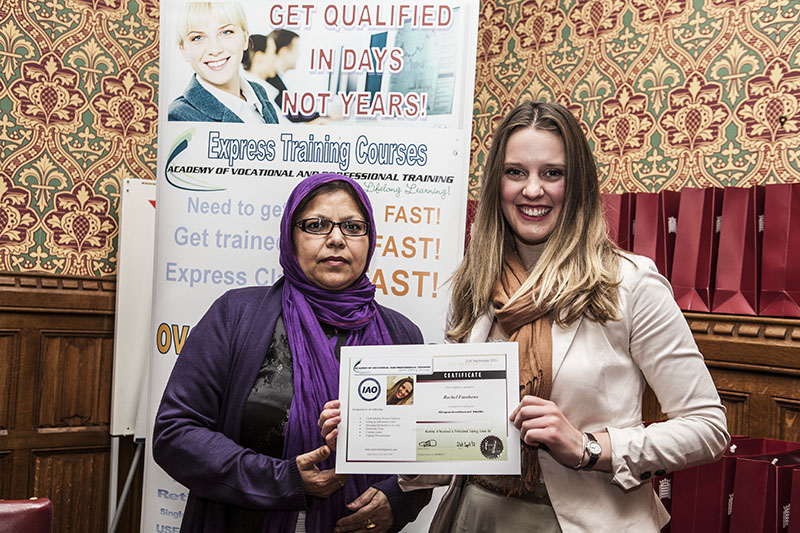
The Academy of Vocational and Professional Training (AVPT) have had an exceptional year, with a huge list of positive achievements. A year in which AVPT launched globally was marked the first cohort of students being presented with their certificates by  Baroness Uddin followed by congratulations from Lord Ahmed, in the impressive setting of the House of Lords.

“This was a huge achievement for us,” explains Diane Shawe, the CEO, “Our 395 courses are all globally accredited by the International Accreditation Organisation, meaning that they are accepted anywhere around the world. We’ve achieved so much this year and we felt very excited for the future when watching the first generation of our students receive their beautiful and meaningful certificates.”

The globally accredited status given to AVPT by the International Accreditation Organisation in June 2012 means that the courses available hold a big draw to students that want to travel. Diane sees this as recognition of the significant rise in e-learning.  This has also meant that AVPT’s launch of its Scholarship Den initiative hasStudent pitching to judges at ASVPT Scholarship DenStudent pitching to judges for scholarship happened at just the right time; young people, with a desire to better themselves or start a business are awarded with £2,000 of AVPT training. This has led to the continued and dynamic success of the academy’s offering.

In October 2012, AVPT was the main sponsor of the education section of the Youth Enterprise Live Show 2012 at Earl’s Court in PA9C1793London and had the Mayor of Hammersmith and Fulham as the guest of honour to officially open the AVPT stand where they attracted over 350 enquiries for the short courses.

To finish off an already exceptional year, AVPT won a contract with a Middle-Eastern Government to provide crisis management and leadership training to the government heads of departments.  After a highly successful training programme, AVPT was also added to the official procurement list for the UK’s Ministry of Justice and Department for Work and Pensions and so is able to provide training for these two large departments.

Rachel Fanshawe receives her certificate from Baroness Uddin

Rachel Fanshawe receives her certificate from Baroness Uddin at the House of Lords

This remarkable success story has continued into 2013 and the AVPT team are already setting their sights on the next target. The company has begun work towards striking up a partnership with The Department of Business, Innovation and Skills to carry on its successes with departments of the UK government.

Diane explains, “We have built solid relationships with all that we work with, and over the course of 2013 we want to be able to offer students from across the world a larger platform of study. We believe by building foundations with The Department of Business, Innovation and Skills, we can do this efficiently.”

AVPT is dedicated to helping students in reaching their full potential and have launched the first UK voucher code website offering customers the chance to find special offers and deals on short courses. The website, expresscoursevouchers.com, allows the general public to take advantage of new education and training deals everyday.

Tim Dingle, the Chief Development Officer at AVPT says, “We’ve been extremely busy this year and have created a paradigm shift for online adult education.  Our Social Enterprise division, known as ACEE, will also begin to deliver training courses to the wider community, by awarding bursaries to people who are disadvantaged or cannot afford to up-skill. We are totally committed to life-long learning  and to helping students better themselves. We are passionate is this goal and believe we have a unique and powerful product that people are connecting with very quickly.”  The National Lottery has view our proposition in a positive light has it helps the wider community.

Next generation of mobile learning

Next generation of mobile learning

The Social Enterprise division of AVPT  ‘ACEE’ will launch a project in July 2013 called ‘Switch Momentum’.  ‘Switch Momentum’ is targeting the areas where knife crime and gang problems pose a real threat for teenagers who do not want to get involved but are locked into their homes in order to be safe.

Diane says, “Switch Momentum will provide teenagers with a way out of challenging and pressurised situations. We believe everybody can fulfill their potential given the right opportunities and we believe we can offer this positive environment.”

Diane Shawe finishes by saying, “This is targeting young people in the summer vacation who may not be going on holiday, a projects like ‘Switch Momentum’  can offer that inclusive learning experience in a calm environment to them”.

As a natural progression of their growth, AVPT is also looking to inspire and train  a new workforce of Virtual Tutor Facilitators (VTFs). AVPT  has already trained several individuals and have found that they help create a seamless bond between the student and their studies. By May 2013, AVPT will have created 300 jobs.

Tim Dingle explains, “The VTF is a revolutionary new idea. Teaching is changing, and we are creating dynamic change. We have created a jobs and helped people to work creatively and passionately in adult life-long learning. We’re extremely pleased with this.”

AVPTGLOBAL almost 400 courses all globally accredited

AVPTGLOBAL almost 400 courses all globally accredited

AVPT will be present at three major exhibitions throughout 2013.

The Scottish Beauty Show 2013, which takes place in the heart of Edinburgh  and the Wales Hair and Beauty Show 2013 which is in Cardiff. Finally in this busy year, AVPT will be presenting at the Business Start Up Show 2013, at the Excel centre, London.

Visit www.avptglobal.com to view our range of courses and services and see if we can help you upskill yourself or team.


Revision? Forget it

How to Massively Improve Your Chance of Success, Now!

Become a VTF with AVPTGlobal

Become a VTF with AVPTGlobal

article by Tim T Dingle BSc (Hons) MIBiol PGCE MBA, Chief Development Officer at the Academy of Vocational and Professional Training (AVPTglobal)

I sometimes wonder what an alien might think if they were monitoring our schools, downloading training course and looking at how students try to learn.  They would be forgiven for thinking that they have been artfully designed to train students in the art of forgetting. Throughout the time you take most conventional courses (excepting, of course, the cutting edge ones at AVPT  www.avptglobal.com) it may seem that you spend your time ‘learning’ and ‘revising’ for tests. What then follows is extraordinary; we forget that information within weeks.

This pattern seems continue throughout schools, professional training cycles and college courses. This heroic shuffling in and out of knowledge from our cerebral hemispheres seems to be a constant cycle. Then students are tasked, days before a crucial exam, with relearning everything that they have managed to forget over the course of the year. This is the classic ‘summative assessment’ situation with a history of failure in so many cultures.  This often takes almost as much time as if we were doing it from scratch. It seems that the UK Education Minister, Michael Gove is known to be an admirer of this system.

The reason that forgetting is so common in traditional learning cycles is that the way we are taught to encode and recall memories, causes fading over time. Those memories that can be recalled are the one that get repeated and are strengthened. They are prepared for the long term and placed within the Long Term Memory System (LTM). This is important because (from an evolutionary point of view) repetition correlates with importance. Meaningful or important things tend to happen again; random things tend not to.

One of the problems with most learning systems lies in a distinction between two ways to go about this repetition.  It can be separated into ‘spaced learning’ (SL) and ‘massed learning’ (ML). Massed leaning is sometimes called cramming. You may remember those long sessions; students love them and believe the longer they stare at their notes /books, the more it is effective. The spaced repetition method is where the repetitions are spaced out over a period of time. The best analogy is to think of memories as plants in the garden of your memory; then think of repetition as watering with your watering can.

The ML system is like watering a plant by emptying the whole watering can all at once; then failing to do so for months.  The mechanism for SL Learning is to imagine watering the plant once a week in measured amounts from the can, over a period of months. This regularity, combined with a systematic  approach and by using a ‘chunked up’ seems to be crucial to success; an approach that, we believe at AVPT, is how all online learning must develop. The long term effect of these totally different techniques of watering (but the same total volume of water) results in two very different plants (one is probably dead).

Now imagine something else that can radically improve memory and success. Incredible as it seems the greatest advances in improving our chances of success can be had for free, right now. I’m talking about improving your brain from the outside in. If you take it seriously it can and will lead to faster and more accurate decision-making. It will yield greater productivity and inspire innovation. If you want to be mercenary about it, it’s the kind of smart that starts making money.

All you need to ‘invest’ is approximately 30 minutes a day.  And maybe a decent pair of trainers. Over the last 30 years I have seen many articles describing how aerobic exercise is beneficial to health. There is no doubt there is a lot of truth in what has been written.  Improving oxygen distribution in the body… reducing the chances of heart disease… losing extra pounds… exercise has many benefits. But cardiovascular exercise goes way beyond reducing blood pressure and cholesterol.  Current research shows that exercise can alter the very structure of the nerve cells in the brain. You could read the evidence in (fairly dull) scientific papers, of which over 1000 have been produced in the last 12 months.

There are many people like me who recognise the impact that cardiovascular exercise has had on their career and every aspect of their life. It may surprise you that there is a growing cohort of business people and entrepreneurs who credit exercise not as just a component of their successful lives, but as the biological catalyst in all of their achievements.

In very basic terms, our brains function due to groups of chemicals ‘jumping’ between the neurons (nerves) within.  My research indicates that BDNF – Brain Derived Neurotrophic Factor – is one of the most significant of these chemicals. BDNF is a protein that is controlled by the BDNF gene in our DNA.  BDNF acts on brain cells by encouraging the growth and differentiation (dividing and deciding what they want to be) of new neurons and synapses.  The neurons start growing new connections on their branch- like ends (called dendrites). The more dendrites that grow, the more connections are made.  The more connections you have in your brain, the greater your capacity to think: using another plant analogy, BDNF is a ‘miracle grow’ for your brain cells.

It works in the areas of the brain vital to learning, memory, and higher thinking.  BDNF itself is important for long-term memory.  Which is why it makes you smarter. So, exercise increases BDNF – great!  But… when you are stressed, you release the hormone corticosterone.  This has been shown to decrease the amount of BDNF!

In other words, being stressed makes you less smart and less able to make good decisions.If your exposure to stress is persistent, this can cause an area of the brain called the hippocampus to actively shrink.  This has been shown to take place in humans suffering from chronic depression. The secret of creating change within the brain that can boost your intelligence, memory and decision making qualities (as well as relieving depression) is

The optimal amount seems to be 30 minutes of aerobic activity a day.  Running, swimming, active walking – they’re all good as long as you do them regularly. I’m always interested in finding new ways to learn better and faster. I am a busy and driven individual.  I try to read one book every day on top of a full time business career.  The amount of time I have available to spend learning new things is limited.  It’s important to get as much educational value out of my time as possible, so retention, recall and transfer are critical.

I need to be able to accurately remember the information I learn, recall it at a later time and utilise it effectively in a wide variety of situations. One sure-fire way to become a more effective learner is to learn new things and keep practicing them. The Science backs this up.  A 2004 article in the journal Nature[1] reported that people who learned how to juggle increased the amount of grey matter in their occipital lobes, the area of the brain associated with visual memory.When these individuals stopped practicing their new skill, this grey matter vanished.

So if you’re learning a new language, it is important to keep practicing the language in order to maintain the gains you have achieved. This ‘use-it-or-lose-it’ phenomenon involves a brain process known as pruning. Certain pathways in the brain are maintained, whilst others are eliminated.  If you want the new information you have just learned to stay put, keep practicing and rehearsing it.

One of the key secrets of memory is how brain cells connect without actually touching.  The gaps are called synapses – remember those chemicals that ‘jump’ across the gaps?  Circuits are formed that retain memory, but they disappear if they are not used over and over again.

So go juggle right now!

http://www.avptglobal.com


[1] Draganski, B., Gaser, C., Busch, V., & Schuierer, G. (2004). Neuroplasticity: Changes in grey matter induced by training. Nature, 427(22), 311-312.


Can you train to become a Virtual Tutor?

could you do with some additional income!

Because your skills and experience are worth it

Because your skills and experience are worth it

Teaching and Learning has changed!  
Employment has Changed!
The World has Changed!
Could you manage up to 20 virtual students each month
and help them qualify from your PC
iPad or Tablet?
Using the latest interactive
Learning Management System
we have over 260 specialist on-line
and classroom fast track workshops
all accredited to Global Standards
You may be a professional, or retired
a graduate, personal coach, a consultant
or a teacher wanting to work from anywhere.
  • You make the investment and
  • We will Train you,
  • Register you,
  • and even Pay you when we
  • send students to you throughout the year

This two day workshop will enable you to follow procedure, e-monitor, e-mentor and e-access your students progress and help them to complete their online course using a cutting edge Learning Management System. Statistics have shown that institutions of higher learning increasingly embrace online education, with 65.5 percent of chief academic officers now calling online education ‘critical’ to their institutions! long-term strategy, an opinion that’s risen more than 15% over eight years.

After you qualify you will be able to work with our students online as a one of our Virtual Tutor Facilitators using your Global Accredited certificate by the IAO.


Turning 50 isn’t the end of a business career – new wave of olderpreneurs

Get qualified in days not years

Get qualified in days not years

article by Diane Shawe M.Ed

Turning 50 isn’t the end of a business career – it’s the beginning. And an ever-growing wave of ‘olderpreneurs’, starting a business have 70% chance of surviving their first five years compared with only a 28% survival rate for those younger than them.

Nearly half the self-employment population is over 50, and one in six new businesses started in the UK are set up by post-half-centurions.

So what’s fuelling the entrepreneurial impetus of the ‘silver startup’, and why are they doing so well?

Necessity

The over-50s age group has been particularly hard-hit by the recession. Last year, the Office of National Statistics (ONS) revealed 28% of those aged between 50 and state pension age were out of work – compared with only 20% of those aged under 50.

Why? One of the biggest factors is the rife ageism that permeates practically every industry in the UK, that anyone over 50 who’s been forced to look for employment will testify to with a weary nod. The ONS estimates those who lose their job aged 50 or over have only a 10% chance of being re-employed.

Deciding to use their money from redundancies to fund ta company, over the course of two years the payout had trickled in its entirety into the business. But it was worth the investment – and they often don’t have to rely on the ineffective banks at the moment.

Become a Virtual Teacher Facilitator

Become a Virtual Teacher Facilitator

New challenge

At a fundamental level, sometimes people just want to do something different in their later years.

It’s interesting that recent YouGov and Standard Life research found the average age at which people feel totally confident in their working skills is 37, while the more elusive sense of fulfilment peaks at 50. Perhaps this climax of achievement and sense of ability leads to a need for a new direction, a new challenge, once a person passes the half-century mark.

If  we take a look at the Government statistics below it will give us an overview  Source Office of National Statistics

Summary of labour market statistics published on 23 January 2013

Between June to August 2012 and September to November 2012:

  • the number of people in full-time employment increased by 113,000,
  • the number of people in part-time employment fell by 23,000,
  • the number of unemployed people fell by 37,000, and
  • the number of economically inactive people, aged from 16 to 64, fell by 13,000.

Between September to November 2007 and September to November 2012:

  • the number of people in full-time employment fell by 341,000,
  • the number of people in part-time employment increased by 660,000,
  • the number of unemployed people increased by 854,000, and
  • the number of economically inactive people, aged from 16 to 64, fell by 75,000.

Chart 1: Changes in number of people in the labour market between September to November 2007 and September to November 2012, seasonally adjusted

Changes over 5 years

Source: Labour Force Survey – Office for National Statistics

The employment rate for those aged from 16 to 64 for September to November 2012 was 71.4%. This was up 0.1 percentage point on June to August 2012 and up 1.1 on a year earlier, but it was lower than the pre-recession peak of 73.0% recorded for March to May 2008. The number of people in full-time employment aged 16 and over increased by 113,000 between June to August and September to November 2012 to reach 21.57 million but the number of people in part-time employment fell by 23,000 to reach 8.11 million. Compared with a year earlier:

  • the number of men in full-time employment increased by 237,000,
  • the number of men in part-time employment increased by 95,000,
  • the number of women in full-time employment increased by 77,000,
  • the number of women in part-time employment increased by 144,000, and
  • the total number of people in employment increased by 552,000, the largest annual increase since 1989.

Chart 2: Changes in number of people in employment between September to November 2011 and September to November 2012, seasonally adjusted

Annual employment changes

Source: Labour Force Survey – Office for National Statistics

The unemployment rate for September to November 2012 was 7.7% of the economically active population, down 0.1 on June to August 2012 and down 0.7 on a year earlier. The number of unemployed men aged 16 and over fell by 37,000 between June to August and September to November 2012 to reach 1.41 million, but the number of unemployed women was unchanged at 1.08 million. The number of women unemployed for up to six months increased by 26,000 to reach 571,000. This may reflect changes to the benefits system resulting in more single mothers starting to look for work (see Claimant Count section of this Bulletin for further details).

The economic inactivity rate for those aged from 16 to 64 for September to November 2012 was 22.5%, unchanged on June to August 2012 but down 0.7 on a year earlier. The number of economically inactive people aged from 16 to 64 fell by 13,000 between June to August and September to November 2012 to reach 9.03 million.

The number of people claiming Jobseeker’s Allowance fell by 12,100 between November and December 2012 to reach 1.56 million.

Between July to September 2012 and October to December 2012, the number of vacancies increased by 10,000 to reach 494,000. This is the highest number of vacancies since October to December 2008, but it is 200,000 lower than the pre-recession peak of 694,000 recorded for January to March 2008.

Between September to November 2011 and September to November 2012, total pay for employees in Great Britain rose by 1.5%. This annual growth rate for earnings was lower than the increase of 2.7% in the Consumer Prices Index between November 2011 and November 2012.
Source Office of National Statistics

Breaking News….. Standby for the roll out of Master Practitioner VTF

master vtf by AVPT Global

AVPT Global about to launch Master VTF practitioner Course

The ultimate course that over an intense and amazing week will develop all the skills necessary to work around the world training new Virtual Tutor Facilitator in their new career. Course topics include: Advanced Facilitation, Body Language, Teaching & Learning Skills, Mediation, Communication, Presentation Excellence and Assessment and online LMS systems.

It is brand new and uses all the latest techniques, theory and experience to deliver simply the best training course (train the trainer) out there. Graduates will get to spend a full day shadowing the professionals and learning the insight track for delivering excellence in learning.

The course will allow the trainers to deliver the workshops anywhere in the world having gained their IAO  global accredited certificate. The demand for such a course has been intense and we are delight to be taking enquiries and reservations for the first course dates. Become the best in the field, be the person you want to be and never except anything less than excellence.

To receive the latest updates for the launch of the  Master Practitioner VTF Course click here

Image

Merry Christmas from AVPT Global

happy christmas from Diane Shawe