Tag Archives: big sociiety policy

Enterprise Women Launching Club in Kensington, Chelsea and Westminster

Calling ALL BUSINESSWOMEN in Kensington, Chelsea and Westminster!!  Are you looking to grow your business and build strong local networks of trusted peers who will share and learn from each other? Do you want to be part of a community of substance that understands female-owned businesses and delivers practical value to its members?

County House
Date:

Tuesday, March 25, 2014 – 10:00 to 12:00

Venue:

County House

Venue address:

46 New Broad Street, London, EC2M 1JH

Price:

£27.60 inc VAT (includes lunch)

Then local host, Diane Shawe, offers you a warm welcome to join her at the Kensington, Chelsea and Westminster Women’s Business Club launch. The event is for women who are looking for that extra special support, advice, collaborative relations to help them develop and expand their business.  Join us on Linkedin

Get your free copy when you attend this event

Diane is Chief Executive Officer of the Academy of Vocational and Professional Training Ltd, which provides online and workshop fast-track soft skills training courses, Ms. Shawe is passionate about technology and the impact it will have on delivering training to students on the move that can be measured and proven. In addition Diane sits on several executive committee which includes the Conservative Education Society. As well as being a published author of several business books including, “The 10 habits of a successful women Rainmaker – From Tactics to Strategy: What works”, which is included!

Our first theme will be called, “No Random acts of Lunch.” The people who are most successful at business development, do not commit “random acts of lunch”.

Diane, will also be discussing how plans can take on many different forms and why developing your negotiation skills is VITAL! She will look at the 10 steps of honing in your negotiation skills, so that you never have to stumble away feeling unsure, vulnerable or disappointed about a meeting or presentation.  This will be the best 2 hours you could spend.

We are delighted to have guest speaker Bev Hurley at our meeting. A dynamic serial entrepreneur, mentor, angel investor and one of the UK’s leading authorities on female entrepreneurship, Bev Hurley has spent more than 30 years building successful businesses of all sizes – and sharing her expertise to create and grow hundreds of others.

PRESENTERS FOCUS

Diane Shawe

The Kensington, Chelsea and Westminster Business Club is being hosted by Diane Shawe. She is the founder and CEO of two successful training companies based in London and Luxembourg as well as an established publisher of several business books. Diane has a wealth of knowledge and experience across multi-disciplines. Diane believes that people should try to integrate the following practice into their daily lives: “never do anything as though you are a professional amateur”

Bev Hurley

A dynamic serial entrepreneur, mentor, angel investor and one of the UK’s leading authorities on female entrepreneurship, Bev Hurley has spent more than 30 years building successful businesses of all sizes – and sharing her expertise to create and grow hundreds of others.
So what are you waiting for? Book your place now!

We look forward to seeing you all there…

To book your place, first log in or create a new account, and click the BUY NOW

If you have any problems registering for this event, please email farhana@enterprising-women.org
or
diane@avptglobal.com

Social Media – Delivering targeted messages Part 1:

 Localise, segment and personalise your social media engagement for more effective marketing

By our Guest Blogger:  Tamsin Oxford on Sep 24, 2013

For organisations to effectively engage with their consumers, segmenting and then personalising social media content is vital

The core of any business is the customer. What corporations and their brand stakeholders have realised is that the traditional broadcast model for engagement is no longer effective or efficient.

Organisations need to gain insight into audiences, segment their social engagement into specific groups and appeal to a diverse demographic without compromising brand integrity or messaging.

This feature is the first of three examining how to create customised experiences for customers across different platforms. In this feature we are considering how a business can accurately identify core groups, get to know their audiences and segment customers into niche collections. Sound complex? Not necessarily.

“Social media offers interaction that traditional media could never give to the marketer,” says Devon Stanton, PR and Promotions Manager at Megarom [www.megarom.co.za], “In addition, there is an impressive range of toolsets available that can analyse your social media audience and pull out vital demographic and interaction data. By utilising this information, you’ll be able to craft your social media to best suit your audience.”

A white paper by Experian offers a superb breakdown as to what segmentation is and why it is of value to the business. They define it as “the process of dividing your database into groups based on single or multiple criteria.”

This offers value in that you can drill down into the essentials of the client for improved targeting and flexibility. What better way to locate and address the most profitable customers and ensure that there is relevance in this communication? The right message to the right people at the right time – it works, that’s why it’s a cliché.

The business can no longer afford to be generic. A bland message directed across all social platforms may hit one or two people along the way, but it is unlikely to generate brand loyalty or encourage customers to identify with the brand itself.

“Take the time to understand what motivates people to share and talk about topics,” says Scott Gray, Head of Planning at Quirk [www.quirk.biz], “Interests are so fragmented that being generic doesn’t work anymore. To get messages to spread across social networks, brands have to have a point of view and get this to the most relevant group of people. If you’re not relevant, you’re dead.”

Steps to segmentation

Jeremy Waite, Head of Social Strategy at Adobe EMEA, offers a four-step process by which organisations can identify core groups and segment them efficiently that include:

  1. Influence – build relationships with key influencers
  2. Data – data helps brands identify which content drives conversation
  3. Optimising content – using this information helps to streamline content development that says the right things
  4. Measuring impact – stay aware of the impact of social efforts to continually drive conversation and stay relevant and targeted

The many faces of influence

“Building relationships with key influencers is vital,” says Waite, “Data shows that only 6% of fans regularly engage with companies they like on Facebook. By identifying the people most likely to drive conversation, and the types of posts and messages that engage these influences, this helps to increase engagement.”

Veronica Gross del Rio, EMEAI Social Media Manager at Interface  [http://www.interface.com/neteffect], agrees and adds, “Begin determining which social sites you should participate in and what topics are trending or popular. Track how your customers are using social media. We are a B2B company that designs and makes carpet tiles, for us interior designers and architects are the key people who specify our products so we need to convince them more than we need to convince the final buyer. Having the most accurate profile of them on social media is vital.”

It may be obvious that a business needs to identify its core markets and platforms to ensure it markets products effectively, but social media analysis and communications are not the forte of every organisation. It is here that solutions such as Quirk, Codestar and Adobe Social come into play. These companies have made it their business to understand the market and what the organisation needs in order to effectively understand, track and target their customers.

“Successful brands like Starbucks, Xbox and Dell have reduced most of their reporting to only one page that includes all the relevant metrics and information that they need to know about their customers,” says Waite, “These are known as the five ‘W’ – a strategy that Adobe Consulting has also adopted.”

These five ‘W’ are:

  • Who
  • What
  • When
  • Why
  • Where

Who are people talking about, what are they saying, why are they talking about you, when did the conversations begin and where did they take place.

“We design specific apps and landing pages for various products and services advertised on Facebook and often for specific consumer groups,” says Vinny Pianna, Director of Facebook specialists Codastar. “We find that ads for specific customer groups are far more successful than general ones. To segment this effectively we have looked at where we are successful and worked hard to build on this. The key to success is to tailor your messaging, advertising and landing pages for each group.”

Understand the core

To succeed in creating an effective marketing strategy across social media your organisation must ensure it is relevant, targeted, on trend and specific. To do so you need to listen to your customers and understand what they are interested in and make sure that you are communicating with them on the right platforms.

“The web has allowed people to form groups and communities around common interests,” says Gray, “If you’re into dressing up like Batman and singing karaoke, there’s probably a community of people like you. I think that more effective targeting is driven along lines of interest and passions rather than race, gender or age. People are the new conduits of media.”

Interface used these tactics to develop a targeted social media campaign to launch a new product. They created specific content for each social media channel that tapped into their unique qualities and the campaign has been a huge success as a result. Gross del Rio believes that it is this very targeted approach that has made all the difference to the success of their campaign.

“I think that knowing who your audience is and understanding the goals of the campaign will net you far better return on investment,” concludes Stanton, “The data is there to help you make better marketing decisions so use it to maximise results.”

In part two of this series will ask the experts how to take this concept one step further to tailor social media messaging to ensure you appeal to different needs, motives and preferences.

The 4th annual Corporate Social Media Summit Europe

Dec 4, 2013 – Dec 5, 2013, London

Become a social business: For superior marketing response, sharper corporate decision-making, enhanced innovation and a happier, more loyal customer

Related Articles

Why do your customers Like your brand?

We mean to help you so that in turn you help us

We mean to help you so that in turn you help us

Have you every wondered why people shy away from solving problems?

banner bbb aug 2013 avptglobalDo you spend a lot of time frowning?  are you even aware that you frown?

article by Diane Shawe M.Ed
CEO Academy of Vocational and Professional Ltd.

Do you think more people focus on the half empty glass or the half full. Which are you? At times, it would seem that we have more problems then we can handle, but this all boils down to self responsibility critical thinking skills and optimism. Taking the bull by the horn can be a scary things, so check out a few well know secrets?

1.      Smile!  It is impossible to hold a frown and smile at the same time, try it, you will be amazed at how your brain will help you look and keep on the bright side of life.

2. Separating negative feelings from positive thoughts. This is an important step in solving problems. Only after you have cleared your mind with unnecessary thoughts can you start solving your problems accordingly.

3.      Treat each problem as a challenge an opportunity for self-improvement.

4.      Lose the scapegoat attitude. Are you pointing your finger or blaming others for mishaps? Take responsibilities for your mistakes. No one is perfect, so never put the blames on others unless your trying to say that they are much smarter because they got you to do something you did not intend.

5.      Commit your problem with a pen and paper, and rate the depth of the problem and state the worse that could happen. Face the fear and then write down all the options of solving it.

6.      Keep a journal and treat it as a “secret friend” who is always willing to listen to your grievances. Write your feelings freely.

7.      Develop a noteworthy hobby, for this will help you lessen or minimise stress in your life.

8.      Take time off from work and create variations of your daily schedule. Relax and check out the best movies in town. Travel and meet new wonderful people. You will find these activities worthwhile in the long run.

AVPTGLOBAL almost 400 courses all globally accredited

AVPTGLOBAL almost 400 courses all globally accredited

 4 Steps problem solving tools

1.      To determine the root cause of the problem. Ask a question, answer it, then ask why, answer that, then ask what if, and so on until you run out, that might likely be the root of the problem.

2.      Draw up a strategy, then act upon it. (Pretend you was advising a friend and follow your own advice)

3.      Give yourself a deadline, and reward yourself when you have completed the task

4.      Reflect so you can avoid repeating the same mistakes .

Problems are problems. They are there not to annoy you; but problems are created when you fail to act upon them. Learn to  Let go and you will free yourself of  worry. Remember, less worries mean less stress, so you won’t just spend your time looking at problems, but working to solve them.

If you think that you really want some time out because of problems, visit the next room called “improvement.”

Why not take a look at some of our problem solving courses now.  Click here

AVPT HAIR EXTENSION DEPARTMENT LOGO JULY 2013

Glossophobia: The number one fear in the UK!

fear of public speaking course

Speaking presentation survival school course

Got to make a presentation? Make a wedding speech? Say something at an event? Nervous? How AVPT Global can help you right now with the fear of public speaking.

Tim T Dingle BSc (Hons) MIBiol PGCE MBA

Chief Development Officer, Academy of Vocational and Professional Training

Having trained hundreds of people in brilliant public speaking (and many more to be Standup comics) I am often asked about the causes of Glossophobia. This is a type of speech anxiety and is most commonly the fear of public speaking or of speaking in general. An estimated 75% of all people experience some degree of anxiety and nervousness when public speaking. I am lucky and don’t suffer- whatever size the audience. The good news is it can be cured and overcome.

The more specific symptoms of speech anxiety can be grouped into three categories: verbal, physical and non-verbal. The verbal symptoms include, but are not limited to a tense voice, a quivering voice, and vocalised pauses, which tend to comfort anxious speakers.

The symptoms I see the most in training are the physical ones. These result from the sympathetic part of the autonomic nervous system responding to the situation with a fight-or-flight adrenalin reaction. Since the sympathetic system is all-or-nothing, adrenaline secretion produces a wide array of symptoms at once – all of which are supposed to enhance a student’s ability to fight or escape a dangerous scenario. These symptoms include acute hearing, increased heart rate, increased blood pressure, dilated pupils, increased perspiration, increased oxygen intake, stiffening of upper back muscles and the classic dry mouth. None of which are much good when you are about to give a wedding speech. The good news is they can be relieved with training and some skilled guidance.

learning to speak under pressure

Looking good when speaking under pressure

Public speaking experts agree that one of the most important steps in preparing for a speech is practice. Yet after giving the same speech so many times, it can be difficult to maintain an authentic voice, especially once nerves kick in. More than anything, a successful speech hinges on your ability to know your audience and establish a connection. Shape your speech around a subject that you genuinely care about and try to focus on what you have to offer your audience.

Your concentration will naturally shift away from what is at stake for you personally, calming your nerves and allowing you to connect to your audience in a real way. Then, tell a story. Take the audience on a journey. While there are many aspects that will contribute to the success of your speech, it is the authentic, heartfelt moments that will be remembered most.

The importance of learning to speak in front of an audience is undeniable; invariably intertwined with leadership, motivation, and change. While Glossophobia is common, in fact the most common phobia in the UK, it is certainly a fear that can be overcome. But the power of spoken word is reason in itself to push past that fear.

So remember that nerves are natural: use your nerves to propel you through the speech, and know that your physical response to stress will only make the speech all that much more rewarding once you finally step down from that stage. Remember to be authentic: pick a topic that you truly care about, and the audience will be stirred to care as well. And finally, don’t be afraid to aim big. You were chosen to speak for a reason, and you have a meaningful story to tell. So take slow, rhythmic breaths and change the world- and take this course in conquering your fear of public speaking!

Why Study With Us Unemployed Poster

BYOD! The change is here.

Bring Your Own Device

1 personal development beta students needed

Try out our LMS system today

Tim T Dingle BSc (Hons) MIBiol PGCE MBA Chief Development Officer at the Academy of Vocational and Professional Training.

AVPT Global is issuing a technological tsunami alert; feel the force of a very real wave of BYOD / BYOT and new mobile learning and learn how to avoid being swamped.

Here at AVPT Global we like to bring you some advanced news and perhaps a serious warning of impending change. I have worked in the education sector for 25 years and seen many changes in technology during that time. There is a clear and present need to improve the soft skills and learning of individuals- whether at School, University or in business. Already at AVPT we are using the latest technology to improve training and it is clear that mobile learning is massive. I came across the term bring your own device (BYOD) in a recent workshop for employers. It means the policy of permitting employees to bring personally owned mobile devices (laptops, tablets, and smart phones) to their workplace and use those devices to access company information and applications. The term bring your own technology (BYOT) is being used more frequently in an educational context. It is a part of a supplementary school technology resourcing model, where the home and the school collaborate in arranging for use their own digital technology to be extended into the classroom to assist their teaching and learning and the organisation of their schooling.

The BYOD / BYOT ‘tsunami’ is rapidly coming over the horizon for educational institutions and businesses. BYOD is making significant inroads in the business world already with about 75% of employees in high growth markets such as Brazil and Russia and 44% in developed markets already using their own technology at work. In most cases, businesses simply can’t block the trend.

We believe that BYOD may help employees be more productive and become genuine Life Long Learners. It can and should increase employee morale and convenience by using their own devices and makes the company look like a flexible and attractive employer.  Many feel that BYOD can even be a means to attract new staff (and we all know how hard it is to get the right person on board): 44% of job seekers now view an organisation more positively if it supports their device.

AVPTGLOBAL almost 400 courses all globally accredited

AVPTGLOBAL almost 400 courses all globally accredited

We have found at AVPT that if businesses are to survive they will need to be proactive and really note and respond to the trends.  They will need to shape the largely inevitable development to the best advantage or try to surpass the deeds of King Canute and prevent the wave from swamping their institutions. Perhaps not surprisingly at this very early stage many of the early BYOT moves are making this mistake, are naïve, simplistic and preoccupied with the relatively mundane, showing little appreciation of what BYOT could entail.

We believe at AVPT global that there are least six global megatrends coming together that will impact on all businesses, schools, institutions to some form of BYOT. These megatrends relate to the normalised use of personal digital devices in every facet of life, the burgeoning digital and educative capacity of the student’s homes, cloud computing, parent digital empowerment, government’s increasing inability to fund state of the art personal technology for all and the inexorable evolution of schooling from its insular paper-based mode to one that is more digital and networked.

Fundamental to BYOT is that personal choice of the technology by the individual (whether in School, Higher Education and Business). While businesses /schools might and probably should provide advice, the final choice should rest with the individual. The will give an enhanced facility for the personalisation of learning in and outside the business and educational premises. That is the secret of the success of online mobile learners. In our online Learning Management System that can be used by the owner of device, at home, work or on the move (found out VTF are driving this change).The individuals are having their ownership of the technology and the information respected and absorbed.

Get qualified whilst on the move with AVPT

Get qualified whilst on the move with AVPT

So the future that BYOD / BYOT is creating will cause a profound educational change. It has immense potential that will assist change in the nature of schooling, teaching, learning and the relationship with homes and work. However, to realise this potential there has to be really strong leadership in education and businesses management. It has to change thinking and begin to understand what is needed terms of the power of mobile learning. Leaders have to take charge of the process, understand the possibilities and appreciate what is required for sustained success and development. At AVPT we see leaders training who are training to be proactive, learning about the forces impelling institutions to some form of BYOT. We see the need to appreciate the real potential for society in educational, social, economic, technical, administrative and political terms.

At the Academy of Vocational and Professional Training we believe these are still very early days with BYOT / BYOD. There isn’t much out there being written about these changes to mobile learning except in some pioneers in the field. The focus of most business and institutions is technical with little thought given the wider educational or financial implications. The greatest challenge with BYOT / BYOD will be human. The technical aspect is easy- and always will be. The key is to understand the historic significance of this development and to recognise that we are moving to a new model of mobile learning, teaching and institutional resourcing where everyone collaborates, facilitates and genuine accepts these changes.

AVPTLTD LOGO  6

Importance of developing a strategic approach to learning and harnessing the internal skills

Download your free copy today

Download your free copy today

Corporates, enterprises and charities all wish to run their operations at the minimum costs allowed.

Article  by Diane Shawe M.Ed
CEO of AVPTGLOBAL

We all recognise that in today’s environment, business moves faster than ever. Most organisations now recognise the importance of developing a strategic approach to learning and harnessing the internal skills of their teams. Moving away from more tactical based activities associated with training such as measuring skills-based behaviours, to focusing on acquisition of knowledge and learning transfer that result in individual and organisational performance improvements.

E-learning has the potential to fully integrate the benefits of personal freedom with connectivity (belonging to a purposeful group of learners). From an educational perspective the “e” in e-learning stands for more than electronic; it can also stand for extending and enhancing the learning experience.

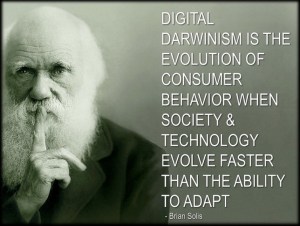
Quote by Darwin rapid-technology-social-changeNew market opportunities open and close at blinding speed, new competitors emerge overnight, product life cycles are getting shorter, and customers are more knowledgeable and sophisticated. This fast-changing environment has led to requirement to change learning and training.  However more often than not, the task of aligning the learning organisation to the business can be challenging and the perception of how the business views the learning organisation in terms of aligning to strategic initiatives is different to how the learning organisation perceives itself.

Downsizing has resulted in a mass drainage and outflow of skills as employees or contractors are let go.  To ensure that an organisation can compete globally and remains at par with the technological changes in the global market committing to the investment of on-going skill training is often viewed as a potential unnecessary incision into the bottom line.  This continued way of thinking comes at a cost because of the risks involved in

developing the professionalism of the staff (Lucey, 2004). The fear of poaching of the staff by other companies after significant investment has been made in upskilling and training from the said company is of real concern, because skilled, experienced staff when pulled in can respond faster to problems brought forward by the customers and ensure high productivity and efficiency in the long run (Corbett & Huggett, 2009).

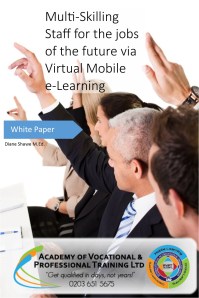
With the explosion of mobile technology, organisations need to take advantage of the benefits, scalability, and viability of using mobile e-learning, using smart phones, tablets, and notepads that offer a blended solution  to read more click to download white paper…

AVPTGLOBAL almost 400 courses all globally accredited

AVPTGLOBAL almost 400 courses all globally accredited

Manisha Gaur discusses why Global Accreditation is leading the way to unified integrated accreditation

The rise of International Accreditation

News Title

by AVPT Global

For decades, regional accreditation bodies had been granting educational institutes with primary accreditation after evaluating them on a regional scale. However, as globalization grew, it became extremely important for educational institutes to be acknowledged world over so that when students look for credit transfer and international job opportunities, it does not stand in the way.  This gave rise to International Accreditation. This topic was represented by Ms. Manisha Gaur, Director Operations at Venkateshwara Group of Institutions, India.

She discussed how globalization has affected today’s education systems and the education providers are looking forward to establishing a centralized education system.

The phenomenon is occurring, but at a very slower pace and this is where the accreditation agencies have to play their role. They need to set up a unified and integrated accreditation system for all the educational institutions globally so the standardisation of education can be done successfully.

A smarter way to study with www.avptglobal.com

A smarter way to study with http://www.avptglobal.com

Regional accreditation bodies have existed and also evaluated education providers on a regional scale, thereby granting them Primary accreditation.  However, the rapid growth of globalization calls for a global entity which can evaluate them against internationally proven standards of education and grant them an internationally recognized Secondary Accreditation.

This secondary accreditation is basically known as International Accreditation. With international accreditation, the school, college or university will be internationally accepted. Students of such educational institutes can further study in the educational institute of their choice in any country without the tension of their credits transfer and also, work with any employer without the tension of their degree acceptance.  For these reasons, it has also become a major deciding factor by students when selecting their higher educational institutes/ universities. Additionally, it has also become important to employers. Employers globally feel more comfortable hiring students from internationally accredited institutes.
Based on this information, she presented why international accreditation is needed globally and how, in the last couple of years, it has gained massive importance, even more than national and regional accreditation bodies. Her topic also informed the participants as to how International accreditation bodies evaluate the institute on the basis of their academic and organisational management and provide them with international accreditation. This international accreditation not only enhances the institute’s profile regionally but also internationally which is why, today, we see a majority of the students and institutes around the world demanding international accredited programs.
About the Speaker

Manisha Gaur is a highly respected member of the Indian education community. She is not only involved in the teaching of the students but she takes it as a responsibility where she wants to develop students into becoming pillars of the society. She has been associated with the Indian Education Board and the National Accreditation body where she has conducted various presentations and has published various researches. She has also received numerous awards from the regional and international community for her services.
AVPTGLOBAL almost 400 courses all globally accredited

AVPTGLOBAL almost 400 courses all globally accredited

The Currency of Digital Learning

Using technology for life long learning

Using technology for life long learning

How do we digitally learn?  How do you learn effectively in a workshop? What is the currency of digital learning?

By Tim T Dingle BSc (Hons) MIBiol PGCE MBA

Chief Development Officer at  the Academy of Vocational and Professional Training.

When you want to acquire a new skill or apply some new knowledge, do you learn by passively sitting and listening to an expert lecture for 90 minutes without a break and 150 Power point slides? What do you actually retain that enhances the value and the currency of your learning. The currency is defined  as something of value, or something that represents value: knowledge, gold, respect, or social media following, all represent different kinds of currency. In 2013 it could be that the currencies in digital and workshop learning are changing.

Learning is evolving and not simply by the tools that actuate it. The process of adopting new learning domains and materials (many digital) has exposed the need for new skills. It is debatable whether or not such skills need to be expressly taught, or if they’re simply the residue of intense, well-designed learning experiences. Whether or not they are old learning (content) with a new coat of paint, or genuinely represent a paradigm shift in learning priorities, it is difficult to doubt their constant application in a 21st century world that is super fast connected, digital, omni-social and multi-faceted.

No longer is it considered sufficient to teach children to simply read and write, and fill in the middle with discrete facts about history, mathematics, and scientific processes. There are new skills that transcend content areas, in this way functioning as natural pathways out of old thinking: creativity, problem-solving and collaboration. One can problem-solve across and within topics formerly thought of as science and history and moving between them both moves them beyond academia, and back to the real world. This is possible because flexible cognitive and creative capacities are not rigid.

The brain science literature suggests that workshop learners understand and remember more when they talk about what they are learning.  However, there are some people who attend workshop and training seem to have information wash over them and are uncomfortable with talking or moving.   So, to get improved retention and learning in both digital and workshops:

1.  Do something physical when you learn: incorporate some sort of movement or body activity every 20 minutes, on line or face-to-face.

2.   Walk and talk, walk and learn: I do this a lot in half-day or full-day trainings.   Participants might do an exercise, but the results are on the wall for a debrief. Using a tablet for true learning as you move.

3.  Flip Chart Products: This is where participants will write specific responses on labelled charts on the wall at designated times.    It can be an answer to a question, a question learners still have, a summary statement, an opinion about the content, facts they want to remember, or how they plan to use the content.  Then stick it on the wall. It works with digital media as well- plaster the wall with paper!

With the proper technologies and thoughtful new methodologies, courses can become content infinite. When the learning goals supersede the content areas, things begin to change. As the currencies in digital learning evolve, they necessarily evolve the learning with them.

AVPTLTD LOGO  6


Check out our 1 day business bootcamp

The Academy Of Vocational And Professional Training look forward to the year ahead after a year of success and achievements

Lord Ahmed congraulate students and AVPT on achievements

Lord Ahmed congratulates students and AVPT on achievements

The Academy of Vocational and Professional Training (AVPT) have had an exceptional year, with a huge list of positive achievements. A year in which AVPT launched globally was marked the first cohort of students being presented with their certificates by  Baroness Uddin followed by congratulations from Lord Ahmed, in the impressive setting of the House of Lords.

“This was a huge achievement for us,” explains Diane Shawe, the CEO, “Our 395 courses are all globally accredited by the International Accreditation Organisation, meaning that they are accepted anywhere around the world. We’ve achieved so much this year and we felt very excited for the future when watching the first generation of our students receive their beautiful and meaningful certificates.”

The globally accredited status given to AVPT by the International Accreditation Organisation in June 2012 means that the courses available hold a big draw to students that want to travel. Diane sees this as recognition of the significant rise in e-learning.  This has also meant that AVPT’s launch of its Scholarship Den initiative hasStudent pitching to judges at ASVPT Scholarship DenStudent pitching to judges for scholarship happened at just the right time; young people, with a desire to better themselves or start a business are awarded with £2,000 of AVPT training. This has led to the continued and dynamic success of the academy’s offering.

In October 2012, AVPT was the main sponsor of the education section of the Youth Enterprise Live Show 2012 at Earl’s Court in PA9C1793London and had the Mayor of Hammersmith and Fulham as the guest of honour to officially open the AVPT stand where they attracted over 350 enquiries for the short courses.

To finish off an already exceptional year, AVPT won a contract with a Middle-Eastern Government to provide crisis management and leadership training to the government heads of departments.  After a highly successful training programme, AVPT was also added to the official procurement list for the UK’s Ministry of Justice and Department for Work and Pensions and so is able to provide training for these two large departments.

Rachel Fanshawe receives her certificate from Baroness Uddin

Rachel Fanshawe receives her certificate from Baroness Uddin at the House of Lords

This remarkable success story has continued into 2013 and the AVPT team are already setting their sights on the next target. The company has begun work towards striking up a partnership with The Department of Business, Innovation and Skills to carry on its successes with departments of the UK government.

Diane explains, “We have built solid relationships with all that we work with, and over the course of 2013 we want to be able to offer students from across the world a larger platform of study. We believe by building foundations with The Department of Business, Innovation and Skills, we can do this efficiently.”

AVPT is dedicated to helping students in reaching their full potential and have launched the first UK voucher code website offering customers the chance to find special offers and deals on short courses. The website, expresscoursevouchers.com, allows the general public to take advantage of new education and training deals everyday.

Tim Dingle, the Chief Development Officer at AVPT says, “We’ve been extremely busy this year and have created a paradigm shift for online adult education.  Our Social Enterprise division, known as ACEE, will also begin to deliver training courses to the wider community, by awarding bursaries to people who are disadvantaged or cannot afford to up-skill. We are totally committed to life-long learning  and to helping students better themselves. We are passionate is this goal and believe we have a unique and powerful product that people are connecting with very quickly.”  The National Lottery has view our proposition in a positive light has it helps the wider community.

Next generation of mobile learning

Next generation of mobile learning

The Social Enterprise division of AVPT  ‘ACEE’ will launch a project in July 2013 called ‘Switch Momentum’.  ‘Switch Momentum’ is targeting the areas where knife crime and gang problems pose a real threat for teenagers who do not want to get involved but are locked into their homes in order to be safe.

Diane says, “Switch Momentum will provide teenagers with a way out of challenging and pressurised situations. We believe everybody can fulfill their potential given the right opportunities and we believe we can offer this positive environment.”

Diane Shawe finishes by saying, “This is targeting young people in the summer vacation who may not be going on holiday, a projects like ‘Switch Momentum’  can offer that inclusive learning experience in a calm environment to them”.

As a natural progression of their growth, AVPT is also looking to inspire and train  a new workforce of Virtual Tutor Facilitators (VTFs). AVPT  has already trained several individuals and have found that they help create a seamless bond between the student and their studies. By May 2013, AVPT will have created 300 jobs.

Tim Dingle explains, “The VTF is a revolutionary new idea. Teaching is changing, and we are creating dynamic change. We have created a jobs and helped people to work creatively and passionately in adult life-long learning. We’re extremely pleased with this.”

AVPTGLOBAL almost 400 courses all globally accredited

AVPTGLOBAL almost 400 courses all globally accredited

AVPT will be present at three major exhibitions throughout 2013.

The Scottish Beauty Show 2013, which takes place in the heart of Edinburgh  and the Wales Hair and Beauty Show 2013 which is in Cardiff. Finally in this busy year, AVPT will be presenting at the Business Start Up Show 2013, at the Excel centre, London.

Visit www.avptglobal.com to view our range of courses and services and see if we can help you upskill yourself or team.


Preserving Quality in on-line education

Article by Diane Shawe M.Ed.

Various transformations taking place throughout the world had impacted  changes in teaching and learning– one of the activities with the oldest traditions in human history. Globalisation is changing established relationship, practice and culture and destroying territorial boundaries.  An important role in reorganising education systems and the implementation of lifelong learning principles is an obligation of higher education institutions, especially K2 educational institutions.

It is important for higher education institutions to respond to changing social needs for new learning styles and ways.  These include training teacher within the lifelong learning sector and administrators to focus on quality improvement in on-line education.

To continue discussion about on-line study quality and areas of effective use of these studies it is necessary to conceptualise what is quality in on-line studies.  Exploring by what means it can be achieved and what is the impact of technology on these studies. However, analysis of scientific literature shows that still little attention is given to on-line learning quality, more research studies are devoted to analysis of quality of traditional education, although much from the latter is adapted in on-line learning.

The term ‘quality’ can rarely be heard in public discussion about learning. What I mean by ‘quality’ is in the delivery and assessment processes when delivering  blended learning contents via various media’   Opinion about the quality of learning depends on numerous aspects, for example, on a person’s experience, status (teacher, student or other), circumstances and so on.  Even if learning is determined to be ‘quality’ at a certain period, it will not remain forever static, because the assessment of ‘quality’ is forever developing, on-going innovative learning technologies and methods are being discovered, approach to learning is changing and so on.

I believe that we should endeavour  to agree that ‘quality’ in on-line learning is an objective which is improving, continuously being searched for but it is not possible to claim that it is achieved.

Seeking to use modern technological opportunities for the delivery and improvement of on-line learning  several  necessary external conditions need to be satisfied in order to move towards ‘quality’:

  • Both students and teachers must possess satisfactory computer literacy;
  • Learning Management Systems must be synchronous and asynchronous;
  • Both students and teachers have to have access to e-learning technologies;
  • Quality digital contents (courses and learning material) must be designed;
  • Computer networks and the Internet reaching all communities of the country must be established;

E-administration tools that delivery Course Management Systems (CMS) is often confused with Learning Management Systems (LMS);  for  instance Moodle which is predominantly  a Course Management System has probably hampered the real introduction of asynchronous LMS from which real on-line interaction between student and teacher can be directed.  Whilst there is a place for CMS to support self-service,  it is to be viewed as a segment that would contribute to the whole online LMS blended learning  principles.

Every new learning technology (books, computers, the Internet) has caused revolutionary changes in learning. The quality of on-line study is a goal. It can be improved, sought, but the process is never-ending due to changes of conditions, learning technologies and at last– the concept of the quality itself.

Diane Shawe CEO of Academy of Vocational and Professional Training

Can on-line courses be accredited successfully?