Category Archives: Smartphones

The Will to Succeed: Why So Many Businesses Fail in their First Year

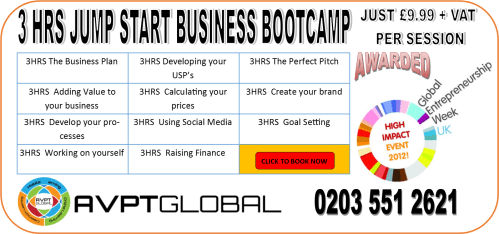
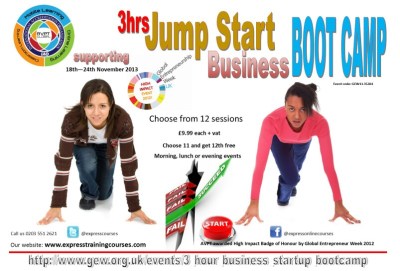
The Ultimate 3 hour Jumpstart Business Bootcamp Cover

Join us during GEWUK week. Book your place now

If you’re going through Hell, Keep Going – Winston Churchill

By Tim T Dingle BSc (Hons) PGCE MBA
Chief Development Officer at the Academy of Vocational and Professional Training

In 2013, 62 per cent of all start-ups will fail within their first year of trading.

We have evidence to support this and yet we see that many people are now being forced into self employment as a result of the most intense financial economical downturn. Yes we are all going through economic hell in the United Kingdom at the moment; but  there is a need for us all to keep going.

This astonishing statistic, and one that becomes even worse in certain parts of the country. In parts of the UK business failure rates have reached almost 85 per cent.

Yet the truth is that half a million people per year set up new businesses.

They do so for a number of good reasons including

  • being in ‘control’,
  • ‘being their own boss’,
  • ‘getting a better work / life balance’
  • ‘freedom’.
  • only way to earn some money

Do any of these thoughts resonate with you? Most business owners work very long hours, for very little reward. Having met with many owners and business people I think that is universally true.  They often cannot afford ­or have not planned ­ to take on anyone else. In the United Kingdom, nearly 99 % of business is made up of SMEs (Small to Medium Enterprise with less than 250 people), amounting to almost 4 million SMEs. Of these, the staggering fact is that­ 97% of which have fewer than 20 people and 70% are one-person owner managed businesses.
AddThis Social Bookmarking Sharing Button WidgetBut here is the really stunning fact you may recognise; most of these business owners end up investing all their money (or family savings) and giving up the very reasons they started the business: freedom, work / life balance and control. Far be it from being in control, most businesses and business owners are in fact spinning out of control, being highly reactive rather than proactive, with no real goals, no clear vision and many being so time deficient that there is no time to think, let alone have time for a plan.

So why do so many business fail and so quickly?  Consider this quotation from Sidney A. Freidman (I have it over my desk),

“You can achieve anything you want in life if you have the courage to dream it, the intelligence to make a realistic plan, and the will to see that plan through to the end.”

The ‘courage to dream’ is essential and business owners have without question been courageous.

However that dream must be qualified by a very sound non-emotional understanding of money and finance.  From cash flow to paying too many people too much, most people start out in business without any idea of how much money is really required. They don’t then make a plan or even an intelligent business plan. Those brave souls who start their own business and take all those risks then fail as they give up far too quickly.  Any new business will be lucky to break even in their first year. Many people new to business often assume that they are going to make a fortune within 12 months. The truth is less than 80% of new start-ups make a profit in their first year. You need to have the will to see that plan through to the end.

jumpstartbusinessbootcampnotimetowastegewuk 3      Years ago you would have been looked up for having a ‘vision’. Now it is considered essential for business owners.  But having a vision is not enough.  Failure starts when the manager is incompetent. Most small businesses fail because the owner does not have the knowledge to run a business properly.

AVPT is supporting Global Entrepreneur Week in 2013 with a series of Business Jumpstart Bootcamps. Get qualified and do the basics! Take one of our brilliant Boot Camps or train on line- sign up now at www.avptglobal.com

Must business don’t get the importance branding; their own personal brand or their business brand. Every single piece of your company has to scream out your brand including your brochures, websites, delivery vans and the uniforms that you and your staff wear. Everything has to congruent.

I am continually surprised that most people that are afraaid to sell. This essential soft skill (which I teach and we have brilliant short online courses waiting for you) of how to close the sale is a MUST HAVE item. This is an art form that needs teaching. Some people are naturally good closers but others have to learn by reading and studying. The more you practice the better you will become. So make a note to self: learn how to sell!

One really crucial understanding for all employees and the owner is understanding what the true demand is and the companies own Unique Selling Point. Small businesses often overestimate the demand and usually have no unique selling proposition built in to their products.

Now here is the crucial point so often ignored by new business owners. You need the ability to get on with other people. A brilliant ‘soft skill’ that can be acquired. We all know that we have to treat our customers with respect but what about our suppliers? I am amazed that I have to explain to intelligent people that this is an essential of business success. If you do not pay your suppliers on time they will start quoting you higher prices. If you are rude to them they might stop doing business with you altogether. I like the Tony Robbins thought that,

‘The degree to which you manage your relationships is often the degree to which you will be successful’.

In my experience from commercial mediation (a sensible alternative to conflict) a huge proportion of a manager’s time is wasted on managing unwarranted conflict, misunderstanding and so on, that could amount  to over a full working day per week. ­So, could you be more productive if you used this ‘conflict time’ for ‘selling time’? Want more money?

jumpstartbusinessbootcampnotimetowastegewuk 7Finally, a large number of businesses fail because they are over-reliant on a very small number of clients. This is the hidden danger that lurks for all business owners. It takes just one unexpected closure to result in significant financial hardship. Short-term future earnings can be massively reduced, and invoices for completed work can go unpaid. While maintaining caution about spreading yourself too thin, try not to rely on a very small client base. If you deal with a very few clients, or if a small number make up most of your turnover, you must start finding and bringing in new clients and business. Right now.

A business needs a good business plan that covers all these issues and makes them part of a living, working document. If you want back control of your life and your business then write a plan and get help (with writing or implement it). Business failure can be quick and unexpected. Make sure that you are totally aware of the major risks facing your company and ensure that you are in the best possible position to avoid them.

Churchill was right. Make sure when you have the courage to dream that you make an intelligence to plan and have the will to keep going. If you’re going through hell, keep going.
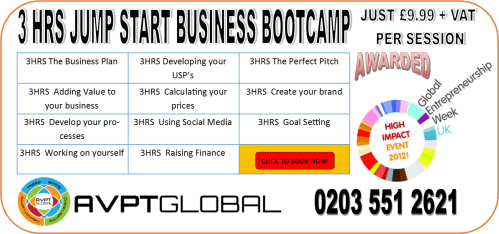

3 HR JUMP START BUSINESS BOOTCAMP WITH GEWUK 18 NOV 2013

Can the Law of Reciprocity Make or Break Your Business?

We mean to help you so that in turn you help us

We mean to help you so that in turn you help us

Understanding the Law of Reciprocity

article by: Tim T Dingle BSc (Hons) MIBiol PGCE MBA
CDO  Academy of Vocational and Professional Training

Have you ever wondered why some people seem luckier than others? Have you ever been (mildly) annoyed that others attract more referrals than you? There has got to be a reason, hasn’t there? Well a good definition of ‘luck’ is when action meets opportunity. People that help other people every chance (they get) almost always come out on top. I am amazed by the simple gestures of holding a door for someone, returning a lost wallet and giving someone a referral produces 2 things:  First, the feeling that the person on the receiving end of your kindness is compelled to reciprocate; and second, you create a positive thoughts/feelings about your self-image. There’s something very powerful at play that causes this phenomenon.

Psychologists call it The Law of Reciprocity and it says that when someone does something nice for you, you will have a deep-rooted psychological urge to do something nice in return. It is buried deep inside our DNA and is an evolutionary survival mechanism. As a matter of fact, you may even reciprocate with a gesture far more generous than their original good deed. You can try and resist this law, but your DNA will intervene and you will more than likely still feel that you need to respond in kind to a good deed. If that’s true (and it is) then it would be to your advantage to understand the right way – and the wrong way to take advantage of this powerful law.

Do you think that the Law of Reciprocity can make or break your business?

Diane Shawe the CEO of the Academy of Vocational and Professional Training states “the law of reciprocity is like a karmic “piggy bank”. What you broadcast into the universe, whether it is positive or negative, is a deposit due to be returned to you. Your deposits may be returned quickly, without the effects of past and future deposits added”  but then she goes on to say “How then do we define the purpose of Business Etiquette?”  interesting combination.

For this reason, it is wise to bank positive deposits often.

As someone who is running (or is aspiring to run) their own business, there are a couple of ways you can invest in the use of reciprocity: the Constructive Way and the Destructive Way.

The Constructive Way

80% students get qualified
One of the hardest parts of a new business relationship is building trust and rapport. To do that, there are some things you have to establish up front with a potential client to show them you’re one of the good guys. These fall in the area of intent, empathy and credibility. So, if you really are one of the good guys, you can show people what you’re made of simply by being friendly, honest, and helpful. That’s the idea behind a lot of the freebies that bloggers give away all the time. By giving something that’s of legitimate value away with no expectation of compensation, you’re achieving several things.

  • If the material or help you’re giving away is of high quality, you’re establishing yourself as a person of credibility – someone who knows what they’re talking about.
  • You’re demonstrating empathy by showing the recipient that you understand they’re looking for answers. You understand that they need help – and you’re someone who’s willing to give it to them.
  • You’re showing that your intent is not just to get into their wallets – but to sincerely help.

In the process, you stimulate the DNA program of The Law of Reciprocity. When you establish yourself as an honest, sincere, and giving person – you make it much easier for people to buy from you when you have something to offer. It is at that point they already like you, they have seen that you know your stuff, and they trust you. All that makes it much easier for them to choose you.

The Destructive Way
3 HR JUMP START BUSINESS BOOTCAMP WITH GEWUK 18 NOV 2013While responding to The Law of Reciprocity is hard-wired into us, most people aren’t stupid, but can often be inexperienced or too trusting. If the Law is exploited as a tactic, they often experience a lot of discomfort and dis-ease about the situation. Even though I use the word ‘exploiting’ ( I don’t believe that most people conspire to use this law) you might best understand it as someone being false’ pretense, a front; you are pretending to be sincere and helpful, therefore only to trick people into feeling a sense of obligation. Poor salespeople are easy to find – and when someone is using reciprocity as a pressure tactic, it’s obvious. You’ve been there as a consumer.

I’ll bet you don’t have to go back very far in your memory bank to remember a time when someone seemed a little too nice. Even though they were doing something positive for you, you still instinctively didn’t trust them. That’s because their intentions weren’t sincere and you sensed it. Using the Law that way may trick someone from time to time, but it likely won’t lead to repeat sales, good will, or referrals. Pressured prospects tend to disappear quietly.

So the right way to gain maximum benefit from the Law of Reciprocity is to use it sincerely and for the right reasons: to help others and to grow your relationships. There are a lot of aggressive sales and marketing people out there, but listen to them with caution. Consumers are smarter than ever before. Being aggressive tends to offend and alienate. Instead, aim for active and inclusivity. What’s the difference? Aggressive is relentless and pushy. Active and exclusivity is, well, active listening and keeping them involved.

If what you’re selling is truly of value, you don’t have to be a bully to get people to buy. You just have to work hard to get your name out there and develop your brand. Since you are one of the good guys, ask yourself; What small thing can I provide today that my customers can really use?

When you come up with an answer – give it to them. It’s the right thing to do – and because of The Law of Reciprocity, your customers will gladly return that generosity when you do have something to sell.

AddThis Social Bookmarking Sharing Button Widget

AddThis Social Bookmarking Sharing Button Widget

AddThis Social Bookmarking Sharing Button Widget

AVPT  is back for more after being awarded A High Impact Badge of Honour by the Global Entrepreneur Week in 2012

AVPT awarded High Impact Badge of Honour by Global Entrepreneur  Week 2012

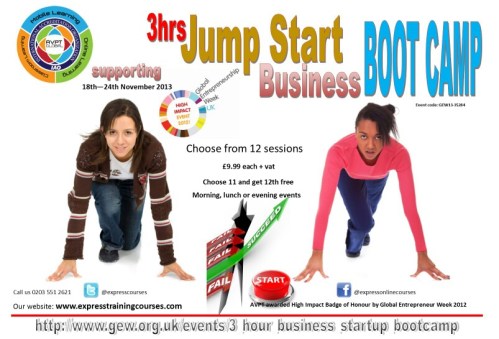
This year we have set up a range of 3hr ‘Jump Start’ your business bootcamp in support of the Global Entrepreneur Week starting on the 18th – 24th  November 2013

3 hour business startup bootcamp 2012

Last year 361 organisations ran activities in 2012 that met the

High Impact criteria set by Global Entrepreneurship Week – AVPT along with other High Impact providers was congratulated this week and awarded their high impact badge of honour.

Global Entrepreneurship Week is the world’s largest campaign to promote entrepreneurship, taking place in 115 countries.  In 2012, the campaign took place 12-18 November and Academy of Vocational and Professional Training supported the week by launching a 3 hour Business Startup Bootcamp which was attended by a group of candidates who enroled on the GEW website.

In the UK, the campaign is hosted by Youth Business International, a global network of initiatives that help young entrepreneurs to start their own business, in partnership with Barclays.

The theme for 2012 was: Pass it On!  AVPT supported Global Entrepreneurship Week UK to pass on the practical help & support needed by early start-ups and individuals who are considering taking the plunge. GEW’s aim was to create a collaborative, local and practical week which enables people to learn more about the wealth of support that is available to entrepreneurs in the UK.  Read more…

 PLEASE SEE TIMETABLE BEFORE BOOKING YOUR BOOTCAMP!

Timetable for November 2013

TIMETABLE


AddThis Social Bookmarking Sharing Button Widget.

Have you every wondered why people shy away from solving problems?

banner bbb aug 2013 avptglobalDo you spend a lot of time frowning?  are you even aware that you frown?

article by Diane Shawe M.Ed
CEO Academy of Vocational and Professional Ltd.

Do you think more people focus on the half empty glass or the half full. Which are you? At times, it would seem that we have more problems then we can handle, but this all boils down to self responsibility critical thinking skills and optimism. Taking the bull by the horn can be a scary things, so check out a few well know secrets?

1.      Smile!  It is impossible to hold a frown and smile at the same time, try it, you will be amazed at how your brain will help you look and keep on the bright side of life.

2. Separating negative feelings from positive thoughts. This is an important step in solving problems. Only after you have cleared your mind with unnecessary thoughts can you start solving your problems accordingly.

3.      Treat each problem as a challenge an opportunity for self-improvement.

4.      Lose the scapegoat attitude. Are you pointing your finger or blaming others for mishaps? Take responsibilities for your mistakes. No one is perfect, so never put the blames on others unless your trying to say that they are much smarter because they got you to do something you did not intend.

5.      Commit your problem with a pen and paper, and rate the depth of the problem and state the worse that could happen. Face the fear and then write down all the options of solving it.

6.      Keep a journal and treat it as a “secret friend” who is always willing to listen to your grievances. Write your feelings freely.

7.      Develop a noteworthy hobby, for this will help you lessen or minimise stress in your life.

8.      Take time off from work and create variations of your daily schedule. Relax and check out the best movies in town. Travel and meet new wonderful people. You will find these activities worthwhile in the long run.

AVPTGLOBAL almost 400 courses all globally accredited

AVPTGLOBAL almost 400 courses all globally accredited

 4 Steps problem solving tools

1.      To determine the root cause of the problem. Ask a question, answer it, then ask why, answer that, then ask what if, and so on until you run out, that might likely be the root of the problem.

2.      Draw up a strategy, then act upon it. (Pretend you was advising a friend and follow your own advice)

3.      Give yourself a deadline, and reward yourself when you have completed the task

4.      Reflect so you can avoid repeating the same mistakes .

Problems are problems. They are there not to annoy you; but problems are created when you fail to act upon them. Learn to  Let go and you will free yourself of  worry. Remember, less worries mean less stress, so you won’t just spend your time looking at problems, but working to solve them.

If you think that you really want some time out because of problems, visit the next room called “improvement.”

Why not take a look at some of our problem solving courses now.  Click here

AVPT HAIR EXTENSION DEPARTMENT LOGO JULY 2013

Glossophobia: The number one fear in the UK!

fear of public speaking course

Speaking presentation survival school course

Got to make a presentation? Make a wedding speech? Say something at an event? Nervous? How AVPT Global can help you right now with the fear of public speaking.

Tim T Dingle BSc (Hons) MIBiol PGCE MBA

Chief Development Officer, Academy of Vocational and Professional Training

Having trained hundreds of people in brilliant public speaking (and many more to be Standup comics) I am often asked about the causes of Glossophobia. This is a type of speech anxiety and is most commonly the fear of public speaking or of speaking in general. An estimated 75% of all people experience some degree of anxiety and nervousness when public speaking. I am lucky and don’t suffer- whatever size the audience. The good news is it can be cured and overcome.


The more specific symptoms of speech anxiety can be grouped into three categories: verbal, physical and non-verbal. The verbal symptoms include, but are not limited to a tense voice, a quivering voice, and vocalised pauses, which tend to comfort anxious speakers.

The symptoms I see the most in training are the physical ones. These result from the sympathetic part of the autonomic nervous system responding to the situation with a fight-or-flight adrenalin reaction. Since the sympathetic system is all-or-nothing, adrenaline secretion produces a wide array of symptoms at once – all of which are supposed to enhance a student’s ability to fight or escape a dangerous scenario. These symptoms include acute hearing, increased heart rate, increased blood pressure, dilated pupils, increased perspiration, increased oxygen intake, stiffening of upper back muscles and the classic dry mouth. None of which are much good when you are about to give a wedding speech. The good news is they can be relieved with training and some skilled guidance.

learning to speak under pressure

Looking good when speaking under pressure

Public speaking experts agree that one of the most important steps in preparing for a speech is practice. Yet after giving the same speech so many times, it can be difficult to maintain an authentic voice, especially once nerves kick in. More than anything, a successful speech hinges on your ability to know your audience and establish a connection. Shape your speech around a subject that you genuinely care about and try to focus on what you have to offer your audience.

Your concentration will naturally shift away from what is at stake for you personally, calming your nerves and allowing you to connect to your audience in a real way. Then, tell a story. Take the audience on a journey. While there are many aspects that will contribute to the success of your speech, it is the authentic, heartfelt moments that will be remembered most.

The importance of learning to speak in front of an audience is undeniable; invariably intertwined with leadership, motivation, and change. While Glossophobia is common, in fact the most common phobia in the UK, it is certainly a fear that can be overcome. But the power of spoken word is reason in itself to push past that fear.

So remember that nerves are natural: use your nerves to propel you through the speech, and know that your physical response to stress will only make the speech all that much more rewarding once you finally step down from that stage. Remember to be authentic: pick a topic that you truly care about, and the audience will be stirred to care as well. And finally, don’t be afraid to aim big. You were chosen to speak for a reason, and you have a meaningful story to tell. So take slow, rhythmic breaths and change the world- and take this course in conquering your fear of public speaking!

Why Study With Us Unemployed Poster

AVPT Supporting the Global Entrepreneur Week November 2013 after being awarded a High Impact Badge in 2012

AVPT  is back for more after being awarded A High Impact Badge of Honour by the Global Entrepreneur Week in 2012

AVPT awarded High Impact Badge of Honour by Global Entrepreneur  Week 2012

This year we have set up a range of 3hr ‘Jump Start’ your business bootcamp in support of the Global Entrepreneur Week starting on the 18th – 24th  November 2013

3 hour business startup bootcamp 2012

Last year 361 organisations ran activities in 2012 that met the

High Impact criteria set by Global Entrepreneurship Week – AVPT along with other High Impact providers was congratulated this week and awarded their high impact badge of honour.

Global Entrepreneurship Week is the world’s largest campaign to promote entrepreneurship, taking place in 115 countries.  In 2012, the campaign took place 12-18 November and Academy of Vocational and Professional Training supported the week by launching a 3 hour Business Startup Bootcamp which was attended by a group of candidates who enroled on the GEW website.

In the UK, the campaign is hosted by Youth Business International, a global network of initiatives that help young entrepreneurs to start their own business, in partnership with Barclays.

The theme for 2012 was: Pass it On!  AVPT supported Global Entrepreneurship Week UK to pass on the practical help & support needed by early start-ups and individuals who are considering taking the plunge. GEW’s aim was to create a collaborative, local and practical week which enables people to learn more about the wealth of support that is available to entrepreneurs in the UK.

Through the week, they wanted to: Encourage those people who are not yet entrepreneurs to think about starting up their own business Improve entrepreneurship skills for aspiring entrepreneurs and start-ups Help people to access practical support – locally, regionally and nationally We did this by passing on: skills, contacts, knowledge, confidence and resources.

Ruth Onuoho who attended the 3 hour bootcamp wrote on her feedback form: “That they should bring their brother, mother, sister, everyone! I would tell them to bring a dictaphone, note pad and pen and use it until their hands bleed” Abigail Shillingford also wrote: “Informative and professional and the business advice is different and more resourceful than the local government or high street agencies”. Antony Berry said ” “The bootcamp provided a masterclass in the ways to think about yourself & your business.

In the UK, the campaign is hosted by Youth Business International, a global network of initiatives that help young entrepreneurs to start their own business, in partnership with Barclays.

At this years campaign they  believe that a large national campaign to promote entrepreneurship is a vital part of making the UK more entrepreneurial, to encourage more people to start up their own business.

GEWUK’s aim is to create a collaborative, local and practical week which enables people to learn more about the wealth of support that is available to entrepreneurs in the UK. 20% of UK adults have heard of Global Entrepreneurship Week and it remains by some margin the nation’s largest entrepreneurship-focused campaign.

Very practical advice given”. Find out about our forthcoming events by visiting our http://gewuk-jumpstart-3hour-business-bootcamp.eventbrite.co.uk/

http://www.academy-of-vocational-and-professional-training.com Global Life Long Learning 0203 551 2621

AVPTGLOBAL almost 400 courses all globally accredited

AVPTGLOBAL almost 400 courses all globally accredited

BYOD! The change is here.

Bring Your Own Device

1 personal development beta students needed

Try out our LMS system today

Tim T Dingle BSc (Hons) MIBiol PGCE MBA Chief Development Officer at the Academy of Vocational and Professional Training.

AVPT Global is issuing a technological tsunami alert; feel the force of a very real wave of BYOD / BYOT and new mobile learning and learn how to avoid being swamped.

Here at AVPT Global we like to bring you some advanced news and perhaps a serious warning of impending change. I have worked in the education sector for 25 years and seen many changes in technology during that time. There is a clear and present need to improve the soft skills and learning of individuals- whether at School, University or in business. Already at AVPT we are using the latest technology to improve training and it is clear that mobile learning is massive. I came across the term bring your own device (BYOD) in a recent workshop for employers. It means the policy of permitting employees to bring personally owned mobile devices (laptops, tablets, and smart phones) to their workplace and use those devices to access company information and applications. The term bring your own technology (BYOT) is being used more frequently in an educational context. It is a part of a supplementary school technology resourcing model, where the home and the school collaborate in arranging for use their own digital technology to be extended into the classroom to assist their teaching and learning and the organisation of their schooling.

The BYOD / BYOT ‘tsunami’ is rapidly coming over the horizon for educational institutions and businesses. BYOD is making significant inroads in the business world already with about 75% of employees in high growth markets such as Brazil and Russia and 44% in developed markets already using their own technology at work. In most cases, businesses simply can’t block the trend.

We believe that BYOD may help employees be more productive and become genuine Life Long Learners. It can and should increase employee morale and convenience by using their own devices and makes the company look like a flexible and attractive employer.  Many feel that BYOD can even be a means to attract new staff (and we all know how hard it is to get the right person on board): 44% of job seekers now view an organisation more positively if it supports their device.

AVPTGLOBAL almost 400 courses all globally accredited

AVPTGLOBAL almost 400 courses all globally accredited

We have found at AVPT that if businesses are to survive they will need to be proactive and really note and respond to the trends.  They will need to shape the largely inevitable development to the best advantage or try to surpass the deeds of King Canute and prevent the wave from swamping their institutions. Perhaps not surprisingly at this very early stage many of the early BYOT moves are making this mistake, are naïve, simplistic and preoccupied with the relatively mundane, showing little appreciation of what BYOT could entail.

We believe at AVPT global that there are least six global megatrends coming together that will impact on all businesses, schools, institutions to some form of BYOT. These megatrends relate to the normalised use of personal digital devices in every facet of life, the burgeoning digital and educative capacity of the student’s homes, cloud computing, parent digital empowerment, government’s increasing inability to fund state of the art personal technology for all and the inexorable evolution of schooling from its insular paper-based mode to one that is more digital and networked.

Fundamental to BYOT is that personal choice of the technology by the individual (whether in School, Higher Education and Business). While businesses /schools might and probably should provide advice, the final choice should rest with the individual. The will give an enhanced facility for the personalisation of learning in and outside the business and educational premises. That is the secret of the success of online mobile learners. In our online Learning Management System that can be used by the owner of device, at home, work or on the move (found out VTF are driving this change).The individuals are having their ownership of the technology and the information respected and absorbed.

Get qualified whilst on the move with AVPT

Get qualified whilst on the move with AVPT

So the future that BYOD / BYOT is creating will cause a profound educational change. It has immense potential that will assist change in the nature of schooling, teaching, learning and the relationship with homes and work. However, to realise this potential there has to be really strong leadership in education and businesses management. It has to change thinking and begin to understand what is needed terms of the power of mobile learning. Leaders have to take charge of the process, understand the possibilities and appreciate what is required for sustained success and development. At AVPT we see leaders training who are training to be proactive, learning about the forces impelling institutions to some form of BYOT. We see the need to appreciate the real potential for society in educational, social, economic, technical, administrative and political terms.

At the Academy of Vocational and Professional Training we believe these are still very early days with BYOT / BYOD. There isn’t much out there being written about these changes to mobile learning except in some pioneers in the field. The focus of most business and institutions is technical with little thought given the wider educational or financial implications. The greatest challenge with BYOT / BYOD will be human. The technical aspect is easy- and always will be. The key is to understand the historic significance of this development and to recognise that we are moving to a new model of mobile learning, teaching and institutional resourcing where everyone collaborates, facilitates and genuine accepts these changes.

AVPTLTD LOGO  6

The Third Gulf Education Conference Hosted Many Educational Ministers From Around the World in London

20130619_111059

AVPT at Gulf Educational Conference 2013

The Third Gulf Education Conference Hosted Many Educational Ministers From Around the World in London


by Arub Masoodi BA (Hons)
Public Relations (Social Media Focus) Intern, AVPT Global Ltd

Diane Shawe CEO & her team were exhibitors at this prestigious event where ministers and the heads of department met to discuss rethinking higher education in a global and digital age.
The conference took place on 19th and 20th June at the fabulous Millennium Gloucester Hotel in London.

The Gulf Education Conference, now in its third year, is an unrivaled occasion for leaders of education to meet and exchange ideas to further develop and enhance education around the world. The Conference allows a platform to collaborate on a global scale with leaders in education from the Gulf, Mena, UK & US in attendance while also creating a platform to address weak spots and key problem areas in order to implement better plans for improvement. Leaders of education such as, H.E. Ali Adeeb, Minister of Higher Education & Scientific Research Iraq, and Anjum Malik, cofounder Alhambra US Chamber Director, Global Marketing, GIEL University of Texas Austin, were in attendance.

AVPT attracted high levels of interest in their soft skills course when several ministers felt more attention was needed to develop these skills in their country.
Enquiries came flooding in from the Embassy of the Republic of Iraq, the American University in Cairo, the British Embassy in Doha and the Logic Institute CEO Husain Fateel who wants to create a joint venture with AVPT Global. AVPT attracted over 30 enquiries that are now being followed up.

AVPT, along with ministers of education, Chancellors and heads of corporation were able to engage directly with one another and discuss the future of education while collaborating on ideas and extending links to better global education.  

AVPTLTD LOGO 7

12 Benefits of Mobile Learning

Next generation of mobile learning

Learning on the move with
http://www.avptglobal.com

Rapid technology change is here to stay.

article by Diane Shawe M.Ed  CEO Academy of Vocational and Professional Training.

No sense in trying to change the way the world wants to learn. Access to broadband, smartphone, the growth of the mobile tablet has changed the face of how we access knowledge.

But rather than simply program designers and consumers–or even ecological threats–this kind of change also introduces significant threats  or should we say opportunities to education. Throughout the Industrialised delivery of education, there is likely very little that can be actively done to reduce the perceived threats by many faculty heads, especially as the advancement is firstly driven by economic issues. But we can begin to understand them better and view them as opportunities.

Watch the Hard Facts behind Soft Skills by Professor James Heckman

As learning practices and technology tools change, mobile learning itself will continue to evolve. For 2013, the focus is on a variety of challenges, from how learners access content to how the idea of a “curriculum” is defined.

The rapid growth of Technology like tablets, smartphones, apps, and access to broadband internet are lubricating the shift to mobile learning, but a truly asynchronous mobile learning environment goes beyond the tools for learning to the lives and communities valued by each individual learner.

PA9C1822
Training for the jobs yet to be created

It is only within these communities that the native context of each learner can be fully understood. Here, in these communities that are both local and digital, a ”need to learn” is born, knowledge accrues incrementally, progress resonates naturally, and a full picture of each learner as a human being fully emerges as we embark on the true essence of Life Long Learning.

1. Access – Aids voluntary and active learning

A mobile learning environment is about access to content, peers, experts, portfolio artifacts, credible sources, and previous thinking on relevant topics. It can be actuated via a smartphone or tablet, laptop or in-person, but access is constant–which in turn shifts a unique burden to learn on the shoulders of the student.

2. Metrics – Performance of Knowledge

As mobile learning is a blend of the digital and physical, diverse metrics (i.e., measures) of understanding and “performance of knowledge” will be available. It is important that mobile learning supplies and validate that learning has taken place.

3. Cloud – Increased collaboration

The cloud is the enabler of “smart” mobility. With access to the cloud, all data sources and project materials are constantly available, allowing for previously inaccessible levels and styles of revision and collaboration. This also reduces the burden of data storage in the immediate device enabling speed of access to be maintained. Also no complex disaster recovery procedures.

4. Transparent

Transparency is the natural by product of connectivity, mobility, and collaboration. As planning, thinking, performance, evaluation and reflection are both mobile and digital, they gain an immediate audience with both local and global communities through social media platforms from twitter to facebook, linkedin to Pinterest.

5. Play – Learning by doing

Play is one of the primary characteristics of authentic, progressive learning, both a cause and effect of an engaged mind. In a mobile learning environment learners are encountering a dynamic and often unplanned set of data, domains, and collaborators, changing the tone of learning from academic and compliant to personal and playful means that soft skills training is becoming even more apparent.

6. Asynchronous Learning

Among the most powerful principles of mobile learning is asynchronous access. This unbolts an educational environment from a school floor and allows it to move anywhere, anytime in pursuit of truly entrepreneurial learning. It also enables a learning experience that is increasingly personalised: just in time, just enough, just for me reducing the length of time one can qualify.

7. Self-Actuated

With asynchronous access to content, peers, and experts comes the potential for self-actuation. Here, learners plan topic, sequence, audience, and application via facilitation of teachers who now act as experts of resource and assessment.

8. Divergent Thinking

With mobility comes diversity. As learning environments change constantly, that fluidity becomes a norm that provides a stream of new ideas, unexpected challenges, and constant opportunities for revision and application of thinking. Audiences are diverse, thinking is diverse, as are the environments data is being gleaned from by both the student and the teacher.

9. Curation – Evidence storage and Management

Apps and mobile devices can not only support curation, but can do so better than even the most efficient teacher might hope to do. By design, these technologies adapt to learners, store files, compare and evaluate, publish thinking, and connect learners, making curation a matter of process rather than ability.

10. Blending the Learning Styles

A mobile learning environment will always represent a much better path to the whole concept of blended learning. –physical movement, personal communication, Learning styles and digital interaction.

11. Always-On – Classroom never full

AppleAVPTGlobalLogo516Always-on 24hr learning is self-actuated, spontaneous, iterative, and recursive. There is a persistent need for information access, cognitive reflection, and interdependent function through mobile devices. It is also embedded in communities capable of intimate and natural interaction with students.

12. Authentic Learning

All of the previous 11 principles yield an authenticity to learning that is impossible to reproduce in a classroom using the industrialised teaching methods. They ultimately converge to enable experiences that are truly personalised changing the way we think about learning and teaching.

AVPTGLOBAL almost 400 courses all globally accredited

Academy of Vocational and Professional Training signs a Five Year Contract with Deputy Vice Chancellor of Cambodian Mekong University

Diane Shawe and Dr. Philip Dews

Diane Shawe and Dr.Philip Dews

To deliver Softskills training to it’s students throughout Cambodia

25th May 2013, Diane Shawe, United Kingdom

Dr. Philip Dews, the Deputy Vice Chancellor for Cambodian Mekong University  signed a 5 year exclusive contract with Diane Shawe the founder and CEO of Academy of Vocational & Professional Training (AVPTGLOBAL), the leader in delivering of over 300 soft skills globally accredited courses.

The agreement was signed by Dr. Philip Dews, the Deputy Vice Chancellor for Cambodian Mekong University and Diane Shawe the founder and CEO of Academy of Vocational & Professional Training, at their offices in the City of London, UK.

With the new contract in place, through the CHE college and Cambodia Mekong University student can apply online to study with AVPT’s UK Virtual Tutor Facilitators who will support them during the course they have registered to undertake.

With a population of over 15 million and a anticipated growth rate of 8%, over 50 of Cambodia’s population is under the age of 18 and even those who have already attained a degree do not have the necessary soft skills to meet the needs of a variety of employers.

This lack of skills will prove a particular challenge as the country is expanding rapidly as a tourist destination and yet does not have the hospitality courses necessary to train the number of staff large enough to satisfy the demand.

The Cambodian Prime Minister Hun Sen is aware of this situation and has declared that the educational institutes must find ways to support the development of the variety of skills required in the tourism sector.

Dr. Dews said: “Inspired by the Prime Ministers vision, I discovered AVPT whilst researching for UK  soft skill training providers. [whilst in Cambodia] I then did my due diligence of the organisation itself online. When I came to the UK, I arranged a meeting with Diane Shawe and had the opportunity to be shown the unique learning management system and some of the course materials. I am confident that I have found the solution for the soft skills training for the Cambodia population.”

AVPT delivers a wide range of soft skills courses through it’s cutting edge learning management system which work fluently and securely with various mobile devices.

Diane Shawe said: “We are passionate about education and how technology can play a part in helping to upskill people around the world.  When Dr. Dews shared the problem they wanted to rectify in Cambodia, I knew we could help.  What most people, employers, entrepreneurs and even some educational institutions do not have today is the time, the necessary resources and the infrastructure they need to support and deliver a cost effective broad selection of soft skill courses, but we have already created them.  AVPT have streamlined the process and make learning quicker because we have made the investment to design, research, write, and create the system which is student (user) centric and time sensitive.  All our courses can be completed in days not years.”

Diane also believes that: “Our online courses transcend multiple barriers to learning, because they can be scalable which consequently reduces the cost of acquisition of knowledge per person.  The knowledge gained is also measurable, which encourages the student to progress and allows their online tutor VTF (or workshop leader) to provide the flexible support system most beneficial for motivation.  And additionally online training is environmentally friendly and adds to the accessible and inclusive nature of the courses.”

Dr. Dews also confirmed that the CHE will want to cement this long term commitment by sending its first group of 200 students to the UK for workshop training very soon.  This will be a reward for some of the thousands of students in the college giving them the chance to study here and experience British culture in advance of greeting tourists in their own country.  Such large numbers of students coming to the UK will help Cambodia cater for the huge demand within their hospitality sector as several large resorts open this summer.

AVPTLTD LOGO  6