Tag Archives: elearning

Enterprise Women Launching Club in Kensington, Chelsea and Westminster

Calling ALL BUSINESSWOMEN in Kensington, Chelsea and Westminster!!  Are you looking to grow your business and build strong local networks of trusted peers who will share and learn from each other? Do you want to be part of a community of substance that understands female-owned businesses and delivers practical value to its members?

County House
Date:

Tuesday, March 25, 2014 – 10:00 to 12:00

Venue:

County House

Venue address:

46 New Broad Street, London, EC2M 1JH

Price:

£27.60 inc VAT (includes lunch)

Then local host, Diane Shawe, offers you a warm welcome to join her at the Kensington, Chelsea and Westminster Women’s Business Club launch. The event is for women who are looking for that extra special support, advice, collaborative relations to help them develop and expand their business.  Join us on Linkedin

Get your free copy when you attend this event

Diane is Chief Executive Officer of the Academy of Vocational and Professional Training Ltd, which provides online and workshop fast-track soft skills training courses, Ms. Shawe is passionate about technology and the impact it will have on delivering training to students on the move that can be measured and proven. In addition Diane sits on several executive committee which includes the Conservative Education Society. As well as being a published author of several business books including, “The 10 habits of a successful women Rainmaker – From Tactics to Strategy: What works”, which is included!

Our first theme will be called, “No Random acts of Lunch.” The people who are most successful at business development, do not commit “random acts of lunch”.

Diane, will also be discussing how plans can take on many different forms and why developing your negotiation skills is VITAL! She will look at the 10 steps of honing in your negotiation skills, so that you never have to stumble away feeling unsure, vulnerable or disappointed about a meeting or presentation.  This will be the best 2 hours you could spend.

We are delighted to have guest speaker Bev Hurley at our meeting. A dynamic serial entrepreneur, mentor, angel investor and one of the UK’s leading authorities on female entrepreneurship, Bev Hurley has spent more than 30 years building successful businesses of all sizes – and sharing her expertise to create and grow hundreds of others.

PRESENTERS FOCUS

Diane Shawe

The Kensington, Chelsea and Westminster Business Club is being hosted by Diane Shawe. She is the founder and CEO of two successful training companies based in London and Luxembourg as well as an established publisher of several business books. Diane has a wealth of knowledge and experience across multi-disciplines. Diane believes that people should try to integrate the following practice into their daily lives: “never do anything as though you are a professional amateur”

Bev Hurley

A dynamic serial entrepreneur, mentor, angel investor and one of the UK’s leading authorities on female entrepreneurship, Bev Hurley has spent more than 30 years building successful businesses of all sizes – and sharing her expertise to create and grow hundreds of others.
So what are you waiting for? Book your place now!

We look forward to seeing you all there…

To book your place, first log in or create a new account, and click the BUY NOW

If you have any problems registering for this event, please email farhana@enterprising-women.org
or
diane@avptglobal.com

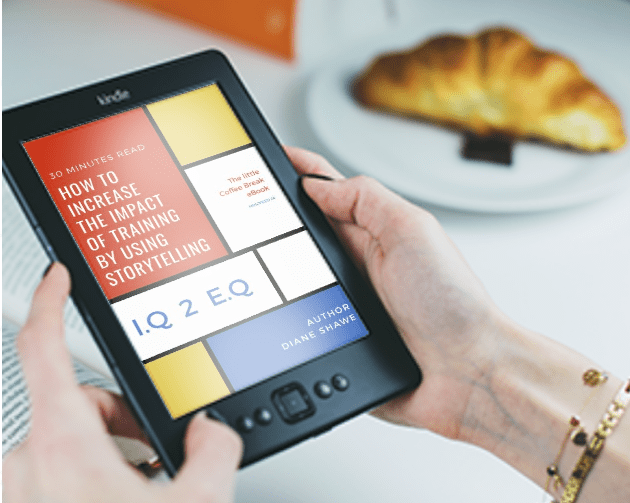
How to Increase the Impact of Training Using Storytelling

One of the most important tasks of a top trainer is to keep the delegates engaged

One of the most important tasks of a top trainer is to keep the delegates engaged

article by Diane Shawe M.Ed.

CEO AVPT Ltd

One of the most important tasks of a top trainer is to keep the delegates engaged. The more delegates are immersed in a training course, the more likely that they will learn. There have been many great ways to do this as listed below:

Game

A game is an exercise that normally has a set of rules and an element of competition. Games also normally include some element of reward or pay off. Although traditional games include competing against some one or another team, they are also many non-competitive games available.

 Icebreakers

Icebreakers are normally used as an exercise to introduce group members to one another, infuse some energy into the beginning of a workshop, and to lead into the topic material.

Energizer

An energizer is a brief pick-me-up designed to invigorate a group if energy in the room is waning, or to bring them back together following a break. Energizers may be a short version of any game or icebreaker, or a brief set of stretches. They are completed within approximately two to five minutes.

Simulations

A simulation is used to train future operators when the equipment that they will use is either very expensive or dangerous. Simulations are designed to be as realistic as possible so that participants can learn from the situation without worrying about damage or financial cost.

Brain teasers

Brain teasers are puzzles to keep participants busy or to highlight key points. Brain teasers have the flexibility for a creative trainer to create their own rules to fit a particular session. They can include perception exercises, joining the dots, or drawing activities.

Role Plays

Role-playing is a helpful way to gauge how participants are learning material or how they react to certain situations. They are very useful way to practice new skills in a non-threatening environment.

Case Studies

Case studies are stories normally extracted from a participant’s workplace or industry. It may also be a simulated scenario. They may be studied by individuals/groups and then analyzed to demonstrate particular training points or to stimulate discussion. A great way to do this is to tell powerful stories. Stories capture people’s imagination and help them to visualise a concept.  In this introduction brochure you will learn why storytelling matters and how to make great stories to enhance your training.

But do Stories Matter?

Consider a typical day. How many stories do you hear? Stories seem to be everywhere. TV is full of stories from soap operas to sitcoms to various drama series. Even news is primarily told as one story after another. Massive number of fiction and movies are consumed every single day.  Now, analyse yourself to see when you are most susceptible to persuasion.

You will see that it is when you have been told a really good story. The story can be about anything; but it is usually a story that sells you an idea or a product.

Consider famous public speakers. What is it about their speeches that make them stand out? It is always the story they tell us in their speeches and the way they deliver it that moves us. They make the story emotional, even somewhat personal. Their stories give us hope and promise us a better future. Their stories make us forget about the past or our everyday problems. Their stories give us energy and motivate us to follow up with an idea. There is always a protagonist that you can connect with emotionally.

You feel their pain and joy. While the story is told, you are curious to know how it ends. You cannot wait until it reaches its climax. You want to know what the protagonist decides when he is suddenly forced to make a choice. While you are fully engaged with the story, the real message is then given to you, directly or indirectly. You understand the message through the story and you feel that you have a first-hand experience of the issue.  The real power of stories is that they can be remembered very easily and be retold to others. This is in fact largely the main way that cultural memes pass through generations.

What Can Storytelling Do for Teaching?

When it comes to training, you have two critical aims; to teach a new skill and to increase the likelihood that this new skill is retained long after the course.  Stories can serve both needs. The story itself can be used to explain a particular concept or illustrate the benefits of following a particular attitude in a vivid way. It is also easier to remember the story which can reinforce the learning after the course. People can tell the story to others and thereby spread your training without your direct involvement.

The story can then spread by word of mouth and if it is good enough it may go viral. If it was your original story it can do wonders for your reputation as a trainer. Many people will want to know more about you and hear more stories. This is because people are addicted to good stories. We cannot get enough of it. If we discover that someone is a good storyteller and his stories work for us, we want to hear every story he has to say. We become somewhat addicted to his stories.  As a public performer who provides training courses and aspires to become more popular and better known, you cannot underestimate the power of storytelling.   read more by downloading our free booklet from here

80% students get qualified

Have you every wondered why people shy away from solving problems?

banner bbb aug 2013 avptglobalDo you spend a lot of time frowning?  are you even aware that you frown?

article by Diane Shawe M.Ed
CEO Academy of Vocational and Professional Ltd.

Do you think more people focus on the half empty glass or the half full. Which are you? At times, it would seem that we have more problems then we can handle, but this all boils down to self responsibility critical thinking skills and optimism. Taking the bull by the horn can be a scary things, so check out a few well know secrets?

1.      Smile!  It is impossible to hold a frown and smile at the same time, try it, you will be amazed at how your brain will help you look and keep on the bright side of life.

2. Separating negative feelings from positive thoughts. This is an important step in solving problems. Only after you have cleared your mind with unnecessary thoughts can you start solving your problems accordingly.

3.      Treat each problem as a challenge an opportunity for self-improvement.

4.      Lose the scapegoat attitude. Are you pointing your finger or blaming others for mishaps? Take responsibilities for your mistakes. No one is perfect, so never put the blames on others unless your trying to say that they are much smarter because they got you to do something you did not intend.

5.      Commit your problem with a pen and paper, and rate the depth of the problem and state the worse that could happen. Face the fear and then write down all the options of solving it.

6.      Keep a journal and treat it as a “secret friend” who is always willing to listen to your grievances. Write your feelings freely.

7.      Develop a noteworthy hobby, for this will help you lessen or minimise stress in your life.

8.      Take time off from work and create variations of your daily schedule. Relax and check out the best movies in town. Travel and meet new wonderful people. You will find these activities worthwhile in the long run.

AVPTGLOBAL almost 400 courses all globally accredited

AVPTGLOBAL almost 400 courses all globally accredited

 4 Steps problem solving tools

1.      To determine the root cause of the problem. Ask a question, answer it, then ask why, answer that, then ask what if, and so on until you run out, that might likely be the root of the problem.

2.      Draw up a strategy, then act upon it. (Pretend you was advising a friend and follow your own advice)

3.      Give yourself a deadline, and reward yourself when you have completed the task

4.      Reflect so you can avoid repeating the same mistakes .

Problems are problems. They are there not to annoy you; but problems are created when you fail to act upon them. Learn to  Let go and you will free yourself of  worry. Remember, less worries mean less stress, so you won’t just spend your time looking at problems, but working to solve them.

If you think that you really want some time out because of problems, visit the next room called “improvement.”

Why not take a look at some of our problem solving courses now.  Click here

AVPT HAIR EXTENSION DEPARTMENT LOGO JULY 2013

Glossophobia: The number one fear in the UK!

fear of public speaking course

Speaking presentation survival school course

Got to make a presentation? Make a wedding speech? Say something at an event? Nervous? How AVPT Global can help you right now with the fear of public speaking.

Tim T Dingle BSc (Hons) MIBiol PGCE MBA

Chief Development Officer, Academy of Vocational and Professional Training

Having trained hundreds of people in brilliant public speaking (and many more to be Standup comics) I am often asked about the causes of Glossophobia. This is a type of speech anxiety and is most commonly the fear of public speaking or of speaking in general. An estimated 75% of all people experience some degree of anxiety and nervousness when public speaking. I am lucky and don’t suffer- whatever size the audience. The good news is it can be cured and overcome.

The more specific symptoms of speech anxiety can be grouped into three categories: verbal, physical and non-verbal. The verbal symptoms include, but are not limited to a tense voice, a quivering voice, and vocalised pauses, which tend to comfort anxious speakers.

The symptoms I see the most in training are the physical ones. These result from the sympathetic part of the autonomic nervous system responding to the situation with a fight-or-flight adrenalin reaction. Since the sympathetic system is all-or-nothing, adrenaline secretion produces a wide array of symptoms at once – all of which are supposed to enhance a student’s ability to fight or escape a dangerous scenario. These symptoms include acute hearing, increased heart rate, increased blood pressure, dilated pupils, increased perspiration, increased oxygen intake, stiffening of upper back muscles and the classic dry mouth. None of which are much good when you are about to give a wedding speech. The good news is they can be relieved with training and some skilled guidance.

learning to speak under pressure

Looking good when speaking under pressure

Public speaking experts agree that one of the most important steps in preparing for a speech is practice. Yet after giving the same speech so many times, it can be difficult to maintain an authentic voice, especially once nerves kick in. More than anything, a successful speech hinges on your ability to know your audience and establish a connection. Shape your speech around a subject that you genuinely care about and try to focus on what you have to offer your audience.

Your concentration will naturally shift away from what is at stake for you personally, calming your nerves and allowing you to connect to your audience in a real way. Then, tell a story. Take the audience on a journey. While there are many aspects that will contribute to the success of your speech, it is the authentic, heartfelt moments that will be remembered most.

The importance of learning to speak in front of an audience is undeniable; invariably intertwined with leadership, motivation, and change. While Glossophobia is common, in fact the most common phobia in the UK, it is certainly a fear that can be overcome. But the power of spoken word is reason in itself to push past that fear.

So remember that nerves are natural: use your nerves to propel you through the speech, and know that your physical response to stress will only make the speech all that much more rewarding once you finally step down from that stage. Remember to be authentic: pick a topic that you truly care about, and the audience will be stirred to care as well. And finally, don’t be afraid to aim big. You were chosen to speak for a reason, and you have a meaningful story to tell. So take slow, rhythmic breaths and change the world- and take this course in conquering your fear of public speaking!

Why Study With Us Unemployed Poster

BYOD! The change is here.

Bring Your Own Device

1 personal development beta students needed

Try out our LMS system today

Tim T Dingle BSc (Hons) MIBiol PGCE MBA Chief Development Officer at the Academy of Vocational and Professional Training.

AVPT Global is issuing a technological tsunami alert; feel the force of a very real wave of BYOD / BYOT and new mobile learning and learn how to avoid being swamped.

Here at AVPT Global we like to bring you some advanced news and perhaps a serious warning of impending change. I have worked in the education sector for 25 years and seen many changes in technology during that time. There is a clear and present need to improve the soft skills and learning of individuals- whether at School, University or in business. Already at AVPT we are using the latest technology to improve training and it is clear that mobile learning is massive. I came across the term bring your own device (BYOD) in a recent workshop for employers. It means the policy of permitting employees to bring personally owned mobile devices (laptops, tablets, and smart phones) to their workplace and use those devices to access company information and applications. The term bring your own technology (BYOT) is being used more frequently in an educational context. It is a part of a supplementary school technology resourcing model, where the home and the school collaborate in arranging for use their own digital technology to be extended into the classroom to assist their teaching and learning and the organisation of their schooling.

The BYOD / BYOT ‘tsunami’ is rapidly coming over the horizon for educational institutions and businesses. BYOD is making significant inroads in the business world already with about 75% of employees in high growth markets such as Brazil and Russia and 44% in developed markets already using their own technology at work. In most cases, businesses simply can’t block the trend.

We believe that BYOD may help employees be more productive and become genuine Life Long Learners. It can and should increase employee morale and convenience by using their own devices and makes the company look like a flexible and attractive employer.  Many feel that BYOD can even be a means to attract new staff (and we all know how hard it is to get the right person on board): 44% of job seekers now view an organisation more positively if it supports their device.

AVPTGLOBAL almost 400 courses all globally accredited

AVPTGLOBAL almost 400 courses all globally accredited

We have found at AVPT that if businesses are to survive they will need to be proactive and really note and respond to the trends.  They will need to shape the largely inevitable development to the best advantage or try to surpass the deeds of King Canute and prevent the wave from swamping their institutions. Perhaps not surprisingly at this very early stage many of the early BYOT moves are making this mistake, are naïve, simplistic and preoccupied with the relatively mundane, showing little appreciation of what BYOT could entail.

We believe at AVPT global that there are least six global megatrends coming together that will impact on all businesses, schools, institutions to some form of BYOT. These megatrends relate to the normalised use of personal digital devices in every facet of life, the burgeoning digital and educative capacity of the student’s homes, cloud computing, parent digital empowerment, government’s increasing inability to fund state of the art personal technology for all and the inexorable evolution of schooling from its insular paper-based mode to one that is more digital and networked.

Fundamental to BYOT is that personal choice of the technology by the individual (whether in School, Higher Education and Business). While businesses /schools might and probably should provide advice, the final choice should rest with the individual. The will give an enhanced facility for the personalisation of learning in and outside the business and educational premises. That is the secret of the success of online mobile learners. In our online Learning Management System that can be used by the owner of device, at home, work or on the move (found out VTF are driving this change).The individuals are having their ownership of the technology and the information respected and absorbed.

Get qualified whilst on the move with AVPT

Get qualified whilst on the move with AVPT

So the future that BYOD / BYOT is creating will cause a profound educational change. It has immense potential that will assist change in the nature of schooling, teaching, learning and the relationship with homes and work. However, to realise this potential there has to be really strong leadership in education and businesses management. It has to change thinking and begin to understand what is needed terms of the power of mobile learning. Leaders have to take charge of the process, understand the possibilities and appreciate what is required for sustained success and development. At AVPT we see leaders training who are training to be proactive, learning about the forces impelling institutions to some form of BYOT. We see the need to appreciate the real potential for society in educational, social, economic, technical, administrative and political terms.

At the Academy of Vocational and Professional Training we believe these are still very early days with BYOT / BYOD. There isn’t much out there being written about these changes to mobile learning except in some pioneers in the field. The focus of most business and institutions is technical with little thought given the wider educational or financial implications. The greatest challenge with BYOT / BYOD will be human. The technical aspect is easy- and always will be. The key is to understand the historic significance of this development and to recognise that we are moving to a new model of mobile learning, teaching and institutional resourcing where everyone collaborates, facilitates and genuine accepts these changes.

AVPTLTD LOGO  6

12 Benefits of Mobile Learning

Next generation of mobile learning

Learning on the move with
http://www.avptglobal.com

Rapid technology change is here to stay.

article by Diane Shawe M.Ed  CEO Academy of Vocational and Professional Training.

No sense in trying to change the way the world wants to learn. Access to broadband, smartphone, the growth of the mobile tablet has changed the face of how we access knowledge.

But rather than simply program designers and consumers–or even ecological threats–this kind of change also introduces significant threats  or should we say opportunities to education. Throughout the Industrialised delivery of education, there is likely very little that can be actively done to reduce the perceived threats by many faculty heads, especially as the advancement is firstly driven by economic issues. But we can begin to understand them better and view them as opportunities.

Watch the Hard Facts behind Soft Skills by Professor James Heckman

As learning practices and technology tools change, mobile learning itself will continue to evolve. For 2013, the focus is on a variety of challenges, from how learners access content to how the idea of a “curriculum” is defined.

The rapid growth of Technology like tablets, smartphones, apps, and access to broadband internet are lubricating the shift to mobile learning, but a truly asynchronous mobile learning environment goes beyond the tools for learning to the lives and communities valued by each individual learner.

PA9C1822
Training for the jobs yet to be created

It is only within these communities that the native context of each learner can be fully understood. Here, in these communities that are both local and digital, a ”need to learn” is born, knowledge accrues incrementally, progress resonates naturally, and a full picture of each learner as a human being fully emerges as we embark on the true essence of Life Long Learning.

1. Access – Aids voluntary and active learning

A mobile learning environment is about access to content, peers, experts, portfolio artifacts, credible sources, and previous thinking on relevant topics. It can be actuated via a smartphone or tablet, laptop or in-person, but access is constant–which in turn shifts a unique burden to learn on the shoulders of the student.

2. Metrics – Performance of Knowledge

As mobile learning is a blend of the digital and physical, diverse metrics (i.e., measures) of understanding and “performance of knowledge” will be available. It is important that mobile learning supplies and validate that learning has taken place.

3. Cloud – Increased collaboration

The cloud is the enabler of “smart” mobility. With access to the cloud, all data sources and project materials are constantly available, allowing for previously inaccessible levels and styles of revision and collaboration. This also reduces the burden of data storage in the immediate device enabling speed of access to be maintained. Also no complex disaster recovery procedures.

4. Transparent

Transparency is the natural by product of connectivity, mobility, and collaboration. As planning, thinking, performance, evaluation and reflection are both mobile and digital, they gain an immediate audience with both local and global communities through social media platforms from twitter to facebook, linkedin to Pinterest.

5. Play – Learning by doing

Play is one of the primary characteristics of authentic, progressive learning, both a cause and effect of an engaged mind. In a mobile learning environment learners are encountering a dynamic and often unplanned set of data, domains, and collaborators, changing the tone of learning from academic and compliant to personal and playful means that soft skills training is becoming even more apparent.

6. Asynchronous Learning

Among the most powerful principles of mobile learning is asynchronous access. This unbolts an educational environment from a school floor and allows it to move anywhere, anytime in pursuit of truly entrepreneurial learning. It also enables a learning experience that is increasingly personalised: just in time, just enough, just for me reducing the length of time one can qualify.

7. Self-Actuated

With asynchronous access to content, peers, and experts comes the potential for self-actuation. Here, learners plan topic, sequence, audience, and application via facilitation of teachers who now act as experts of resource and assessment.

8. Divergent Thinking

With mobility comes diversity. As learning environments change constantly, that fluidity becomes a norm that provides a stream of new ideas, unexpected challenges, and constant opportunities for revision and application of thinking. Audiences are diverse, thinking is diverse, as are the environments data is being gleaned from by both the student and the teacher.

9. Curation – Evidence storage and Management

Apps and mobile devices can not only support curation, but can do so better than even the most efficient teacher might hope to do. By design, these technologies adapt to learners, store files, compare and evaluate, publish thinking, and connect learners, making curation a matter of process rather than ability.

10. Blending the Learning Styles

A mobile learning environment will always represent a much better path to the whole concept of blended learning. –physical movement, personal communication, Learning styles and digital interaction.

11. Always-On – Classroom never full

AppleAVPTGlobalLogo516Always-on 24hr learning is self-actuated, spontaneous, iterative, and recursive. There is a persistent need for information access, cognitive reflection, and interdependent function through mobile devices. It is also embedded in communities capable of intimate and natural interaction with students.

12. Authentic Learning

All of the previous 11 principles yield an authenticity to learning that is impossible to reproduce in a classroom using the industrialised teaching methods. They ultimately converge to enable experiences that are truly personalised changing the way we think about learning and teaching.

AVPTGLOBAL almost 400 courses all globally accredited

The Gulf Education Conference 2013

Gulf Education

Gulf Education Conference 2013

Gulf Education Conference comes to London, UK for the 3rd year running on 19th/20th June.

Facilitating Innovation and Change-Rethinking Higher Education in a Global and Digital Age: Issue, Implication and Opportunities

by Arub Masoodi BA (Hons)
Public Relations Intern, AVPT Global Ltd

An impressive line-up of high profile ministers of education from the Gulf states will be coming to discuss innovation and change in education in today’s global and digital age. This unique event, already in its third year, allows a platform for leaders and education experts from around the world to meet and establish partnerships between organizations, academies and universities with an interest in the Middle East/North Africa (MENA).

AVPT Global will have the privilege of exhibiting at stand 13 at the Gulf Education Conference, which is set to take place in London at the Millennium Gloucester Hotel on 19th and 20th June, where it feels confident it will be able to meet the ways in which the world is rethinking the delivery of education and learning.

The theme for this year is facilitating innovation and change-rethinking higher education in a global and digital age: issue, implication and opportunities. This will be explored from all angles through interactive sessions and lectures given by key people attending.  There will also be an impressive gala dinner where AVPT will mingle with heads of state. AVPT has worked with the Oman embassy to train in soft skills such as critical thinking and problem solving, and will continue to do so in 2013. AVPT has also recently signed an exclusive five year contract with a university in Cambodia for the teaching of soft skills delivered online.

Several passionate experts in education are confirmed speakers at the conference. Among them are: Bayan Sami Abdul Rahman, Kurdistan Regional Government High Representative to the UK, Dr.Ali Saeed Mohammad, KRG Minister of Higher Education and Scientific Research and Anjum Malik, Co-founder of Alhambra US Chamber Director. Several other high profile experts with a passion for education will also be in attendance.

Diane Shawe, CEO and founder of AVPT Global stated that digital education is the education of the future in today’s technological age.

Registration is coming to a close soon. Read more here…

AVPTLTD LOGO  6


Manisha Gaur discusses why Global Accreditation is leading the way to unified integrated accreditation

The rise of International Accreditation

News Title

by AVPT Global

For decades, regional accreditation bodies had been granting educational institutes with primary accreditation after evaluating them on a regional scale. However, as globalization grew, it became extremely important for educational institutes to be acknowledged world over so that when students look for credit transfer and international job opportunities, it does not stand in the way.  This gave rise to International Accreditation. This topic was represented by Ms. Manisha Gaur, Director Operations at Venkateshwara Group of Institutions, India.

She discussed how globalization has affected today’s education systems and the education providers are looking forward to establishing a centralized education system.

The phenomenon is occurring, but at a very slower pace and this is where the accreditation agencies have to play their role. They need to set up a unified and integrated accreditation system for all the educational institutions globally so the standardisation of education can be done successfully.

A smarter way to study with www.avptglobal.com

A smarter way to study with http://www.avptglobal.com

Regional accreditation bodies have existed and also evaluated education providers on a regional scale, thereby granting them Primary accreditation.  However, the rapid growth of globalization calls for a global entity which can evaluate them against internationally proven standards of education and grant them an internationally recognized Secondary Accreditation.

This secondary accreditation is basically known as International Accreditation. With international accreditation, the school, college or university will be internationally accepted. Students of such educational institutes can further study in the educational institute of their choice in any country without the tension of their credits transfer and also, work with any employer without the tension of their degree acceptance.  For these reasons, it has also become a major deciding factor by students when selecting their higher educational institutes/ universities. Additionally, it has also become important to employers. Employers globally feel more comfortable hiring students from internationally accredited institutes.
Based on this information, she presented why international accreditation is needed globally and how, in the last couple of years, it has gained massive importance, even more than national and regional accreditation bodies. Her topic also informed the participants as to how International accreditation bodies evaluate the institute on the basis of their academic and organisational management and provide them with international accreditation. This international accreditation not only enhances the institute’s profile regionally but also internationally which is why, today, we see a majority of the students and institutes around the world demanding international accredited programs.
About the Speaker

Manisha Gaur is a highly respected member of the Indian education community. She is not only involved in the teaching of the students but she takes it as a responsibility where she wants to develop students into becoming pillars of the society. She has been associated with the Indian Education Board and the National Accreditation body where she has conducted various presentations and has published various researches. She has also received numerous awards from the regional and international community for her services.
AVPTGLOBAL almost 400 courses all globally accredited

AVPTGLOBAL almost 400 courses all globally accredited

The Currency of Digital Learning

Using technology for life long learning

Using technology for life long learning

How do we digitally learn?  How do you learn effectively in a workshop? What is the currency of digital learning?

By Tim T Dingle BSc (Hons) MIBiol PGCE MBA

Chief Development Officer at  the Academy of Vocational and Professional Training.

When you want to acquire a new skill or apply some new knowledge, do you learn by passively sitting and listening to an expert lecture for 90 minutes without a break and 150 Power point slides? What do you actually retain that enhances the value and the currency of your learning. The currency is defined  as something of value, or something that represents value: knowledge, gold, respect, or social media following, all represent different kinds of currency. In 2013 it could be that the currencies in digital and workshop learning are changing.

Learning is evolving and not simply by the tools that actuate it. The process of adopting new learning domains and materials (many digital) has exposed the need for new skills. It is debatable whether or not such skills need to be expressly taught, or if they’re simply the residue of intense, well-designed learning experiences. Whether or not they are old learning (content) with a new coat of paint, or genuinely represent a paradigm shift in learning priorities, it is difficult to doubt their constant application in a 21st century world that is super fast connected, digital, omni-social and multi-faceted.

No longer is it considered sufficient to teach children to simply read and write, and fill in the middle with discrete facts about history, mathematics, and scientific processes. There are new skills that transcend content areas, in this way functioning as natural pathways out of old thinking: creativity, problem-solving and collaboration. One can problem-solve across and within topics formerly thought of as science and history and moving between them both moves them beyond academia, and back to the real world. This is possible because flexible cognitive and creative capacities are not rigid.

The brain science literature suggests that workshop learners understand and remember more when they talk about what they are learning.  However, there are some people who attend workshop and training seem to have information wash over them and are uncomfortable with talking or moving.   So, to get improved retention and learning in both digital and workshops:

1.  Do something physical when you learn: incorporate some sort of movement or body activity every 20 minutes, on line or face-to-face.

2.   Walk and talk, walk and learn: I do this a lot in half-day or full-day trainings.   Participants might do an exercise, but the results are on the wall for a debrief. Using a tablet for true learning as you move.

3.  Flip Chart Products: This is where participants will write specific responses on labelled charts on the wall at designated times.    It can be an answer to a question, a question learners still have, a summary statement, an opinion about the content, facts they want to remember, or how they plan to use the content.  Then stick it on the wall. It works with digital media as well- plaster the wall with paper!

With the proper technologies and thoughtful new methodologies, courses can become content infinite. When the learning goals supersede the content areas, things begin to change. As the currencies in digital learning evolve, they necessarily evolve the learning with them.

AVPTLTD LOGO  6


Check out our 1 day business bootcamp

Mobile Learning is the HOT’s

Helping a Higher Order of Thinking Skills

Get qualified in days not years

article by Tim Dingle CDO Academy of Vocational and Professional Training Ltd.

The world of online learning is changing very rapidly. Instead of the old mantra of ‘e’ Leaning, we can now truly think about ‘mobile’ learning or mLearning. There is no doubt, mLearning is hot. And for good reason. If done right, it can produce great results by decreasing costs and improving performance.

Recently, I had a conversation with someone new to mLearning and it struck me that she didn’t fully understand the value of mLearning.  I think this is common as more people are joining the world of mLearning.  Understanding mLearning’s value helps you make the best decisions about when and why to use it.

So here at the Academy of Vocational and Professional Training, we recopognise the power of mLearning and suggest the following reasons why it will dominate the online education market.

1.      Decreased training costs.  Producing learning content is time consuming whether it’s online or not.  With mLearning, each time the course is accessed your return on investment improves because you are dividing the fixed production costs by number of uses.  You also have savings through decreased travel, reduced material, and hopefully improved (and more efficient) performance.

2.      Less material costs.  Let’s say you have to train how to arrange equipment in a sterile environment like an operating room.  If you had to use the real environment, it would be costly.  Even setting up a fake environment has material costs and labour.  By creating the environment online and letting the learner practice, you never have to worry about the costs associated with set up, use, and clean up.

3. Increased productivity.
 Because mLearning is not bound by geography or time, you can control training’s impact on production by training people during down times.  In addition, with the current economy, you’re asking people to do more with less.  So mLearning is a great way to give them the tools and skills needed to enhance their performance.

4. Getting the message across.  You may have a great facilitator, but that’s no guarantee that the courses are presented the same across sessions.  mLearning allows you to create a standardized process and consistency in the delivery of content.  It also compresses delivery time.

5. Synchronous and Asynchronous Learning  Live learning events require that those who participate align their schedules to the training calendar.  mLearning eliminates this because the course can be accessed anytime, anywhere.
6. Giving the freedom to fail.  Real learning requires some failure.  But no one likes to fail in a classroom full of other people.  mLearning lets you fail without fear.  This encourages exploration and testing of ideas.  With the right feedback you create a great learning environment.  Worst case, you can always start over.  Something you can’t always do in class.

A New Career Opportunity


7. Learning and Retaining.
  The combination of multimedia and instructional design can produce a very rich learning experience that is repeatable.  Throw in some good practice activities with feedback and you have a learning environment that’s going to help your learners retain the course content which will produce results.

8. Student Centred learning.  Look out the window at a car park. My guess is that you’ll see a dozen or more different cars.  They all do the same thing, yet we have personal opinions about what we want to drive. The same for learning.  Learners want control.  mLearning allows you to offer control to the learners in a way that classroom learning doesn’t.
mLearning Nurtures a Learning Organisation and Community

9. Learning Management.  Many people see mLearning as only the authored courses.  But mLearning includes all sort of online technologies.  If you incorporate some of the tools that allow collaboration and conversation, you can capture organizational knowledge that is available for future learners.

10. The Sharing Economy.  The foundation of a learning community is built on sharing what you know with others.  This is where incorporating a forum or wiki really adds value to your mLearning.  Depending on how the course is structured, you can encourage sharing of resources and insight gained from the course.

In addition to all these advantages, mLearning is really good for the environment. An Open University’s study found that producing and providing distance learning courses consumes an average of 90% less energy and produces 85% fewer CO2 emissions per student than conventional face to face courses.

One of the challenges with making mLearning effective is how you manage the courses and access to resources.  I’m an advocate of freeing up the course navigation and giving the learner more control .If you’re using a learning management system you might consider how that impacts the learning.
MLearning is cost effective and can produce great results.  It’s all a matter of how you use it. Have at look at our online learning system, mLearning and the eLearning future. Go to: www.expresstraingcourse.com or call us on 0203 551 2621

Tim Dingle BSc (Hons), PGCE, MIBiol, MBA has been involved in education, management and training for the last 30 years. Tim is a former Headmaster of a top school and gained an MBA with a distinction. His dissertation was on Body Language and Interview skills. He has a unique insight into teaching, leadership and management and has now written 24 books on a variety of topics in education. His background in management also includes being Chairman on England Schools Rugby and running a successful Comedy venue. He is rained in NLP and other advanced brain strategies and lectures on these topics around the world.  His academic pedigree (in Biology, Teaching and Body Language) combined with his Mediation skills, gained him a place on the Board of the Global Negotiation Insight Institute (which used to be the Harvard Negotiation project). He has an inspirational style and his enthusiasm for learning is infectious. Tim was an officer in the Royal Navy Reserves for 20 years and is a Yachtmaster and successful sailor.

Tim Dingle is the Chief Development Officer at The Academy of Vocational and Professional training.