Category Archives: Networking

Academy of Vocational and Professional Training signs a Five Year Contract with Deputy Vice Chancellor of Cambodian Mekong University

Diane Shawe and Dr. Philip Dews

Diane Shawe and Dr.Philip Dews

To deliver Softskills training to it’s students throughout Cambodia

25th May 2013, Diane Shawe, United Kingdom

Dr. Philip Dews, the Deputy Vice Chancellor for Cambodian Mekong University  signed a 5 year exclusive contract with Diane Shawe the founder and CEO of Academy of Vocational & Professional Training (AVPTGLOBAL), the leader in delivering of over 300 soft skills globally accredited courses.

The agreement was signed by Dr. Philip Dews, the Deputy Vice Chancellor for Cambodian Mekong University and Diane Shawe the founder and CEO of Academy of Vocational & Professional Training, at their offices in the City of London, UK.

With the new contract in place, through the CHE college and Cambodia Mekong University student can apply online to study with AVPT’s UK Virtual Tutor Facilitators who will support them during the course they have registered to undertake.

With a population of over 15 million and a anticipated growth rate of 8%, over 50 of Cambodia’s population is under the age of 18 and even those who have already attained a degree do not have the necessary soft skills to meet the needs of a variety of employers.

This lack of skills will prove a particular challenge as the country is expanding rapidly as a tourist destination and yet does not have the hospitality courses necessary to train the number of staff large enough to satisfy the demand.

The Cambodian Prime Minister Hun Sen is aware of this situation and has declared that the educational institutes must find ways to support the development of the variety of skills required in the tourism sector.

Dr. Dews said: “Inspired by the Prime Ministers vision, I discovered AVPT whilst researching for UK  soft skill training providers. [whilst in Cambodia] I then did my due diligence of the organisation itself online. When I came to the UK, I arranged a meeting with Diane Shawe and had the opportunity to be shown the unique learning management system and some of the course materials. I am confident that I have found the solution for the soft skills training for the Cambodia population.”

AVPT delivers a wide range of soft skills courses through it’s cutting edge learning management system which work fluently and securely with various mobile devices.

Diane Shawe said: “We are passionate about education and how technology can play a part in helping to upskill people around the world.  When Dr. Dews shared the problem they wanted to rectify in Cambodia, I knew we could help.  What most people, employers, entrepreneurs and even some educational institutions do not have today is the time, the necessary resources and the infrastructure they need to support and deliver a cost effective broad selection of soft skill courses, but we have already created them.  AVPT have streamlined the process and make learning quicker because we have made the investment to design, research, write, and create the system which is student (user) centric and time sensitive.  All our courses can be completed in days not years.”

Diane also believes that: “Our online courses transcend multiple barriers to learning, because they can be scalable which consequently reduces the cost of acquisition of knowledge per person.  The knowledge gained is also measurable, which encourages the student to progress and allows their online tutor VTF (or workshop leader) to provide the flexible support system most beneficial for motivation.  And additionally online training is environmentally friendly and adds to the accessible and inclusive nature of the courses.”

Dr. Dews also confirmed that the CHE will want to cement this long term commitment by sending its first group of 200 students to the UK for workshop training very soon.  This will be a reward for some of the thousands of students in the college giving them the chance to study here and experience British culture in advance of greeting tourists in their own country.  Such large numbers of students coming to the UK will help Cambodia cater for the huge demand within their hospitality sector as several large resorts open this summer.

AVPTLTD LOGO  6

Revealed: How Improved Confidence Brings Powerful Success

group of people

Confidence can be your key to success.

Confidence in Life and Networking can be learned.

Article by Diane Shawe Author

If you don’t have any shadows, you’re not standing in the light.
Lady Gaga

1. Learn to USE YOUR INNER DNA confidence

I feel it’s something that is always there, something you’re born with that gets lost along the way, or stolen by others. Sometimes you have to dig deep to find it again.
Amy Lee Tempest

 When you were born you did not emerge unsure of your cry or insecure about your umbilical cord. You came out unaware of external judgement, concerned only with your own experience and needs. I’m not suggesting that you should be oblivious to other people. It is just that it may help to remember confidence was your original nature before time started chiselling away at it. When you start feeling unsure of yourself remember: we were all born with confidence, and we can all get it back if we learn to silence the thoughts that threaten it.

2. Success WILL HAPPEN

It might seem strange to say expect success since you can’t predict the future, although according to Peter Drucker, ‘the best way to predict the future is invent it’. Conventional wisdom suggests you should expect the worst because then you won’t be disappointed if you fail and you’ll be pleasantly surprised if you succeed. Research suggests this isn’t universally true; pessimism can undermine your performance creating a self-fulfilling prophecy. Find the successes in every day and you will notice over time that they increase.

3. The unknown IS OK

Control is an illusion, you infantile egomaniac. Nobody knows what’s gonna happen next: not on a free way  not in an airplane, not inside our own bodies and certainly not on a racetrack with 40 other infantile egomaniacs.
Nicole Kidman in Days of Thunder (playing Dr Claire Lewinski)

People often think confidence means knowing you can create the outcome you want. To some extent it does, but this idea is not universally true for everyone. Confidence comes from knowing your competence / skills and acknowledging it’s not solely responsible for creating your world. When you take that weight off your shoulders and realise that sometimes the twists and turns have nothing to do with what you did or should have done, it’s easier to feel confident in what you are trying to achieve. Networking becomes easier and you fear.

4. Learn to receive praise.

It’s amazing how easy it is to believe all the negative things people say and yet discredit the positive. Taking a compliment is an art. Sometimes, it’s instinctive to assume they’re just being nice or that maybe you aren’t really skilled—you just got lucky. Occasionally, this may be true, but for the most part you earn the praise you receive. Don’t talk yourself out of believing it. Instead, recycle it into confidence. You did a fantastic job on your project at work-that means you can do it again. You had an amazing performance-that means you can trust you’re talented. Other people want you to succeed; now you just have to believe them when they show you you’re worthy.

5. Practice WILL MAKE YOU MORE confident

The harder you practice, the luckier you get.
Gary Player (Golfer) 1964

Like anything else in life, your confidence will improve with practice. A great opportunity to do this is when you meet new people. Just like if you were the new kid in school, they have no idea who you are—meaning you have an opportunity to show them. As you shake their hand, introduce yourself, and listen to them speak, watch your internal monologue. If you start doubting yourself in your head, replace your thoughts with more confident ones. Ask yourself what a confident person would do, and then try to emulate that. Watch your posture and your tone. Hunching and mumbling will make you feel and look less confident, so stand up and speak slowly and clearly. People are more apt to see you how you want to be seen if they suspect you see yourself that way.

You may have confidence in some areas and not in others; that’s how it works for most of us. Draw from those areas where you’re self-assured. Above all, remember you are talented and have real ability regardless of what mistakes you think you may have made. Start by acknowledging it and it is the first step to believing it in your heart; believing it is the key to living it. Living it is the key to reaching your potential.

Visit amazon for a selection of Diane Shawe Mindfeed books https://www.amazon.co.uk/Diane-Shawe/e/B0052WG8V6


The Currency of Digital Learning

Using technology for life long learning

Using technology for life long learning

How do we digitally learn?  How do you learn effectively in a workshop? What is the currency of digital learning?

By Tim T Dingle BSc (Hons) MIBiol PGCE MBA

Chief Development Officer at  the Academy of Vocational and Professional Training.

When you want to acquire a new skill or apply some new knowledge, do you learn by passively sitting and listening to an expert lecture for 90 minutes without a break and 150 Power point slides? What do you actually retain that enhances the value and the currency of your learning. The currency is defined  as something of value, or something that represents value: knowledge, gold, respect, or social media following, all represent different kinds of currency. In 2013 it could be that the currencies in digital and workshop learning are changing.

Learning is evolving and not simply by the tools that actuate it. The process of adopting new learning domains and materials (many digital) has exposed the need for new skills. It is debatable whether or not such skills need to be expressly taught, or if they’re simply the residue of intense, well-designed learning experiences. Whether or not they are old learning (content) with a new coat of paint, or genuinely represent a paradigm shift in learning priorities, it is difficult to doubt their constant application in a 21st century world that is super fast connected, digital, omni-social and multi-faceted.

No longer is it considered sufficient to teach children to simply read and write, and fill in the middle with discrete facts about history, mathematics, and scientific processes. There are new skills that transcend content areas, in this way functioning as natural pathways out of old thinking: creativity, problem-solving and collaboration. One can problem-solve across and within topics formerly thought of as science and history and moving between them both moves them beyond academia, and back to the real world. This is possible because flexible cognitive and creative capacities are not rigid.

The brain science literature suggests that workshop learners understand and remember more when they talk about what they are learning.  However, there are some people who attend workshop and training seem to have information wash over them and are uncomfortable with talking or moving.   So, to get improved retention and learning in both digital and workshops:

1.  Do something physical when you learn: incorporate some sort of movement or body activity every 20 minutes, on line or face-to-face.

2.   Walk and talk, walk and learn: I do this a lot in half-day or full-day trainings.   Participants might do an exercise, but the results are on the wall for a debrief. Using a tablet for true learning as you move.

3.  Flip Chart Products: This is where participants will write specific responses on labelled charts on the wall at designated times.    It can be an answer to a question, a question learners still have, a summary statement, an opinion about the content, facts they want to remember, or how they plan to use the content.  Then stick it on the wall. It works with digital media as well- plaster the wall with paper!

With the proper technologies and thoughtful new methodologies, courses can become content infinite. When the learning goals supersede the content areas, things begin to change. As the currencies in digital learning evolve, they necessarily evolve the learning with them.

AVPTLTD LOGO  6


Check out our 1 day business bootcamp

Diane Shawe speaks at Business Startup on the 6th & 7th June 2013

business startup show 2013

Welcome to AVPT Global! We will be exhibiting at the Business startup show on the 6th & 7th |June 2013. We will be showing you some of our popular courses, how to turn your mobile device into a learning and teaching tool and how to create a new career doing this.  We get people qualified in days, not years, through our soft skills training courses, which are globally accredited through IAO and are available online or in workshops. All online courses are supported with a personal tutor!

free ticketVisit us on stand 330

business startup show 2013 dIANE sHAWE

Text ‘EARNINGS’ to  0793 798 5077 to get a £100 voucher? Click the Banner!

Diane Shawe M.Ed MIoD IEBE

Hear Diane speak on How to use your mobile phone to learn and earn.

Diane previously spent six years working for the Department of Trade and Industry working with bodies that award funding to business start-ups. In this presentation she will share six ways to raise finance for your company without resorting to banks – important guidance in this period of economic constraint.


About Diane Shawe M.Ed MIoD IEBE

As the CEO of AVPT Global, which provides online fast-track training courses, Ms. Shawe utilises her expertise in education and business administration to oversee individual, one-on-one, group and corporate training. In addition, she ensures that staff members are reporting and achieving and that the business is meeting its target of student recruitment. Ms. Shawe also manages the quality of training, company finances and front-end marketing, while also maintaining the business profile. She has been in the educational field for the last 15 years and has successfully led her company for the past five.

Find out how Diane’s company has created the next best online career!

In addition to handling her day-to-day responsibilities with flair, Ms. Shawe has published several books, including: “How to Cyber Kiss your Business to Success,” and “100 Ways to Generate Quick Emergency Cash.” She believes that people should try to integrate the following practice into their daily lives: “never do anything as though you are a professional amateur.”

Her next publication is due out in June title ‘The digital face of Education’

Share this

Tweet about this seminar

Keep Taking the Tablets

Keep taking the tablets

Keep taking the tablets

-More Than 1 Billion Smart Devices Sold Last Year Changes Everything

article by: Tim T Dingle BSc (Hons) MIBiol PGCE MBA  CDO at AVPTGLOBAL

I can remember clearly (it was after all, only 3 years ago on April 3rd 2010) when Steve Jobs unveiled a unique consumer tablet with an unusual name. It had been one of his obsessions for years, even before the iPhone. Many people thought Apple would be better served by coming out with a netbook: you remember netbooks, don’t you?

According to the International Data Corporation[1], worldwide shipments of smart connected devices grew an amazing 29.1% year over year in 2012, crossing 1 billion units sold with a value of $576.9 billion. The market expansion was largely driven by 78.4% year-over-year growth in tablet shipments, which surpassed 128 million in 2012. Quite astonishing and I hope everyone had a great Christmas opening the tablets!

We all know that smart devices can deliver amazing functionality; from constant Internet and social media connection to brilliantly helpful apps. They are genuinely changing the way we operate as a society. The change is happening so rapidly and almost seamlessly that most of us probably don’t realise how much we use and rely on our smartphones and tablets.  How did the business world even operate without employees having constant access to their phones, email and the Internet? How did busy parents keep track of their schedules without a calendar that never leaves their side and actually reminds them of events?

apps galore!

apps galore!

If we pause to consider that now we can use apps to find the best meal when on the road, the nearest petrol station or to locate possible holdups on route. We don’t even have to watch TV or connect to an online news site to get instant national and local news. We can scan rail and plane tickets with our smart phones and check in with no paper for international flights. While smart devices are making everyday activities easier for consumers, some businesses are facing challenges to compete effectively. The challenge is being met by forward thinking companies like AVPT Global[2] who seek to use tablets and smart phone technology to be at the heart of online learning and push forward the rise of mLearning.

The iPad and other smart devices (including my brilliant Samsung Note 10.1) have had huge initial impact on access to information, business sales and social interaction. In fact the pioneering of this new category has in some ways been even more significant than the iPod and even the iPhone, because it has disrupted so many different device manufacturers. It has created a market opportunity for smart device manufacturers and created a challenge to other PC makers and even potentially influencing how we may watch television in the future. It has also extended digital content opportunities to make books and video on-the-go a more practical experience, ending the back breaking march of the child with books to school perhaps?

The iPad was the first device to successfully bridge the gap between the PC and smartphone for consumers. Since it landed in the first consumer’s hands more than 55 million iPads have been sold worldwide, used for watching (and streaming) movies, reading books, magazines and newspapers, Web surfing and playing games. Tablets are becoming familiar common coffee-table fixtures in households around the country. They’re also being stowed in the briefcases and bags of travellers, whether they’re going by car or by plane. And they’re increasingly carried by teachers, doctors, lawyers, real estate agents — a wide range of professionals who find they can do much of their work with a tablet. Put simply, the tablet has become the go-to PC substitute for a variety of activities.

A smarter way to study with www.avptglobal.com

A smarter way to study with http://www.avptglobal.com

People now leave their laptops behind more often, taking advantage of the tablet’s lighter weight, ubiquitous wifi (and 3G /4G) connectivity, its longer battery life and catalogue of useful applications. We are seeing some of the tasks traditionally performed on PCs and laptops, now being performed on the tablet. In fact, all five of the top activities (email, Web surfing, game-playing, social networking and online shopping) shifted towards the tablet in late 2011.

Many of these are activities we do on our smart phones, of course, but doing them on the tablet is not only more pleasurable visually, it leads to entirely new behaviours. Watching video (be it movies, TV or YouTube) is definitely one of the preferred uses of tablet owners who also have smartphones, as is Web surfing and email, according to new research from Nielsen. In a great piece of research called, “Tablets are for meals. Smartphones are for snacks,” Nielsen[3] shows how 10 per cent or less of smartphone owners opt to do those activities on their phones. Social networking (both Facebook and Twitter) is also better done on a tablet than smartphone, as is writing emails. Aside from making phone calls, the only activity right now where the smartphone beats the tablet is instant messaging. But even 18 per cent said they’re doing that on their tablets. It appears that mobile phones tend to be the gateway drug in emerging markets where consumers typically move on to a tablet.

The IDC report that grabbed the headlines last week (1.2 billion smart devices), goes on to say that it expects global smart connected device unit shipments to surpass 2.2 billion units by 2017. Consumers and business buyers are now starting to see smartphones, tablets, and PCs as a single continuum of connected devices separated primarily by screen size. Each of these devices is primarily used for data applications and different individuals choose different sets of screen sizes in order to fit their unique needs. These kinds of developments are creating exciting new opportunities that will continue to drive the smart connected devices market forward in a positive way. The first step on the long road to mLearning is just beginning and the potential for individuals and companies to grasp the opportunity is seen by only a few.

Taking the Tablets has never been so exciting.

AVPT-Logo-ALL-INFO


[2] The Academy of Vocational and Professional Training www.avptglobal.com

[3] Dan Lee, Director of Product, Digital Nielsen July 18th 2012

Four Pillars that underpin buyers requirements for eLearning

Get qualified in days not years

article by Diane Shawe M.Ed

Whilst I am in the industry and excited by the latest trends in e-learning  through blended Learning Management Systems (LMS)  learning being hugely of interest at present, I believe that the four  pillars that go to underpin the buyers requirements and therefore still define the industry offerings are centered around the following:

• Compliance and accreditation
• Scalable and flexible whilst achieving a real reduction in Cost
• Improving , track and measuring Learners performance
• Real time management, alignment and communication to support ongoing changes.

The ability to track and report learner performance remains upper most in many procurers mind.

It will become increasingly important to have specified learning strategy which can deliver effectively against all of these requirements, and getting the “e-learning mix” of technologies obviously including content, collaboration and communication environments (social learning) and control mechanisms will be the key to further industry growth.

Under-pining these trends we are seeing growing interest in how e-learning can address softer skills and this is why we have concentrated our LMS content to this area of learning.

Some vendors are following the vertical market and configuring the offer to meet specific needs, others are differentiating by adding social media and social learning functionalists, and others such as us are aligning the LMS to the latest technologies being colonised by the e-learning industry – mobile/smart devices and video driven content. The trend from the USA is strongly toward talent management and we are often lagging behind.

The smart vendors in my view are aligning and integrating with other solutions: HR, ERP, CRM etc…. Content or Content, which to choose…..?

These developments can only be positive for the industry, as the demand for quality and quantative content will grow and grow.

My one but final view is that we will progress from blending to mixing the content provision as this will be the key challenge to the e-learning industry. The importance of content won’t go away, its just changing faster becoming more “Re-purposable” , “Flexible”, “Interoperable”, and “Accessible” learning content!

Now get this, I am so loving the fact that on its way to us is 3 Dimensional technologies, simulation, holographic all of which will increase the demand for new genres of learning content into a learning reality!

http://www.expresstrainingcourses.co.uk

E-learning growth ‘set to rise to £19 billion by 2015

Get qualified whilst on the move with AVPT

article by Diane Shawe M.Ed.

Academy of Vocational and Professional Training (AVPT) finds that the market for e-learning just keeps growing and growing, according to various research and sales figure surveys

A survey by Ambient Insight Research has showed that the worldwide market for e-learning products was $32.1 billion (£20.5 billion) in 2010 and is expected to rise to $49.9 billion by 2015.

Products and methods of online learning that were deemed the most successful in sales rates included “how to” videos, step-by-step interactive guides and course notes which have multi-media inserts and annotations which directed learners to other resources.

Writer for Gadget magazine, Andre Joubert of MWEB Business said that he thinks the availability of media-rich, interactive e-learning content on the internet – and the advent of uncapped, business-strength broadband connectivity is changing the face of e-learning. He based his analysis on South Africa, but his principles apply worldwide as global sales figures show.

We noted from our research that Mr Joubert said: “E-learning has long been recognised as offering considerable advantages over conventional classroom-based training when it comes to training employees and management quickly, efficiently and conveniently.

So what about the Virtual Classroom?

We see 2012/13 as being the breakthrough year for virtual classrooms, as organisations move on from webinars (which are increasingly commonplace) to more interactive environments offered by virtual classrooms.

I am certainly excited by our  online courses which are recognised and accredited in over 200 subject matters.  As  result of this growing trend AVPT has launched the first globally accredited Virtual Tutor Facilitator course. To train

A New Career Opportunity as a VTF

professionals in becoming a qualified online Tutor who want flexibility and positive earning potential to assist individuals gain a professional recognised certificate  using a mobile learning Management solutions through facilitating their online learning.

Training through online learning is now widely available on the internet and can be beneficial to anything from flower arranging, PowerPoint presentations through to health and safety.

Soft skills is now becoming the new hard skills and offering mobile training and  advice  through e-learning are valuable to many people and a range of businesses globally.

Tim Dingle AVPT Chief Development Officer cited many benefits of the virtual classroom, such as convenience, relevance, immediacy, affordability and ease of use. He added that beginning the learning experience can be as easy as starting up an internet browser.

According to research by Key Note from last year, instructor-led training represents the largest sector of the market, although e-learning teaching – which includes blended learning – showed the highest growth over the review period between 2005 and 2009.

Mobile Learning forging forward.

A 2009 research report summarised that they thought mobile learning could be a “maybe just maybe”, In 2010  a definite trend was being recorded and in 2011 they saw mobile learning as a major driver for the growth of the e-learning market.

The driver is not one of simple learning enhancement and support but driven by a requirement for portability and availability made possible by smart phones and tablet devices, the learning “additionality”. The PC might still remain key to many learners for some years to come but I believe that the call for mobility, flexibility and the trends to workforce mobility will win the day.

We are particularly taken with the concept of second screen learning, in that learners will use mobile devices i-pads, smart phones etc… in conjunction with other forms media such as skype, bluetooth and appliances imbedded in a variety of devices such as the TV, car or even on your fridge.

I do not see mobile learning as a straight replacement to existing genres, and accordingly iIdo not advise organisations to rush headlong into mobile learning solutions because they can be an expensive option if not properly planned out.

Mobile learning in appropriate additional ways  can be used to enhance the learning mix. One principle game changer is our ability to upload current or new courses into our LMS, cutting down on project development planning time and costs and enabling a blended Learning proposition to commence not only laterally but securely, scalable and in real time.

For instance the unemployed, people of disability, prison population, senior citizens and excluded children from the educational system could all benefit in real time whilst keeping the overall unit costs down by scaling and up-skilling with an emphasis on inclusion and virtual support.

Content can now increasingly be authored or in many cases converted to become fit for all purpose all range device delivery and in real time.

HTML5 coupled with Cloud based services will further embed e-learning into the all- pervasive always on internet. Indeed the terminology of mobile learning/ e-learning will lose differentiation, as will the nature of the device that the learning is undertaken upon.

Technology coupled with the growing importance of social media learning will lead to greater learner acceptance. I for one have seen a pattern stemming from the services we are offering to date and look forward to 2013 as we believe it is going to be a bumper year for mobile learning.

Visit us on http://www.expresstrainingcourses.com or call us if you would like more information on 0203 551 2621.

Join us now with over 200 courses

£6000 worth of Scholarship awarded to 3 candidates following their 3 minute pitch at the Scholarship Den.

Entries now being accepted for November 2012

E-Learning hub, the Academy of Vocational and Professional Training, wards 3 scholars a scholarship at ‘Dragon’s Den’ style initiative
by Diane Shawe CEO

AVPT Launched it’s first Scholarship Den on  Friday 12th October 2012 at the Youth Enterprise Live Initiative at Earls Court Exhibition Centre, 10 lucky young people entered the 3 minute pitch to explain to five judges why they deserved a scholarship and how it would help their business.  Dragon’s Den style! Potential scholars battled it out for the chance to acquire a scholarship worth over £2,000 from The Academy of Vocational and Professional Training (AVPT). Cutting the red tape to students scholarship

Kamal Hyman was one of the lucky candidate who pitched for a suite of Personal Development courses.  Kamal says “I arrived at the exhibition not expecting to really gain anything, and now my parent and I are over the moon!” He goes onto say that he want’s to be an inspiration to other young teenagers and help motivate them towards their career aspirations.

AVPT supports young adults by offering them affordable and quick globally accredited soft skills qualifications. Diane Shawe, Founder and CEO says: “Our courses range from £250 to £4,500, which can be done either online or at one of our fast track training workshops. However, we respect that some students aren’t in the financial position to pay this money, and that’s why we have created the Scholarship Den.”

AVPT has found that many graduates are struggling to take their first, all important, steps on the career ladder as potential employers worry that graduates do not have enough experience. Tim Dingle, Chief Development Officer, explains how AVPT can help graduates overcome this issue, “Many students and young people are stuck in a catch 22. Employers aren’t willing to take the risk on inexperienced individuals and graduates aren’t able to gain experience. AVPT specialise in courses that are prepared at NVQ level 4 standard. The courses are packaged in a chunk-able format so that blended learning can take place whilst the student is on the move and help young people into work quickly.”

The ‘Chunk-able format’an  Introduction to a new kind of Learning  in which the courses are designed in, allows students to work on the move using their tablet, smartphone or notebook, rather than committing to a 2000-word essay and most courses can even be completed in just one month! Every student is assisted by a live Virtual Tutor Facilitator so as to ensure every student completes there course in four weeks.

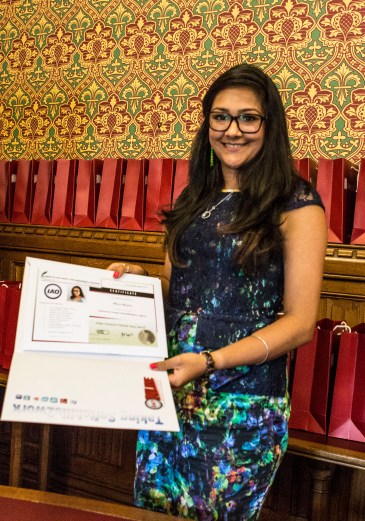
On September 21st 2012, AVPT’s first intake of students received their awards at the House of Lords with certificated globally accredited by the International Accreditation Organisation (IAO). Lord Ahmed congratulated the students and recognised that e-learning has a place in helping all types of people continue in life-long blended learning.

Students receiving their certificates Baroness Uddin and Lord Ahmed

As the m-learning hub continues to grow, AVPT is now working with apprenticeship schemes to provide apprentices with the key skills they require. With this new initiative and the Scholarship Den’s launch, looking forward it is set to be a very busy and successful year!

To find out more information about the Academy of Vocational and Professional Training please visit http://www.avptglobal.com or call 0203 551 2621.

Watch our Videos

Students receiving their certificates Baroness Uddin and Lord Ahmed Introduction to a new kind of Learning
Cutting the red tape to students scholarship

£8000 worth of Scholarship to be given to four students in 45minutes.

Image

Maya receiving her certificate at the house of Lords

E-Learning hub, the Academy of Vocational and Professional Training, targets scholars by launching a ‘Dragon’s Den’ style initiative

Launching Friday 12th October 2012 on stand 315 at the Youth Enterprise Live Initiative at Earls Court Exhibition Centre, young people will be encouraged to pitch the reasons they deserve a scholarship to a group of experts, Dragon’s Den style! Potential scholars will be battling it out for the chance to acquire a scholarship worth over £2,000 from The Academy of Vocational and Professional Training (AVPT). Four of the candidates will be chosen on the day, to mark the launch of the Scholarship Den with Channel 4 recording the day’s events.

AVPT supports young adults by offering them affordable and quick globally accredited soft skills qualifications. Diane Shawe, Founder and CEO says: “Our courses range from £250 to £4,500, which can be done either online or at one of our fast track training workshops. However, we respect that some students aren’t in the financial position to pay this money, and that’s why we have created the Scholarship Den.”

AVPT has found that many graduates are struggling to take their first, all important, steps on the career ladder as potential employers worry that graduates do not have enough experience. Tim Dingle, Chief Development Officer, explains how AVPT can help graduates overcome this issue, “Many students and young people are stuck in a catch 22. Employers aren’t willing to take the risk on inexperienced individuals and graduates aren’t able to gain experience. AVPT specialise in courses that are prepared at NVQ level 4. The courses are packaged in a chunk-able format so that blended learning can take place whilst the student is on the move and help young people into work quickly.”

APVT Global launches Scholarship Den

The ‘Chunk-able format’ in which the courses are designed in, allows students to work on the move using their tablet, smartphone or notebook, rather than committing to a 2000-word essay and most courses can even be completed in just one month!

On September 21st 2012, AVPT’s first intake of students received their awards at the House of Lords with certificated globally accredited by the International Accreditation Organisation (IAO). Lord Ahmed congratulated the students and recognised that e-learning has a place in helping all types of people continue in life-long blended learning.

As the m-learning hub continues to grow, AVPT is now working with apprenticeship schemes to provide apprentices with the key skills they require. With this new initiative and the Scholarship Den’s launch, looking forward it is set to be a very busy and successful year!

To find out more information about the Academy of Vocational and Professional Training please visit http://www.avptglobal.com or call 0203 551 2621.

The ‘Multi-Generational’ workforce and m-learning

article by Diane Shawe BBA., M.Ed IEEE  CEO Academy of Vocational and Professional Training Ltd

Social Media, New media and e-Networking, whatever we want to call it,  has certainly changed more than the way we work, the way we share and consume knowledge and even complain. The context in which we work is faster and faster, and result can almost happen in real time around the world.

Well they have come up with yet another gadgetry word, wait for it…  The workforce of the 21st century is now being referred to as the  ‘Multi-Generational Workforce’ because it consist of a mixture of baby boomer’s and generation Y.

Generation Y differs from the baby boomer’s because they were brought up in the digital era. They are familiar with the internet and social media and easily post a question into their on-line network and receive all types of answers in seconds!

With this in mind, we see a lot of the old ‘Tanker’ type organisations refusing to initiate, release, set free the use of this new powerful media throughout there organisation because of speculative fear mongering proposed by their IT departments!  I guess these guys need to safeguard their jobs!  I know the truth hurts.  They say a tanker takes a much longer time to turn than a speed boat.  Look at the graveyard of large tanker companies who just did not heed the writing on the wall.

This unstoppable social media era has taken a few large employees by surprise because smaller leaner business have taken the reins by freeing and empowering all their staff to become ambassador’s for their company  enabling not one but many to respond to change and  guarantee online responsive service and  quality to the every fast moving consumer who can complain in nano seconds around the world!

The investment of continuous education (lifelong learning) of any work force is imperative. With more and more titanic type organisations downsizing, multi skilling the remaining staff efficiently is a no brainer!

Research of Harvard shows that in 1986 when the first baby boomer’s started to work they had to rely for 75% on their own knowledge. The other 25% came from sources such as manuals. In 2009 people were relying on only 10% on their own knowledge and on 90% on information from third party sources such as social networks. New media did not merely change the way we work but primarily the way we share knowledge and learn. Therefore, companies need to make sure their workforce knows how to navigate the vast online environment.

In this sense, m-Learning is more than just a cost saving method but a strategic tool to avoid damaging the company’s reputation and to project a positive brand image.

Social Media and employees
One single negative post or tweet of an employee can have a devastating effect on the image of an organisation. For this reason, many organisations have implemented policies which offer support and guidance on the usage of social media. This empowers employees to use social media when necessary while still avoiding the pitfalls that can generate negative PR fallouts. But merely setting up these policies will cut short of these goals. That is why, increasingly, organizations use m-learning to communicate these guidelines and rules in an interesting and interactive manner. There is another major advantage to use m-Learning versus traditional training methods: the costs. Academy of vocational and Professional Training can assist any company deliver to their entire workforce  courses that are significant in  a scalable way. m-learning provides a solution which can be accessed from the desktop, iPad, Tablet, notebook or smartphone at any time and be kept up to date in real time with changes.

mobile-learning
m-Learning is increasingly used for specific training purposes, such as communicating the social media guidelines, but it can also play a major role in the broader development and training of personnel. One of the key characteristics of well-designed m-learning solutions, is that they create a space where workers can be active and inquisitive in their learning.

What’s next?
On the modern work floor we encounter a mix of various generation groups. In the year 2012 knowledge is not the ultimate goal, because knowledge is just a few mouse clicks away. It is about how one is able to apply this knowledge and provide an added value. There are several ways to make learning more interesting for both young and mature workers. Simulations, e-coaching and online peer-to-peer learning can help bring together the generation gap. Below we provide some ideas on how we can help to accelerate learning within the organisation:

1. Keep it simple.
By adding a variety of  layers, a blended learning approach meets the various learning styles with tool that are relevant and challenging for each employee. Keeping it light by a combining video, images and text without eating too much data.  Encourage employees to share experiences and let them contribute to the improvement of m-learning, so that they experience blending learning as one coherent experience.

2. Work with real-life cases
Real-life cases are recognisable and will therefore be motivating. Employees should be encouraged to collaborate and share knowledge and ideas. This can be reached by integrating a familiar environment. Many employees love to learn if this will assist them to execute their daily work.

3. Mirror reality
Learning is most effective when simulations are as closely related to reality as possible. We know that Facebook, Twitter or LinkedIn are the new game shifters in online communications and could be used most effectively in a controlled environement. Competitions or games could help challenge and stimulated the employee to make certain choices or come up with ideas. Be recognised and awarded. These are the most concrete experiences one can gain.

4. Make progress visible
People must be motivated to continue to learn. It is important that one can measure their progress in adopting new ideas, knowledge and behavioural changes. By acknowledging progress, the incentive to continue grows. By creating a competition element, one adds value. The employee can measure the success of the decisions made when they lead to a comparable and competitive result.

In many organisations, there is much to improve in terms of development and training. Sometimes employers forget that the whole organisation could suffer from economic and emotional depression, especially whey no energy is put into real motivation or stimulation.

While everyone knows that knowledge, development and involvement can make all the difference for a company to increase performance. Introducing an m-learning tool to reflect and inspire a higher order of thinking skills which incorporate communications, could reinforce each and every member of staff throughout an organisation.  After all it is not the size of the dog, but the fight in the dog that will set the new trendsetters apart. So  Let’s get to work! Let’s help your organisation stimulate on a scalable and cost effect way with our no nonsense approach to m-learning, courses and certificates that count globally.

For more information about our services visit www.academy-of-vocational-and-professional-training.com or call us on 0203 551 2621 to discuss our bespoke or white labelling services.