
Tag Archives: blended learning

Glossophobia: The number one fear in the UK!

fear of public speaking course

Speaking presentation survival school course

Got to make a presentation? Make a wedding speech? Say something at an event? Nervous? How AVPT Global can help you right now with the fear of public speaking.

Tim T Dingle BSc (Hons) MIBiol PGCE MBA

Chief Development Officer, Academy of Vocational and Professional Training

Having trained hundreds of people in brilliant public speaking (and many more to be Standup comics) I am often asked about the causes of Glossophobia. This is a type of speech anxiety and is most commonly the fear of public speaking or of speaking in general. An estimated 75% of all people experience some degree of anxiety and nervousness when public speaking. I am lucky and don’t suffer- whatever size the audience. The good news is it can be cured and overcome.

The more specific symptoms of speech anxiety can be grouped into three categories: verbal, physical and non-verbal. The verbal symptoms include, but are not limited to a tense voice, a quivering voice, and vocalised pauses, which tend to comfort anxious speakers.

The symptoms I see the most in training are the physical ones. These result from the sympathetic part of the autonomic nervous system responding to the situation with a fight-or-flight adrenalin reaction. Since the sympathetic system is all-or-nothing, adrenaline secretion produces a wide array of symptoms at once – all of which are supposed to enhance a student’s ability to fight or escape a dangerous scenario. These symptoms include acute hearing, increased heart rate, increased blood pressure, dilated pupils, increased perspiration, increased oxygen intake, stiffening of upper back muscles and the classic dry mouth. None of which are much good when you are about to give a wedding speech. The good news is they can be relieved with training and some skilled guidance.

learning to speak under pressure

Looking good when speaking under pressure

Public speaking experts agree that one of the most important steps in preparing for a speech is practice. Yet after giving the same speech so many times, it can be difficult to maintain an authentic voice, especially once nerves kick in. More than anything, a successful speech hinges on your ability to know your audience and establish a connection. Shape your speech around a subject that you genuinely care about and try to focus on what you have to offer your audience.

Your concentration will naturally shift away from what is at stake for you personally, calming your nerves and allowing you to connect to your audience in a real way. Then, tell a story. Take the audience on a journey. While there are many aspects that will contribute to the success of your speech, it is the authentic, heartfelt moments that will be remembered most.

The importance of learning to speak in front of an audience is undeniable; invariably intertwined with leadership, motivation, and change. While Glossophobia is common, in fact the most common phobia in the UK, it is certainly a fear that can be overcome. But the power of spoken word is reason in itself to push past that fear.

So remember that nerves are natural: use your nerves to propel you through the speech, and know that your physical response to stress will only make the speech all that much more rewarding once you finally step down from that stage. Remember to be authentic: pick a topic that you truly care about, and the audience will be stirred to care as well. And finally, don’t be afraid to aim big. You were chosen to speak for a reason, and you have a meaningful story to tell. So take slow, rhythmic breaths and change the world- and take this course in conquering your fear of public speaking!
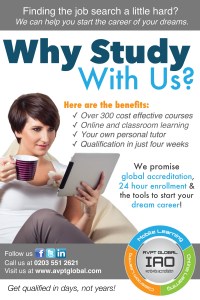
Why Study With Us Unemployed Poster

Manisha Gaur discusses why Global Accreditation is leading the way to unified integrated accreditation

The rise of International Accreditation

News Title

by AVPT Global

For decades, regional accreditation bodies had been granting educational institutes with primary accreditation after evaluating them on a regional scale. However, as globalization grew, it became extremely important for educational institutes to be acknowledged world over so that when students look for credit transfer and international job opportunities, it does not stand in the way.  This gave rise to International Accreditation. This topic was represented by Ms. Manisha Gaur, Director Operations at Venkateshwara Group of Institutions, India.

She discussed how globalization has affected today’s education systems and the education providers are looking forward to establishing a centralized education system.

The phenomenon is occurring, but at a very slower pace and this is where the accreditation agencies have to play their role. They need to set up a unified and integrated accreditation system for all the educational institutions globally so the standardisation of education can be done successfully.

A smarter way to study with www.avptglobal.com

A smarter way to study with http://www.avptglobal.com

Regional accreditation bodies have existed and also evaluated education providers on a regional scale, thereby granting them Primary accreditation.  However, the rapid growth of globalization calls for a global entity which can evaluate them against internationally proven standards of education and grant them an internationally recognized Secondary Accreditation.

This secondary accreditation is basically known as International Accreditation. With international accreditation, the school, college or university will be internationally accepted. Students of such educational institutes can further study in the educational institute of their choice in any country without the tension of their credits transfer and also, work with any employer without the tension of their degree acceptance.  For these reasons, it has also become a major deciding factor by students when selecting their higher educational institutes/ universities. Additionally, it has also become important to employers. Employers globally feel more comfortable hiring students from internationally accredited institutes.
Based on this information, she presented why international accreditation is needed globally and how, in the last couple of years, it has gained massive importance, even more than national and regional accreditation bodies. Her topic also informed the participants as to how International accreditation bodies evaluate the institute on the basis of their academic and organisational management and provide them with international accreditation. This international accreditation not only enhances the institute’s profile regionally but also internationally which is why, today, we see a majority of the students and institutes around the world demanding international accredited programs.
About the Speaker

Manisha Gaur is a highly respected member of the Indian education community. She is not only involved in the teaching of the students but she takes it as a responsibility where she wants to develop students into becoming pillars of the society. She has been associated with the Indian Education Board and the National Accreditation body where she has conducted various presentations and has published various researches. She has also received numerous awards from the regional and international community for her services.
AVPTGLOBAL almost 400 courses all globally accredited

AVPTGLOBAL almost 400 courses all globally accredited

Turning 50 isn’t the end of a business career – new wave of olderpreneurs

Get qualified in days not years

Get qualified in days not years

article by Diane Shawe M.Ed

Turning 50 isn’t the end of a business career – it’s the beginning. And an ever-growing wave of ‘olderpreneurs’, starting a business have 70% chance of surviving their first five years compared with only a 28% survival rate for those younger than them.

Nearly half the self-employment population is over 50, and one in six new businesses started in the UK are set up by post-half-centurions.

So what’s fuelling the entrepreneurial impetus of the ‘silver startup’, and why are they doing so well?

Necessity

The over-50s age group has been particularly hard-hit by the recession. Last year, the Office of National Statistics (ONS) revealed 28% of those aged between 50 and state pension age were out of work – compared with only 20% of those aged under 50.

Why? One of the biggest factors is the rife ageism that permeates practically every industry in the UK, that anyone over 50 who’s been forced to look for employment will testify to with a weary nod. The ONS estimates those who lose their job aged 50 or over have only a 10% chance of being re-employed.

Deciding to use their money from redundancies to fund ta company, over the course of two years the payout had trickled in its entirety into the business. But it was worth the investment – and they often don’t have to rely on the ineffective banks at the moment.

Become a Virtual Teacher Facilitator

Become a Virtual Teacher Facilitator

New challenge

At a fundamental level, sometimes people just want to do something different in their later years.

It’s interesting that recent YouGov and Standard Life research found the average age at which people feel totally confident in their working skills is 37, while the more elusive sense of fulfilment peaks at 50. Perhaps this climax of achievement and sense of ability leads to a need for a new direction, a new challenge, once a person passes the half-century mark.

If  we take a look at the Government statistics below it will give us an overview  Source Office of National Statistics

Summary of labour market statistics published on 23 January 2013

Between June to August 2012 and September to November 2012:

  • the number of people in full-time employment increased by 113,000,
  • the number of people in part-time employment fell by 23,000,
  • the number of unemployed people fell by 37,000, and
  • the number of economically inactive people, aged from 16 to 64, fell by 13,000.

Between September to November 2007 and September to November 2012:

  • the number of people in full-time employment fell by 341,000,
  • the number of people in part-time employment increased by 660,000,
  • the number of unemployed people increased by 854,000, and
  • the number of economically inactive people, aged from 16 to 64, fell by 75,000.

Chart 1: Changes in number of people in the labour market between September to November 2007 and September to November 2012, seasonally adjusted

Changes over 5 years

Source: Labour Force Survey – Office for National Statistics

The employment rate for those aged from 16 to 64 for September to November 2012 was 71.4%. This was up 0.1 percentage point on June to August 2012 and up 1.1 on a year earlier, but it was lower than the pre-recession peak of 73.0% recorded for March to May 2008. The number of people in full-time employment aged 16 and over increased by 113,000 between June to August and September to November 2012 to reach 21.57 million but the number of people in part-time employment fell by 23,000 to reach 8.11 million. Compared with a year earlier:

  • the number of men in full-time employment increased by 237,000,
  • the number of men in part-time employment increased by 95,000,
  • the number of women in full-time employment increased by 77,000,
  • the number of women in part-time employment increased by 144,000, and
  • the total number of people in employment increased by 552,000, the largest annual increase since 1989.

Chart 2: Changes in number of people in employment between September to November 2011 and September to November 2012, seasonally adjusted

Annual employment changes

Source: Labour Force Survey – Office for National Statistics

The unemployment rate for September to November 2012 was 7.7% of the economically active population, down 0.1 on June to August 2012 and down 0.7 on a year earlier. The number of unemployed men aged 16 and over fell by 37,000 between June to August and September to November 2012 to reach 1.41 million, but the number of unemployed women was unchanged at 1.08 million. The number of women unemployed for up to six months increased by 26,000 to reach 571,000. This may reflect changes to the benefits system resulting in more single mothers starting to look for work (see Claimant Count section of this Bulletin for further details).

The economic inactivity rate for those aged from 16 to 64 for September to November 2012 was 22.5%, unchanged on June to August 2012 but down 0.7 on a year earlier. The number of economically inactive people aged from 16 to 64 fell by 13,000 between June to August and September to November 2012 to reach 9.03 million.

The number of people claiming Jobseeker’s Allowance fell by 12,100 between November and December 2012 to reach 1.56 million.

Between July to September 2012 and October to December 2012, the number of vacancies increased by 10,000 to reach 494,000. This is the highest number of vacancies since October to December 2008, but it is 200,000 lower than the pre-recession peak of 694,000 recorded for January to March 2008.

Between September to November 2011 and September to November 2012, total pay for employees in Great Britain rose by 1.5%. This annual growth rate for earnings was lower than the increase of 2.7% in the Consumer Prices Index between November 2011 and November 2012.
Source Office of National Statistics

Academy of Vocational and Professional Training presents its students certificates at the House of Lords

Rachel Fanshawe receives her certificate from Baroness Uddin

The Academy of Vocational & Professional Training held it’s first graduation ceremony on Friday 21st September in the Grand Committee room at the House of Lords.  The first intake of 38 was presented their certificates by Baroness Uddin of which six students from Oman was awarded certificates in Leadership Skills, Crisis Management and effective feedback.

All the courses supplied by AVPT are globally accredited by the International Accreditation Organisation (IAO) who granted AVPT full accreditation in June 2012.  Diane Shawe the CEO was delighted and wanted to mark this very special occassion for the first lot of students to benefit from this global accreditation.

Afterwards, Lord Ahmed (founder of the

Lord Ahmed & Diane Shawe CEO

Entrepreneurship Committee in the House of Lords) offered up congratulations and was delighted that technology could inspire and be a constructive vehicle to help vocational training through m-learning.

Diane Shawe founder & Chief Executive Officer launched this global service which offers more than 240 outstanding interactive on-line and express classroom courses, covering a wide variety of subjects. The courses are flexible, scalable and student centered. Diane and her team are committed to supporting the global lifelong learning experience.

The Academy of Vocational and Professional Training is a globally accredited organisation whose courses and certificates are recognised around the world. Tim Dingle Chief Development Office states “In these times of economic and educational uncertainty it makes sense to gain qualifications that can improve life chances, and we believe that our online blended learning methodology uses fully trained virtual tutors will aid super-learning through our latest e-learning management strategies”.

AVPT’s courses work for anyone who wishes to learn rapidly, whether unemployed, redundant, disabled, retired, graduate, single mothers, ex-forces, lawyers or those simply wishing to up-skill or become one of the growing number of online Virtual Tutor Facilitator.

Academy of Vocational & Professional training will be exhibiting at stand 315. They are the key sponsors for the education section and will be delivering 8 seminar and workshops at the Youth Enterprise live on the 12th & 13th October 2012.  Tickets are available online free of charge.

www.expresstrainingcourses.com

Is the Accrediting Industry ready for the rise and challenge of the e-learning education?

Individual online learning courses and even entire online degree programs are increasingly a part of the mainstream in higher education.

Article by Diane Shawe M.Ed.  IEBE

Steadily-improving online delivery systems and an emphasis on globalisation have encouraged more and more higher education institutions to try to reach diverse learners around the world.  In light of the growing population of learners from various cultural backgrounds engaged in online education, there is an urgent need to understand how accreditation of an online e-learning provider can reach across all cultural dimensions.

Distance Education has been around for more than a decade now. The ever changing landscape of education through technological innovations has allowed distance education in necessitating strict quality control measures to comply with. Thus, accreditation plays a primary role in ensuring quality in Distance Education system. Accreditation is a process through which institutions offering higher education are analysed by internal and external peer review.

Distance education is not a new phenomenon, and accreditors have been reviewing online courses for a long time now. Accreditation for these distance learning programs involve regional, national, and specialised bodies along with the governmental and public organisations that rely heavily on review of quality of these providers.

One such value has been to illustrate the necessity of accrediting distance education with respect to the rise in public and private education providers. Distance learning poses great challenges to the arena of accreditation mainly by transforming the traditional faculty into online faculty and diminishing the value of physical one on one interaction with students.

Distance learning represents a challenge to the accreditation agencies by modifying the meaning of “higher education institutions” by removing the brick and mortar lecture halls with web based chat rooms, and brick and mortar campuses institutes to a website. An academic provider is no longer restricted to the existence of a physical infrastructure, it can be found anywhere, anytime – all one needs is a computer or smartphone and access to internet.

Distance Education challenges the accreditation system by modifying the face of what we know as a college or a university degree. Electronic access not only encourages but also supports a more mobile form of a student behaviour through which students are enrolled in more than one institution at a time. The National Vocational Qualifications has taken a newer meaning and involves a richer blended learning of educational courses being taken by a student and delivered through multiple technological mediums.

What is Blended Learning?

Blended learning approach training is one that combines face-to-face instruction with online instruction and activities. A wide variety of methods can be used to interact with a blended learning course; technology such as mobile devices, computers, video conferencing, and other electronic media to name a few. The goal of blended learning is to provide a useful, practical way for learners and instructors to get and provide material in more ways than simple face-to-face interaction.

The online component of blended learning allows instructors and students to stay connected. Interact anytime, anywhere Distance Education and the ever changing role of education providers in this era are obviating the need for:

  • Recognizing the characteristics of distance education provision be it a traditional classroom or online chat room;
  • Altering guidelines for accreditation, strategies or principles to ensure quality within the distinguished model of distance education delivery; and
  • Paying extensive consideration to the achievement of the students and outcomes in the electronic environment of distance education whereby structured classroom facilities are not available.

As Academy of Vocational and Professional Training roles out its interactive soft skill online e-learning express courses selecting a scalable global accreditation company has become increasingly important.

//