Category Archives: online teaching

Turning 50 isn’t the end of a business career – new wave of olderpreneurs

Get qualified in days not years

Get qualified in days not years

article by Diane Shawe M.Ed

Turning 50 isn’t the end of a business career – it’s the beginning. And an ever-growing wave of ‘olderpreneurs’, starting a business have 70% chance of surviving their first five years compared with only a 28% survival rate for those younger than them.

Nearly half the self-employment population is over 50, and one in six new businesses started in the UK are set up by post-half-centurions.

So what’s fuelling the entrepreneurial impetus of the ‘silver startup’, and why are they doing so well?

Necessity

The over-50s age group has been particularly hard-hit by the recession. Last year, the Office of National Statistics (ONS) revealed 28% of those aged between 50 and state pension age were out of work – compared with only 20% of those aged under 50.

Why? One of the biggest factors is the rife ageism that permeates practically every industry in the UK, that anyone over 50 who’s been forced to look for employment will testify to with a weary nod. The ONS estimates those who lose their job aged 50 or over have only a 10% chance of being re-employed.

Deciding to use their money from redundancies to fund ta company, over the course of two years the payout had trickled in its entirety into the business. But it was worth the investment – and they often don’t have to rely on the ineffective banks at the moment.

Become a Virtual Teacher Facilitator

Become a Virtual Teacher Facilitator

New challenge

At a fundamental level, sometimes people just want to do something different in their later years.

It’s interesting that recent YouGov and Standard Life research found the average age at which people feel totally confident in their working skills is 37, while the more elusive sense of fulfilment peaks at 50. Perhaps this climax of achievement and sense of ability leads to a need for a new direction, a new challenge, once a person passes the half-century mark.

If  we take a look at the Government statistics below it will give us an overview  Source Office of National Statistics

Summary of labour market statistics published on 23 January 2013

Between June to August 2012 and September to November 2012:

  • the number of people in full-time employment increased by 113,000,
  • the number of people in part-time employment fell by 23,000,
  • the number of unemployed people fell by 37,000, and
  • the number of economically inactive people, aged from 16 to 64, fell by 13,000.

Between September to November 2007 and September to November 2012:

  • the number of people in full-time employment fell by 341,000,
  • the number of people in part-time employment increased by 660,000,
  • the number of unemployed people increased by 854,000, and
  • the number of economically inactive people, aged from 16 to 64, fell by 75,000.

Chart 1: Changes in number of people in the labour market between September to November 2007 and September to November 2012, seasonally adjusted

Changes over 5 years

Source: Labour Force Survey – Office for National Statistics

The employment rate for those aged from 16 to 64 for September to November 2012 was 71.4%. This was up 0.1 percentage point on June to August 2012 and up 1.1 on a year earlier, but it was lower than the pre-recession peak of 73.0% recorded for March to May 2008. The number of people in full-time employment aged 16 and over increased by 113,000 between June to August and September to November 2012 to reach 21.57 million but the number of people in part-time employment fell by 23,000 to reach 8.11 million. Compared with a year earlier:

  • the number of men in full-time employment increased by 237,000,
  • the number of men in part-time employment increased by 95,000,
  • the number of women in full-time employment increased by 77,000,
  • the number of women in part-time employment increased by 144,000, and
  • the total number of people in employment increased by 552,000, the largest annual increase since 1989.

Chart 2: Changes in number of people in employment between September to November 2011 and September to November 2012, seasonally adjusted

Annual employment changes

Source: Labour Force Survey – Office for National Statistics

The unemployment rate for September to November 2012 was 7.7% of the economically active population, down 0.1 on June to August 2012 and down 0.7 on a year earlier. The number of unemployed men aged 16 and over fell by 37,000 between June to August and September to November 2012 to reach 1.41 million, but the number of unemployed women was unchanged at 1.08 million. The number of women unemployed for up to six months increased by 26,000 to reach 571,000. This may reflect changes to the benefits system resulting in more single mothers starting to look for work (see Claimant Count section of this Bulletin for further details).

The economic inactivity rate for those aged from 16 to 64 for September to November 2012 was 22.5%, unchanged on June to August 2012 but down 0.7 on a year earlier. The number of economically inactive people aged from 16 to 64 fell by 13,000 between June to August and September to November 2012 to reach 9.03 million.

The number of people claiming Jobseeker’s Allowance fell by 12,100 between November and December 2012 to reach 1.56 million.

Between July to September 2012 and October to December 2012, the number of vacancies increased by 10,000 to reach 494,000. This is the highest number of vacancies since October to December 2008, but it is 200,000 lower than the pre-recession peak of 694,000 recorded for January to March 2008.

Between September to November 2011 and September to November 2012, total pay for employees in Great Britain rose by 1.5%. This annual growth rate for earnings was lower than the increase of 2.7% in the Consumer Prices Index between November 2011 and November 2012.
Source Office of National Statistics

Breaking News….. Standby for the roll out of Master Practitioner VTF

master vtf by AVPT Global

AVPT Global about to launch Master VTF practitioner Course

The ultimate course that over an intense and amazing week will develop all the skills necessary to work around the world training new Virtual Tutor Facilitator in their new career. Course topics include: Advanced Facilitation, Body Language, Teaching & Learning Skills, Mediation, Communication, Presentation Excellence and Assessment and online LMS systems.

It is brand new and uses all the latest techniques, theory and experience to deliver simply the best training course (train the trainer) out there. Graduates will get to spend a full day shadowing the professionals and learning the insight track for delivering excellence in learning.

The course will allow the trainers to deliver the workshops anywhere in the world having gained their IAO  global accredited certificate. The demand for such a course has been intense and we are delight to be taking enquiries and reservations for the first course dates. Become the best in the field, be the person you want to be and never except anything less than excellence.

To receive the latest updates for the launch of the  Master Practitioner VTF Course click here

2012 in review

The WordPress.com stats helper monkeys prepared a 2012 annual report for this blog.

Here’s an excerpt:

The new Boeing 787 Dreamliner can carry about 250 passengers. This blog was viewed about 980 times in 2012. If it were a Dreamliner, it would take about 4 trips to carry that many people.

Click here to see the complete report.

Image

Merry Christmas from AVPT Global

happy christmas from Diane Shawe

Why Stress can stop you from achieving excellence in 2013

managing your stress

managing your stress

Article by Diane Shawe M.Ed.

Take 5 minutes a day to keep your stress level down

Everything seems much faster, urgent and possibly unfulfilling! Just after Christmas and heading into the New Year it can often be a stressful time for lots of people for lots of reasons.

Stress is created by worrying about things in the future or things that have already happened, both of which you cannot change at the very moment you are worrying about it.

Before you read any further do this little test.  ‘At this very very moment whist you are reading this is there a problem affecting you reading this article at this moment in time that is stopping you from reading it? If your answer is ‘no’ then this is because you are living in the ‘NOW’

Living too much into the future or reliving the past are both causes of fear and pain. You would probably find yourself concerned with some of the following thoughts…

  • How can I stop the pain?
  • How can I switch your mind off,
  • How can I stop worrying?
  • How can I relax?
  • How can I be happy?

Well I invite you to explore two words ‘acceptance’ and ‘surrender’ a good place to start.

Become fully present is very empowering and helps you live in the higher order of thinking.

If only our lives was like typing when we can simply undo, delete or Hyperlink to a quick useful reference but alas, lots of things are unavoidable in life.  Never before has it become more important to find ways to decrease and prevent stressful incidents and decrease negative reactions to stress, especially as they can lead to short or long term illnesses.

Here are some of the things that can be done instantly by just remembering to be conscious of them.

Managing time

Time management skills can allow you more time with your family and friends and possibly increase your performance and productivity. This will help reduce your stress.

To improve your stress management:

  • Save time by focusing and concentrating, delegating, and scheduling time for yourself.
  • Keep a record of how you spend your time, including work, family, and leisure time.
  • Prioritise your time by rating tasks by importance and urgency.
  • Redirect your time to those activities that are important and meaningful to you.
  • Manage your commitments by not over- or under committing. Don’t commit to what is not important to you.
  • Deal with procrastination by using a day planner, breaking large projects into smaller ones, and setting short-term deadlines.
  • Examine your beliefs to reduce conflict between what you believe and what your life is like.
  • Build healthy coping strategies

It is important that you identify your coping strategies. One way to do this is by recording the stressful event, your reaction, and how you cope in a stress journal. With this information, you can work to change unhealthy coping strategies into healthy ones-those that help you focus on the positive and what you can change or control in your life.

Lifestyle

Some behaviors and lifestyle choices affect your stress level. They may not cause stress directly, but they can interfere with the ways your body seeks relief from stress. Try to:

  • Balance personal, work, and family needs and obligations.
  • Have a sense of purpose in life.
  • Get enough sleep, since your body recovers from the stresses of the day while you are sleeping.
  • Eat a balanced diet for a nutritional defense against stress.
  • Get moderate exercise throughout the week.
  • Limit your consumption of alcohol.
  • Don’t smoke.

Social support

Social support is a major factor in how we experience stress. Social support is the positive support you receive from family, friends, and the community. It is the knowledge that you are cared for, loved, esteemed, and valued. More and more research indicates a strong relationship between social support and better mental and physical health.

Changing your thinking pattern

When an event triggers negative thoughts, you may experience fear, insecurity, anxiety, depression, rage, guilt, and a sense of worthlessness or powerlessness. These emotions trigger the body’s stress, just as an actual threat does. Dealing with your negative thoughts and how you see things can help reduce stress.

  • Thought-catching helps you stop a negative thought to help eliminate stress.
  • Disproving irrational thoughts helps you to avoid exaggerating the negative thought, anticipating the worst, and interpreting an event incorrectly.
  • Problem solving helps you identify all aspects of a stressful event and find ways to deal with it.
  • Changing your communication style helps you communicate in a way that makes your views known without making others feel put down, hostile, or intimidated. This reduces the stress that comes from poor communication. Use the assertiveness ladder to improve your communication style.

Why Continued Personal Development is important

Lifelong learning it’s important to your continued growth and smiley to core with lives every changing environment, circumstances and economical. Everyday life can often present challenges and like any thing in life if you don’t equip yourself with the right tools trying to fix the problem with the wrong tools can itself be the greater source of frustration.

www.expressingtrainingcourses.com

Four Pillars that underpin buyers requirements for eLearning

Get qualified in days not years

article by Diane Shawe M.Ed

Whilst I am in the industry and excited by the latest trends in e-learning  through blended Learning Management Systems (LMS)  learning being hugely of interest at present, I believe that the four  pillars that go to underpin the buyers requirements and therefore still define the industry offerings are centered around the following:

• Compliance and accreditation
• Scalable and flexible whilst achieving a real reduction in Cost
• Improving , track and measuring Learners performance
• Real time management, alignment and communication to support ongoing changes.

The ability to track and report learner performance remains upper most in many procurers mind.

It will become increasingly important to have specified learning strategy which can deliver effectively against all of these requirements, and getting the “e-learning mix” of technologies obviously including content, collaboration and communication environments (social learning) and control mechanisms will be the key to further industry growth.

Under-pining these trends we are seeing growing interest in how e-learning can address softer skills and this is why we have concentrated our LMS content to this area of learning.

Some vendors are following the vertical market and configuring the offer to meet specific needs, others are differentiating by adding social media and social learning functionalists, and others such as us are aligning the LMS to the latest technologies being colonised by the e-learning industry – mobile/smart devices and video driven content. The trend from the USA is strongly toward talent management and we are often lagging behind.

The smart vendors in my view are aligning and integrating with other solutions: HR, ERP, CRM etc…. Content or Content, which to choose…..?

These developments can only be positive for the industry, as the demand for quality and quantative content will grow and grow.

My one but final view is that we will progress from blending to mixing the content provision as this will be the key challenge to the e-learning industry. The importance of content won’t go away, its just changing faster becoming more “Re-purposable” , “Flexible”, “Interoperable”, and “Accessible” learning content!

Now get this, I am so loving the fact that on its way to us is 3 Dimensional technologies, simulation, holographic all of which will increase the demand for new genres of learning content into a learning reality!

http://www.expresstrainingcourses.co.uk

E-learning growth ‘set to rise to £19 billion by 2015

Get qualified whilst on the move with AVPT

article by Diane Shawe M.Ed.

Academy of Vocational and Professional Training (AVPT) finds that the market for e-learning just keeps growing and growing, according to various research and sales figure surveys

A survey by Ambient Insight Research has showed that the worldwide market for e-learning products was $32.1 billion (£20.5 billion) in 2010 and is expected to rise to $49.9 billion by 2015.

Products and methods of online learning that were deemed the most successful in sales rates included “how to” videos, step-by-step interactive guides and course notes which have multi-media inserts and annotations which directed learners to other resources.

Writer for Gadget magazine, Andre Joubert of MWEB Business said that he thinks the availability of media-rich, interactive e-learning content on the internet – and the advent of uncapped, business-strength broadband connectivity is changing the face of e-learning. He based his analysis on South Africa, but his principles apply worldwide as global sales figures show.

We noted from our research that Mr Joubert said: “E-learning has long been recognised as offering considerable advantages over conventional classroom-based training when it comes to training employees and management quickly, efficiently and conveniently.

So what about the Virtual Classroom?

We see 2012/13 as being the breakthrough year for virtual classrooms, as organisations move on from webinars (which are increasingly commonplace) to more interactive environments offered by virtual classrooms.

I am certainly excited by our  online courses which are recognised and accredited in over 200 subject matters.  As  result of this growing trend AVPT has launched the first globally accredited Virtual Tutor Facilitator course. To train

A New Career Opportunity as a VTF

professionals in becoming a qualified online Tutor who want flexibility and positive earning potential to assist individuals gain a professional recognised certificate  using a mobile learning Management solutions through facilitating their online learning.

Training through online learning is now widely available on the internet and can be beneficial to anything from flower arranging, PowerPoint presentations through to health and safety.

Soft skills is now becoming the new hard skills and offering mobile training and  advice  through e-learning are valuable to many people and a range of businesses globally.

Tim Dingle AVPT Chief Development Officer cited many benefits of the virtual classroom, such as convenience, relevance, immediacy, affordability and ease of use. He added that beginning the learning experience can be as easy as starting up an internet browser.

According to research by Key Note from last year, instructor-led training represents the largest sector of the market, although e-learning teaching – which includes blended learning – showed the highest growth over the review period between 2005 and 2009.

Mobile Learning forging forward.

A 2009 research report summarised that they thought mobile learning could be a “maybe just maybe”, In 2010  a definite trend was being recorded and in 2011 they saw mobile learning as a major driver for the growth of the e-learning market.

The driver is not one of simple learning enhancement and support but driven by a requirement for portability and availability made possible by smart phones and tablet devices, the learning “additionality”. The PC might still remain key to many learners for some years to come but I believe that the call for mobility, flexibility and the trends to workforce mobility will win the day.

We are particularly taken with the concept of second screen learning, in that learners will use mobile devices i-pads, smart phones etc… in conjunction with other forms media such as skype, bluetooth and appliances imbedded in a variety of devices such as the TV, car or even on your fridge.

I do not see mobile learning as a straight replacement to existing genres, and accordingly iIdo not advise organisations to rush headlong into mobile learning solutions because they can be an expensive option if not properly planned out.

Mobile learning in appropriate additional ways  can be used to enhance the learning mix. One principle game changer is our ability to upload current or new courses into our LMS, cutting down on project development planning time and costs and enabling a blended Learning proposition to commence not only laterally but securely, scalable and in real time.

For instance the unemployed, people of disability, prison population, senior citizens and excluded children from the educational system could all benefit in real time whilst keeping the overall unit costs down by scaling and up-skilling with an emphasis on inclusion and virtual support.

Content can now increasingly be authored or in many cases converted to become fit for all purpose all range device delivery and in real time.

HTML5 coupled with Cloud based services will further embed e-learning into the all- pervasive always on internet. Indeed the terminology of mobile learning/ e-learning will lose differentiation, as will the nature of the device that the learning is undertaken upon.

Technology coupled with the growing importance of social media learning will lead to greater learner acceptance. I for one have seen a pattern stemming from the services we are offering to date and look forward to 2013 as we believe it is going to be a bumper year for mobile learning.

Visit us on http://www.expresstrainingcourses.com or call us if you would like more information on 0203 551 2621.

Join us now with over 200 courses

Mobile Learning is the HOT’s

Helping a Higher Order of Thinking Skills

Get qualified in days not years

article by Tim Dingle CDO Academy of Vocational and Professional Training Ltd.

The world of online learning is changing very rapidly. Instead of the old mantra of ‘e’ Leaning, we can now truly think about ‘mobile’ learning or mLearning. There is no doubt, mLearning is hot. And for good reason. If done right, it can produce great results by decreasing costs and improving performance.

Recently, I had a conversation with someone new to mLearning and it struck me that she didn’t fully understand the value of mLearning.  I think this is common as more people are joining the world of mLearning.  Understanding mLearning’s value helps you make the best decisions about when and why to use it.

So here at the Academy of Vocational and Professional Training, we recopognise the power of mLearning and suggest the following reasons why it will dominate the online education market.

1.      Decreased training costs.  Producing learning content is time consuming whether it’s online or not.  With mLearning, each time the course is accessed your return on investment improves because you are dividing the fixed production costs by number of uses.  You also have savings through decreased travel, reduced material, and hopefully improved (and more efficient) performance.

2.      Less material costs.  Let’s say you have to train how to arrange equipment in a sterile environment like an operating room.  If you had to use the real environment, it would be costly.  Even setting up a fake environment has material costs and labour.  By creating the environment online and letting the learner practice, you never have to worry about the costs associated with set up, use, and clean up.

3. Increased productivity.
 Because mLearning is not bound by geography or time, you can control training’s impact on production by training people during down times.  In addition, with the current economy, you’re asking people to do more with less.  So mLearning is a great way to give them the tools and skills needed to enhance their performance.

4. Getting the message across.  You may have a great facilitator, but that’s no guarantee that the courses are presented the same across sessions.  mLearning allows you to create a standardized process and consistency in the delivery of content.  It also compresses delivery time.

5. Synchronous and Asynchronous Learning  Live learning events require that those who participate align their schedules to the training calendar.  mLearning eliminates this because the course can be accessed anytime, anywhere.
6. Giving the freedom to fail.  Real learning requires some failure.  But no one likes to fail in a classroom full of other people.  mLearning lets you fail without fear.  This encourages exploration and testing of ideas.  With the right feedback you create a great learning environment.  Worst case, you can always start over.  Something you can’t always do in class.

A New Career Opportunity


7. Learning and Retaining.
  The combination of multimedia and instructional design can produce a very rich learning experience that is repeatable.  Throw in some good practice activities with feedback and you have a learning environment that’s going to help your learners retain the course content which will produce results.

8. Student Centred learning.  Look out the window at a car park. My guess is that you’ll see a dozen or more different cars.  They all do the same thing, yet we have personal opinions about what we want to drive. The same for learning.  Learners want control.  mLearning allows you to offer control to the learners in a way that classroom learning doesn’t.
mLearning Nurtures a Learning Organisation and Community

9. Learning Management.  Many people see mLearning as only the authored courses.  But mLearning includes all sort of online technologies.  If you incorporate some of the tools that allow collaboration and conversation, you can capture organizational knowledge that is available for future learners.

10. The Sharing Economy.  The foundation of a learning community is built on sharing what you know with others.  This is where incorporating a forum or wiki really adds value to your mLearning.  Depending on how the course is structured, you can encourage sharing of resources and insight gained from the course.

In addition to all these advantages, mLearning is really good for the environment. An Open University’s study found that producing and providing distance learning courses consumes an average of 90% less energy and produces 85% fewer CO2 emissions per student than conventional face to face courses.

One of the challenges with making mLearning effective is how you manage the courses and access to resources.  I’m an advocate of freeing up the course navigation and giving the learner more control .If you’re using a learning management system you might consider how that impacts the learning.
MLearning is cost effective and can produce great results.  It’s all a matter of how you use it. Have at look at our online learning system, mLearning and the eLearning future. Go to: www.expresstraingcourse.com or call us on 0203 551 2621

Tim Dingle BSc (Hons), PGCE, MIBiol, MBA has been involved in education, management and training for the last 30 years. Tim is a former Headmaster of a top school and gained an MBA with a distinction. His dissertation was on Body Language and Interview skills. He has a unique insight into teaching, leadership and management and has now written 24 books on a variety of topics in education. His background in management also includes being Chairman on England Schools Rugby and running a successful Comedy venue. He is rained in NLP and other advanced brain strategies and lectures on these topics around the world.  His academic pedigree (in Biology, Teaching and Body Language) combined with his Mediation skills, gained him a place on the Board of the Global Negotiation Insight Institute (which used to be the Harvard Negotiation project). He has an inspirational style and his enthusiasm for learning is infectious. Tim was an officer in the Royal Navy Reserves for 20 years and is a Yachtmaster and successful sailor.

Tim Dingle is the Chief Development Officer at The Academy of Vocational and Professional training.

£6000 worth of Scholarship awarded to 3 candidates following their 3 minute pitch at the Scholarship Den.

Entries now being accepted for November 2012

E-Learning hub, the Academy of Vocational and Professional Training, wards 3 scholars a scholarship at ‘Dragon’s Den’ style initiative
by Diane Shawe CEO

AVPT Launched it’s first Scholarship Den on  Friday 12th October 2012 at the Youth Enterprise Live Initiative at Earls Court Exhibition Centre, 10 lucky young people entered the 3 minute pitch to explain to five judges why they deserved a scholarship and how it would help their business.  Dragon’s Den style! Potential scholars battled it out for the chance to acquire a scholarship worth over £2,000 from The Academy of Vocational and Professional Training (AVPT). Cutting the red tape to students scholarship

Kamal Hyman was one of the lucky candidate who pitched for a suite of Personal Development courses.  Kamal says “I arrived at the exhibition not expecting to really gain anything, and now my parent and I are over the moon!” He goes onto say that he want’s to be an inspiration to other young teenagers and help motivate them towards their career aspirations.

AVPT supports young adults by offering them affordable and quick globally accredited soft skills qualifications. Diane Shawe, Founder and CEO says: “Our courses range from £250 to £4,500, which can be done either online or at one of our fast track training workshops. However, we respect that some students aren’t in the financial position to pay this money, and that’s why we have created the Scholarship Den.”

AVPT has found that many graduates are struggling to take their first, all important, steps on the career ladder as potential employers worry that graduates do not have enough experience. Tim Dingle, Chief Development Officer, explains how AVPT can help graduates overcome this issue, “Many students and young people are stuck in a catch 22. Employers aren’t willing to take the risk on inexperienced individuals and graduates aren’t able to gain experience. AVPT specialise in courses that are prepared at NVQ level 4 standard. The courses are packaged in a chunk-able format so that blended learning can take place whilst the student is on the move and help young people into work quickly.”

The ‘Chunk-able format’an  Introduction to a new kind of Learning  in which the courses are designed in, allows students to work on the move using their tablet, smartphone or notebook, rather than committing to a 2000-word essay and most courses can even be completed in just one month! Every student is assisted by a live Virtual Tutor Facilitator so as to ensure every student completes there course in four weeks.

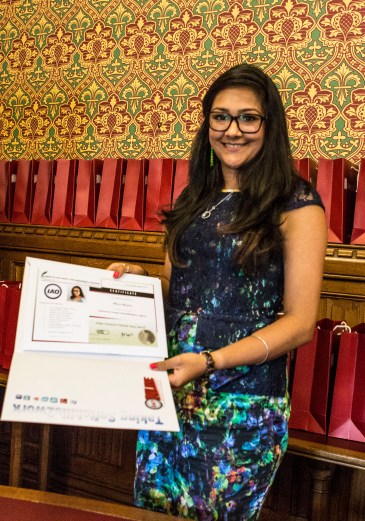
On September 21st 2012, AVPT’s first intake of students received their awards at the House of Lords with certificated globally accredited by the International Accreditation Organisation (IAO). Lord Ahmed congratulated the students and recognised that e-learning has a place in helping all types of people continue in life-long blended learning.

Students receiving their certificates Baroness Uddin and Lord Ahmed

As the m-learning hub continues to grow, AVPT is now working with apprenticeship schemes to provide apprentices with the key skills they require. With this new initiative and the Scholarship Den’s launch, looking forward it is set to be a very busy and successful year!

To find out more information about the Academy of Vocational and Professional Training please visit http://www.avptglobal.com or call 0203 551 2621.

Watch our Videos

Students receiving their certificates Baroness Uddin and Lord Ahmed Introduction to a new kind of Learning
Cutting the red tape to students scholarship

£8000 worth of Scholarship to be given to four students in 45minutes.

Image

Maya receiving her certificate at the house of Lords

E-Learning hub, the Academy of Vocational and Professional Training, targets scholars by launching a ‘Dragon’s Den’ style initiative

Launching Friday 12th October 2012 on stand 315 at the Youth Enterprise Live Initiative at Earls Court Exhibition Centre, young people will be encouraged to pitch the reasons they deserve a scholarship to a group of experts, Dragon’s Den style! Potential scholars will be battling it out for the chance to acquire a scholarship worth over £2,000 from The Academy of Vocational and Professional Training (AVPT). Four of the candidates will be chosen on the day, to mark the launch of the Scholarship Den with Channel 4 recording the day’s events.

AVPT supports young adults by offering them affordable and quick globally accredited soft skills qualifications. Diane Shawe, Founder and CEO says: “Our courses range from £250 to £4,500, which can be done either online or at one of our fast track training workshops. However, we respect that some students aren’t in the financial position to pay this money, and that’s why we have created the Scholarship Den.”

AVPT has found that many graduates are struggling to take their first, all important, steps on the career ladder as potential employers worry that graduates do not have enough experience. Tim Dingle, Chief Development Officer, explains how AVPT can help graduates overcome this issue, “Many students and young people are stuck in a catch 22. Employers aren’t willing to take the risk on inexperienced individuals and graduates aren’t able to gain experience. AVPT specialise in courses that are prepared at NVQ level 4. The courses are packaged in a chunk-able format so that blended learning can take place whilst the student is on the move and help young people into work quickly.”

APVT Global launches Scholarship Den

The ‘Chunk-able format’ in which the courses are designed in, allows students to work on the move using their tablet, smartphone or notebook, rather than committing to a 2000-word essay and most courses can even be completed in just one month!

On September 21st 2012, AVPT’s first intake of students received their awards at the House of Lords with certificated globally accredited by the International Accreditation Organisation (IAO). Lord Ahmed congratulated the students and recognised that e-learning has a place in helping all types of people continue in life-long blended learning.

As the m-learning hub continues to grow, AVPT is now working with apprenticeship schemes to provide apprentices with the key skills they require. With this new initiative and the Scholarship Den’s launch, looking forward it is set to be a very busy and successful year!

To find out more information about the Academy of Vocational and Professional Training please visit http://www.avptglobal.com or call 0203 551 2621.