Category Archives: online courses

Academy of Vocational and Professional Training awarded Global Accreditation by IAO

iao accreditation sealThe International Accreditation Organisation (IAO)  granted full accreditation to Academy of Vocational and Professional Training Ltd., UK, after meeting their rigorous Points Profile© System.

Article by Diane Shawe M.Ed

In February 2012 AVPT Ltd gained Candidacy Status after complying with the first stages of the  assessment criteria.  Full accreditation was granted to the institution, after the IAO’s evaluation commission evaluated the school’s on-line Learning Management System, (LMS) on-line academic courses, supporting Virtual Facilitators and organisational and management structure.

The CEO Diane Shawe is very pleased with this enormous progress. In February she posted a blog about Accrediting organisations recognising the rise of e-learning

The Academy of Vocational and Professional Training Ltd. delivers over 240 courses accessible on-line or as express classroom style learning. To serve as a complete blended solution to deliver high quality learning to students, with supportive personal facilitators that helps get them qualified to the highest standard quickly.

IAO acknowledges that AVPT can deliver on its mission statement.

“The mission of AVPT is to establish, preserve and promote the finest interactive educational standards worldwide that can be accessible to all globally. To use their expertise and resources to support individual study, lifelong learning by bringing education directly into the hands of individuals, communities, businesses and organisations in General. To enhance the quality and impact of teaching and the learning experience.”

IAO’s international accreditation also recognises that Academy of Vocational and Professional Training Ltd complied with the standards and criteria that meet its quality of education responsibility to its students and to the education profession along with all the services and privileges of regional, national and international professional recognition.

Diane Shawe  states

“We have a passion for education and using cutting edge mobile technologies that allow us to get people qualified in days not years.

We have an exciting and special way of doing this including the use of fully trained virtual tutors incorporating psychological shortcuts, brain training, super-learning and the latest e-learning strategies…that encourages a higher order of thinking and doing skills.”

Tim Dingle the newly appointed Non Executive Director states that

“Academy of Vocational and Professional Training offer more than 240 outstanding interactive on-line courses, covering a wide variety of subjects. The courses can also be delivered in classroom style fast track blended learning.  They are flexible, scalable and  student centred. We are committed to supporting the global lifelong learning experience a globally accredited organisation who’s courses and certificates are recognised around the world.”

Visit http://www.expresstrainingcourses.com for more information. We are happy to discuss personal training, scalable training for employers around the world, bespoke online courses for organisations, enterprises and networking groups.

Why 2013 is going to be a bumper year to become a Virtual Teacher

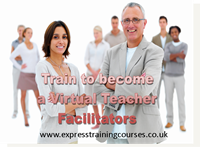
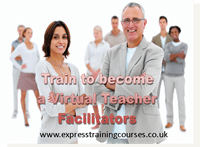
Become a Virtual Teacher Facilitator

I originally blogged way back in 2010 that the growth for professional trainers was going to grow.  But I have since spotted a gap in the market which is now becoming a growing trend throughout 2012.

So why is 2012/13  going to be a different type of bumper year for training organisations or consultant who can help the  unemployed individuals upgrade into a new skill that will help them generate their own income?

Well usher in the new breed of Virtual Teachers!  If your not up to speck with the new direction and growth in the market then you could really find yourself on the old fashion self by 2016!  Make no mistake, becoming a trainer is all about running a business.   Being up to date with the latest techniques, developments, trends and needs is just as essential if you decided to set up a coffee shop.

Institutions of higher learning increasingly embrace on-line education, with 65.5 percent of chief academic officers now calling on-line education ‘critical’ to their institutions! long-term strategy, an opinion that’s risen more than 15% over eight years.

Like any business you still have to source new customers, gain glowing appraisals and testimonials, get your pricing right, court the right type of publicity and sustain credibility.  Oh! and let’s not forget making a profit.

We all know it takes a certain kind of self belief and courage to set up any type of business in today’s climate. You could even make a claim based on sheer desperation, the need to do something to generate an income.

But it even takes more courage to leave your destiny in the hands of many of the businesses today, no matter what their global or brand status might be. Most people are now being spurred into self employment due to the levels of redundancies, job insecurities and the need to meet ongoing expenses.

Participants are more interested in the qualifications and or skills they will gain in the subject at hand, and the experience you have in doing jobs similar to theirs and your track record in ‘doing’ rather than ‘talking about’ the topic.

What is really important is your ability to engage with participants around this experience and help them to translate that into action. That is where the true value often lies for them. Of course we know that there are academic trainers and teacher courses which award accredited or private certificates.

Choosing the entrepreneurial route can bring great benefits, but there are also challenges.

What are some of the considerations before you decide to set up, invest or replicate another successful business model?

  1. Be candid about your strength and weaknesses. What do you have to bring to the table?
  2. Do as much homework as you can before taking the plunge
  3. Look carefully into all aspects of owning and running a business and sound out anyone you know who has already done it.
  4. Be prepared to change your idea or abandon outdated school of thoughts.
  5. Don’t be scared to appraise negative feedback, all businesses have a negative and positive aspect to them.
  6. Prepare a business or marketing plan. You’ll save yourself a lot of time, money and stress if you understand as much about the theoretical side of the business as well as the vocational aspects

Ask yourself these key questions before launching your business:

a) Is there a demand, how long will the demand last, is it scalable, can you bolt it onto anything else, can you partner?

b) Have you got the full support of your family? Your decision is likely to impact on them, so talk to them first. Don’t be put off by their own fears, if you can actively offer up reassurances of how you can cope with whatever concerns them, then will be serve to give both them and yourself the confidence to move forward.

c) Speak to any contacts you have in the sector you plan to work in. If you are going to invest in a Franchise, they try to get some feedback from any previous candidates who have made the investment.

d) Check out the competition. If there isn’t any, why not? You may not have rivals but will you have any customers?

e) Are you prepared to work the long hours to get the business off the ground?

f) Do you have the necessary skills? Can you cope with paperwork? Can you cope with criticism?

g) What about funding? Talk to several banks and consider various options, be careful though, they are not assisting many businesses today they are more interested in protecting their own levels of risk and increasing their profits. Some of the smaller banks might be of interest as they might treat you more like a customer than a commodity.

h) Could your training course attract funding on behalf of the student? This might make it simple for them to enter your training services if some of the costs could be supplemented.

i)  Are you clear at delivering information, can you present subject matters or theory step by step, what training would you need to boost your technique, confidence and presentation skills.  Could you get funding for your own training?

Important advice about redundancy money

If you are considering using your redundancy money, make sure you set aside enough for household bills and other costs. It is important that you think of your redundancy money as your cushion until you get yourself back on your feet.

  1. Invest what you feel you can afford to risk or lose but do so where you have some knowledge and a passion for the subject involved.
  2. Try not be over powered by flash organisations offering huge earning potential subject to you parting with lots of your own money.
  3. Don’t rely on the referrals and testimonial they supply to you.  Do some of your own research.
  4. Remember every business has to start small and keep lean before it can grow to a stable long term business
  5. Don’t rely on marketing short-cuts, this can be very expensive and  not very productive.

More and more people are looking for good quality training courses that can add value to their life, career portfolio and career longevity.

It has been proven that most recessions bring an influx of new businesses, entrepreneurs and even millionaires. One of these new areas of business is the growth of the non surgical hair replacement and hair enhancement sector.

The UK and Europe has a shortage of properly trained trainers who can deliver a variety of hair extension and hair enhancement technique to the non professional and professionally qualified sector.

An opportunity now exists for anyone wanting to enter the vocational training market with a service that has far reaching benefit and impressive revenue streams.

An opportunity exists throughout the UK today to establish your own virtual training school in this very selective and much needed service. Visit our website to read a little more about how you can make the first steps to becoming a Virtual Trainer

Train to become a globally accredited Virtual Teacher

Train to Become a Globally accredited Virtual Teacher

Trainers fast track training

Next Course date: 14th, 15th & 16th May 2012

The World of education has changed, and this has impacted on personal trainers, teachers and life coaches on how they source and deliver training.
There is an opportunity to train as a Virtual Teacher and start working with students all around the world. This 2 day course will enable you to follow procedure, e-monitor, e-mentor and e-access your students progress and help them to complete their online course.
Institutions of higher learning increasingly embrace on-line education, with 65.5 percent of chief academic officers now calling on-line education ‘critical’ to their institutions! long-term strategy, an opinion that’s risen more than 15% over eight years.
67% believe academic outcomes from on-line classes are equivalent to those in face-to-face learning, but still, one-third of academic leaders think on-line classes are inferior. We do not agree with this but we do understand that resistance to change can often impede new growth.
registration form virtual teacher course
This 2 day workshop will introduce the changing face of virtual education and how you can prepare and adapt yourself and business for this expanding sector.
At this two day event you will understand more about the following:
  • Enhance your understanding of learning styles and trends for 2012
  • Reaction to Change, Early adopters and Diehards.
  • Learning Management Systems
  • Mobile legacy courses
  • Interactive content
  • Blogs and education
  • Digital publishing and learning
  • QR Codes and how it will benefit educators
  • Hosting Learning in the cloud
  • New Blended Learning in community, mobile, webinar and video
  • Augmented Reality related to mobile learning and diversity
  • Virtual Worlds multi learners simulations in 3D
  • Pocket Video Technology for informal learning
  • Social Media integrating across all devices to improve on-line collaboration
  • What is a Virtual Tutor/Trainer Teacher
  • Defining the growth of on-line Soft Skills Training
  • Benefits and Advantages for Virtual on-line Tutor/Trainers
  • Diminished environmental Constraints
  • The New On-line E-Learning Process
  • The Opportunity
  • e-monitoring, e-montoring, e-assessments and reporting.
 iao
There is an opportunity to train as a Virtual Teacher and start working with students all around the world. This 2 day course will enable you to follow procedure, e-monitor, e-mentor and e-access your students progress and help them to complete their on-line course.
iebe logo        skillsforlife   FSB
Labels: online training, life coach, personal development, project management, teachers, trainers, Educators, online courses, heads of departments,educators,universities,colleges
Event Organizer: Diane Shawe M.Ed IEBE (CEO at Academy of Vocational and Professional Training Ltd)

Can difficult or tough conversations be pre-managed?

Managing difficult or tough conversation.

by Diane Shawe M.Ed IEBE

Unless you are on an island, it is not possible to avoid communicating with other people. Just stop for a moment, and think about how much time of your day you spend in conversation with other people? Whether in your car, in meetings, on the phone, by text message, e-mail or social media. Our days are frequently filled with short snippets of conversation and sometimes long exchanges.

Some people are better in conversation, while others prefer to write messages where they can take advantage of the delete key and work out the best wording. Have you taken some time to examine your approach? What are your results like; do you tend to have consistently peaceful conversations where people get heard and are listened to, or do they frequently de-compensate to a level of discussion that is argumentative or unpleasant or they just simply mis-interpret what you though you said or what they thought they heard?

Conversations can be a challenge, and we also have to be aware of the conversation going on inside our head at the same time. What if we say the wrong thing, or we are speaking carefully but our body language or voice is sending a very different message? How are we supposed to manage all that?

Fortunately, we can learn techniques to help prevent conversations from getting difficult and recognise what to do if they go off track. We can also learn how to get to the heart of a problem, move through a conversation, and keep it focused on the future instead of spinning in circles.

We can all benefit from a little education on dealing with difficult or tough conversations. Speaking and presentation coaches can help, but in the heat of the moment they aren’t perched on our shoulders whispering what we should be saying.

Our previous clients tell us that our courses are ideal for workplace training and development. They appreciate that our courses are up to date, relevant, and globally accredited. More than that, they are also excited to see that our courses are available in a format that they can use for e-Learning, either as the approach for the whole course or for a 1 day blended learning approach.

We have just released our Managing Difficult Conversations Training course. We believe that training courses need to be designed with busy people in mind. Our new training course include everything you need to help you, your staff or leaders hold challenging conversations!

From understanding the impact of body language and how your voice is projected, facial expressions, to formulating questions that get to the underlying problem. Our course provide information on many hands-on techniques and will also help you learn how to apply positive intent, how to use our process to plan a conversation, and how to implement and follow up on an action plan.

You can enrol on our course on line in our 4 week e-learning program, or you can opt for a 1 day intense learning experience workshops.

Developing and Maintaining a Succession Plan

Get qualified in days not years!

by Diane Shawe M.Ed

A 1 day Business Succession Planning  training course can be incredibly beneficial to any SME organisation.

Change is a hallmark of today’s business world. In particular, our workforce is constantly changing – people come and go, and move into new roles within the company. Succession planning can help you make the most of that change by ensuring that when someone leaves, there is someone new to take their place.

It is surprising that from a one day  workshop we could  help you learn or teach your staff:

  • The value of succession planning for successful businesses.
  • The key elements of a succession plan in terms of roles, responsibility, function, scope, and evaluation.

Introduction and Course Overview

First you will have an opportunity to identify your personal learning objectives and then we would cover the following areas.

1 day intense workshop lesson Plan:

A Need for Succession Planning

To begin, participants will explore the differences between succession planning and replacement hiring, including some of the advantages of succession planning.

Defining a Succession Plan

This session introduces the SUCCESS acronym, which defines the succession plan process that the remainder of the course will focus on.

Pre-Assignment Review

Next, participants will use information gathered in their pre-assignment to identify the critical people in their organization.

Identifying Resources and Analysing Risks

This session will give participants some tools to identify internal and external successors. We will also look at a sample risk assessment.

Defining Roles, Responsibilities, and Functions

During this session, participants will start creating risk assessments, individualized engagement plans, and succession plan profiles.

Gathering Information

This session will help participants identify ways to look within their own organizations and determine what the critical positions are.

Forecasting Needs

There are six key ingredients to being able to forecast what people you will need when. Participants will explore each item in small groups. Participants will also learn about the role of coaching and mentoring.

Putting the Plan Together

Next, participants will learn about using Appreciative Inquiry and Leadership Quality Assessments to develop a succession plan.

Putting the Plan into Action

During this session, participants will explore the idea of phased implementation. We will also look at using technology to facilitate putting the plan into action.

Evaluating and Reviewing the Plan

This session will look at the importance of evaluation. Participants will also work on modifying an evaluation check list to suit their organization’s needs.

How can you enrol?

It’s simple you can just click here and select if you would like to do the course on-line or attend one of our fast track workshops.

Is the Accrediting Industry ready for the rise and challenge of the e-learning education?

Individual online learning courses and even entire online degree programs are increasingly a part of the mainstream in higher education.

Article by Diane Shawe M.Ed.  IEBE

Steadily-improving online delivery systems and an emphasis on globalisation have encouraged more and more higher education institutions to try to reach diverse learners around the world.  In light of the growing population of learners from various cultural backgrounds engaged in online education, there is an urgent need to understand how accreditation of an online e-learning provider can reach across all cultural dimensions.

Distance Education has been around for more than a decade now. The ever changing landscape of education through technological innovations has allowed distance education in necessitating strict quality control measures to comply with. Thus, accreditation plays a primary role in ensuring quality in Distance Education system. Accreditation is a process through which institutions offering higher education are analysed by internal and external peer review.

Distance education is not a new phenomenon, and accreditors have been reviewing online courses for a long time now. Accreditation for these distance learning programs involve regional, national, and specialised bodies along with the governmental and public organisations that rely heavily on review of quality of these providers.

One such value has been to illustrate the necessity of accrediting distance education with respect to the rise in public and private education providers. Distance learning poses great challenges to the arena of accreditation mainly by transforming the traditional faculty into online faculty and diminishing the value of physical one on one interaction with students.

Distance learning represents a challenge to the accreditation agencies by modifying the meaning of “higher education institutions” by removing the brick and mortar lecture halls with web based chat rooms, and brick and mortar campuses institutes to a website. An academic provider is no longer restricted to the existence of a physical infrastructure, it can be found anywhere, anytime – all one needs is a computer or smartphone and access to internet.

Distance Education challenges the accreditation system by modifying the face of what we know as a college or a university degree. Electronic access not only encourages but also supports a more mobile form of a student behaviour through which students are enrolled in more than one institution at a time. The National Vocational Qualifications has taken a newer meaning and involves a richer blended learning of educational courses being taken by a student and delivered through multiple technological mediums.

What is Blended Learning?

Blended learning approach training is one that combines face-to-face instruction with online instruction and activities. A wide variety of methods can be used to interact with a blended learning course; technology such as mobile devices, computers, video conferencing, and other electronic media to name a few. The goal of blended learning is to provide a useful, practical way for learners and instructors to get and provide material in more ways than simple face-to-face interaction.

The online component of blended learning allows instructors and students to stay connected. Interact anytime, anywhere Distance Education and the ever changing role of education providers in this era are obviating the need for:

  • Recognizing the characteristics of distance education provision be it a traditional classroom or online chat room;
  • Altering guidelines for accreditation, strategies or principles to ensure quality within the distinguished model of distance education delivery; and
  • Paying extensive consideration to the achievement of the students and outcomes in the electronic environment of distance education whereby structured classroom facilities are not available.

As Academy of Vocational and Professional Training roles out its interactive soft skill online e-learning express courses selecting a scalable global accreditation company has become increasingly important.

//

What Impression do you make? How to develop your personal brand

group of people

How to develop your personal brand

Have you given much thought about the impression you make? How much leeway do you have to express yourself at work, at home, and via your social media?

By Diane Shawe, M.Ed. IEBE

If you go to the hospital, they are dressed a certain way, the staff may even speak to each other in a certain way. If you stop at most petrol stations, the salesperson is probably dressed quite differently than your physician, and yet still in a way that reflects and supports the business. You go to these people in order to receive a service or a product, and you probably go to them specifically because they have left some kind of impression on you. We refer to this impression as their personal impact.

Have you given much thought about the impression that you make? How much leeway do you have to express yourself at work, at home, or even via the social media? While the impact you have can be derived from the way you present yourself (through how you behave and what you wear), we also have to look at ways that reflect your personality and individualism. Have you considered yourself to be a brand, and have your considered how you could strengthen your brand in work, business and socially?

When you plan to take a short holiday and ask your neighbor to watch your home for you, what is it that makes you ask that particular neighbor? Are they trustworthy? Friendly? Do they consistently conduct themselves in a way that leads you to think they are a good person? If so, you are feeling some of the impact of their personality.

They present themselves in a particular way, and unless you see some demonstration of inconsistency (which may lead you to question their credibility), to you their impact seems quite clear.

What kind of impact trail are you leaving behind, What impact do you want to make and leave with others?

For more information on personal impact and how to create your personal brand, visit us at http://www.expresstrainingcourses.co.uk

Personal Branding 2 Day training course

Just click HERE to tell us what information you would like us to send you.