Tag Archives: short courses

High Blood Pressure, Hypertension: The New AIDS Epidemic?

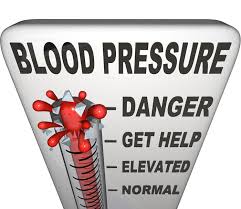
high blood pressure check your now

Strokes, Heart attack, thinning arteries

High blood pressure could be as devastating to global health as AIDS, causing more deaths over the next two decades than the infectious disease, a group of international experts is warning.

article by Diane Shawe M.Ed

Writing in the International Journal of Epidemiology, three British experts in international health said most governments and aid agencies around the world are doing too little to combat high blood pressure, and that current efforts to target the condition mirror the halting global reaction to HIV/AIDS 20 years ago.

hypertension can move you towards high blood pressure

Manage your Hypertension

In an editorial entitled “Is hypertension the new HIV epidemic? ” the authors — Peter Lloyd-Sherlock from the University of East Anglia, and Shah Ebrahim and Heiner Grosskurth of the London School of Hygiene and Tropical Medicine — suggest that “valuable lessons for hypertension could be taken from HIV/AIDS policies,” but health officials are not applying them to the growing rate of high blood pressure.

“Our response to the global epidemic of hypertension seems little better than our response to HIV/AIDS two decades ago: too little too late,” they write. “Can we not wake up earlier this time, before millions have died?

Hypertension is seen as a disease of the West, of prosperity and therefore of little relevance to poorer countries. This is despite the growing body of evidence that prevalences in poorer countries are quickly catching up.” They noted that hypertension is a non-communicable (NCD) disease and argued that the behavioral factors associated with it —obesity, lack of physical exercise, and poor diet — make it difficult to persuade funders and taxpayers to help people who “eat and smoke too much.”

They added that the situation is reminiscent of the slow response to AIDS prior to 1990. “HIV was faced with political denial and public misunderstanding in the early years of the pandemic, especially in some poorer countries,” they said. “There is a similar pattern of denial with hypertension … based on the misguided view that hypertension does not affect poorer social groups.”

“Yet there is substantial evidence that hypertension is highly prevalent among poorer groups and that they are less likely to have access to effective treatment. As with HIV, hypertension can be both a cause and a consequence of poverty, over work, non satisfaction in your job, debt, no job.”

hypertension caused by stress at work  can move you towards high blood pressure

Job burnout and stress in epidemic proportions

Managing your stress and Hypertension in the West.

Today’s workforce is experiencing job burnout and stress in epidemic proportions. Workers at all levels feel stressed out, insecure and misunderstood. Many people feel the demands of the workplace, combined with the demands of home, have become too much to handle. A one-day workshop explores the causes of such stress and suggests general and specific stress management strategies that people can use every day.


Sourced from © 2014 NewsmaxHealth. All rights reserved.

Available from Amazon and Google Books

Is there really a global skill race?

new rules of engagement towards long term employability-Entreployability the new breed by Diane Shawe jan 2014If there is a global skill race, who’s winning?

Governments all over the world want their countries to have high-value, high-skill economies, and they realise that the first step towards this aim is to have a well-educated workforce. In the UK, an appreciation of the connection between economic success and education has led to widening participation in university, as well as lifelong learning, being politicised as a priority.

But many Commentary from the organisations such as the Teaching and Learning Research Programme shows that this policy prescription may not be enough to avert a significant attack on skilled and professional employment in the UK.

Policy-makers have yet to appreciate the fundamental shifts which are now taking place in the way companies use skilled people. Large firms are increasingly aware that emerging economies, especially but not exclusively India and China, are building up their education systems at a rapid rate. Leading corporations are abandoning the idea that high-end activities such as research and design have to go on in the high-cost economies of Europe, North America or Japan. Instead, they are developing ways in which high-value work can be standardised, as manual work already has been. Once this is achieved, high-skill people in low-cost countries suddenly become an attractive option for multinationals.

This means that we may be entering an era in which many of the young people now investing heavily in their education across the developed world may struggle to attain the comfortable jobs and careers to which they aspire. They risk being bypassed by decisions to send work that would once have come their way naturally to people in Asia and elsewhere, who bring the same skills to employers at much lower prices.

We know that many people would argue that UK employers should provide work for UK people, but with the global competitive markets forcing prices down, UK employers need to remain competitive if they are indeed wanting to sell any of their services.

The Challenge

At least 26 million unemployed people have been looking for work across Europe during the long, hot summer of 2013. They will not be the only ones looking.

Millions of school and university leavers will join them in the search. Millions more are looking for more work than they already have – another part-time job, or a full-time job in place of part-time work.

And millions of others are not registered as unemployed but are also searching for paid work to supplement their income: pensioners in need; partners of someone in work whose wage has fallen; students who are studying full-time but cannot survive without a job on the side; children who are officially too young to work but whose families need the money.

Four key components that contribute to the challenges we all face ahead:

  1. Multi-Generational Workplace
  2. Technological Development
  3. Inexperienced
  4. Globalisation

13 Questions governments around the world will need to address that will affect you and your children’s children.

In order to help shape the
debate over labour and entrepreneurial policy for the twenty-first century we need to get involved in asking these questions throughout our communities, educational institute’s and economists. Questions such as:

  1. How do we ensure that workers get the skills they need to succeed in the twenty-first century workplace? (Not just the young people but those unemployed now)
  2. Will employers hire and train workers who initially lack skills?
  3. What happens to the worker laid off from a manufacturing job at age 55 —does he get training in new technologies or is he stuck in lower-wage jobs like groundskeeper, security guard, and warehouse stock controller?
  4. How do we make sure that people with disabilities have access to the technologies that facilitate their participation in the workplace?
  5. How will e-commerce impact employment?

To find out more, order your copy of ‘The new rules of engagement for long term employability’ By Diane Shawe

new rules of engagement towards long term employability-Entreployability the new breed by Diane Shawe jan 2014

10 reasons why negotiation is not the same as bargaining

Planning your negotiation stanceNegotiating is less about confrontation and aggression than it is about flexibility and innovative thinking.

Where as bargaining can lead to lots of problems which may not result in a win-win outcome.

article by Diane Shawe M.ED  AVPT Ltd

Although people often think that negotiating is the same as bargaining, it is not. Negotiating is a process, and bargaining is one stage of that process. There are three other stages of negotiating, and even those are tempered by timing, intuition, and flexibility to the process.  We are going to set out some of the real nuggets you should put in place to establish a firm ground for all considerations.

(Adapted from Shell, Richard: Bargaining for Advantage: Negotiation Strategies for Reasonable People, Penguin, 1999)

(Adapted from Shell, Richard: Bargaining for Advantage: Negotiation Strategies for Reasonable People, Penguin, 1999)


1. Do your Research

When doing research and preparing for negotiations, there are three important considerations:

  • Collecting facts
  • Knowing priorities
  • Knowing principles

The facts that you collect are all the direct and indirect information that you will need to back you up during negotiations. With access to information today, it is a much simpler task than ever to accumulate all kinds of data and statistics. For example, if you are preparing to purchase a vehicle or a house, plenty of information is available, such as comparable properties and prices. If you are preparing to negotiate a raise, or are negotiating salary increases at work, then comparable wage statistics, the history of the organisation and its mission and values, previous experiences in the collective bargaining process, and strategic plans are all important concepts to understand.

2. Focus on your priority

Knowing priorities means having a good understanding of what you want from the negotiation. You also need to know what the other party wants. Understanding your principles, both as a negotiator and as an individual, will help you to form and present a case that is compelling and believable.

Understanding the principles of the other party can also be very helpful to you. A little more research can help you to understand what the organization’s beliefs are, how they have approached previous negotiations, what terms seem to be more important to them than others, and what terms they could be willing to be flexible with.

3. Identifying Your Walk Away Position (WAP)

When you establish your priorities, make sure you have a clear understanding of your Walk Away Position (WAP). What is the least that you will accept (or the highest price that you are willing to pay)? Establish your WAP value in your mind and keep it clearly available so that you do not get caught up in the heat of negotiating, either ending up with something you never wanted, or turning down a deal that was better than your WAP. If you are negotiating on someone else’s behalf, make sure that you know their WAP so that you do not make any mistakes in negotiating for them.

4. Identifying Your Best Alternative to a Negotiated Agreement (BATNA)

In addition to your WAP, you also need a Best Alternative to a Negotiated Agreement (BATNA) in your plan. Sometimes an issue can be settled before the bargaining phase begins if it meets your criteria as a BATNA. For example, if you are planning to purchase a home – which is often a very emotional decision – and the realtor comes to you with an offer that you can live with, and you get the home you want without having to participate in any heavy bargaining or entering into a price war, then you may have reached your BATNA. Not all negotiations have to be bargained; sometimes, when you negotiate, you can lose the opportunity to get what might have been a BATNA if you had not been after such a bargain.

5. Working Within the Zone of Possible Agreement (ZOPA)

1 AVPT Student Recruitment drop in Advert no dateThe Zone of Possible Agreement (ZOPA) is an area of overlap where the desired outcomes of both parties reside, and where both parties can live with the outcome. Once you reach a ZOPA, the finer details need to be worked out within the scope of what both parties have already found is potentially working for them. For example, if your business forecasting allows for a 2% salary increase each year for the next three years, and similar companies in your industry are offering the same, and the union is asking for 7% over four years, then you may be within the ZOPA.

In general, there are three possible outcomes to a negotiation.

  • Lose-Lose
  • Win-Lose
  • Win-Win

6. Getting Everyone’s Perspective

Gathering perspective is something that can take place throughout the negotiation process. It begins in the research phase, where the negotiator considers the needs of the members of an organization in conjunction with the strategic vision and mission of the negotiation. This does not mean that everyone will get what they want in an agreement; rather, it means that all points of view are considered. There is no point in entering negotiations and reaching an agreement that ignores a section of stakeholders or breaks the law.

Gathering perspective can be a considerable undertaking, depending on the size and scope of the operation. This is one area where outside resources can be utilized (an outside firm conducting employee satisfaction surveys, for example).

7. Developing a Sustainable Agreement?

In this age of complex life and work arrangements, a sustainable agreement can be said to reflect the reality of the business. An agreement cannot be a rigid reflection of ineffective negotiations; rather, it must reflect the reality of business and economic cycles, industries, and real issues that people face. It must also reflect the multiple aspects of the stakeholders who both provide input, and are affected by the results. An agreement also cannot focus on one aspect of the business when the business impacts other industries, cultures, or linguistic groups.

In developing a sustainable agreement, the partners must ensure that, first of all, the organizations that they negotiate on behalf of are interested in having an agreement. Partners must also ensure that negotiating organizations will enforce and take part in the terms of that agreement. If the agreement cannot stand on its own, and the parties who sign it refuse to use it, then the paper it is printed on is useless.

A sustainable agreement really does incorporate feedback from all stakeholders. Although we will never always agree with other people, and although we can write an agreement much more quickly than we can negotiate the terms of one, an agreement is just that, an agreement.

8. Resolving Power Struggles

Negotiating has a lot to do with power. You may find yourself drawn into a compelling conversation that becomes a struggle for power between you and your counterpart. You will have to remind yourself that the negotiation is a process and what your priorities are. The outcome is not personal, and you needn’t get drawn into a power struggle. If you notice that the tone of conversation changes and a power struggle is taking place, one very fast way to disarm it is to take responsibility for it.

You can try a statement like the following:

“Do you mind if we pause for a few moments? I can feel myself taking your last few statements personally and I can feel my heels digging in. Please accept my apologies. Do you mind if we take a short break, and then we can go over this point again once I have had a chance to clear my mind. Perhaps we can try to approach it from a different angle?”

You do not have to mention that you feel the conversation becoming a power struggle. Simply acknowledge the change in tone within the meeting, and then take a moment to collect yourself and regain composure as you move forward. In most cases, the break you put into the conversation may be enough for your partner to also review their approach and consider an alternative.

9. Detach yourself from the outcome

The outcome of this negotiation is not about you personally. If your side wins or loses, you do not become a winner or loser. Very few negotiations actually involve life or death issues. Keep your feet squarely on the ground by realizing that, as a negotiator, your job is to lead people through a process, not to win. Try to think of it in terms of four potential outcomes.

  1. The two of you do not reach an agreement, and the negotiation ends.
  2. Your counterpart will agree to your terms.
  3. You will agree to your counterpart’s terms.
  4. The two of you will compromise on some point in between your positions, perhaps closer to your terms and perhaps not.

In some situations, you have the potential to reach the agreement that you wanted. In other outcomes, both parties may leave unsatisfied. Sometimes not reaching an agreement is the best outcome. (You walk away from a deal with your bank account or integrity intact.) At other times, it is the worst arrangement. (Now, how will you get someone out to fix the service elevator by Friday?)

10. Know your Role and Value

Creating and claiming value are at the heart of the negotiating process. Creating value means that we can develop effective and creative solutions that meet the needs of everyone involved in the negotiation. In negotiation terms, this is commonly known as “expanding the pie.” Claiming value refers to the size of the piece of the pie we receive as a result of negotiation. Many negotiators can do a good job at either creating or claiming value, but not both. Master negotiators do an excellent job of striking this balance by having a good understanding of the interests of both parties, and by identifying common ground, rather than simply aiming for a target and not allowing for any flexibility.

When you are negotiating, check your personal baggage at the door. Think of the things that might be on your mind as you prepare for negotiations.

COMING SOON

10 HABITS OF A WOMEN RAINMAKER by Diane Shawe

If you want to receive a signed copy a her book launch, join her in Linkedin

Kensington, Chelsea and Westminster Enterprising Womens Club for more information.

cropped-avptglobal-2-new-banner-july-2013.jpg

The Academy Of Vocational And Professional Training look forward to the year ahead after a year of success and achievements

Lord Ahmed congraulate students and AVPT on achievements

Lord Ahmed congratulates students and AVPT on achievements

The Academy of Vocational and Professional Training (AVPT) have had an exceptional year, with a huge list of positive achievements. A year in which AVPT launched globally was marked the first cohort of students being presented with their certificates by  Baroness Uddin followed by congratulations from Lord Ahmed, in the impressive setting of the House of Lords.

“This was a huge achievement for us,” explains Diane Shawe, the CEO, “Our 395 courses are all globally accredited by the International Accreditation Organisation, meaning that they are accepted anywhere around the world. We’ve achieved so much this year and we felt very excited for the future when watching the first generation of our students receive their beautiful and meaningful certificates.”

The globally accredited status given to AVPT by the International Accreditation Organisation in June 2012 means that the courses available hold a big draw to students that want to travel. Diane sees this as recognition of the significant rise in e-learning.  This has also meant that AVPT’s launch of its Scholarship Den initiative hasStudent pitching to judges at ASVPT Scholarship DenStudent pitching to judges for scholarship happened at just the right time; young people, with a desire to better themselves or start a business are awarded with £2,000 of AVPT training. This has led to the continued and dynamic success of the academy’s offering.

In October 2012, AVPT was the main sponsor of the education section of the Youth Enterprise Live Show 2012 at Earl’s Court in PA9C1793London and had the Mayor of Hammersmith and Fulham as the guest of honour to officially open the AVPT stand where they attracted over 350 enquiries for the short courses.

To finish off an already exceptional year, AVPT won a contract with a Middle-Eastern Government to provide crisis management and leadership training to the government heads of departments.  After a highly successful training programme, AVPT was also added to the official procurement list for the UK’s Ministry of Justice and Department for Work and Pensions and so is able to provide training for these two large departments.

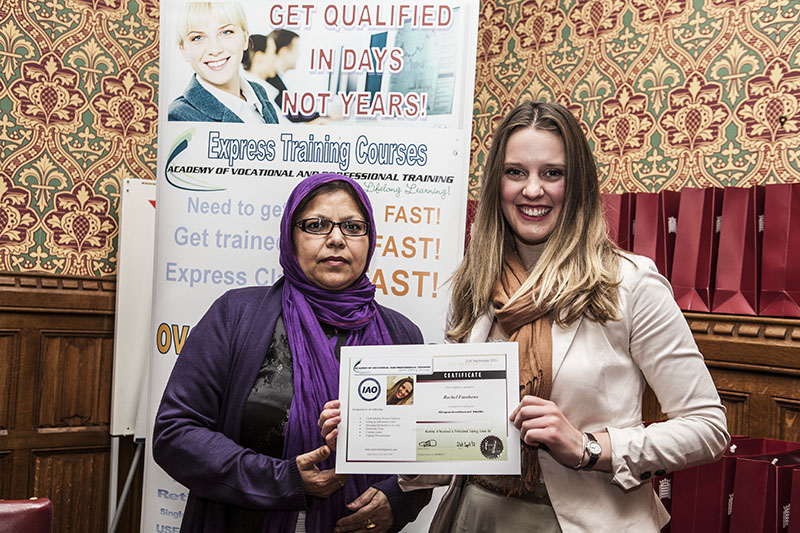
Rachel Fanshawe receives her certificate from Baroness Uddin

Rachel Fanshawe receives her certificate from Baroness Uddin at the House of Lords

This remarkable success story has continued into 2013 and the AVPT team are already setting their sights on the next target. The company has begun work towards striking up a partnership with The Department of Business, Innovation and Skills to carry on its successes with departments of the UK government.

Diane explains, “We have built solid relationships with all that we work with, and over the course of 2013 we want to be able to offer students from across the world a larger platform of study. We believe by building foundations with The Department of Business, Innovation and Skills, we can do this efficiently.”

AVPT is dedicated to helping students in reaching their full potential and have launched the first UK voucher code website offering customers the chance to find special offers and deals on short courses. The website, expresscoursevouchers.com, allows the general public to take advantage of new education and training deals everyday.

Tim Dingle, the Chief Development Officer at AVPT says, “We’ve been extremely busy this year and have created a paradigm shift for online adult education.  Our Social Enterprise division, known as ACEE, will also begin to deliver training courses to the wider community, by awarding bursaries to people who are disadvantaged or cannot afford to up-skill. We are totally committed to life-long learning  and to helping students better themselves. We are passionate is this goal and believe we have a unique and powerful product that people are connecting with very quickly.”  The National Lottery has view our proposition in a positive light has it helps the wider community.

Next generation of mobile learning

Next generation of mobile learning

The Social Enterprise division of AVPT  ‘ACEE’ will launch a project in July 2013 called ‘Switch Momentum’.  ‘Switch Momentum’ is targeting the areas where knife crime and gang problems pose a real threat for teenagers who do not want to get involved but are locked into their homes in order to be safe.

Diane says, “Switch Momentum will provide teenagers with a way out of challenging and pressurised situations. We believe everybody can fulfill their potential given the right opportunities and we believe we can offer this positive environment.”

Diane Shawe finishes by saying, “This is targeting young people in the summer vacation who may not be going on holiday, a projects like ‘Switch Momentum’  can offer that inclusive learning experience in a calm environment to them”.

As a natural progression of their growth, AVPT is also looking to inspire and train  a new workforce of Virtual Tutor Facilitators (VTFs). AVPT  has already trained several individuals and have found that they help create a seamless bond between the student and their studies. By May 2013, AVPT will have created 300 jobs.

Tim Dingle explains, “The VTF is a revolutionary new idea. Teaching is changing, and we are creating dynamic change. We have created a jobs and helped people to work creatively and passionately in adult life-long learning. We’re extremely pleased with this.”

AVPTGLOBAL almost 400 courses all globally accredited

AVPTGLOBAL almost 400 courses all globally accredited

AVPT will be present at three major exhibitions throughout 2013.

The Scottish Beauty Show 2013, which takes place in the heart of Edinburgh  and the Wales Hair and Beauty Show 2013 which is in Cardiff. Finally in this busy year, AVPT will be presenting at the Business Start Up Show 2013, at the Excel centre, London.

Visit www.avptglobal.com to view our range of courses and services and see if we can help you upskill yourself or team.