

Keep taking the tablets
-More Than 1 Billion Smart Devices Sold Last Year Changes Everything
article by: Tim T Dingle BSc (Hons) MIBiol PGCE MBA CDO at AVPTGLOBAL
I can remember clearly (it was after all, only 3 years ago on April 3rd 2010) when Steve Jobs unveiled a unique consumer tablet with an unusual name. It had been one of his obsessions for years, even before the iPhone. Many people thought Apple would be better served by coming out with a netbook: you remember netbooks, don’t you?
According to the International Data Corporation[1], worldwide shipments of smart connected devices grew an amazing 29.1% year over year in 2012, crossing 1 billion units sold with a value of $576.9 billion. The market expansion was largely driven by 78.4% year-over-year growth in tablet shipments, which surpassed 128 million in 2012. Quite astonishing and I hope everyone had a great Christmas opening the tablets!
We all know that smart devices can deliver amazing functionality; from constant Internet and social media connection to brilliantly helpful apps. They are genuinely changing the way we operate as a society. The change is happening so rapidly and almost seamlessly that most of us probably don’t realise how much we use and rely on our smartphones and tablets. How did the business world even operate without employees having constant access to their phones, email and the Internet? How did busy parents keep track of their schedules without a calendar that never leaves their side and actually reminds them of events?
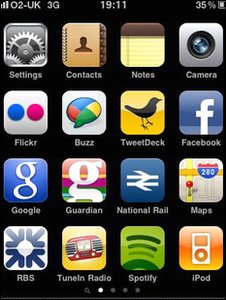
apps galore!
If we pause to consider that now we can use apps to find the best meal when on the road, the nearest petrol station or to locate possible holdups on route. We don’t even have to watch TV or connect to an online news site to get instant national and local news. We can scan rail and plane tickets with our smart phones and check in with no paper for international flights. While smart devices are making everyday activities easier for consumers, some businesses are facing challenges to compete effectively. The challenge is being met by forward thinking companies like AVPT Global[2] who seek to use tablets and smart phone technology to be at the heart of online learning and push forward the rise of mLearning.
The iPad and other smart devices (including my brilliant Samsung Note 10.1) have had huge initial impact on access to information, business sales and social interaction. In fact the pioneering of this new category has in some ways been even more significant than the iPod and even the iPhone, because it has disrupted so many different device manufacturers. It has created a market opportunity for smart device manufacturers and created a challenge to other PC makers and even potentially influencing how we may watch television in the future. It has also extended digital content opportunities to make books and video on-the-go a more practical experience, ending the back breaking march of the child with books to school perhaps?
The iPad was the first device to successfully bridge the gap between the PC and smartphone for consumers. Since it landed in the first consumer’s hands more than 55 million iPads have been sold worldwide, used for watching (and streaming) movies, reading books, magazines and newspapers, Web surfing and playing games. Tablets are becoming familiar common coffee-table fixtures in households around the country. They’re also being stowed in the briefcases and bags of travellers, whether they’re going by car or by plane. And they’re increasingly carried by teachers, doctors, lawyers, real estate agents — a wide range of professionals who find they can do much of their work with a tablet. Put simply, the tablet has become the go-to PC substitute for a variety of activities.

A smarter way to study with http://www.avptglobal.com
People now leave their laptops behind more often, taking advantage of the tablet’s lighter weight, ubiquitous wifi (and 3G /4G) connectivity, its longer battery life and catalogue of useful applications. We are seeing some of the tasks traditionally performed on PCs and laptops, now being performed on the tablet. In fact, all five of the top activities (email, Web surfing, game-playing, social networking and online shopping) shifted towards the tablet in late 2011.
Many of these are activities we do on our smart phones, of course, but doing them on the tablet is not only more pleasurable visually, it leads to entirely new behaviours. Watching video (be it movies, TV or YouTube) is definitely one of the preferred uses of tablet owners who also have smartphones, as is Web surfing and email, according to new research from Nielsen. In a great piece of research called, “Tablets are for meals. Smartphones are for snacks,” Nielsen[3] shows how 10 per cent or less of smartphone owners opt to do those activities on their phones. Social networking (both Facebook and Twitter) is also better done on a tablet than smartphone, as is writing emails. Aside from making phone calls, the only activity right now where the smartphone beats the tablet is instant messaging. But even 18 per cent said they’re doing that on their tablets. It appears that mobile phones tend to be the gateway drug in emerging markets where consumers typically move on to a tablet.
The IDC report that grabbed the headlines last week (1.2 billion smart devices), goes on to say that it expects global smart connected device unit shipments to surpass 2.2 billion units by 2017. Consumers and business buyers are now starting to see smartphones, tablets, and PCs as a single continuum of connected devices separated primarily by screen size. Each of these devices is primarily used for data applications and different individuals choose different sets of screen sizes in order to fit their unique needs. These kinds of developments are creating exciting new opportunities that will continue to drive the smart connected devices market forward in a positive way. The first step on the long road to mLearning is just beginning and the potential for individuals and companies to grasp the opportunity is seen by only a few.
Taking the Tablets has never been so exciting.

[2] The Academy of Vocational and Professional Training www.avptglobal.com
[3] Dan Lee, Director of Product, Digital Nielsen July 18th 2012



















 All about Hair Extensions & Hairloss Courses and Franchise Opportunity by Diane Shawe
You must be logged in to post a comment.