A top vocational training provider will continue its mission to get budding business leaders up and running next month with a series of high intensity bootcamps as part of Global Entrepreneur Week.
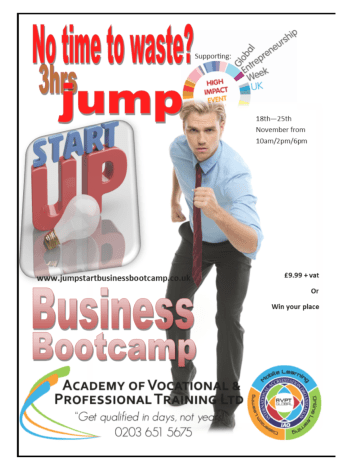
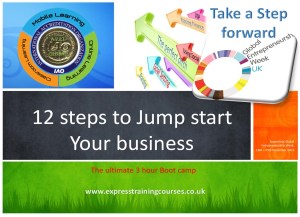
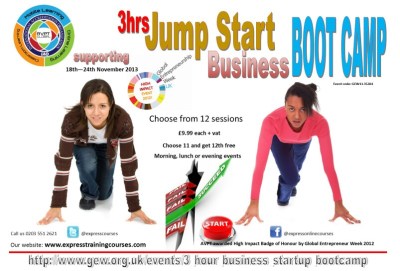
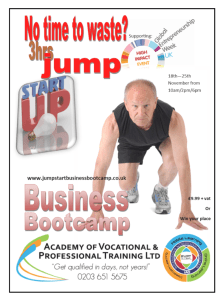
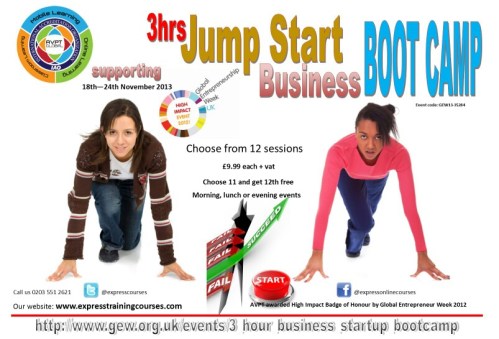
The Academy of Vocational and Professional Training was awarded a High Impact badge for its efforts during the 2012 series of events. On the back of this, it has designed a series of three hour ‘Jump Start Your Business’ master classes which focus on a dozen essentials that every entrepreneur-in-the-making should know.
Taking place throughout Global Entrepreneur Week (18 – 24 November 2013) the Academy of Vocational and Professional Training’s bootcamps are packed with practical information, indispensable no-nonsense advice, hands on guidance and immediately implementable strategy. Designed for anyone looking to start their own businesses, the sessions are led by experienced trainers and business gurus from the Academy of Vocational and Professional Training.
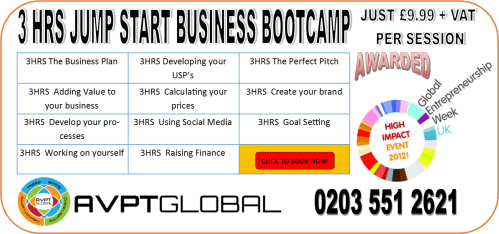
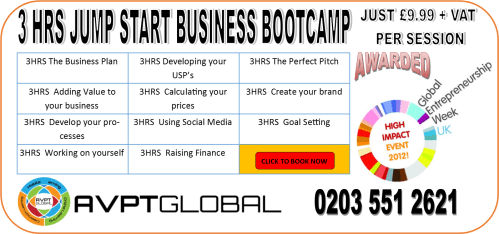
Starting right from the germination of an idea through to getting a fledging new company flying, classes on the 18th- 19thNovember cover how to write a business plan, identifying a USP, how to write a perfect pitch and adding value.
Calculating prices and worth, creating a brand, designing business processes and using social media will be tackled on the 20th– 21st. To round out the week, the bootcamp sessions will focus on the marketing plan, goal setting, working on yourself and raising finance.
Informative, professional and inspiring, the bootcamp has been designed to support key Global Entrepreneur week values. Taking place in more than 115 countries simultaneously, the UK programme of events is focused on getting more young people started in business to encourage a nationwide culture of entrepreneurism.
Diane Shawe founder and CEO of The Academy of Vocational and Professional Training said, “We were thrilled to receive our High Impact badge of honour in recognition of our efforts during last year’s Global Entrepreneur Week and are determined to do even better this time around!
“We know that starting a business can be an immense challenge and even though government and other agencies do provide some support, many of those interested in starting their own business can still feel overwhelmed. We have poured all of our knowledge and experience into creating our Jump Start programme of events. Feedback from last year’s sessions was so encouraging that we have further developed the concept, packed in even more useful advice and pledged to help everyone attending feel empowered and confident about taking their first steps in business.”
The UK Global Entrepreneur Week activities will be organised by Youth Business International. Its aim it to create a collaborative, local and practical week which makes it easier for those new to business to learn more and more easily access the support available to them.
AVPT is the only UK Globally Accredited online and workshop based provider of over 390 Soft Skills courses using a cutting edge, proprietary online Learning Management system.
The Academy of Vocational and Professional Training’s bootcamp sessions are all priced at £9.99. To register for a master class and to see the full timetable of events visit click here.
Diane Shawe M.Ed
The route to success is to take the things that we dream about and wish for, and turn them into reality. Thinking, planning, and taking action on the things we really want starts to set the wheels in motion. Just following our Smart Spirit guide will help you get to grips on how to start setting your goals.
Do you set goals for yourself now? What are some examples?
Do you write them down?
How often do you review your goals?
How do you reward yourself for meeting your goals?
You need to select things that motivate you and make you stretch.
Getting out of our comfort zone helps us create the circumstances that we need in order to get what we want.
Selecting easy goals won’t excite you and motivate you to go them.
If you want real change to take place, you’ve got to be willing to take some risks and go after what you want.
Setting goals with SPIRIT
When you are creating big goals, you may need to break them into several small, achievable goal statements.
Specific
Be specific about what you want or don’t want to achieve. The result should be tangible and measurable. “Look gorgeous” is pretty ambiguous; “Lose 20 pounds” is specific.
Prizes
Reward yourself at different points in the goal, particularly if it’s long-term. If your goal is to clean up the backyard to prepare for winter, you might treat yourself to a special meal cooked outside when you are all finished. For bigger goals, check your bucket list to see if there are things on there that could be good rewards!
Individual
The goal must be something that you want to do. If your spouse wants you to lose 20 pounds but you think you look fine, you’re not going to want to work towards the goal. When your boss is setting targets for you at work, try to find an aspect of it that is meaningful to you and that you can connect to. (This is where working with people and organizations that have similar values to you is helpful.)
Review
Review your progress periodically. Does the goal still make sense? Are you stuck? Do you need to adjust certain parts of it?
Inspiring
Frame the goal positively. Make it fun to accomplish. For example, you could make a poster of the end result, frame it, and post it on the wall.
Time-Bound
Give yourself a deadline for achieving the goal. Even better, split the goal into small parts and give yourself a deadline for each item.
Setting goals with SMART
Use the SMART method to create actionable goals. SMART is a mnemonic used by life coaches, motivators, HR departments, and educators for a system of goal identification, setting, and achievement. Every letter in SMART stands for an adjective that describes an effective way to set goals.
Specific. When setting goals, they should answer the highly specific questions of who, what, where, when, and why. Instead of the general goal, “I want to get into shape,” try for a specific goal, “I want to run my first half-marathon next year.”
Measurable. In order for us to track our progress, goals should be quantifiable. “I’m going to walk more” is far more difficult to track and measure than “Everyday I’m going to walk around the track 10 times.”
Attainable. It is important to evaluate your situation honestly and recognise which goals are realistic, and which are a little far-fetched. Instead of, “I am going to be very rich,” (while admirable) it might be more realistic to say, “I am going to increase my turnover by 10% quarterly.
Relevant. Is this goal relevant to your life and to the “big picture” questions you have already asked yourself? Some good questions to ask yourself when figuring this out are: does it seem worthwhile? Is now the right time for this? Does this match my needs?
Time-related. Setting a “due date” to meet goals not only keeps you on track, but it prevents pesky daily roadblocks from getting in the way. Instead of saying “I’m going to get my bank loan someday”, you might consider saying, “I’m going to get my bank loan in 3 months.”
Coping Strategy
Everyone has setbacks!
Remember to GET BACK ON AND KEEP GOING.
Evaluate your action plan and adjust as needed.
Goal achievers are optimists!
OUR ONLINE GOAL SETTING COURSE
What Will Students Learn?
Identify what’s important to you in your life
Use goal setting activities and appropriate language to articulate what you want in your life
Explain what your dreams and goals are for both the short and long term
Use motivating techniques to help you reach your goals
Understand how to deal with setbacks
What Topics are Covered?
Self-understanding
Laying the foundation
What’s in your bucket?
Getting down to business
Getting started today
Dealing with setbacks
What’s Included?D.C.
Instruction by an expert facilitator online
Specialised manual and course materials
Personalised certificate of completion
Click here to find out more about this online course
A man is just the product of his thoughts. What he thinks he becomes. Mahatma Gandhi
Can a book really inspire an entrepreneur?
article by Diane Shawe M.Ed
CEO of AVPT GLOBAL s.a.r.l
Every once in a while, you read a book that changes you — inspiring your career, clarifying your goals, challenging your thinking. The right book can give you the courage to start your business, the reality check that you’re not yet ready or the quiet affirmation that you’re not alone in your fears or ambitions. It can set you on your path to success. I have chosen 14 books one of which includes my own. I hope you like them.
Who Moved My Cheese?is an amusing and enlightening story of four characters who live in a maze and look for cheese to nourish them and make them happy. Cheese is a metaphor for what you want to have in life – whether it is a good job, a loving relationship, money or a possession, health or spirital peace of mind. And the maze is where you look for what you want – the organisation you work in, or the family or community you live in.
This profound book from bestselling author, Spencer Johnson, will show you how to anticipate change, adapt to change quickly, enjoy change and be ready to change quickly again and again. Discover the secret for yourself and learn how to deal with change, so that you suffer from less stress and enjoy more success in your work and in life.
Written for all ages, this story takes less than an hour to read, but its unique insights can last for a lifetime.
Spencer Johnson Author Publisher: Vermilion; Reprinted Ed edition (4 Mar 1999)
“To start a business, you just need to define a problem. But to wake up every day, no matter what, and DO that business, you need a reason. Ms. Rand taught me that focusing on a purpose is the best way to make a difference to my world.” — Jason Womack
The first ebook to advise you on ‘What they don’t tell you about Getting started in the hair extension business’ by Diane Shawe. Whether you are a beginner, been in business for a few years or want to explore how you can increase your annual turnover, this is an book designed to help you prepare yourself. A book for students, mobile hairdressers, professional hairdressers, beauticians, any one considering starting up in the hair business, hair consultants and specialist technicians. Useful for schools and colleges, private training schools and anyone currently running a hair and beauty business.
“I read [this book] when I was in college, studying marketing. It helped me to cement that this was the field for me and that at the end of the day, it’s all about creativity. Although at the time it refered to advertising, it’s actually applicable to all parts of the marketing mix. Ogilvy gives rules, but then breaks them. I love it!” — Jim Joseph
“This was one of the first business books I read and it taught me that ‘saving’ money is equally as important as ‘making’ money. I’m now requiring my teenage children to read the book and report back to me on how it impacted them.” — Mark Kohler
“This book was seminal for me early in my business career. It brought structure and insight to the at-the-time mysterious subject of leadership, and it addressed matters of both the head and heart.” — Mark Sanborn
“This book helped me in two very distinct ways. First, it opened my eyes to how business can be sourced and conducted globally for even the smallest of businesses — the global economy isn’t limited to the big corporations anymore. Second, it was life changing because it made me, as an entrepreneur, ask deeper questions about what I want out of life, not just the business.”
— Shari Alexander
Tribal Leadership, by Dave Logan, John King and Halee Fischer-Wright(HarperBusiness, 2011)
“Despite conventional wisdom, research reveals that naturally forming small groups of people within organizations, and not leaders, drive success, quality and innovation. This book provides a great framework for companies to build a culture of success, quality and innovation.”
— Ross Kimbarovsky
“I especially find this book to be helpful for businesses that are in the early stages of development as it teaches them to prepare for the many types of situations they may experience. As we all know, one of the biggest obstacles to overcome as an early-stage company is managing the element of the unknown. Strategy and preparation can, in many ways, guide a company and help mitigate future mistakes.” — Ryan Himmel
“The only thing worse than training people and having them leave, is not training them and having them stay”
The hard truth about softskills
article by Diane Shawe M.Ed
CEO AVPT Global S.a.r.l
Though the benefits of soft skills training may be hard to measure in the short term, individuals and organisations need to look beyond simple pain relief, from a symptom of a much bigger problem and toward a long term, system-wide wellness approach. Soft skills training is the key to job security and a healthy organisation, a successful economy that help people into work. There is a quick, effective and surprisingly quick solution offered by the Academy of Professional and Vocational training. Read on…
You may have heard the saying, that in business that you are either selling aspirin (making a customer’s pain go away) or vitamins (by making the customer’s existing situation better). The work at the Academy of Professional and Vocational training (AVPT) involves helping individuals and organisations with soft skills or behavioral competencies; things like interpersonal communication, self-awareness, conflict negotiation, collaboration and leadership. These soft skills are typically considered vitamins more than aspirin. But why should they?
Many organisations suffer a great deal of pain because employees lack proficiency in many of these interpersonal skill and all too often the only thing that has been transferable is bad habits, poor performance and ineffective execution of tasks. The pain may be as obvious and sometime quantifiable, but that doesn’t lessen its impact on the bottom line both for the company and the individuals earning power.
The downturn in the UK and global economy resulted in slashed budgets of training and development departments, and many departments jettisoned altogether. But what is the cost of not focusing on these people skills both now and in the near future? So which is more important: technical skills or soft skills? It seems that you need technical skills to get taken on by a company (which can be a big ‘if’) or to do an apprentice course, but soft skills are what help you succeed once you are hired. Both are ultimately important, but technical skills get a lot more attention, especially in a poor economy where securing a job is paramount.
Indeed it has been suggested by various people that in a number of professions soft skills may be more important over the long term than occupational skills. The legal profession is one example where the ability to deal with people effectively and politely, more than their mere occupational skills, can determine the professional success of a lawyer (See the rather marvelous article by Giuseppe Giusti: Soft Skills for Lawyers, Chelsea Publishing ([2]), 2008)
A recent survey conducted by the Graduate Management Admission Council found that although MBA’s were strong in analytical aptitude, quantitative expertise, and information-gathering ability, they were sorely lacking in other critical areas that employers find equally attractive: strategic thinking, written and oral communication, leadership, and adaptability.
To get, and keep, a job you typically need a repertoire of technical skills. Dentists need to know how to fill cavities. Secretaries need to type 100+ words per minute. Accountants need to take long term qualifications. But beyond the technical skills, though, which dentist do you go to?
The current state of Europe
At least 26 million unemployed people have been looking for work across Europe during the long, hot summer of 2013. They will not be the only ones looking. Millions of school and university leavers will join them in the search. Millions more are looking for more work than they already have – another part-time job, or a full-time job in place of part-time work.
Have you planned to join that group or stay a member of that group or are you planning to solve your problem?
While your technical skills may get your foot in the door, your people skills are what open most of the doors to come. Your work ethic, your attitude, your communication skills, your emotional intelligence and a whole host of other personal attributes are the soft skills that are crucial for career success.
Interact with Soft Skills and get the new Hard Skills of the future
Traditionally, people don’t receive adequate soft skills training – either during vocational instruction or as part of on-the-job training. That’s why services like those of AVPT are great for helping people build great people-skills. What is a huge bonus for employers is that courses in soft skills are cheap, quick (none last more than 4 weeks), effective and have global accreditation.
As an apprentice, development of these skills should be encouraged alongside regular training and study. The development of these skills is about learning through guidance, practice and working out which areas you could improve on. Excellent online courses in communication can be very important in gaining a vital interpersonal skill.
Just take a look at what the future is going to look like with big data? What type of jobs could you create for yourself\/
Working as a team is key to the success of any company and something that you can be taught by the latest online courses. If you are not used to it, it can be difficult to cope with people with different personality traits who you may clash with in the outside world. Teamwork development will come as you work on different projects and learn the best ways to negotiate and liaise with others.
For an apprentice it is essential that they have the opportunity to develop their soft skills and through an online (but guided system of virtual tutors) like that offered by AVPT) it can be done quickly and cost effectively alongside the technical training. Being proactive is a personality trait that some people are born with while others have to work on its development. It is the difference between being the person who is always being told what to do or being the person that goes out there and figures it out for themselves. It is a skill that is valued amongst employers as it makes companies more productive.
Although building workforce competency is generally focused on first-time employees, human resource professionals say in Critical Skills Needs and Resources for the Changing Workforce—a poll released in June 2008 by the Society for Human Resource Management (SHRM) found that many workplace soft skills have become more important for experienced employees than for new workers. These skills include critical thinking/problem solving, leadership, professionalism/work ethic, teamwork/collaboration, and adaptability/flexibility.
Become a Virtual Teacher Facilitator
Proficiency in these soft skills separate organisations who may survive yet another year versus those who grow, adapt and are able to compete in a global economy. Employees proficient in soft skills demonstrate higher employee engagement, greater productivity, and help make an entire organisation more competitive in the marketplace. It makes sense to look at the new training paradigm offered by Academy of Vocational and Professional Training Ltd.
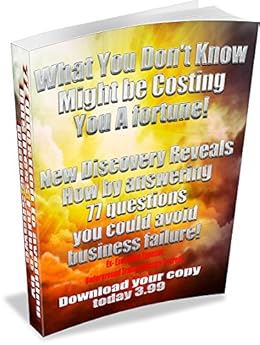
In 2013, 62 per cent of all start-ups will fail within their first year of trading.
We have evidence to support this and yet we see that many people are now being forced into self employment as a result of the most intense financial economical downturn. Yes we are all going through economic hell in the United Kingdom at the moment; but there is a need for us all to keep going.
This astonishing statistic, and one that becomes even worse in certain parts of the country. In parts of the UK business failure rates have reached almost 85 per cent.
Yet the truth is that half a million people per year set up new businesses.
They do so for a number of good reasons including
being in ‘control’,
‘being their own boss’,
‘getting a better work / life balance’
‘freedom’.
only way to earn some money
Do any of these thoughts resonate with you? Most business owners work very long hours, for very little reward. Having met with many owners and business people I think that is universally true. They often cannot afford or have not planned to take on anyone else. In the United Kingdom, nearly 99 % of business is made up of SMEs (Small to Medium Enterprise with less than 250 people), amounting to almost 4 million SMEs. Of these, the staggering fact is that 97% of which have fewer than 20 people and 70% are one-person owner managed businesses.
But here is the really stunning fact you may recognise; most of these business owners end up investing all their money (or family savings) and giving up the very reasons they started the business: freedom, work / life balance and control. Far be it from being in control, most businesses and business owners are in fact spinning out of control, being highly reactive rather than proactive, with no real goals, no clear vision and many being so time deficient that there is no time to think, let alone have time for a plan.
So why do so many business fail and so quickly? Consider this quotation from Sidney A. Freidman (I have it over my desk),
“You can achieve anything you want in life if you have the courage to dream it, the intelligence to make a realistic plan, and the will to see that plan through to the end.”
The ‘courage to dream’ is essential and business owners have without question been courageous.
However that dream must be qualified by a very sound non-emotional understanding of money and finance. From cash flow to paying too many people too much, most people start out in business without any idea of how much money is really required. They don’t then make a plan or even an intelligent business plan. Those brave souls who start their own business and take all those risks then fail as they give up far too quickly. Any new business will be lucky to break even in their first year. Many people new to business often assume that they are going to make a fortune within 12 months. The truth is less than 80% of new start-ups make a profit in their first year. You need to have the will to see that plan through to the end.
Years ago you would have been looked up for having a ‘vision’. Now it is considered essential for business owners. But having a vision is not enough. Failure starts when the manager is incompetent. Most small businesses fail because the owner does not have the knowledge to run a business properly.
Must business don’t get the importance branding; their own personal brand or their business brand. Every single piece of your company has to scream out your brand including your brochures, websites, delivery vans and the uniforms that you and your staff wear. Everything has to congruent.
I am continually surprised that most people that are afraaid to sell. This essential soft skill (which I teach and we have brilliant short online courses waiting for you) of how to close the sale is a MUST HAVE item. This is an art form that needs teaching. Some people are naturally good closers but others have to learn by reading and studying. The more you practice the better you will become. So make a note to self: learn how to sell!
One really crucial understanding for all employees and the owner is understanding what the true demand is and the companies own Unique Selling Point. Small businesses often overestimate the demand and usually have no unique selling proposition built in to their products.
Now here is the crucial point so often ignored by new business owners. You need the ability to get on with other people. A brilliant ‘soft skill’ that can be acquired. We all know that we have to treat our customers with respect but what about our suppliers? I am amazed that I have to explain to intelligent people that this is an essential of business success. If you do not pay your suppliers on time they will start quoting you higher prices. If you are rude to them they might stop doing business with you altogether. I like the Tony Robbins thought that,
‘The degree to which you manage your relationships is often the degree to which you will be successful’.
In my experience from commercial mediation (a sensible alternative to conflict) a huge proportion of a manager’s time is wasted on managing unwarranted conflict, misunderstanding and so on, that could amount to over a full working day per week. So, could you be more productive if you used this ‘conflict time’ for ‘selling time’? Want more money?
Finally, a large number of businesses fail because they are over-reliant on a very small number of clients. This is the hidden danger that lurks for all business owners. It takes just one unexpected closure to result in significant financial hardship. Short-term future earnings can be massively reduced, and invoices for completed work can go unpaid. While maintaining caution about spreading yourself too thin, try not to rely on a very small client base. If you deal with a very few clients, or if a small number make up most of your turnover, you must start finding and bringing in new clients and business. Right now.
A business needs a good business plan that covers all these issues and makes them part of a living, working document. If you want back control of your life and your business then write a plan and get help (with writing or implement it). Business failure can be quick and unexpected. Make sure that you are totally aware of the major risks facing your company and ensure that you are in the best possible position to avoid them.
Churchill was right. Make sure when you have the courage to dream that you make an intelligence to plan and have the will to keep going. If you’re going through hell, keep going.
Have you ever wondered why some people seem luckier than others? Have you ever been (mildly) annoyed that others attract more referrals than you? There has got to be a reason, hasn’t there? Well a good definition of ‘luck’ is when action meets opportunity. People that help other people every chance (they get) almost always come out on top. I am amazed by the simple gestures of holding a door for someone, returning a lost wallet and giving someone a referral produces 2 things: First, the feeling that the person on the receiving end of your kindness is compelled to reciprocate; and second, you create a positive thoughts/feelings about your self-image. There’s something very powerful at play that causes this phenomenon.
Psychologists call it The Law of Reciprocity and it says that when someone does something nice for you, you will have a deep-rooted psychological urge to do something nice in return. It is buried deep inside our DNA and is an evolutionary survival mechanism. As a matter of fact, you may even reciprocate with a gesture far more generous than their original good deed. You can try and resist this law, but your DNA will intervene and you will more than likely still feel that you need to respond in kind to a good deed. If that’s true (and it is) then it would be to your advantage to understand the right way – and the wrong way to take advantage of this powerful law.
Do you think that the Law of Reciprocity can make or break your business?
Diane Shawe the CEO of the Academy of Vocational and Professional Training states “the law of reciprocity is like a karmic “piggy bank”. What you broadcast into the universe, whether it is positive or negative, is a deposit due to be returned to you. Your deposits may be returned quickly, without the effects of past and future deposits added” but then she goes on to say “How then do we define the purpose of Business Etiquette?” interesting combination.
For this reason, it is wise to bank positive deposits often.
As someone who is running (or is aspiring to run) their own business, there are a couple of ways you can invest in the use of reciprocity: the Constructive Way and the Destructive Way.
The Constructive Way
One of the hardest parts of a new business relationship is building trust and rapport. To do that, there are some things you have to establish up front with a potential client to show them you’re one of the good guys. These fall in the area of intent, empathy and credibility. So, if you really are one of the good guys, you can show people what you’re made of simply by being friendly, honest, and helpful. That’s the idea behind a lot of the freebies that bloggers give away all the time. By giving something that’s of legitimate value away with no expectation of compensation, you’re achieving several things.
If the material or help you’re giving away is of high quality, you’re establishing yourself as a person of credibility – someone who knows what they’re talking about.
You’re demonstrating empathy by showing the recipient that you understand they’re looking for answers. You understand that they need help – and you’re someone who’s willing to give it to them.
You’re showing that your intent is not just to get into their wallets – but to sincerely help.
In the process, you stimulate the DNA program of The Law of Reciprocity. When you establish yourself as an honest, sincere, and giving person – you make it much easier for people to buy from you when you have something to offer. It is at that point they already like you, they have seen that you know your stuff, and they trust you. All that makes it much easier for them to choose you.
The Destructive Way While responding to The Law of Reciprocity is hard-wired into us, most people aren’t stupid, but can often be inexperienced or too trusting. If the Law is exploited as a tactic, they often experience a lot of discomfort and dis-ease about the situation. Even though I use the word ‘exploiting’ ( I don’t believe that most people conspire to use this law) you might best understand it as someone being false’ pretense, a front; you are pretending to be sincere and helpful, therefore only to trick people into feeling a sense of obligation. Poor salespeople are easy to find – and when someone is using reciprocity as a pressure tactic, it’s obvious. You’ve been there as a consumer.
I’ll bet you don’t have to go back very far in your memory bank to remember a time when someone seemed a little too nice. Even though they were doing something positive for you, you still instinctively didn’t trust them. That’s because their intentions weren’t sincere and you sensed it. Using the Law that way may trick someone from time to time, but it likely won’t lead to repeat sales, good will, or referrals. Pressured prospects tend to disappear quietly.
So the right way to gain maximum benefit from the Law of Reciprocity is to use it sincerely and for the right reasons: to help others and to grow your relationships. There are a lot of aggressive sales and marketing people out there, but listen to them with caution. Consumers are smarter than ever before. Being aggressive tends to offend and alienate. Instead, aim for active and inclusivity. What’s the difference? Aggressive is relentless and pushy. Active and exclusivity is, well, active listening and keeping them involved.
If what you’re selling is truly of value, you don’t have to be a bully to get people to buy. You just have to work hard to get your name out there and develop your brand. Since you are one of the good guys, ask yourself; What small thing can I provide today that my customers can really use?
When you come up with an answer – give it to them. It’s the right thing to do – and because of The Law of Reciprocity, your customers will gladly return that generosity when you do have something to sell.
AVPT is back for more after being awarded A High Impact Badge of Honour by the Global Entrepreneur Week in 2012
This year we have set up a range of 3hr ‘Jump Start’ your business bootcamp in support of the Global Entrepreneur Week starting on the 18th – 24th November 2013
3 hour business startup bootcamp 2012
Last year 361 organisations ran activities in 2012 that met the
High Impact criteria set by Global Entrepreneurship Week – AVPT along with other High Impact providers was congratulated this week and awarded their high impact badge of honour.
Global Entrepreneurship Week is the world’s largest campaign to promote entrepreneurship, taking place in 115 countries. In 2012, the campaign took place 12-18 November and Academy of Vocational and Professional Training supported the week by launching a 3 hour Business Startup Bootcamp which was attended by a group of candidates who enroled on the GEW website.
In the UK, the campaign is hosted by Youth Business International, a global network of initiatives that help young entrepreneurs to start their own business, in partnership with Barclays.
The theme for 2012 was: Pass it On! AVPT supported Global Entrepreneurship Week UK to pass on the practical help & support needed by early start-ups and individuals who are considering taking the plunge. GEW’s aim was to create a collaborative, local and practical week which enables people to learn more about the wealth of support that is available to entrepreneurs in the UK. Read more…
PLEASE SEE TIMETABLE BEFORE BOOKING YOUR BOOTCAMP!
Got to make a presentation? Make a wedding speech? Say something at an event? Nervous? How AVPT Global can help you right now with the fear of public speaking.
Having trained hundreds of people in brilliant public speaking (and many more to be Standup comics) I am often asked about the causes of Glossophobia. This is a type of speech anxiety and is most commonly the fear of public speaking or of speaking in general. An estimated 75% of all people experience some degree of anxiety and nervousness when public speaking. I am lucky and don’t suffer- whatever size the audience. The good news is it can be cured and overcome.
The more specific symptoms of speech anxiety can be grouped into three categories: verbal, physical and non-verbal. The verbal symptoms include, but are not limited to a tense voice, a quivering voice, and vocalised pauses, which tend to comfort anxious speakers.
The symptoms I see the most in training are the physical ones. These result from the sympathetic part of the autonomic nervous system responding to the situation with a fight-or-flight adrenalin reaction. Since the sympathetic system is all-or-nothing, adrenaline secretion produces a wide array of symptoms at once – all of which are supposed to enhance a student’s ability to fight or escape a dangerous scenario. These symptoms include acute hearing, increased heart rate, increased blood pressure, dilated pupils, increased perspiration, increased oxygen intake, stiffening of upper back muscles and the classic dry mouth. None of which are much good when you are about to give a wedding speech. The good news is they can be relieved with training and some skilled guidance.
Looking good when speaking under pressure
Public speaking experts agree that one of the most important steps in preparing for a speech is practice. Yet after giving the same speech so many times, it can be difficult to maintain an authentic voice, especially once nerves kick in. More than anything, a successful speech hinges on your ability to know your audience and establish a connection. Shape your speech around a subject that you genuinely care about and try to focus on what you have to offer your audience.
Your concentration will naturally shift away from what is at stake for you personally, calming your nerves and allowing you to connect to your audience in a real way. Then, tell a story. Take the audience on a journey. While there are many aspects that will contribute to the success of your speech, it is the authentic, heartfelt moments that will be remembered most.
The importance of learning to speak in front of an audience is undeniable; invariably intertwined with leadership, motivation, and change. While Glossophobia is common, in fact the most common phobia in the UK, it is certainly a fear that can be overcome. But the power of spoken word is reason in itself to push past that fear.
So remember that nerves are natural: use your nerves to propel you through the speech, and know that your physical response to stress will only make the speech all that much more rewarding once you finally step down from that stage. Remember to be authentic: pick a topic that you truly care about, and the audience will be stirred to care as well. And finally, don’t be afraid to aim big. You were chosen to speak for a reason, and you have a meaningful story to tell. So take slow, rhythmic breaths and change the world- and take this course in conquering your fear of public speaking!

 Article written by: Rebecca Appleton at Dakota Digital
 “We know that starting a business can be an immense challenge and even though government and other agencies do provide some support, many of those interested in starting their own business can still feel overwhelmed. We have poured all of our knowledge and experience into creating our Jump Start programme of events. Feedback from last year’s sessions was so encouraging that we have further developed the concept, packed in even more useful advice and pledged to help everyone attending feel empowered and confident about taking their first steps in business.”

























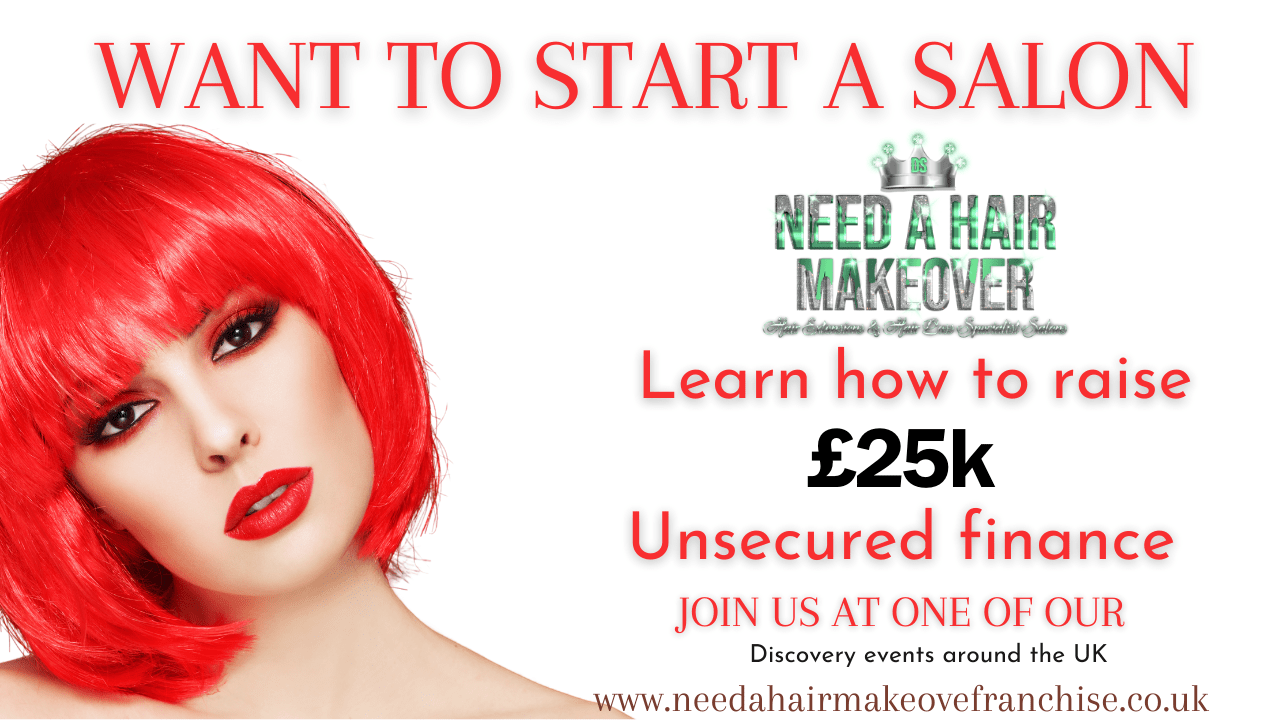

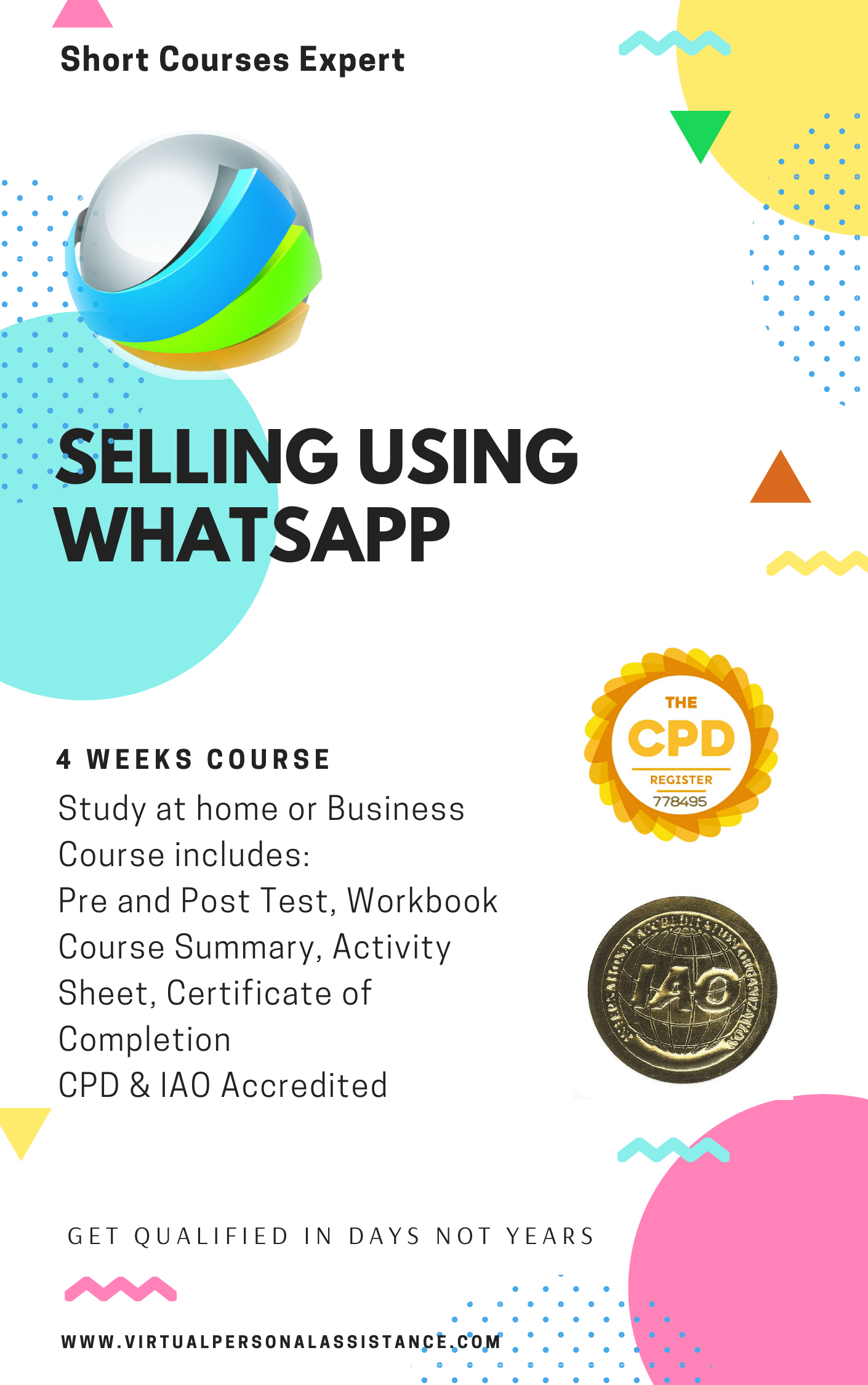








 All about Hair Extensions & Hairloss Courses and Franchise Opportunity by Diane Shawe
You must be logged in to post a comment.