Category Archives: mobile phone broadcasting

High Blood Pressure, Hypertension: The New AIDS Epidemic?

high blood pressure check your now

Strokes, Heart attack, thinning arteries

High blood pressure could be as devastating to global health as AIDS, causing more deaths over the next two decades than the infectious disease, a group of international experts is warning.

article by Diane Shawe M.Ed

Writing in the International Journal of Epidemiology, three British experts in international health said most governments and aid agencies around the world are doing too little to combat high blood pressure, and that current efforts to target the condition mirror the halting global reaction to HIV/AIDS 20 years ago.

hypertension can move you towards high blood pressure

Manage your Hypertension

In an editorial entitled “Is hypertension the new HIV epidemic? ” the authors — Peter Lloyd-Sherlock from the University of East Anglia, and Shah Ebrahim and Heiner Grosskurth of the London School of Hygiene and Tropical Medicine — suggest that “valuable lessons for hypertension could be taken from HIV/AIDS policies,” but health officials are not applying them to the growing rate of high blood pressure.

“Our response to the global epidemic of hypertension seems little better than our response to HIV/AIDS two decades ago: too little too late,” they write. “Can we not wake up earlier this time, before millions have died?

Hypertension is seen as a disease of the West, of prosperity and therefore of little relevance to poorer countries. This is despite the growing body of evidence that prevalences in poorer countries are quickly catching up.” They noted that hypertension is a non-communicable (NCD) disease and argued that the behavioral factors associated with it —obesity, lack of physical exercise, and poor diet — make it difficult to persuade funders and taxpayers to help people who “eat and smoke too much.”

They added that the situation is reminiscent of the slow response to AIDS prior to 1990. “HIV was faced with political denial and public misunderstanding in the early years of the pandemic, especially in some poorer countries,” they said. “There is a similar pattern of denial with hypertension … based on the misguided view that hypertension does not affect poorer social groups.”

“Yet there is substantial evidence that hypertension is highly prevalent among poorer groups and that they are less likely to have access to effective treatment. As with HIV, hypertension can be both a cause and a consequence of poverty, over work, non satisfaction in your job, debt, no job.”

hypertension caused by stress at work  can move you towards high blood pressure

Job burnout and stress in epidemic proportions

Managing your stress and Hypertension in the West.

Today’s workforce is experiencing job burnout and stress in epidemic proportions. Workers at all levels feel stressed out, insecure and misunderstood. Many people feel the demands of the workplace, combined with the demands of home, have become too much to handle. A one-day workshop explores the causes of such stress and suggests general and specific stress management strategies that people can use every day.


Sourced from © 2014 NewsmaxHealth. All rights reserved.

Available from Amazon and Google Books

Social Media challenges for Rainmakers’ How to use linkedin even when you hate selling!

solicitorsgroup logo

LAW2014 18-20 MARCH 2014
KENSINGTON TOWN HALL, LONDON

Although some professional often think that social media is a tacky way of selling,  it is not. Negotiating the process of how you introduce your company and services is just  one stage of that process. There are three  stages  timing, intuition, and flexibility.  Law2014 Strategies for Success conference will be looking at some of the threats posed to the high street law firm by the introduction of ABS it is more important than ever for the high street law firm to maintain their customer base and effectively market themselves.

The Strategies for Success conference is the essential conference for all Management and Marketing personnel working within high street law firms and will provide the busy high street law firm professional with practical marketing tips in an increasingly competitive market place.

The conference will focus on strategies the high street law firm can adopt not only to ensure their survival in the face of fresh competition but to prosper in the new legal landscape. A line up of impressive spreakers on the topics to be covered will be:

Diane Shawe 1Social Media Challenges for RainMakers – how to use Linked In even when you hate selling!
Diane as a founder and CEO of two successful Training Companies based in London and Luxembourg Diane has built the company from a standing start in 2003 to a globally recognised training provider with an impressive year on year growt

john espley

John Espley, Peapod Legal Office

Strategies For Success for Small Law Firms
John has been working in the legal market for 10 years and has always helped small law firms to become more profitable

Alan Joenn

Alan Joenn, Collier Pickard

Fee earners and CRM – why both?
Alan Joenn is the Marketing Director at Collier Pickard. He has over 35 years’ experience in business automation, office automation and personal productivity within the IT sector and the commercial arena.

Phil Dedman

Phil Dedman, Mediaworks

Demystifying SEO 

Phil has worked with many global companies over the last 25 years and continues to be involved with companies internationally for both SME’s & Blue Chip companies

Roger Lane

Roger Lane, Actionstep UK

Modern Practice Management Go Beyond Managing the Matter 

Roger Lane, has spent over 30 years in the IT industry in a wide range of roles, including sales & sales management (including international), product marketing, strategic marketing and general management

Mark Scane

Mark Scane  ITM

Rani Sur

Rani Sur ITM

How to ease the burden of Auto Enrolment – The role of middleware 

Mark is a highly experienced consultant in corporate employee benefits with over 12 years within the pension and benefits market. Whilst Rani is a Senior Technical Consultant at ITM, the leading independent pension data and administration consultants. Rani works with the development and innovations team designing and developing the Auto Enrolment solution at ITM

Clwyd Probert

Clwyd Probert, Whitehat

The Google Zoo: Effective Internet Marketing Strategies For Law Firms 
Clwyd Probert is the founder, CEO and chief technical architect of Whitehat SEO. He is a technologist and marketer with international experience in London and New York

Each speaker is going to set out some of the real nuggets high street solicitors should put in place to establish a firm ground for all considerations once you decide to seriously utilise some of the benefits of Social Media and through the internet.

Diane Shawe M.Ed will be speaking on Thursday 20th March 2014 at 9.30am.

The LAW2014 event is to be held at Kensington Town Hall
Hornton Street, Kensington. London, W8 7NX

Open times

18th March – Day 1 – The event will be open between 8.30am – 5.30pm.

19th March – Day 2 – The event will be open between 8.30am – 5.30pm.

20th March – Day 3 – The event will be open between 8.30am – 4.00pm.

Successful Rainmakers do not focus on selling, successful rainmakers take time to understand what their clients’ needs are—not what they hope or think the clients’ needs are—. The only way to discover what clients require is to communicate, collaborate and then listen to their answers. Only after clarifying their clients’ needs do successful rainmakers try to provide a services to fit their needs.

Diane will report on the 9 mistakes businesses make with Linkedin.

Solicitors can book their 1 day course on how to set up a prime linkedin profile at stand 6.

Solicitors can book their 1 day course on how to set up a prime linkedin profile at stand 6.

express training courses membership and accreditation diane shawe

Is there really a global skill race?

new rules of engagement towards long term employability-Entreployability the new breed by Diane Shawe jan 2014If there is a global skill race, who’s winning?

Governments all over the world want their countries to have high-value, high-skill economies, and they realise that the first step towards this aim is to have a well-educated workforce. In the UK, an appreciation of the connection between economic success and education has led to widening participation in university, as well as lifelong learning, being politicised as a priority.

But many Commentary from the organisations such as the Teaching and Learning Research Programme shows that this policy prescription may not be enough to avert a significant attack on skilled and professional employment in the UK.

Policy-makers have yet to appreciate the fundamental shifts which are now taking place in the way companies use skilled people. Large firms are increasingly aware that emerging economies, especially but not exclusively India and China, are building up their education systems at a rapid rate. Leading corporations are abandoning the idea that high-end activities such as research and design have to go on in the high-cost economies of Europe, North America or Japan. Instead, they are developing ways in which high-value work can be standardised, as manual work already has been. Once this is achieved, high-skill people in low-cost countries suddenly become an attractive option for multinationals.

This means that we may be entering an era in which many of the young people now investing heavily in their education across the developed world may struggle to attain the comfortable jobs and careers to which they aspire. They risk being bypassed by decisions to send work that would once have come their way naturally to people in Asia and elsewhere, who bring the same skills to employers at much lower prices.

We know that many people would argue that UK employers should provide work for UK people, but with the global competitive markets forcing prices down, UK employers need to remain competitive if they are indeed wanting to sell any of their services.

The Challenge

At least 26 million unemployed people have been looking for work across Europe during the long, hot summer of 2013. They will not be the only ones looking.

Millions of school and university leavers will join them in the search. Millions more are looking for more work than they already have – another part-time job, or a full-time job in place of part-time work.

And millions of others are not registered as unemployed but are also searching for paid work to supplement their income: pensioners in need; partners of someone in work whose wage has fallen; students who are studying full-time but cannot survive without a job on the side; children who are officially too young to work but whose families need the money.

Four key components that contribute to the challenges we all face ahead:

  1. Multi-Generational Workplace
  2. Technological Development
  3. Inexperienced
  4. Globalisation

13 Questions governments around the world will need to address that will affect you and your children’s children.

In order to help shape the
debate over labour and entrepreneurial policy for the twenty-first century we need to get involved in asking these questions throughout our communities, educational institute’s and economists. Questions such as:

  1. How do we ensure that workers get the skills they need to succeed in the twenty-first century workplace? (Not just the young people but those unemployed now)
  2. Will employers hire and train workers who initially lack skills?
  3. What happens to the worker laid off from a manufacturing job at age 55 —does he get training in new technologies or is he stuck in lower-wage jobs like groundskeeper, security guard, and warehouse stock controller?
  4. How do we make sure that people with disabilities have access to the technologies that facilitate their participation in the workplace?
  5. How will e-commerce impact employment?

To find out more, order your copy of ‘The new rules of engagement for long term employability’ By Diane Shawe

new rules of engagement towards long term employability-Entreployability the new breed by Diane Shawe jan 2014

Enterprise Women Launching Club in Kensington, Chelsea and Westminster

Calling ALL BUSINESSWOMEN in Kensington, Chelsea and Westminster!!  Are you looking to grow your business and build strong local networks of trusted peers who will share and learn from each other? Do you want to be part of a community of substance that understands female-owned businesses and delivers practical value to its members?

County House
Date:

Tuesday, March 25, 2014 – 10:00 to 12:00

Venue:

County House

Venue address:

46 New Broad Street, London, EC2M 1JH

Price:

£27.60 inc VAT (includes lunch)

Then local host, Diane Shawe, offers you a warm welcome to join her at the Kensington, Chelsea and Westminster Women’s Business Club launch. The event is for women who are looking for that extra special support, advice, collaborative relations to help them develop and expand their business.  Join us on Linkedin

Get your free copy when you attend this event

Diane is Chief Executive Officer of the Academy of Vocational and Professional Training Ltd, which provides online and workshop fast-track soft skills training courses, Ms. Shawe is passionate about technology and the impact it will have on delivering training to students on the move that can be measured and proven. In addition Diane sits on several executive committee which includes the Conservative Education Society. As well as being a published author of several business books including, “The 10 habits of a successful women Rainmaker – From Tactics to Strategy: What works”, which is included!

Our first theme will be called, “No Random acts of Lunch.” The people who are most successful at business development, do not commit “random acts of lunch”.

Diane, will also be discussing how plans can take on many different forms and why developing your negotiation skills is VITAL! She will look at the 10 steps of honing in your negotiation skills, so that you never have to stumble away feeling unsure, vulnerable or disappointed about a meeting or presentation.  This will be the best 2 hours you could spend.

We are delighted to have guest speaker Bev Hurley at our meeting. A dynamic serial entrepreneur, mentor, angel investor and one of the UK’s leading authorities on female entrepreneurship, Bev Hurley has spent more than 30 years building successful businesses of all sizes – and sharing her expertise to create and grow hundreds of others.

PRESENTERS FOCUS

Diane Shawe

The Kensington, Chelsea and Westminster Business Club is being hosted by Diane Shawe. She is the founder and CEO of two successful training companies based in London and Luxembourg as well as an established publisher of several business books. Diane has a wealth of knowledge and experience across multi-disciplines. Diane believes that people should try to integrate the following practice into their daily lives: “never do anything as though you are a professional amateur”

Bev Hurley

A dynamic serial entrepreneur, mentor, angel investor and one of the UK’s leading authorities on female entrepreneurship, Bev Hurley has spent more than 30 years building successful businesses of all sizes – and sharing her expertise to create and grow hundreds of others.
So what are you waiting for? Book your place now!

We look forward to seeing you all there…

To book your place, first log in or create a new account, and click the BUY NOW

If you have any problems registering for this event, please email farhana@enterprising-women.org
or
diane@avptglobal.com

Academy of Vocational & Professional training becomes approved training provider for Growth Accelerator

AVPT Growth Accelerator Training Providers 2014The Academy of Vocational and Professional Training are excited to become an approved training provider for GrowthAccelerator through Grant Thornton.

GrowthAccelerator is a partnership between some of the UK’s leading, private sector growth specialists – Grant Thornton, Innovation and Winning Pitch and backed by Government, to help businesses with high growth potential. If you have fewer than 250 staff, and less than £40 million turnover, you may qualify for up to £2000 per person funding for leadership and management development.   Diane Shawe the CEO is delighted to be supporting the new GrowthAccelerator initiative .

GrowthAccelerator, is a new £200m Government backed programme that aims to provide SMEs across England with the know-how and ability to achieve rapid and sustainable growth.

Lotwina, one of the growth managers at Grant Thornton London, explains  “the GrowthAccelerator initiative  incorporates a training grant for bespoke training development programmes for  management team; expert coaching support and tailored business workshops”.

AVPT will be delivering bespoke training courses in Leadership and management which are a key part of GrowthAccelerator, with every participating business given an opportunity to develop the skills of their leaders and senior managers through match-funded training.

Through GrowthAccelerator, businesses can claim up to £2,000 per senior manager to match fund the cost of leadership and management training that supports the growth objectives of the business.

business man hand touch virtual 3d leadership skillMatch funding significantly increases the value of any senior management training your client invests in – and gives you an opportunity to deliver more leadership and management training relevant to your client’s needs.

Currently there is no limit on the number of senior managers who can be supported, and different managers within the business can undertake different training programmes.

GrowthAccelerator has been developed for businesses with the capacity, commitment and ambition to significantly increase their turnover or employment over the next few years. Many of the companies that AVPT works with and supports are exactly those that this service is aiming to attract and engage with. We are therefore working closely with the GrowthAccelerator programme to cross-refer potential clients and to ensure a good fit between our respective offerings and activities.

Growth Accelerator Diane ShaweWe would love to check your eligibility. We can then partner with you in order to build and deliver a 50% funded training programme that will help power your business to the next level.

For more information and to see how GrowthAccelerator could help your business, please email us on growthaccelerator@expresstrainingcourses.co.uk

80% students get qualified

10 reasons why mlearning is vital to SME’s

It is imperative that SME's utilise moble learning to improve the bottom line

It is imperative that SME’s utilise mobile learning to improve the bottom line

Why Online and Mobile Learning is Essential for Small Businesses

article by Diane Shawe M.Ed

The world of online learning is changing the way training can be delivered very rapidly. There is no doubt that mobile learning is hot and for good reason. If it is done right, it can produce great results for small businesses by decreasing costs and improving performance. Understanding mLearning’s value helps businesses make the best decisions about when and why to use it. Here are some compelling reasons.

What most people, employers, entrepreneurs and even some educational institutions do not have in today’s current environment is time the necessary resources and the infrastructure they need to support and achieve their learning objectives

“Continued Professional Training is imperative for SME’s if they are to compete from the bottom line up, & become sustainable business.  It is not a luxury expenditure but a vital investment as we see more and more Global Small Businesses evolving around the world”  says Diane Shawe M.Ed

There are a variety of Mobile Devices to choose from that can be used for Mobile Learning. Some of the more popular ones include: Samsung Galaxy range, Blackberry, Notebook, Palm Pilot, Apple iPhone, Tablets, Apple iPad, Apple iPod Touch, and many other up and coming tablets and notebooks.

So let us take a look at 10 reasons why mLearning is a better approach for training staff within the SME sector…

1.      Decreased training costs.   With mLearning, each time the course is accessed your return on investment improves because you are dividing the fixed production costs by number of uses. You also have savings through decreased travel, reduced material, and hopefully improved (and more efficient) performance.

2.      Less material costs.  Let’s say you have to train how to arrange equipment in a sterile environment like an operating room.  If you had to use the real environment, it would be costly.  Even setting up a virtual environment has material costs and labour.  By creating the environment online and letting the learner practice, you never have to worry about the costs associated with set up, use, and clean up.  There is also the vast savings on BYOD

Information management courses with avptglobak

Information management courses with avptglobal

3. Increased productivity.  Because mLearning is not bound by geography or time, you can control how it impacts on production by training people during down times.  In addition, with the current economy, you’re asking people to do more with less.  So mLearning is a great way to give them the tools and skills needed to enhance their performance.

4. Getting the message across.   mLearning allows businesses create a standardised process and consistency in the delivery of content.  It also compresses delivery time.

5. Synchronous and Asynchronous Learning: Live learning events require that those who participate align their schedules to the training calendar.  mLearning eliminates this because the course can be accessed anytime, anywhere.  Great for businesses and learners!

6. Giving the freedom to fail.  Real learning requires some failure.  But no one likes to fail in a classroom full of other people.  mLearning lets you fail without fear.  This encourages exploration and testing of ideas.  With the right feedback you create a great learning environment.  Worst case, you can always start over.  Something you can’t always do in class.

7. Learning and Retaining.  The combination of multimedia and instructional design can produce a very rich learning experience that is repeatable.  Throw in some good practice activities with feedback and you have a learning environment that’s going to help your learners retain the course content which will produce results.

8. Student Centred learning.  Look out the window at a car park. My guess is that you’ll see a dozen or more different cars. They all do the same thing, yet we have personal opinions about what we want to drive; the same for learning.  Learners want control.  mLearning allows you to offer control to the learners in a way that classroom learning doesn’t.

9. Learning Management: mLearning includes all sort of online technologies. It incorporates some of the tools that allow collaboration and conversation and can capture organisational knowledge that is available for future learners.

10. The Sharing Economy.  The foundation of a learning community is built on sharing what you know with others.  This is where incorporating a forum with the LMS (Learning Management System) adds value to business mLearning. Depending on how the course is structured, you can encourage sharing of resources and insight gained from the course.

In addition to all these advantages, mLearning is really good for the environment. An Open University’s study found that producing and providing distance learning courses consumes an average of 90% less energy and produces 85% fewer CO2 emissions per student than conventional face to face courses.

One of the challenges with making mLearning effective is how you manage the courses and access to resources. If you’re using a learning management system you might consider how that impacts the learning. MLearning is cost effective and can produce great results.  It’s all a matter of how you use it. Have at look at our online learning system, mLearning and the eLearning future. Go to: www.expresstraingcourse.com

“The only thing worse than training people and having them leave, is not training them and having them stay”

“The only thing worse than training people and having them leave, is not training them and having them stay”

10 reasons why negotiation is not the same as bargaining

Planning your negotiation stanceNegotiating is less about confrontation and aggression than it is about flexibility and innovative thinking.

Where as bargaining can lead to lots of problems which may not result in a win-win outcome.

article by Diane Shawe M.ED  AVPT Ltd

Although people often think that negotiating is the same as bargaining, it is not. Negotiating is a process, and bargaining is one stage of that process. There are three other stages of negotiating, and even those are tempered by timing, intuition, and flexibility to the process.  We are going to set out some of the real nuggets you should put in place to establish a firm ground for all considerations.

(Adapted from Shell, Richard: Bargaining for Advantage: Negotiation Strategies for Reasonable People, Penguin, 1999)

(Adapted from Shell, Richard: Bargaining for Advantage: Negotiation Strategies for Reasonable People, Penguin, 1999)


1. Do your Research

When doing research and preparing for negotiations, there are three important considerations:

  • Collecting facts
  • Knowing priorities
  • Knowing principles

The facts that you collect are all the direct and indirect information that you will need to back you up during negotiations. With access to information today, it is a much simpler task than ever to accumulate all kinds of data and statistics. For example, if you are preparing to purchase a vehicle or a house, plenty of information is available, such as comparable properties and prices. If you are preparing to negotiate a raise, or are negotiating salary increases at work, then comparable wage statistics, the history of the organisation and its mission and values, previous experiences in the collective bargaining process, and strategic plans are all important concepts to understand.

2. Focus on your priority

Knowing priorities means having a good understanding of what you want from the negotiation. You also need to know what the other party wants. Understanding your principles, both as a negotiator and as an individual, will help you to form and present a case that is compelling and believable.

Understanding the principles of the other party can also be very helpful to you. A little more research can help you to understand what the organization’s beliefs are, how they have approached previous negotiations, what terms seem to be more important to them than others, and what terms they could be willing to be flexible with.

3. Identifying Your Walk Away Position (WAP)

When you establish your priorities, make sure you have a clear understanding of your Walk Away Position (WAP). What is the least that you will accept (or the highest price that you are willing to pay)? Establish your WAP value in your mind and keep it clearly available so that you do not get caught up in the heat of negotiating, either ending up with something you never wanted, or turning down a deal that was better than your WAP. If you are negotiating on someone else’s behalf, make sure that you know their WAP so that you do not make any mistakes in negotiating for them.

4. Identifying Your Best Alternative to a Negotiated Agreement (BATNA)

In addition to your WAP, you also need a Best Alternative to a Negotiated Agreement (BATNA) in your plan. Sometimes an issue can be settled before the bargaining phase begins if it meets your criteria as a BATNA. For example, if you are planning to purchase a home – which is often a very emotional decision – and the realtor comes to you with an offer that you can live with, and you get the home you want without having to participate in any heavy bargaining or entering into a price war, then you may have reached your BATNA. Not all negotiations have to be bargained; sometimes, when you negotiate, you can lose the opportunity to get what might have been a BATNA if you had not been after such a bargain.

5. Working Within the Zone of Possible Agreement (ZOPA)

1 AVPT Student Recruitment drop in Advert no dateThe Zone of Possible Agreement (ZOPA) is an area of overlap where the desired outcomes of both parties reside, and where both parties can live with the outcome. Once you reach a ZOPA, the finer details need to be worked out within the scope of what both parties have already found is potentially working for them. For example, if your business forecasting allows for a 2% salary increase each year for the next three years, and similar companies in your industry are offering the same, and the union is asking for 7% over four years, then you may be within the ZOPA.

In general, there are three possible outcomes to a negotiation.

  • Lose-Lose
  • Win-Lose
  • Win-Win

6. Getting Everyone’s Perspective

Gathering perspective is something that can take place throughout the negotiation process. It begins in the research phase, where the negotiator considers the needs of the members of an organization in conjunction with the strategic vision and mission of the negotiation. This does not mean that everyone will get what they want in an agreement; rather, it means that all points of view are considered. There is no point in entering negotiations and reaching an agreement that ignores a section of stakeholders or breaks the law.

Gathering perspective can be a considerable undertaking, depending on the size and scope of the operation. This is one area where outside resources can be utilized (an outside firm conducting employee satisfaction surveys, for example).

7. Developing a Sustainable Agreement?

In this age of complex life and work arrangements, a sustainable agreement can be said to reflect the reality of the business. An agreement cannot be a rigid reflection of ineffective negotiations; rather, it must reflect the reality of business and economic cycles, industries, and real issues that people face. It must also reflect the multiple aspects of the stakeholders who both provide input, and are affected by the results. An agreement also cannot focus on one aspect of the business when the business impacts other industries, cultures, or linguistic groups.

In developing a sustainable agreement, the partners must ensure that, first of all, the organizations that they negotiate on behalf of are interested in having an agreement. Partners must also ensure that negotiating organizations will enforce and take part in the terms of that agreement. If the agreement cannot stand on its own, and the parties who sign it refuse to use it, then the paper it is printed on is useless.

A sustainable agreement really does incorporate feedback from all stakeholders. Although we will never always agree with other people, and although we can write an agreement much more quickly than we can negotiate the terms of one, an agreement is just that, an agreement.

8. Resolving Power Struggles

Negotiating has a lot to do with power. You may find yourself drawn into a compelling conversation that becomes a struggle for power between you and your counterpart. You will have to remind yourself that the negotiation is a process and what your priorities are. The outcome is not personal, and you needn’t get drawn into a power struggle. If you notice that the tone of conversation changes and a power struggle is taking place, one very fast way to disarm it is to take responsibility for it.

You can try a statement like the following:

“Do you mind if we pause for a few moments? I can feel myself taking your last few statements personally and I can feel my heels digging in. Please accept my apologies. Do you mind if we take a short break, and then we can go over this point again once I have had a chance to clear my mind. Perhaps we can try to approach it from a different angle?”

You do not have to mention that you feel the conversation becoming a power struggle. Simply acknowledge the change in tone within the meeting, and then take a moment to collect yourself and regain composure as you move forward. In most cases, the break you put into the conversation may be enough for your partner to also review their approach and consider an alternative.

9. Detach yourself from the outcome

The outcome of this negotiation is not about you personally. If your side wins or loses, you do not become a winner or loser. Very few negotiations actually involve life or death issues. Keep your feet squarely on the ground by realizing that, as a negotiator, your job is to lead people through a process, not to win. Try to think of it in terms of four potential outcomes.

  1. The two of you do not reach an agreement, and the negotiation ends.
  2. Your counterpart will agree to your terms.
  3. You will agree to your counterpart’s terms.
  4. The two of you will compromise on some point in between your positions, perhaps closer to your terms and perhaps not.

In some situations, you have the potential to reach the agreement that you wanted. In other outcomes, both parties may leave unsatisfied. Sometimes not reaching an agreement is the best outcome. (You walk away from a deal with your bank account or integrity intact.) At other times, it is the worst arrangement. (Now, how will you get someone out to fix the service elevator by Friday?)

10. Know your Role and Value

Creating and claiming value are at the heart of the negotiating process. Creating value means that we can develop effective and creative solutions that meet the needs of everyone involved in the negotiation. In negotiation terms, this is commonly known as “expanding the pie.” Claiming value refers to the size of the piece of the pie we receive as a result of negotiation. Many negotiators can do a good job at either creating or claiming value, but not both. Master negotiators do an excellent job of striking this balance by having a good understanding of the interests of both parties, and by identifying common ground, rather than simply aiming for a target and not allowing for any flexibility.

When you are negotiating, check your personal baggage at the door. Think of the things that might be on your mind as you prepare for negotiations.

COMING SOON

10 HABITS OF A WOMEN RAINMAKER by Diane Shawe

If you want to receive a signed copy a her book launch, join her in Linkedin

Kensington, Chelsea and Westminster Enterprising Womens Club for more information.

cropped-avptglobal-2-new-banner-july-2013.jpg

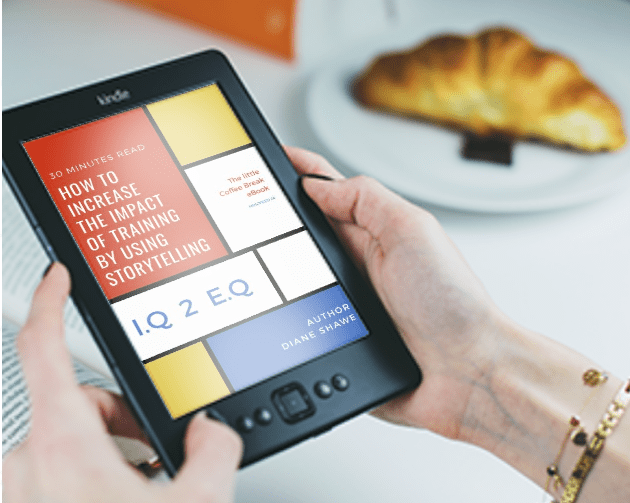
How to Increase the Impact of Training Using Storytelling

One of the most important tasks of a top trainer is to keep the delegates engaged

One of the most important tasks of a top trainer is to keep the delegates engaged

article by Diane Shawe M.Ed.

CEO AVPT Ltd

One of the most important tasks of a top trainer is to keep the delegates engaged. The more delegates are immersed in a training course, the more likely that they will learn. There have been many great ways to do this as listed below:

Game

A game is an exercise that normally has a set of rules and an element of competition. Games also normally include some element of reward or pay off. Although traditional games include competing against some one or another team, they are also many non-competitive games available.

 Icebreakers

Icebreakers are normally used as an exercise to introduce group members to one another, infuse some energy into the beginning of a workshop, and to lead into the topic material.

Energizer

An energizer is a brief pick-me-up designed to invigorate a group if energy in the room is waning, or to bring them back together following a break. Energizers may be a short version of any game or icebreaker, or a brief set of stretches. They are completed within approximately two to five minutes.

Simulations

A simulation is used to train future operators when the equipment that they will use is either very expensive or dangerous. Simulations are designed to be as realistic as possible so that participants can learn from the situation without worrying about damage or financial cost.

Brain teasers

Brain teasers are puzzles to keep participants busy or to highlight key points. Brain teasers have the flexibility for a creative trainer to create their own rules to fit a particular session. They can include perception exercises, joining the dots, or drawing activities.

Role Plays

Role-playing is a helpful way to gauge how participants are learning material or how they react to certain situations. They are very useful way to practice new skills in a non-threatening environment.

Case Studies

Case studies are stories normally extracted from a participant’s workplace or industry. It may also be a simulated scenario. They may be studied by individuals/groups and then analyzed to demonstrate particular training points or to stimulate discussion. A great way to do this is to tell powerful stories. Stories capture people’s imagination and help them to visualise a concept.  In this introduction brochure you will learn why storytelling matters and how to make great stories to enhance your training.

But do Stories Matter?

Consider a typical day. How many stories do you hear? Stories seem to be everywhere. TV is full of stories from soap operas to sitcoms to various drama series. Even news is primarily told as one story after another. Massive number of fiction and movies are consumed every single day.  Now, analyse yourself to see when you are most susceptible to persuasion.

You will see that it is when you have been told a really good story. The story can be about anything; but it is usually a story that sells you an idea or a product.

Consider famous public speakers. What is it about their speeches that make them stand out? It is always the story they tell us in their speeches and the way they deliver it that moves us. They make the story emotional, even somewhat personal. Their stories give us hope and promise us a better future. Their stories make us forget about the past or our everyday problems. Their stories give us energy and motivate us to follow up with an idea. There is always a protagonist that you can connect with emotionally.

You feel their pain and joy. While the story is told, you are curious to know how it ends. You cannot wait until it reaches its climax. You want to know what the protagonist decides when he is suddenly forced to make a choice. While you are fully engaged with the story, the real message is then given to you, directly or indirectly. You understand the message through the story and you feel that you have a first-hand experience of the issue.  The real power of stories is that they can be remembered very easily and be retold to others. This is in fact largely the main way that cultural memes pass through generations.

What Can Storytelling Do for Teaching?

When it comes to training, you have two critical aims; to teach a new skill and to increase the likelihood that this new skill is retained long after the course.  Stories can serve both needs. The story itself can be used to explain a particular concept or illustrate the benefits of following a particular attitude in a vivid way. It is also easier to remember the story which can reinforce the learning after the course. People can tell the story to others and thereby spread your training without your direct involvement.

The story can then spread by word of mouth and if it is good enough it may go viral. If it was your original story it can do wonders for your reputation as a trainer. Many people will want to know more about you and hear more stories. This is because people are addicted to good stories. We cannot get enough of it. If we discover that someone is a good storyteller and his stories work for us, we want to hear every story he has to say. We become somewhat addicted to his stories.  As a public performer who provides training courses and aspires to become more popular and better known, you cannot underestimate the power of storytelling.   read more by downloading our free booklet from here

80% students get qualified

A Quick and Easy Way for job Seekers to Gain Valuable Soft Skills Qualifications

The Academy of Vocational and Professional Training (AVPT) is pioneering a way for people to gain valuable new training with the focus on the soft skills that can often be the deciding factor when it comes to a potential employer’s decision after an interview.

avpt-double2- bored broke brainy girl ok magAll AVPT’s training can be done through a mobile phone or tablet meaning it’s easy to study on-the-go. The tutor, course material and everything else can easily be accessed whenever is convenient. This drastically cuts down on the time it takes to qualify.

Mobile learning is the way forward as 56% of all people on Earth have a smart phone with 50% of those people using mobile as their primary gateway to the Internet (State of Mobile Survey 2013). Because most of us have a phone or tablet glued to our hands at all times, it makes sense to use that time wisely and invest in our own futures.

This sort of learning allows people to gain new qualifications in a matter of weeks with AVPT’s Express Courses and supportive online Virtual Tutors for each student.

Diane Shawe the CEO of Academy of Vocational and Professional training says “The whole country needs to invest in ways to help up-skill every individual so that they can either find work or generate their own income from supplying a service or product” she goes on to say “we need to utilise technology, embrace more adaptable ways of empowering individuals to lead a responsible, inclusive and financially rewarding life so as to buck the increasing trend of unemployment”

Delegates can learn anything from leadership and project management skills to social media and care to skills, hair and beauty through to Security and hospitality.

With so few jobs around at the moment, it’s these skills and certifications that could mean the difference between a job offer, resuming the job hunt or a better change at succeeding in business. Experience and references might tell the story of these skills but it’s accredited certifications that prove their existence.

AVPT understands the competitive job market and has created these courses to help people improve their skill set in the most efficient amount of time possible.

About the Company

AVPT is the only UK Globally Accredited online and workshop based provider of over 390 Soft Skills courses using a cutting edge, proprietary online Learning Management system.

It takes an awful lot of time and effort to create a training course; Designing, researching, writing, and appropriately presenting it. Especially difficult though, even more so is the time taken to create an on-line learning system to work fluently and securely with various technologies. We know this because we have done just this.

What most people, employers, entrepreneurs and even some educational institutions do not have in today’s current environment is time the necessary resources and the infrastructure they need to support and achieve their learning objectives. Both our online and workshop based courses are a cost effective way to deliver and up-skill a wide cross section of our society. Designed to be student (user) centric and time sensitive. We believe that online courses can save time, are easily scalable, reduced acquisition costs per person, measurable, provide a flexible virtual support system, Less paper/ink (environmentally green!) and are generally less stressful owing to their user led flexibility!

Mobile LMS

Learning Management Solution (LMS) & Portal Hub

The Academy of Vocational and Professional Training has a sophisticated LMS solution that is not built on a static system. Yet the user interface is clean, clear, accessible, and easy to understand and work through. It uses little bandwidth, making it quick to load and use, and accessible on a scalable model. Globalisation has changed the way we communicate, do business and relate to each other and technology can help to up-skill a far wider audience.

In today’s ever changing environment, the real promise experts say, is providing learning experiences that are more tailored to individual students that enables more “learning by doing,” which many students find more engaging and useful. Our ‘Chunked’ teaching approach revolutionises the learning experience.

Social Impact

The importance of transferable skills. There can be no doubt about the importance of a degree and a solid academic background but it’s not the only thing that employers will be interested in. Especially where there is strong competition for entry to a job, employers have to find a way to choose. Educators must focus on the personal qualities and skills that can be developed while studying, and acquired as information in mutual exchanges of information. In a competitive employment climate, these can be just as (or more) important to employers as a degree certificate. Employers are looking for people with transferable skills.

For more information email

How to become a successful Project Manager by AVPT Global

To become a successful project manager, you need to look to build and develop these skills.

article by Diane Shawe M.Ed
CEO Academy of Vocational & Professional Training

Project management isn’t just for construction engineers and military logistics experts anymore. Today, in addition to the regular duties of your job, you are often expected to take on extra assignments – and to get that additional job done well, done under budget, and done on time.

At our 1 day workshop we  intended to take you from a supervisory or administrative position to that of a project manager. However, this one-day workshop will familiarise you with the most common terms and the most current thinking about projects. In the mean time lets take a look at the skills checklist and the bullet points for effective project management.

The Skills Checklist

  • All encompassing
  • Goals met as soon as possible (product, time, and money)
  • Applies knowledge, skills, and techniques
  • Balance competing demands
  • Work with a mixture of people/technology
  • Multi-task
  • Define the scope of the project
  • Define goals you can meet and keep them
  • Time management
  • Management identity clusters
  • Strong project management identity
  • Good at documenting steps
  • Self-confidence
  • Flexibility

Summary stages of developing a project

“The only thing worse than training people and having them leave, is not training them and having them stay”

“The only thing worse than training people and having them leave, is not training them and having them stay”

Conceptual/Creation/Initiation Stage

  • Establishing a need
  • Determining feasibility
  • Searching for alternatives
  • Preparing proposals
  • Developing basic budgets
  • Determining basic schedules
  • Naming the starting project team
  • Study; discuss, and analyse
  • Write the project definition
  • Set and end-results objective
  • List imperatives and desirables (SOW)
  • Generate alternative strategies (Brainstorming)
  • Evaluate alternatives & choose a course of action

Planning/Growth/Sell Stage

  • Setting goals
  • Listing tasks to be done
  • Developing schedules in a sequence
  • Developing a budget
  • Getting your plans approved by stakeholders
  • Conducting studies and analyses
  • Designing systems
  • Building and testing prototypes
  • Analyzing results
  • Obtaining approval for production
  • Establish the project objective
  • Choose a basic strategy for achieving the objective
  • Break the project down into subunits or steps
  • Determine the performance standards for each subunit
  • Determine how much time is required to complete each subunit
  • Determine the proper sequence for completing subunits
  • Determine the cost of each subunit
  • Design the necessary staff organization
  • Determine the number of staff needed
  • Determining kind of positions
  • Determine what training is required for project team members
  • Develop the necessary policies and procedures
  • Market study
  • Pilot test
  • Computer simulation
  • Estimating labor costs
  • Estimating labor
  • Estimating overhead
  • Estimating materials
  • Estimating supplies
  • Estimating equipment rentals
  • Estimating general and administrative

Implementation/Execution/Operation Stage

  • Getting the time
  • Getting the money
  • Getting the people
  • Getting the equipment
  • Meeting and leading the team
  • Communication with all stakeholders
  • Controlling the work in progress
  • Establishing standards
  • Monitoring performance
  • Inspection
  • Interim progress reviews
  • Testing
  • Auditing
  • Taking corrective action

Termination/Close out/ Evaluation Stage

  • Letting go of the project
  • Celebrate success
  • Release resources
  • Project completion checklist
  • Test project output to see that it works
  • Write operations manual
  • Complete final drawings
  • Deliver project output to client
  • Train client’s personnel to operate project output
  • Reassign project personnel
  • Dispose of surplus equipment, materials and supplies
  • Release facilities
  • Summarize major problems encountered and their solution
  • Document technological advances made
  • Summarize recommendations for future research and development
  • Summarize lessons learned in dealing with interfaces
  • Write performance evaluation reports on all project staff
  • Provide feedback on performance to all project staff
  • Complete Final audit
  • Write Final report
  • Conduct project review with upper management
  • Declare the project complete

The Statement of Work (SOW)

  • The purpose of statement
  • The scope of statement
  • The project deliverables
  • The goals and objectives
  • The cost and schedule estimates
  • The list of stakeholders
  • The chain of command
  • The communication plan

Project Management Fundamentals 1 day training course

Our  one-day workshop will help you teach participants how to:

–       Define the terms project and project management

–       Identify benefits of projects

–       Identify the phases of a project’s life cycle

–       Sell ideas and make presentations

–       Prioritise projects

–       Begin conceptualszing their project, including goals and vision statements

–       Use a target chart and other planning tools

–       Complete a Statement of Work

What’s Included?

  • Instruction by an expert facilitator
  • Small interactive classes
  • Specialised manual and course materials
  • Globally accredited certificate

Online course option 4 weeks, your own personal tutor click to find out more, its easy to start online…

80% students get qualified

Getting you qualified in days